
Blog

Volkswagen SUVs for Tailgates and Family Weekends in Spartanburg

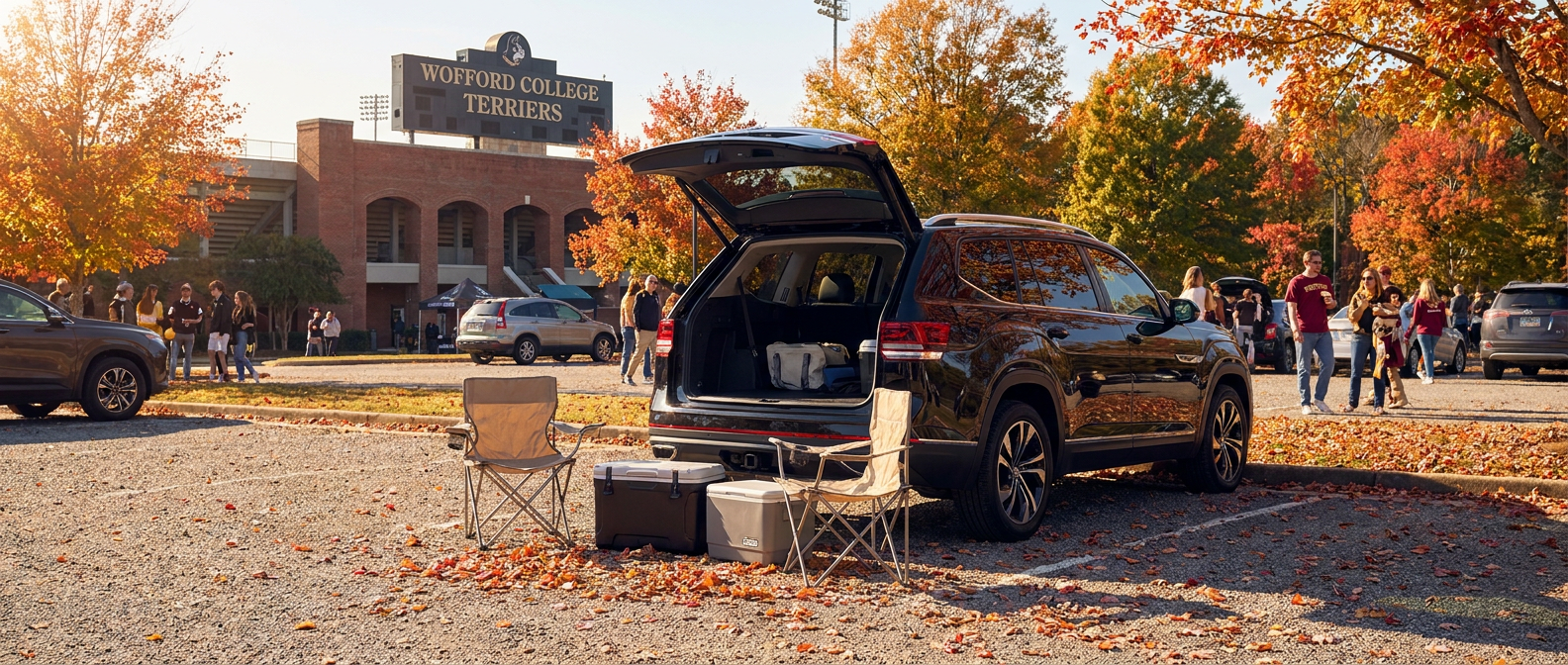
2026 Volkswagen Atlas with liftgate open at a Spartanburg autumn tailgate, showing rear cargo space loaded with gear

Picture a shopper on Reidville Road eyeing the Atlas or the Tiguan. They run a quick mental comparison against a domestic three-row and say something like, "Volkswagen is a great driving car, but I need something more practical for hauling gear." The instinct is completely reasonable, but for the 2026 lineup it's mostly a myth.

Volkswagen lists the 2026 Atlas with a 5,000-pound towing rating and up to 96.6 cubic feet of cargo space. No European soft-roader spec sheet reads like that. You get a legitimate family-weekend vehicle with a refined cabin on top.

The tricky part is that the right Volkswagen SUV for a tailgate at Wofford's Gibbs Stadium is a different answer than the right one for a gear-loaded run to Croft State Park. So let's sort that out with real numbers.

The short version
  • The myth: Volkswagen SUVs trade utility for European driving feel, leaving them short on towing and cargo for real weekends.
  • The reality: the 2026 Atlas is rated for up to 5,000 lb of towing and up to 96.6 cu ft of cargo, on its standard 4-cylinder engine.
  • The 2026 Atlas Cross Sport offers 77.6 cu ft of max cargo and the same 5,000-lb tow rating (with the factory hitch on qualifying trims) in a sportier two-row body.
  • The 2026 Tiguan tops out at 1,800 lb of towing and 69.8 cu ft. Useful for a smaller crew, not for a trailer.
  • Picking the wrong model for your actual weekend is the real mistake. The guide below matches each SUV to the use case it actually handles.

Is the "Volkswagen Isn't Practical" Reputation Earned?

Fair question, and the honest answer is that the reputation fit the old Atlas lineup better than it fits the 2026 one, since before the 2024 redesign a 5,000-pound tow rating required the 3.6-liter V6 and the base 4-cylinder simply couldn't reach it. The base 4-cylinder was capped at 2,000 pounds back then, and that limitation is where much of the reputation comes from.

Does the old reputation still hold? Not for the 2026 Atlas, because Volkswagen moved the 5,000-pound rating to every trim and every drivetrain on the standard turbocharged 4-cylinder engine.

Below is the myth-vs-reality breakdown for all three Volkswagen SUVs at Spartanburg's Steve White Volkswagen.

The ClaimWhat the 2026 Specs Actually ShowSource
"Volkswagen can't tow anything useful"Atlas tows up to 5,000 lb (all trims, FWD or 4MOTION AWD); Atlas Cross Sport tows up to 5,000 lb (with factory hitch on SE w/Technology and above); Tiguan tows up to 1,800 lb (4MOTION)Volkswagen (vw.com)
"The cargo is too small for a real family"Atlas: up to 96.6 cu ft max / 55.5 behind 2nd row / 20.6 behind 3rd row; Atlas Cross Sport: up to 77.6 cu ft max / 40.3 behind rear seats; Tiguan: up to 69.8 cu ft max / 33.8 behind rear seatsVolkswagen (vw.com)
"You need AWD to make these useful"AWD (4MOTION) improves the Tiguan tow rating from 1,500 to 1,800 lb; on the Atlas and Atlas Cross Sport, the 5,000-lb rating holds regardless of drivetrainVolkswagen (vw.com)
"The Atlas still needs the V6 for real towing"The V6 is gone. The 2026 Atlas runs one engine: the 2.0L turbo making 269 hp and 273 lb-ft of torque, rated at 5,000 lb on every trimVolkswagen (vw.com)
"The Tiguan is just as capable as the Atlas for hauling"The tow ceiling of the Tiguan is 1,800 lb, which is 3,200 lb less than the Atlas; useful for a small utility trailer, not a camper or boatVolkswagen (vw.com)

The myth isn't entirely wrong about the Tiguan. 1,800 pounds is a genuine ceiling, and if you're towing anything substantial, the Tiguan will disappoint. But stretching the numbers of the Tiguan across every Volkswagen SUV is where the reputation gets overstated.

Matching the Right Model to Your Actual Spartanburg Weekend

The right pick changes with the weekend, because the spec gap between these three SUVs is wide enough to matter in the real world, and a tailgate at Wofford asks for something different than a trailer run to Croft State Park around Upstate SC.

The Wofford tailgate scenario (Gibbs Stadium parking lots, fall Saturdays, family of five, cooler plus folding gear) lands squarely in Atlas Cross Sport territory. The two-row body gives you a flat load floor and 40.3 cubic feet of accessible cargo behind the rear seats when all five seats are occupied. You can load a 54-quart cooler, a pop-up canopy, chairs, and a bag of charcoal without folding a seat. The rear liftgate opens wide, and the available 115-volt outlet on select trims lets a small grill run on vehicle power. The Atlas Cross Sport sits lower and parks more easily in tighter campus lots than the three-row Atlas, which matters when the Verandah Lot fills early.

The Croft State Park gear-haul scenario (2 lakes, trail access, kayaks or a utility trailer) is where the three-row Atlas earns its keep. Volkswagen rates it at up to 5,000 pounds of towing capacity when properly equipped, enough for a small fishing boat or a loaded utility trailer. The 4MOTION AWD system adds low-speed traction on Croft's unpaved access roads and gravel launches. And if the whole family is coming, 20.6 cubic feet behind the third row still swallows duffel bags and a cooler for seven passengers.

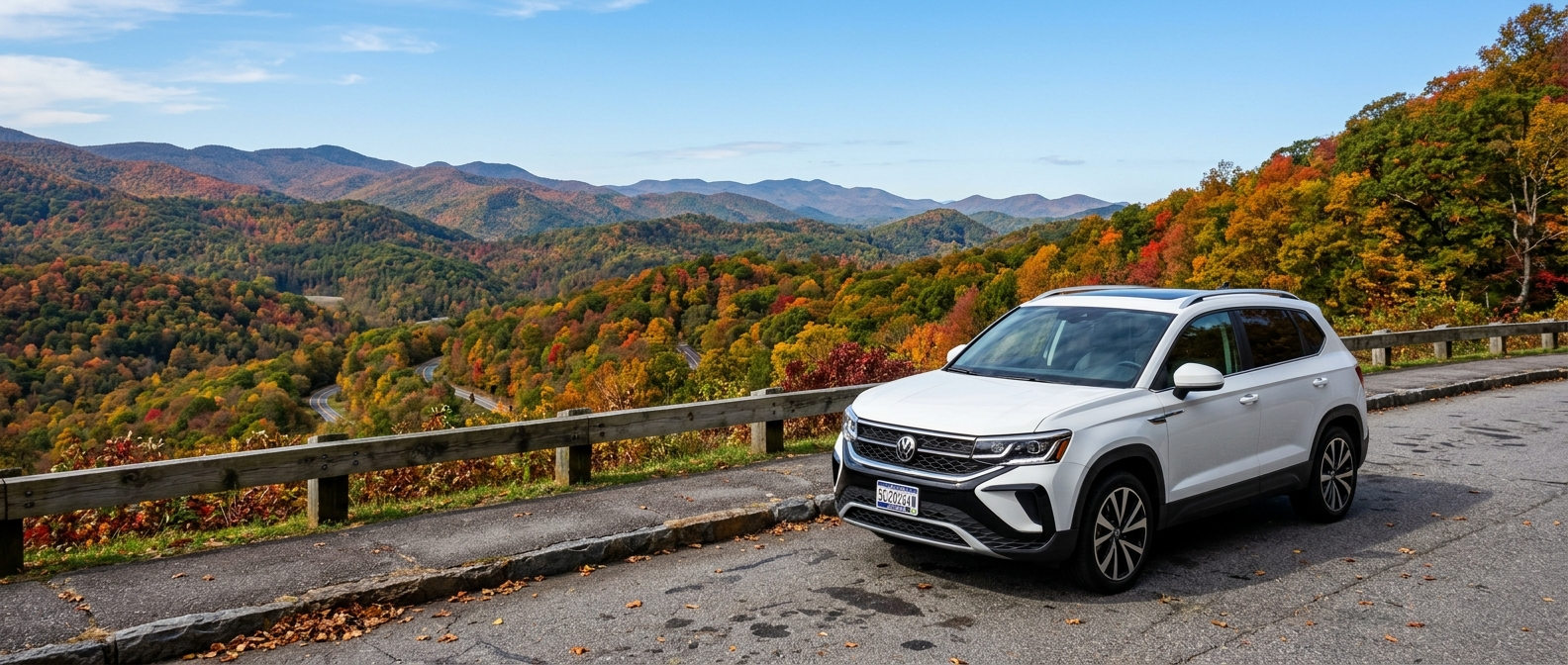
The SC Highway 11 scenic run (Cherokee Foothills National Scenic Highway, 100 miles of curves and elevation change, camping gear) is where the Tiguan makes sense if you're not towing. The more agile two-row body, 33.8 cubic feet of cargo behind the rear seats, and the optional 4MOTION AWD give a couple or small family of four a genuinely enjoyable mountain drive without the Atlas footprint. Its 1,800-pound tow rating covers a small camper trailer or a motorcycle carrier. What it won't do is haul a boat or a loaded four-place camper. So if the trailer is coming on that SC-11 run, the Atlas is the honest answer.

Weekend Use CaseBest FitWhy
Wofford tailgate, family of 5, cooler + gearAtlas Cross SportFlat load floor, 40.3 cu ft behind seats, easier campus parking
Croft State Park boat/trailer haulAtlas (3-row)5,000 lb towing, 4MOTION AWD, trail access traction
SC Hwy 11 scenic run, couple or 4TiguanAgile on curves, right-sized cargo, AWD available
7-passenger family + trailer + gearAtlas (3-row)Only one here with 3 rows and 5,000-lb towing
Solo or duo camping, no trailerTiguan or Atlas Cross SportCargo is sufficient; Tiguan more nimble
The 2026 Atlas moved its 5,000-lb towing rating to every trim. FWD and 4MOTION AWD alike, when Volkswagen dropped the V6 at the 2024 redesign. That's the spec most shoppers are still working from the old version of.
Insider note: When shoppers line the Atlas up against domestic three-row SUVs on towing, the 5,000-lb figure matches what most competing midsize three-rows offer. The Volkswagen spec doesn't lose that race. Where the Atlas does concede is max payload, which Volkswagen lists at 1,102 lb. So if you're towing near the max AND carrying seven people with gear, the total combined weight needs to stay within the Gross Combined Weight Rating. A quick conversation with our team before you load up is worth the five minutes.

See Current Volkswagen Offers

So Which Volkswagen SUV Should You Actually Drive Home?

If any kind of trailer is part of your weekend, the Atlas is the only Volkswagen SUV in our lineup that handles it without compromise, and if there's no trailer in the picture, the Cross Sport or the Tiguan usually makes the smarter, easier-to-park choice. Full stop. The Atlas Cross Sport reaches the same 5,000-pound towing rating in select trims, but you give up the third row and roughly 19 cubic feet of maximum cargo. That tradeoff is worth naming plainly. A family of six or seven has no good answer in the Tiguan or the Cross Sport.

If the weekend is a tailgate or a gear run without a trailer, the Atlas Cross Sport is the sleeper pick. It's easier to maneuver, the cargo floor beats crawling over a third row, and it keeps the same refined driving feel without the three-row footprint. The Tiguan is the right call when the passenger count is four or fewer and the drive itself is part of the point. SC Highway 11 in October with the foliage out is a genuinely good drive in a well-sorted compact SUV.

Come in and tell us what your actual Saturday looks like, and we'll point you at the right one. Browse our inventory to see what's on the lot, or give us a call before you make the trip down Reidville Road.

Frequently Asked Questions

Can the 2026 Volkswagen Atlas actually tow 5,000 pounds?

Yes, and this is the spec that surprises people most. Volkswagen rates every trim of the 2026 Atlas at 5,000 pounds of towing capacity when properly equipped, including the FWD and 4MOTION AWD versions, all running the standard 2.0-liter turbocharged engine producing 269 horsepower and 273 lb-ft of torque. The rating moved from V6-only to a standard 4-cylinder setup at the 2024 redesign. A factory-approved trailer hitch and trailer brakes are required to reach that figure, and the 1,102-pound payload rating means the total combined weight of passengers, cargo, and trailer needs to stay within the vehicle's Gross Combined Weight Rating.

Is the Tiguan big enough for a family tailgate in Spartanburg?

For a smaller crew of four to five with standard tailgate gear (a cooler, chairs, a bag or two), yes. The 2026 Tiguan offers 33.8 cubic feet of cargo space behind the rear seats and expands to 69.8 cubic feet with the seats folded. For a couple or a small family, it works as a solid tailgate vehicle. Where it falls short is towing. Its tow ceiling is 1,800 pounds maximum with 4MOTION AWD (1,500 with FWD), so it won't pull a camper or a boat trailer. If a trailer's involved, the Atlas is the right call.

Steve White Volkswagen Spartanburg

2671 Reidville Rd, Spartanburg, SC 29301

(864) 585-2492

Recommended Posts

Which Volkswagen Fits Your Holiday Shopping Without Going Full-Size SUV?

Which Volkswagen Fits Your Holiday Shopping Without Going Full-Size SUV?

The 2026 Volkswagen Atlas Cross Sport is our pick for most holiday shopping runs. It carries 40.3 cubic feet of cargo behind a full row of passengers, the most of any two-row Volkswagen, and it parks like a compact SUV, not a school bus. If you're running solo or watching the budget, the Tiguan and Taos both earn a real look. Which Volkswagen gives you the most usable cargo room when everyone's along for the ride? The Atlas Cross Sport wins this one with 40.3 cubic feet behind a full row of seats, though what counts here isn't just raw max volume so much as the space you've still got when nobody's been folded away to make room for the groceries. Model Cargo (Seats Up) Cargo (Seats Folded) Rows Key Detail 2026 Volkswagen Taos 27.9 cu ft (FWD) 65.9 cu ft (FWD) 2 Best fuel economy at 31 mpg combined (FWD, EPA) 2026 Volkswagen Tiguan 33.8 cu ft 69.8 cu ft 2 Underfloor storage compartment for concealing bags 2026 Volkswagen Atlas Cross Sport 40.3 cu ft 77.6 cu ft 2 Largest two-row cargo footprint in the lineup 2026 Volkswagen Atlas 20.6 cu ft (behind row 3) 55.5 cu ft (row 3 down) 3 Third row is the tradeoff; 7-passenger capacity 40.3 cubic feet in the Atlas Cross Sport is the figure that matters most if you're picking up family from the airport and swinging by Haywood Mall in Greenville on the way home. All five seats stay occupied, and you still have more trunk room than the Tiguan gives you after folding a seat. The Atlas three-row is a different animal. Great if seven people are coming for Thanksgiving, but that 20.6 cubic feet behind the third row squeezes tighter than you'd expect from a vehicle this size. The squeeze is real. The Tiguan has one trick that's easy to overlook. Volkswagen tucks an underfloor storage compartment beneath the cargo floor, and that's where the bags with the tags still on them go. Keep gifts out of sight without folding a seat or cramming anything behind your head. Explore the 2026 Volkswagen Tiguan Does the Atlas Cross Sport actually park well enough for mall lots and holiday traffic? Yes for open lots, with a caveat for the tight ones. The Cross Sport fits most mall decks around here just fine, though at 195.5 inches it runs longer than the Tiguan, and we'd rather you hear that tradeoff from us than meet it nose-first in a cramped downtown space. The Atlas Cross Sport measures 195.5 inches in length, about ten and a half inches longer than the Tiguan. In an open-air lot on Reidville Road or the sprawling decks at Westgate City Center, that difference is a non-issue. Pull into a tight downtown garage or a compact space and you'll feel it. What the Cross Sport trades in garage friendliness, it gives back everywhere else. Rear legroom sits at 40.4 inches, so passengers in back stay comfortable on longer runs up I-85. Bags slide in. The low cargo floor sits low enough that you're loading things in instead of hoisting them over a sill, and the 60/40 split rear seat lets you carry a passenger and a large item at once when you need to. Browse the full Volkswagen Atlas lineup if you're seriously weighing the three-row. Just go in knowing the cargo math changes. That third row is real estate, and when it's up you're working with 20.6 cubic feet behind it. Our team's read on it. When customers have a compact-SUV budget but need midsize cargo, the Atlas Cross Sport is the one we show first. Its footprint runs bigger than the Tiguan, but the cargo numbers part ways in a real way. 40.3 versus 33.8 cubic feet with passengers aboard. The gap isn't abstract on a loading dock. The Atlas Cross Sport carries 40.3 cubic feet of cargo with all five seats in use. 6.5 cubic feet more than the Tiguan in the same configuration, per Volkswagen specifications. View Current Holiday Offers Is the Taos worth considering if cargo isn't your top priority? Yes, as long as you're not hauling a full car plus a holiday load every week. The Taos handles a solo driver or a couple with room to spare, and its fuel economy leads the lineup, though it tightens up fast once four or five people climb in with cargo of their own. The 2026 Volkswagen Taos carries 27.9 cubic feet behind its rear seats in FWD configuration, a solid number for a subcompact SUV, and it folds to 65.9 cubic feet when you're after maximum room. The EPA rates the FWD Taos at 28 city / 36 highway / 31 combined mpg. Over a season of errand runs between Spartanburg, Greenville, and Anderson, that economy adds up. Watch the ceiling, though. If you're regularly carrying four or five people plus a holiday load, the Taos turns into a game of Tetris. For a solo driver or a couple it's excellent. With the whole family in and a Costco run behind you, it's a tighter call. The Tiguan is the step between them. At 33.8 cubic feet behind the second row, it handles the daily school-and-errand schedule better than the Taos, the underfloor compartment adds a hidden layer of organization, and it's meaningfully more compact on the road than the Atlas Cross Sport. Call that the case for it, in plain terms. FAQ Which 2026 Volkswagen has the most cargo space behind the rear seats without folding them? The 2026 Volkswagen Atlas Cross Sport, with 40.3 cubic feet of cargo space behind the second row with all passengers seated. The Tiguan offers 33.8 cubic feet in the same configuration, and the Taos offers 27.9 cubic feet in FWD trim. The three-row Atlas, by comparison, provides 20.6 cubic feet behind its third row when all seven seats are occupied. Does the Volkswagen Tiguan have any special cargo storage features? Yes. The 2026 Volkswagen Tiguan includes an underfloor cargo storage compartment beneath the main cargo floor. It's a practical feature for keeping valuables or gift bags concealed and organized without folding the rear seat. Is the Volkswagen Atlas Cross Sport or the Atlas better for holiday shopping with passengers? For shoppers who want to carry a full passenger load and still have genuine cargo room, the Atlas Cross Sport is typically the better fit. Its 40.3 cubic feet behind the second row (with five seats occupied) outpaces the Atlas, which only offers 20.6 cubic feet behind its third row. If you regularly need seven seats and cargo together, the Atlas is the right call, but understand you're trading trunk room for the extra row. *By the Steve White Volkswagen Spartanburg Team | November 2026* Get What Your Current Vehicle Is Worth Steve White Volkswagen Spartanburg 2671 Reidville Rd, Spartanburg, SC 29301 (864) 585-2492

Volkswagen Taos vs. Kia Seltos: The Spartanburg Buyer's Guide

Volkswagen Taos vs. Kia Seltos: The Spartanburg Buyer's Guide

In this article Head-to-Head: 2026 Volkswagen Taos vs. 2026 Kia Seltos The Taos Gives You Turbo Power Without Making You Pay for It Twice The Cargo Edge Is Real, and the Rear Seat Is a Detail Nobody Tells You About Three Practical Reasons the Taos Makes Sense in Spartanburg The Taos Is the Right Call for Most Upstate SC Drivers For most Spartanburg drivers, the 2026 Volkswagen Taos is the stronger call. It delivers turbocharged power at every trim level and more cargo room. The Seltos is a genuinely good SUV, and we'll say exactly where it wins. But if you're commuting the I-85 corridor or heading up SC Highway 11 into the Blue Ridge foothills on a weekend, the Taos is built for how you actually drive Upstate. Head-to-Head: 2026 Volkswagen Taos vs. 2026 Kia Seltos Rank Pick Best For Standout Spec 1 2026 Volkswagen Taos Drivers who want turbo power at every trim and more cargo room EPA-rated 28/36/31 mpg FWD; 174 hp standard across all trims 2 2026 Kia Seltos (SX) Drivers who want maximum power and are willing to pay for the top trim 190 hp turbocharged 1.6L on SX only; AWD standard on that trim 3 2026 Kia Seltos (LX/S/EX) Budget-first buyers who prioritize front legroom and don't need extra power 147 hp naturally aspirated; 41.4 in of front legroom vs. 40.1 in of front legroom on the Taos The Taos Gives You Turbo Power Without Making You Pay for It Twice Both of these SUVs can be had with turbo power, but only the Taos hands it to you at every trim, while the Seltos tucks its turbo at the top of the lineup where you also have to take all-wheel drive to get it. The base Seltos engine is a naturally aspirated 2.0-liter making 147 horsepower, not a turbo. That's 27 horsepower less than the Taos delivers at its lowest trim. You have to climb all the way to the SX trim (the top of the Seltos lineup, AWD-only) to get the 1.6-liter turbocharged engine that produces 190 horsepower. Getting there costs a real premium over an already-equipped Taos S. The 2026 Taos runs a 1.5-liter turbocharged four-cylinder producing 174 horsepower and 184 lb-ft of torque in every single trim. One engine. No choosing-your-way-up-the-ladder to get the powertrain you really want. On the SC Highway 11 grades heading toward the Cherokee Foothills, that torque figure is what you feel, and the 8-speed automatic keeps it in the right gear without the hunting you get from a CVT. See current Taos inventory at Steve White Volkswagen Spartanburg The base Seltos engine pairs with a continuously variable transmission, which is fine for pure city commuting. On the I-85 stretches between Spartanburg and Greenville, though, the 8-speed automatic of the Taos and its low-end torque feel noticeably more composed. You feel it on the long hauls. The Cargo Edge Is Real, and the Rear Seat Is a Detail Nobody Tells You About On paper the cargo numbers look close, but a closer read gives the Taos the edge in both configurations, and the gap is the kind of thing you notice on a real loading job instead of a spec chart. The 2026 Taos offers 27.9 cubic feet behind the rear seat versus 26.6 for the Seltos. Fold the seats and that gap becomes 65.9 cubic feet in the Taos against 62.8 in the Seltos. Call it one more large duffel bag, every single trip. What almost nobody mentions in the standard comparison is the Taos rear seat, which slides and reclines. A feature that stays rare in this class, and taller rear passengers get real legroom adjustment out of it. The Seltos rear seat doesn't offer that. So if you've got anyone over six feet who rides in the back regularly, the Taos interior flexibility is a genuine everyday difference, not a spec-sheet footnote. The Seltos does win on front legroom. It offers 41.4 inches versus 40.1 in the Taos. Shorter drivers won't notice that gap at all. But if the driver is tall, it's worth sitting in both before deciding. View Current Volkswagen Specials Buying caution: The Seltos's turbo engine sounds appealing on paper, but it's exclusive to the SX trim and comes with AWD as standard. If you don't need AWD, there's no way to get that 190-hp engine without it. Factor that in when you're comparing what you actually want to spend versus what the Seltos lineup requires. Three Practical Reasons the Taos Makes Sense in Spartanburg The Taos delivers turbocharged performance at every trim level. Blind spot monitoring is standard on every 2026 Taos trim. On the Seltos, it's an add-on on lower trims. The cargo liftover height of the Taos is 27 inches versus 29.4 inches on the Seltos, which makes loading heavier gear a little less awkward on a Saturday morning headed to Croft State Park. The Taos Is the Right Call for Most Upstate SC Drivers For most Upstate drivers the Taos is the right call, though the Seltos earns a fair look if front legroom or a lower base-trim spend sits at the top of your list, and we'll say so plainly. We've put Spartanburg buyers in both of these SUVs, and the conversation usually resolves itself pretty quickly. The Seltos is a solid, well-featured compact SUV. We won't pretend otherwise. But the Taos earns its place on the powertrain, the cargo room, the rear-seat flexibility, and overall value. If your household has a taller rear-seat passenger, hauls weekend gear regularly, or wants consistent turbocharged performance without having to spec into the top trim, the 2026 Volkswagen Taos is the cleaner choice. If you need more front legroom or want to minimize the upfront spend on the base trim, give the Seltos a fair look. We'd call that an honest trade. What we can do is put you in both on the same afternoon at Steve White Volkswagen Spartanburg on Reidville Road and let the drive make the decision. Value Your Trade-In Steve White Volkswagen Spartanburg 2671 Reidville Rd, Spartanburg, SC 29301 (864) 585-2492 In this article Head-to-Head: 2026 Volkswagen Taos vs. 2026 Kia Seltos The Taos Gives You Turbo Power Without Making You Pay for It Twice The Cargo Edge Is Real, and the Rear Seat Is a Detail Nobody Tells You About Three Practical Reasons the Taos Makes Sense in Spartanburg The Taos Is the Right Call for Most Upstate SC Drivers For most Spartanburg drivers, the 2026 Volkswagen Taos is the stronger call. It delivers turbocharged power at every trim level and more cargo room. The Seltos is a genuinely good SUV, and we'll say exactly where it wins. But if you're commuting the I-85 corridor or heading up SC Highway 11 into the Blue Ridge foothills on a weekend, the Taos is built for how you actually drive Upstate. Head-to-Head: 2026 Volkswagen Taos vs. 2026 Kia Seltos Rank Pick Best For Standout Spec 1 2026 Volkswagen Taos Drivers who want turbo power at every trim and more cargo room EPA-rated 28/36/31 mpg FWD; 174 hp standard across all trims 2 2026 Kia Seltos (SX) Drivers who want maximum power and are willing to pay for the top trim 190 hp turbocharged 1.6L on SX only; AWD standard on that trim 3 2026 Kia Seltos (LX/S/EX) Budget-first buyers who prioritize front legroom and don't need extra power 147 hp naturally aspirated; 41.4 in of front legroom vs. 40.1 in of front legroom on the Taos The Taos Gives You Turbo Power Without Making You Pay for It Twice Both of these SUVs can be had with turbo power, but only the Taos hands it to you at every trim, while the Seltos tucks its turbo at the top of the lineup where you also have to take all-wheel drive to get it. The base Seltos engine is a naturally aspirated 2.0-liter making 147 horsepower, not a turbo. That's 27 horsepower less than the Taos delivers at its lowest trim. You have to climb all the way to the SX trim (the top of the Seltos lineup, AWD-only) to get the 1.6-liter turbocharged engine that produces 190 horsepower. Getting there costs a real premium over an already-equipped Taos S. The 2026 Taos runs a 1.5-liter turbocharged four-cylinder producing 174 horsepower and 184 lb-ft of torque in every single trim. One engine. No choosing-your-way-up-the-ladder to get the powertrain you really want. On the SC Highway 11 grades heading toward the Cherokee Foothills, that torque figure is what you feel, and the 8-speed automatic keeps it in the right gear without the hunting you get from a CVT. See current Taos inventory at Steve White Volkswagen Spartanburg The base Seltos engine pairs with a continuously variable transmission, which is fine for pure city commuting. On the I-85 stretches between Spartanburg and Greenville, though, the 8-speed automatic of the Taos and its low-end torque feel noticeably more composed. You feel it on the long hauls. The Cargo Edge Is Real, and the Rear Seat Is a Detail Nobody Tells You About On paper the cargo numbers look close, but a closer read gives the Taos the edge in both configurations, and the gap is the kind of thing you notice on a real loading job instead of a spec chart. The 2026 Taos offers 27.9 cubic feet behind the rear seat versus 26.6 for the Seltos. Fold the seats and that gap becomes 65.9 cubic feet in the Taos against 62.8 in the Seltos. Call it one more large duffel bag, every single trip. What almost nobody mentions in the standard comparison is the Taos rear seat, which slides and reclines. A feature that stays rare in this class, and taller rear passengers get real legroom adjustment out of it. The Seltos rear seat doesn't offer that. So if you've got anyone over six feet who rides in the back regularly, the Taos interior flexibility is a genuine everyday difference, not a spec-sheet footnote. The Seltos does win on front legroom. It offers 41.4 inches versus 40.1 in the Taos. Shorter drivers won't notice that gap at all. But if the driver is tall, it's worth sitting in both before deciding. View Current Volkswagen Specials Buying caution: The Seltos's turbo engine sounds appealing on paper, but it's exclusive to the SX trim and comes with AWD as standard. If you don't need AWD, there's no way to get that 190-hp engine without it. Factor that in when you're comparing what you actually want to spend versus what the Seltos lineup requires. Three Practical Reasons the Taos Makes Sense in Spartanburg The Taos delivers turbocharged performance at every trim level. Blind spot monitoring is standard on every 2026 Taos trim. On the Seltos, it's an add-on on lower trims. The cargo liftover height of the Taos is 27 inches versus 29.4 inches on the Seltos, which makes loading heavier gear a little less awkward on a Saturday morning headed to Croft State Park. The Taos Is the Right Call for Most Upstate SC Drivers For most Upstate drivers the Taos is the right call, though the Seltos earns a fair look if front legroom or a lower base-trim spend sits at the top of your list, and we'll say so plainly. We've put Spartanburg buyers in both of these SUVs, and the conversation usually resolves itself pretty quickly. The Seltos is a solid, well-featured compact SUV. We won't pretend otherwise. But the Taos earns its place on the powertrain, the cargo room, the rear-seat flexibility, and overall value. If your household has a taller rear-seat passenger, hauls weekend gear regularly, or wants consistent turbocharged performance without having to spec into the top trim, the 2026 Volkswagen Taos is the cleaner choice. If you need more front legroom or want to minimize the upfront spend on the base trim, give the Seltos a fair look. We'd call that an honest trade. What we can do is put you in both on the same afternoon at Steve White Volkswagen Spartanburg on Reidville Road and let the drive make the decision. Value Your Trade-In Steve White Volkswagen Spartanburg 2671 Reidville Rd, Spartanburg, SC 29301 (864) 585-2492

Volkswagen Atlas and Tiguan by Model Year: Family Picks for the Spartanburg-Charlotte Run

Volkswagen Atlas and Tiguan by Model Year: Family Picks for the Spartanburg-Charlotte Run

In this article Which model years are the sweet spot for the Atlas? Which model years should you watch out for? Pros and cons: Atlas vs. Tiguan for Spartanburg-to-Charlotte families Which year fits which buyer? The Spartanburg-to-Charlotte run on I-85 is about 73 miles, which sounds easy enough on paper. Do it with two kids, a dog, and a weekend's worth of gear every other Friday, though, and you start caring a lot about which model year you're actually sitting in. Both the Atlas and the Tiguan turn up constantly on used lots around Upstate SC. They're German-engineered, they're family-sized, at least one of them always was, and used examples can look compelling on price. The right year makes a real difference, though. Some years carry open NHTSA recalls. One generation of the Tiguan had a third row, and the current one doesn't. And the Atlas went through a full redesign that changed everything about how it drives. Our team at Steve White Volkswagen Spartanburg walks families through exactly this. We do it whether they're deciding between model years on the used market or weighing used against new. The short version Sweet spot for the Atlas: 2024-2026. The 2024 redesign brought a sharper chassis, standard 269-hp turbo-four, and 20.6 cu ft behind the third row. The 2026 is the current model year on our lot. Sweet spot for the Tiguan: 2026 (new generation, two-row only) or 2020-2023 if you need a used five-to-seven-seat option and are open to the older body. Years to watch on the Atlas: 2018-2019. NHTSA recall 26V590000 covers steering rack bolts that may corrode and fracture on those model years. Confirm any open recalls are resolved before you buy. Years to watch on the Tiguan: 2018 (same steering bolt recall as the Atlas, NHTSA 26V590000) and 2025 (BCM software reset, NHTSA 26V587, now being remedied). Big Tiguan fact families miss: The third row of the Tiguan was discontinued with the latest redesign. If you need seven seats for I-85 runs to Charlotte, the Atlas is your Volkswagen. Browse our used Volkswagen inventory in Spartanburg Which model years are the sweet spot for the Atlas? Target the 2024 through 2026 Atlas if you want the model at its best. The 2024 redesign rebuilt the chassis and cabin from the ground up, though a 2020-2023 example still makes a solid daily driver when the price is right and the recall history checks out clean. You feel the jump right away. The redesign shows up in how the cabin sits and how the chassis handles the slight grade changes on I-85 north of Spartanburg. Before 2024, the Atlas used a 235-hp version of the 2.0L turbo. Volkswagen lists the current 2026 Atlas at 269 horsepower and 273 lb-ft of torque, a meaningful step up in passing power when you're carrying a full load on the highway. Cargo is the other headline. With all three rows up, the 2026 Atlas holds 20.6 cubic feet behind the third row. Fold that row flat and you get 55.5. Clear both rear rows entirely and you're at 96.6 cubic feet. Enough room for a family of five with a genuine road trip's worth of luggage. Model year range Key change Sweet spot or watch? Why it matters for your Charlotte run 2018-2019 First generation Watch Open NHTSA steering-bolt recall (26V590000); verify resolved before purchase 2020-2023 First gen, refreshed safety tech Decent 235 hp, older infotainment; solid if recall-cleared and priced right 2024-2025 Full redesign Sweet spot 269 hp, new chassis, vastly improved rear legroom, modern driver-assist suite 2026 Current model year Sweet spot Same platform as 2024-2025 with current production quality; two active but minor recalls being remedied The 2020-2023 cars make fine daily drivers, but once you've sat in a 2024 or newer Atlas on a 73-mile highway stretch, the older one feels like a previous era. No knock on it, just where the development jump happened to land. Which model years should you watch out for? Watch the 2018-2019 Atlas and the 2018 Tiguan most closely. Those are the years tied to an open NHTSA steering-bolt recall, though a confirmed repair clears the concern completely and puts any of them back in play as a fair used buy for the I-85 corridor. NHTSA recall 26V590000 covers 208,724 vehicles across the 2018-2019 Volkswagen Atlas and 2018 Volkswagen Tiguan (plus 2019 through 2021 Audi Q3 models). Per NHTSA, a bolt that attaches the steering rack to the subframe can corrode and fracture, which can cause a loss of steering control. Owner notification letters went out in November 2026. Check the VIN before you commit, every time. None of that is a reason to panic about every used Atlas or Tiguan on the lot, but it's a reason to run the VIN through the NHTSA recall database before you finalize any purchase. The fix is a dealer remedy, free of charge (your service advisor can pull the status in minutes). You want to confirm it's actually been done, since the recall existing on paper isn't the same as the repair being finished. We can run that check for any vehicle here. 2025 Tiguan heads-up: The 2025 Tiguan carries a separate NHTSA action (recall 26V587) for a body control module software reset that can stall the engine or disable the rearview camera. Owners were being notified in November 2026 and dealers are updating the BCM software at no cost. A software patch, not a hardware problem. Worth knowing, worth confirming. See the 2026 Volkswagen Atlas inventory at Steve White Volkswagen Spartanburg For the Atlas specifically, 2026 production also carries two recalls. One covers incorrect wheel bolts (NHTSA, resolved at the dealer with a free part replacement), and the other a rearview camera software glitch. Both are straightforward dealer fixes. Neither should be a dealbreaker if you're buying new, since we handle open recalls as part of delivery. Explore the 2026 Volkswagen Tiguan at Steve White Volkswagen Spartanburg The years we'd be most cautious about on the used market, absent confirmed remediation, are the 2018-2019 Atlas and the 2018 Tiguan. That steering-bolt recall isn't something you want sitting open on a vehicle headed for regular I-85 highway miles between Spartanburg and Charlotte. Pros and cons: Atlas vs. Tiguan for Spartanburg-to-Charlotte families Pros Cons Atlas: Three rows, 7-seat capacity. Real adults fit in row 2 with 33.7 inches of legroom Atlas: Larger footprint means more fuel on the I-85 run; EPA rates the 2026 4MOTION variant at 20 city / 27 highway Atlas: 5,000-lb tow rating (Volkswagen, 2026 spec) means it can handle a trailer for Upstate weekend trips Atlas: 2018-2019 years carry an open steering-bolt recall; older years also ran a less powerful 235-hp engine Tiguan: EPA rates the 2026 FWD Tiguan S at 26 city / 34 highway, which is noticeably better for a family that commutes this corridor frequently Tiguan: The 2026 redesign eliminated the third row entirely; a family of six has no Tiguan option in the current generation Tiguan: Tighter overall dimensions make it easier to manage in Charlotte parking structures or drop-offs near Upstate schools Tiguan: 2025 models carry an open BCM software recall; confirm it's been remedied on any used example Both: 4MOTION all-wheel drive is available on both for Upstate SC winters, when ice patches are possible on I-85 near the state line Both: 4MOTION variants carry a fuel economy penalty of roughly 4-5 mpg compared to the FWD versions Which year fits which buyer? Your choice really comes down to two numbers, how many seats you need and how often you run to Charlotte. Once you settle those two, the right model year tends to pick itself, whether you end up leaning toward the three-row Atlas or the more efficient Tiguan. The family of five or more doing this corridor regularly. The Atlas is the only Volkswagen that works here; target 2024 or newer. You get the current 269-hp engine, roomier second-row (grandparents in seats 4-5), and full driver-assist suite as standard. The 2020-2023 Atlas works at a lower entry point; confirm steering-bolt recall is cleared on any pre-2020 example. The family of four that runs Charlotte frequently. The 2026 Tiguan at 26 city / 34 highway (EPA, FWD S trim) makes the math work better over a year of trips. It runs a sharper, more efficient package than the Atlas. The tradeoff is cargo. The 2026 Tiguan holds 33.8 cubic feet behind the rear seats, which is generous for a compact SUV but noticeably less than the Atlas at 55.5 (second row folded). If your Charlotte trip involves luggage for three nights plus sports gear, test that cargo area in person before you decide. The family that wants a used Tiguan with a third row. For that, you're looking back to 2017-2023, when the longer-wheelbase Tiguan came with an optional third row. They're legitimate options on the used market. Just know that the 2018 is the recall year for the steering-bolt campaign, and the third-row seat in that generation was designed for smaller passengers, not adults on a 73-mile highway stretch. The buyer who wants new and wants to be done thinking about recalls. Both the 2026 Atlas and 2026 Tiguan are current-production vehicles, and any open recalls are handled as part of delivery. We'll check every open NHTSA item before a vehicle leaves our lot on Reidville Road. See What Your Current Vehicle Is Worth The plain summary runs like this. If your family fills all three rows, there's no Tiguan solution in 2026, and there wasn't in 2025 either. The Atlas is the answer, and the 2024-or-newer version is the generation worth having. If you're four people and fuel economy on a regular Charlotte commute is a priority, the current Tiguan is a genuinely efficient and refined option. Two different vehicles solving two different problems. Neither one is the wrong answer for the wrong family. Frequently Asked Questions Does the 2026 Volkswagen Tiguan have a third row of seats? No. Volkswagen removed the optional third row from the Tiguan with the latest redesign. The 2026 Tiguan seats five passengers across two rows and offers 33.8 cubic feet of cargo space behind the rear seats, expanding to 69.8 cubic feet with the second row folded. If your family needs seven seats for trips between Spartanburg and Charlotte, the 2026 Volkswagen Atlas is the right Volkswagen to look at. Which Atlas model years should I avoid on the used market near Spartanburg? The 2018 and 2019 Volkswagen Atlas model years are the ones to verify carefully before buying. NHTSA recall 26V590000 (issued 2026) covers both years for a steering rack bolt that can corrode and fracture, with owner notifications sent in November 2026. The fix is a free dealer repair, but you'll want confirmation that the remedy has been completed on any specific vehicle before you purchase. Run the 17-digit VIN at nhtsa.gov/recalls, or bring the vehicle to us and we'll check it. Is the 2024-or-newer Atlas a significant upgrade over the 2020-2023 model for highway family trips? Yes, meaningfully so. Volkswagen redesigned the Atlas for 2024, raising the turbocharged engine output from 235 to 269 horsepower and improving the chassis tuning. For families making regular runs on I-85 between Spartanburg and Charlotte, the additional power shows up in highway passing and in how the vehicle handles the grade changes north of Spartanburg. Third-row legroom is also roomier in the current generation, which matters when you're hauling the full family. Get Pre-Approved for Financing Steve White Volkswagen Spartanburg 2671 Reidville Rd, Spartanburg, SC 29301 (864) 585-2492