
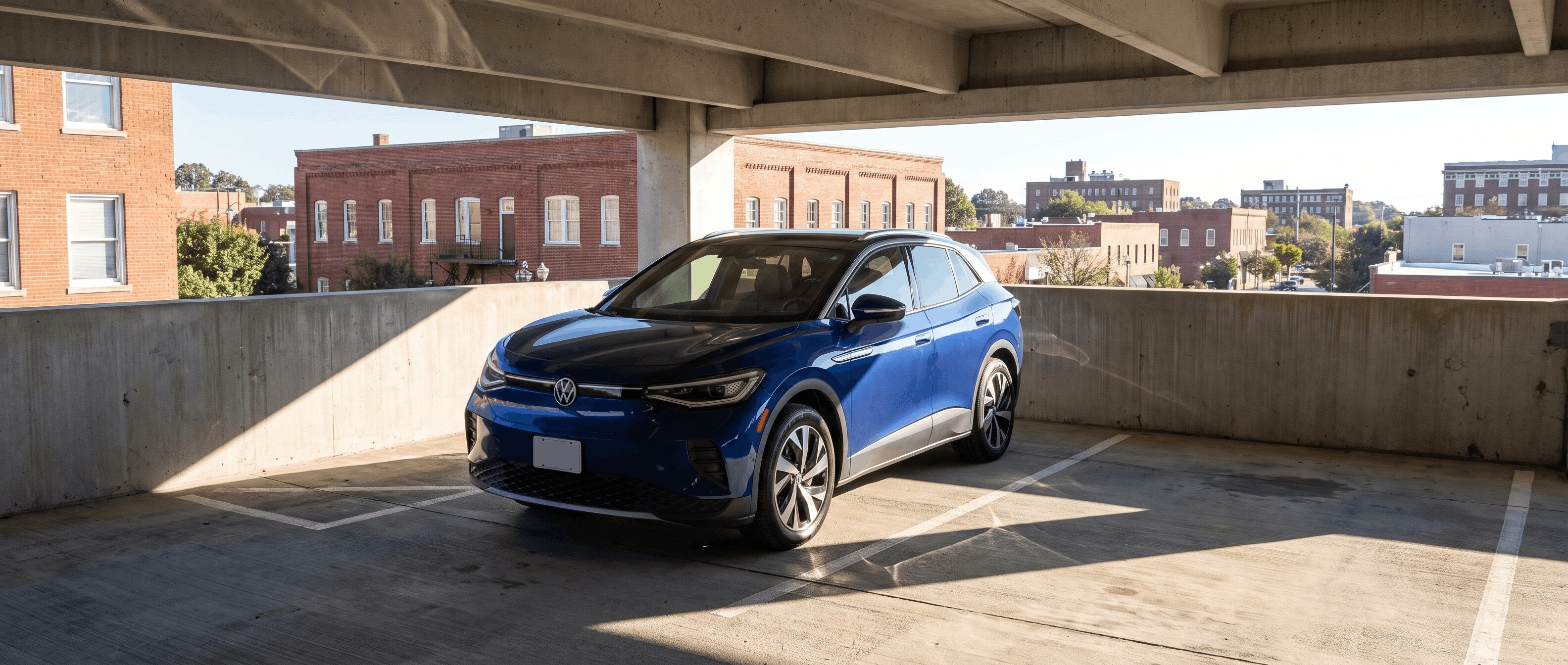
Yes, and we'd call it one of the better fits we carry for drivers running downtown-and-back routes across Upstate SC. That answer comes with a nuance a lot of reviews skip. The ID.4 isn't a "set it and forget it" EV. It has two distinct drive modes that behave very differently, and knowing which one to use where turns a competent electric SUV into something genuinely efficient on the specific roads around here.
Browse the Volkswagen ID.4 and ID. Buzz lineup at Steve White Volkswagen Spartanburg
How Do D Mode and B Mode Actually Work?
D mode and B mode split the driving between coasting and stronger regeneration, and the short of it is that the ID.4 skips true one-pedal driving, so lifting off the accelerator in D mode won't drag the car to a stop the way it would in some rival EVs. Instead, the powertrain prioritizes coasting. According to the own engineering documentation of Volkswagen, coasting takes priority in D mode because converting kinetic energy back into electricity always involves losses, and on a sustained highway stretch, letting the vehicle roll freely preserves more range than constant regeneration.
Switch the shifter to B mode and the behavior changes. Lifting off the throttle now applies meaningful regenerative resistance, and the motor of Volkswagen recovers energy in most moderate braking situations, transitioning to friction brakes only when harder stops demand it. You'll still touch the brake pedal to reach a full stop. Otherwise, B mode handles the rest.
| D Mode (Drive) | B Mode (Brake) | |
|---|---|---|
| How it works | Motor coasts on lift-off; regen activates through the brake pedal | Stronger regen on lift-off; friction brakes for final stop only |
| Best for | Highway segments (I-85 corridor, sustained speed) | Stop-and-go (downtown signals, Reidville Road traffic) |
| Energy behavior | Preserves momentum; fewer conversion losses at speed | Recaptures more energy in deceleration-heavy driving |
| Driver feel | Familiar to gas-car drivers | Light "engine braking" pull on lift-off |
| Spartanburg use case | The 30-mile I-85 run toward Greenville or Anderson | The last mile through downtown to a parking garage |
The EPA rates the 2026 ID.4 at 113 MPGe combined for the rear-wheel-drive version and 102 MPGe combined for the all-wheel-drive. Those numbers assume a blend of city and highway conditions. In Spartanburg, where a typical commute mixes a corridor sprint on I-85 with slower downtown blocks, you'll want D mode on the highway and B mode once you exit. One trip, both efficiency numbers.
Which Mode Do You Actually Need Here?
Which mode you actually need comes down to the stretch of road in front of you, so you'll run B mode through town and D mode on the corridor, and Spartanburg's layout makes that split easy to feel on a normal commute. Reidville Road, where our store sits, feeds directly into the downtown grid in under 10 minutes. The last stretch runs signals, turns, and the occasional backup at peak hours, which is B mode territory. Every deceleration into a red light becomes a small deposit back into the battery rather than heat thrown off by friction brakes.
See how the Taos and other Volkswagen models compare for Upstate commuting
The longer corridor sections are a different story. If your drive involves any sustained I-85 mileage between Spartanburg and Greenville (around 30 miles), you'll want D mode as the default. Aggressive regen on a 70-mph highway stretch costs more energy through conversion than it returns, and coasting between gradual speed changes is the more efficient physics here.
One thing we notice at the counter is that drivers coming from gas cars tend to start in D mode and stay there. The habit makes complete sense. D mode mimics what a traditional automatic transmission does, and the 2026 ID.4 in D mode still recovers energy whenever you actually press the brake. Staying in D mode doesn't waste range; it just leaves a little efficiency on the table in dense urban conditions where B mode would net you measurably more energy back.
View our current 2026 Volkswagen ID.4 inventory
Upstate Charging Terms Worth Knowing
| Term | What it means |
|---|---|
| Level 2 charging | 240-volt AC charging; the 2026 ID.4 accepts up to 11 kW, adding roughly 25-30 miles per hour of charge |
| DC fast charging | Direct-current charging; the 2026 ID.4 supports up to 175 kW, taking the battery from 10% to 80% in roughly 28 minutes |
| MPGe | Miles per gallon equivalent; the EPA's standardized way to compare EV efficiency against gasoline vehicles |
| Eco Assistance | The onboard system of the ID.4; it reads navigation data and prompts you to lift off the accelerator ahead of slowdowns to maximize regen |
Charging Around Downtown Spartanburg
Charging around downtown is easier than the range-anxiety headlines suggest, and for a Spartanburg daily driver the concern shrinks fast once you look at the actual numbers, though it does hinge a little on whether you've got a plug at home. Range anxiety is a reasonable starting concern for any EV buyer, so let's put numbers to it.
See Current Volkswagen ID.4 Offers
The EPA-rated range of the 2026 ID.4 is 291 miles on the rear-wheel-drive version (263 miles on the all-wheel-drive). The average round-trip commute into and out of downtown Spartanburg is a fraction of that. You're not managing range on a daily basis so much as managing a charging routine. The city keeps it simple.
The City of Spartanburg operates public electric vehicle charging stations across downtown parking lots and garages. So an ID.4 driver who parks downtown through the workday can top off while the car sits. The 2026 ID.4 handles Level 2 charging at up to 11 kW, which translates to about 25-30 miles of range added per hour at a Level 2 station. That's enough that a full eight-hour workday of parking adds solid margin on top of whatever you've brought from home.
For road trips or longer Upstate runs on I-26 toward the coast or I-85 toward Atlanta, Spartanburg has public DC fast charging options accessible off both major corridors. The 2026 ID.4 accepts DC fast charging at up to 175 kW, and the own figures of Volkswagen put a 10-to-80 percent charge at approximately 28 minutes at a compatible high-speed station. That's a coffee stop.
The tradeoff worth naming is simple enough. If you don't have a Level 2 charger at home, you're relying on the charging infrastructure for more of your daily top-ups. That works in Spartanburg, but it does ask for a little more planning than plugging in at your own house each evening. It's a fair consideration, not a dealbreaker, and it's worth knowing before you commit.
Explore financing options for the Volkswagen ID.4
What This Means for Your Next Vehicle
The 2026 Volkswagen ID.4 earns its place as a Spartanburg daily driver through a specific set of advantages, though they won't do the work for you: range that exceeds any realistic round-trip commute in the Upstate, a drive-mode system that rewards learning even slightly, and a local charging network that fills gaps for drivers without home charging. The 30-minute DC fast charge window means the I-85 and I-26 corridors to other Upstate cities stay practical.
What it is not is a vehicle that asks nothing of you. Knowing when to use B mode is a small habit with a measurable payoff. Understanding the charging network rather than guessing at it removes the anxiety that comes with a new EV. We'll walk through both of those at delivery, because we think the ownership experience is better when drivers leave the lot with a real handle on the technology instead of just a key fob and a hope.
If you're driving a daily route that touches downtown Spartanburg at any point, the architecture of the ID.4 is built for exactly that pattern. Come see what we have on the lot. We'll walk you through both modes on your test drive so you leave with a clear picture of how the car fits your specific route.
Frequently Asked Questions
Does the 2026 Volkswagen ID.4 have one-pedal driving?
Not in the traditional sense. The ID.4 doesn't decelerate to a complete stop on lift-off alone. In B mode, the regenerative braking is strong enough to handle most moderate slowdowns without touching the friction brake pedal, though you'll still apply the brake to reach a full stop. For Spartanburg drivers, B mode in downtown conditions is the closest thing to one-pedal behavior and a useful efficiency tool on stop-and-go streets.
How long does it take to charge the 2026 Volkswagen ID.4 from 10% to 80%?
At a DC fast charger rated for the maximum 175 kW input of the ID.4, Volkswagen estimates approximately 28 minutes to go from 10% to 80% battery. On a Level 2 home or public charger at 11 kW, you're looking at around eight hours for a complete empty-to-full charge, which fits an overnight home routine or a full workday parked at a public downtown station.