

Wofford College Move-In Day: How to Drive Your Volkswagen In, Unload Fast, and Get Out Clean
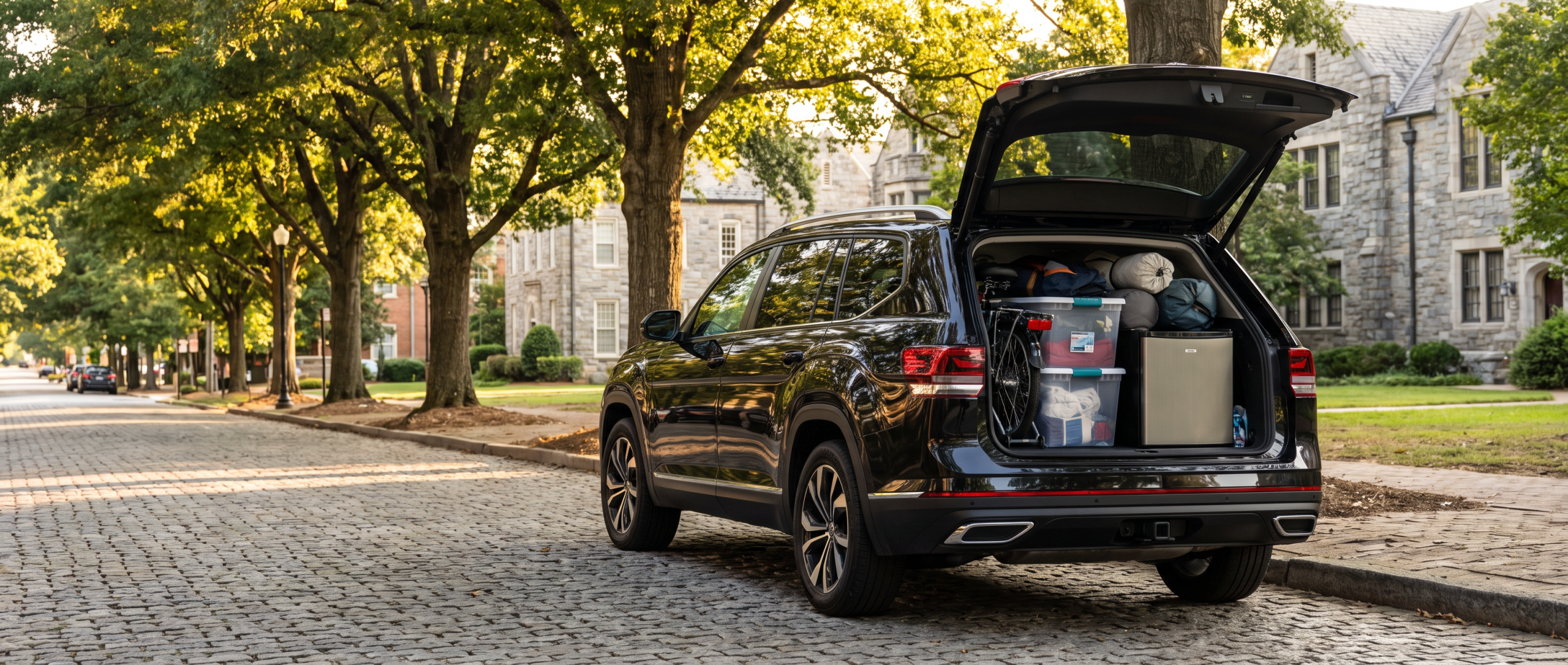
Move-in at Wofford College runs like a timed operation, not a leisurely afternoon. New students check in on Friday, Aug. 28, pick up a hall-specific unloading pass, and are expected to clear their vehicle out of the unloading zone as fast as possible. Bring the wrong car, pack it wrong, or park in the wrong lot, and you’ll slow down the whole line (and yes, Wofford Campus Safety does ticket). Your best move is a Volkswagen loaded with intention, one vehicle with a clear cargo plan and one driver who knows exactly which lot to use before the wheels hit North Church Street.
The 2026 Tiguan is the right size for a single-student dorm run. It fits downtown blocks and designated unloading areas comfortably, and its cargo hold (33.8 cubic feet behind the rear seats, according to the EPA) handles a full load for one student without making you fold a seat. Hauling for two students in separate halls, or driving in from Atlanta or Charlotte? The 2026 Atlas (20.6 cubic feet behind the third row, up to 96.6 with all rows folded) earns the extra footprint. Just be honest about the tradeoff. It’s long, and Wofford’s residential lots and fire lanes run tight. Plan around that.
Move-In Day at Wofford: Do’s and Don’ts
Wofford’s move-in rules are specific and enforced, so the fastest way through is to know your hall’s lot before you arrive, keep someone with the car, and stay out of the unloading zone until the pass is in your hand. Here’s the short version.
| Situation | Do | Don’t |
|---|---|---|
| All halls | Complete check-in first, collect your unloading pass | Pull into the unloading zone before you have the pass |
| Greene Hall | Use the Carlisle lot and Marsh Circle | Park on Campus Drive |
| Wightman / Lesesne | Use Shipp lot or Butler Circle; brief curbside stop on Evins St. allowed | Park along Evins Street |
| The Village (upperclassmen) | Use the fire lane during the officially announced move-in window | Use the fire lane any other time (it’s ticketed) |
| Any hall | Keep at least one person with the vehicle at all times | Leave the car unattended in the unloading zone |
| Any hall | Load in an order you can unload without re-sorting | Pack heaviest bins last, then wonder why they’re buried |
Load Order: The One Technique That Changes the Whole Day
Pack for the unloading zone rather than the driveway, because the order you build at home is what decides how fast the car clears the curb on Aug. 28. Get it right and the first bins out are the ones headed upstairs; get it wrong and you’re re-sorting at the curb while the line stacks up behind you.
In a Tiguan, put the items that go straight to the room (the bedding, the lamp, the backpack) on top and right behind the liftgate. Bins that stay in the car until the second trip, like the over-the-counter stuff, the extra hangers, the breakables, ride deeper. With the rear seat folded, the Tiguan gives you a flat load floor, so you’re not fighting a spare-tire hump or a lip. In the Atlas, the third row folds flat(ish) with a single lever pull on each side. Pile the heaviest items (mini-fridge, storage cubes, the soft luggage nobody else wants to carry) against the seatback of the second row, then layer lighter items toward the rear. Open the liftgate at the Shipp lot or Carlisle lot, and the first things out are the ones that go upstairs. One trip in, one trip out, and the car’s moving before Campus Safety notices it stopped.
It’s August in Spartanburg, and heat matters. Both the Tiguan and Atlas cool their cabins fast with the available dual-zone climate systems, but the bigger issue is whatever gets left sitting in the sun. Keep temperature-sensitive items (electronics, certain medications, snacks that’ll melt) in a reusable tote at your feet, not buried under luggage in a dark cargo area that’ll climb well over 100 degrees while you’re upstairs making the bed.
Browse our current Volkswagen inventory to see which trim levels and configurations are on our lot right now.
One Last Check Before You Leave the Lot
Before you pull onto I-85 or I-26 toward Spartanburg on Aug. 28, take a minute for a fast walkthrough, because a load that looked fine in the driveway can shift enough on the road to block a mirror or keep the liftgate from latching. Confirm the liftgate closes fully and the cargo cover is seated (loose items in a tall load can push the cover up and block your rear view). Check that nothing’s wedged against the rear wiper motor. On the Atlas, verify the third-row headrests are folded down if the row’s holding luggage (they’ll keep the liftgate from closing all the way).
The 2026 Atlas earned a 2026 IIHS TOP SAFETY PICK designation, so on the long I-85 corridor run from Charlotte or the I-26 stretch up from the coast, you’re in a well-tested vehicle. In its FWD configuration, the Tiguan returns up to an EPA-estimated 26 city / 34 highway mpg, which helps if parents are making a round trip the same day. The drive’s manageable. The unload needs a plan.
Our team on Reidville Road is happy to walk you through cargo setups, or just talk through which model fits your move-in, whenever you’d like to swing by.
The 2026 Volkswagen Tiguan and the Boiling Springs School Run: A Real Fit for a Busy Schedule
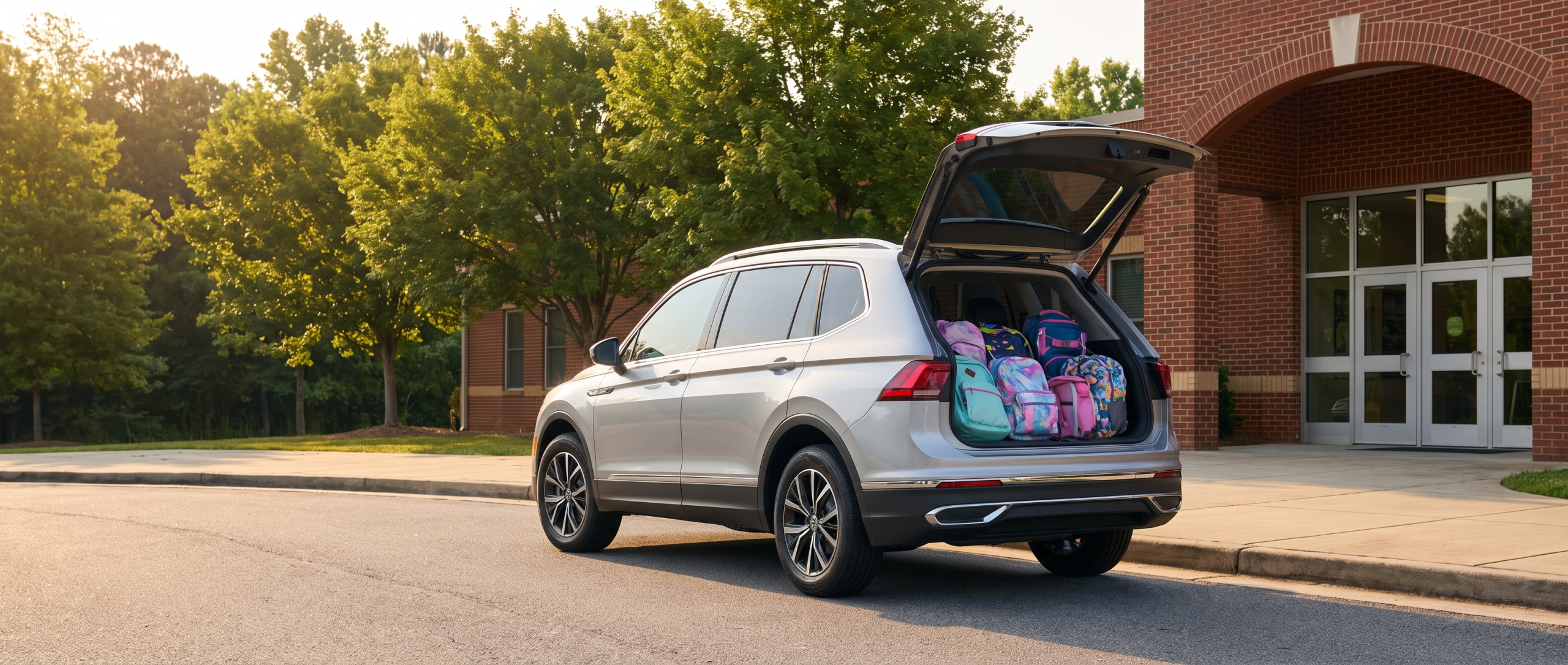
District 2’s first bell rings while Upstate SC is still pushing 90 degrees. By 7:30 a.m. the sun’s already blazing, and you’ve got two kids, a backpack mountain, and a sports bag that may or may not hold cleats. The 2026 Volkswagen Tiguan is built for exactly that scene. German engineering has always put the drive first, and this generation stacks on a standard safety suite plus 37.6 cubic feet of cargo space behind the rear seats to make the morning scramble easier to manage.
Why Does the Tiguan Fit the Boiling Springs School-Year Routine?
Yes, for a two- or three-kid household doing daily District 2 runs the Tiguan fits the school-year routine well, with one limit to name up front, because for 2026 it’s a two-row, five-passenger SUV after Volkswagen dropped the optional third row in the 2025 redesign, so larger families should weigh that first. The trade matters, and we’ll spell it out below. But the reasons the Tiguan works here are specific, and they’re worth walking through one condition at a time.
| Local Condition or School-Year Use | The Tiguan Feature That Handles It | Why It Matters Here |
|---|---|---|
| August heat on Reidville Road, A/C running hard from mile one | EPA-rated 26 city / 34 hwy mpg (FWD, S trim) on regular 87-octane | Stops you burning premium fuel in stop-and-go pickup lines |
| Stop-and-go carpool lane on Old Furnace Road near Boiling Springs High | Front Assist with Automatic Emergency Braking + pedestrian detection (standard) | Flags a kid stepping off the curb before you do |
| Backing out of a packed school parking lot | Rear Cross-Traffic Alert + Active Blind Spot Monitor (standard on every trim) | Warns you of a car coming from the blind side while you’re watching kids walk behind you |
| Two kids, two backpacks, a gear bag, and a week’s groceries on the way home | 37.6 cu ft cargo behind rear seats; 69.8 cu ft with seats folded | That’s the official Volkswagen figure (verified larger than several segment competitors) |
| Late-night activity pickup when visibility drops | Exit Warning (standard) alerts occupants if a cyclist or vehicle approaches as any door opens | Especially useful in low-light parking situations |
| I-85 corridor commute between Spartanburg and Greenville on busy afternoons | Travel Assist: semi-automated adaptive cruise with lane centering (standard with IQ.DRIVE) | Reduces fatigue on a familiar but congested stretch |
The Cargo Reality: Where the Tiguan Actually Earns Its Place
Cargo is where the Tiguan really earns its place for a school-year family, and the figure to hold onto is 37.6 cubic feet behind the second row, a Volkswagen-published number that runs larger than several segment rivals and gives you solid context when you’re weighing compact SUVs for daily District 2 duty.
Fold the second row flat and you’re at 69.8 cubic feet of total cargo volume. That number earns its place on a back-to-school supply run, a band instrument pickup, or a Saturday trip to Croft State Park when the whole crew needs hiking gear and a cooler. In daily school-year use the cargo deck works hard. It swallows a week without the shuffle.
There’s a real trade to name here. The 2026 Tiguan is strictly a five-passenger, two-row SUV, since Volkswagen removed the optional third row when it redesigned the model for 2025. If your household seats six or seven on the regular, the Volkswagen Atlas is the better conversation to have. The Tiguan earns its spot with the two- or three-kid family that would rather have real cargo room than a third row it barely uses and the shrunken space behind it.
IQ.DRIVE Safety: Every Trim, Not Just the Expensive Ones
Every trim gets the core safety here, from the base car to the top one, because Volkswagen makes its IQ.DRIVE package standard across the entire 2026 Tiguan lineup, which means forward collision warning, blind spot monitoring, and lane assist arrive as everyday equipment no matter which Tiguan you drive off our lot. You get the essentials on every one.
In practical Boiling Springs terms, the base-trim Tiguan watching for a pedestrian in a school zone runs the same system as the top-trim SEL R-Line Turbo. The 2026 Tiguan also carries 10 airbags as standard equipment, including a driver knee airbag and a front center airbag. For a family SUV working school zones twice a day, that baseline counts more than any single option.
One pattern our team watches is Reidville Road, which builds real traffic volume through the school-year morning windows. Travel Assist (included with IQ.DRIVE) pairs adaptive cruise control with active lane centering on suitable roads. On a familiar I-85 stretch, after two drop-offs and with the commute not yet done, that steady help adds up. It takes real load off the driver.
The Fuel Economy Tradeoff: What the EPA Numbers Mean on Your Actual Route
The EPA numbers land solid for the class, with one honest caveat, because the rated figures come from a test lab and your Boiling Springs route in August won’t match it, so read the window sticker as a starting point rather than the number you’ll see on your first tank. In S trim with front-wheel drive, the EPA rates the 2026 Tiguan at 26 city / 34 highway / 29 combined mpg. Those are strong figures. Step up to any FWD trim above the S and the combined figure moves to 28 mpg, or 25 city / 32 highway. Add 4MOTION AWD and the EPA estimate drops to 22 city / 30 highway / 25 combined.
On a hot South Carolina morning, air conditioning load trims real-world fuel economy on short trips, which is worth knowing before you hold the window sticker against your first tank. August in Boiling Springs is nothing like EPA test-condition weather. The Tiguan runs on regular 87-octane across every trim, which keeps day-to-day running practical even when the AC works hard.
The engine is a turbocharged 2.0-liter four-cylinder making 201 horsepower and 221 pound-feet of torque, paired with an 8-speed automatic. It’s responsive enough that the Reidville Road on-ramp onto I-85 isn’t a negotiation.
The Volkswagen Taos is worth a look if maximum fuel efficiency drives your decision. Lighter and smaller, the Taos leads the Tiguan on EPA numbers. But if your school-year schedule needs cargo room and the full standard safety suite at every trim, the Tiguan holds a different kind of value.
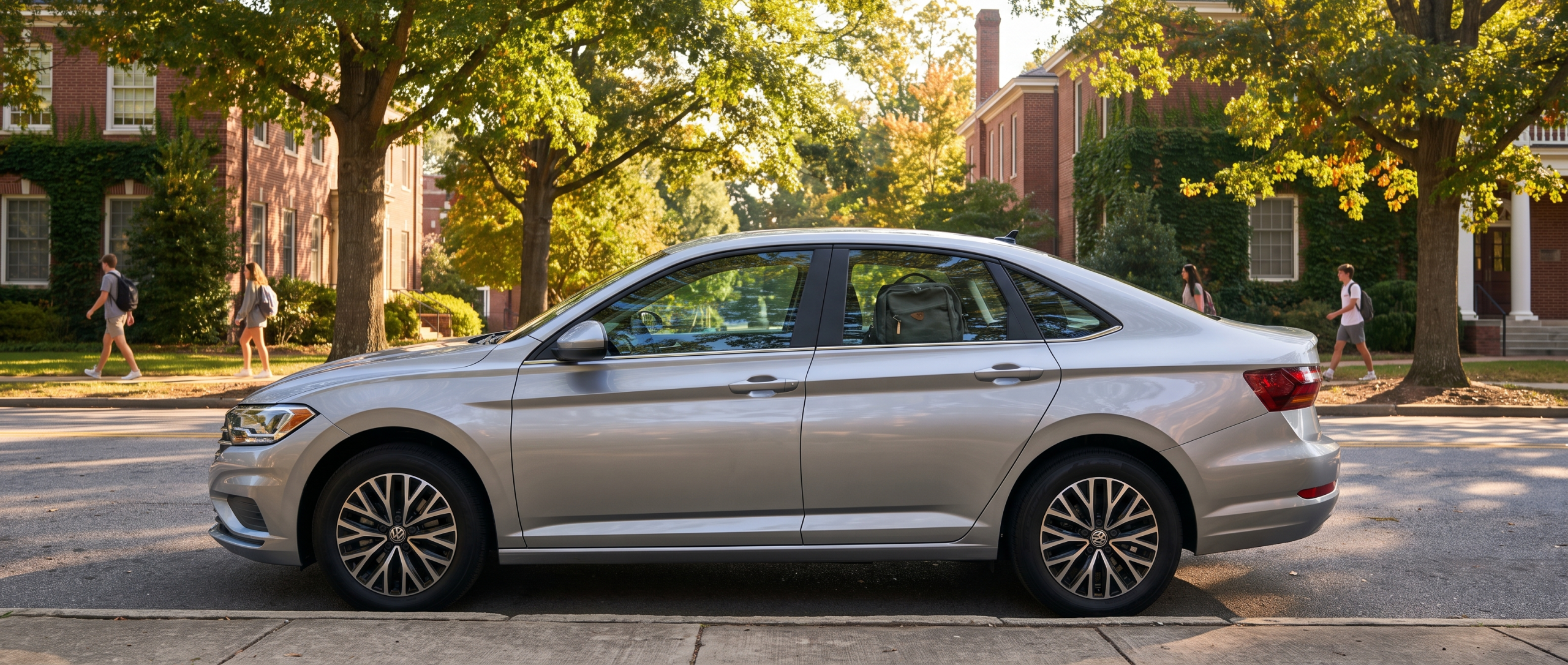
Every August, Spartanburg’s roads shift. Teachers heading to district high schools, students circling for parking near Wofford College, and staff running the I-85 corridor from Greenville to USC Upstate all share the same pavement with different demands. No single model wins every category, and we won’t pretend one does. What you need is a clear look at which 2026 Volkswagen fits the commute you actually run, not a generic ranking someone wrote without knowing Upstate South Carolina.
You’ll get four models here, five decision criteria, verified specs, and one straight tradeoff per pick.
- Fuel-economy priority (long corridor run): The 2026 Jetta hits an EPA-estimated 40 mpg highway on regular gas. Hard to beat for the I-85 stretch.
- Compact footprint + cargo: The 2026 Taos gives you 27.9 cubic feet of cargo behind the rear seats in a body that’s only 175.8 inches long. It fits tight school and campus lots.
- Full safety-tech suite + more room: The 2026 Tiguan carries the complete IQ.Drive package standard, including active blind-spot monitoring and adaptive cruise. Best for drivers who want every assist on the longer runs.
- Driving engagement that survives the commute: The 2026 Golf GTI delivers 241 horsepower and returns 27 mpg combined. It’s the one that makes you look forward to a Monday morning.
- Honest tradeoff: More engagement or cargo usually costs you fuel economy. We lay out exactly where each trade lands.
The 2026 Jetta is worth a look before you read anything else if you’re prioritizing fuel economy on a daily drive across Upstate SC.
What Actually Matters When Choosing a Commuter Volkswagen?
Five variables separate a good commuter pick from a generic one. Fuel economy matters, but so does the parking geometry at your destination, the tech that takes the edge off a route you’ll drive again and again, how much you carry each day, and whether the drive is something you tolerate or something you enjoy. Get all five on the table before you commit to a model.
| Criterion | 2026 Jetta | 2026 Taos | 2026 Tiguan | 2026 Golf GTI |
|---|---|---|---|---|
| EPA fuel economy (combined) | 34 mpg (S trim) | 31 mpg (FWD) | 29 mpg (FWD S) | 27 mpg |
| Best for | Long-distance highway commuter | Tight parking, daily cargo | Safety-tech priority, more cabin room | Driver who wants engagement |
| Key spec | 40 mpg highway, 1.5L turbo | 27.9 cu ft cargo, 175.8 in length | IQ.Drive standard, 33.8 cu ft cargo | 241 hp, VAQ limited-slip diff |
| Main tradeoff | Smallest cargo, sedan only | Less power (174 hp) than Tiguan | Lowest mpg of the four | Lowest city mpg (24), no AWD |
All mpg figures are EPA estimates. Actual results vary by driving habits, load, and route conditions.
Fuel Economy: Where the Jetta Earns Its Reputation
Teachers and staff running a daily corridor from Greenville or points along I-85 know how fast fuel costs compound when you’re driving 180-plus days a year, and the 2026 Jetta S answers that with an EPA rating of 29 city, 40 highway, and 34 combined on regular 87-octane gasoline. That highway number is real and meaningful on a route like I-85 between Greenville and Spartanburg.
The catch is straightforward. The Jetta is a sedan with a 12.8-gallon tank and a relatively modest trunk. If you carry instruments, art supplies, coaching equipment, or anything bulky, you’ll feel the limit. For a solo commuter that’s no deal-breaker. If cargo is part of your daily pattern, it is.
Step up to the Jetta GLI and you’re in a different animal. It runs a 2.0L turbo with 228 horsepower and 258 lb-ft of torque, and the EPA rates it at 26 city / 36 highway / 29 combined. You get more reward on the same corridor and slightly less efficiency. Worth knowing if you’d rather commute with spirited acceleration than chase peak fuel savings.
The 2026 Taos and Tiguan both give you more room. The fuel-economy cost is real, though. We’ll show you where it lands.
Parking Footprint and Cargo: The Taos Case
Parking near Wofford College’s downtown campus is a real conversation, and a smaller footprint earns its keep on the mornings you roll in after 8 with the lots already filling. The 2026 Taos is 175.8 inches long and 72.5 inches wide. The Tiguan is 184.4 inches long and 73 inches wide. On paper that gap looks small, but in a narrow parking structure or a street spot with a bad angle, it’ll matter.
The Taos is also the cargo leader in the lineup for its size. Volkswagen specs it at 27.9 cubic feet behind the rear seats and 65.9 cubic feet with the seats folded. Teachers hauling bins of materials, students moving gear, or staff who carry more than a laptop bag will notice that number. You get more cargo than the Jetta in a body that’s easier to park.
What costs you here is power. The Taos runs a 1.5L TSI four-cylinder making 174 horsepower, and that’s plenty for Spartanburg-area commuting, including the on-ramps along I-85. Decisive highway passing feels less effortless than in the Tiguan or GTI (both bring more punch when you want it). If your drive stacks up highway miles at speed, the Taos still handles it. Just not quick.
The Tiguan’s Safety Suite: IQ.Drive on Every Trim
The 2026 Tiguan ships IQ.Drive standard across the entire lineup, so every driver, whatever trim they pick, gets active blind-spot monitoring, adaptive cruise control with Travel Assist, rear cross-traffic alert, lane assist, front and rear park distance control, and automatic emergency braking. On a repetitive commute route, those features quietly become part of your routine, and you’ll stop thinking of them as a luxury.
The 2026 Tiguan also carries more cargo than the Taos when the seats are folded, 69.8 cubic feet versus 65.9. Behind the rear seats you’re looking at 33.8 cubic feet. The cabin feels genuinely roomier for a Volkswagen compact SUV.
What you give up is fuel economy. The FWD S trim is EPA-rated at 26 city / 34 highway / 29 combined. Add AWD and that drops to 22 city / 30 highway / 25 combined. If your commute is mostly highway miles and fuel economy weighs on the decision, the Tiguan costs you roughly four to five combined mpg against the Jetta, and across a 180-day school year that isn’t a trivial gap. This one earns its place for drivers who want the most safety technology in the largest interior, running shorter or more urban segments where the mpg delta matters less. Call it the safety pick.
Match the Model to How You Actually Drive
The 2026 Golf GTI exists for the driver who wants to enjoy the drive, and if your daily route genuinely doesn’t excite you, that dull stretch carries a real quality-of-life cost across a school year. So we’ll say the part plenty of guides skip. The car you look forward to is worth something.
Its 2.0L turbocharged four-cylinder produces 241 horsepower and 273 lb-ft of torque, paired with a 7-speed DSG dual-clutch automatic. The EPA rates it at 24 city / 32 highway / 27 combined. Volkswagen includes IQ.Drive and adaptive cruise standard. The hatchback shape gives you cargo flexibility a sedan can’t match. Seats five.
The tradeoff is real. At 24 mpg city, it’s the least efficient choice in the stop-and-go around Spartanburg High School or the USC Upstate campus at peak hours. It also skips an AWD option. For a driver whose commute is mostly dry pavement on predictable routes, those tradeoffs stay manageable. For someone chasing maximum efficiency or occasional AWD grip, the GTI isn’t the right tool.
The 2026 Golf GTI is the one we’d point to for a faculty member, administrator, or student who spends most of the drive on open road, values engagement over efficiency, and wants a hatchback that’s genuinely practical without feeling like a compromise.
Frequently Asked Questions
Is the Jetta or the Taos better for a Spartanburg school commute?
It depends on your route and what you carry. The 2026 Jetta gets an EPA-estimated 34 mpg combined and it’s the more efficient choice for a longer highway commute along I-85. The 2026 Taos gives you 27.9 cubic feet of cargo space behind the rear seats in a shorter body, 175.8 inches to the Tiguan’s 184.4, which makes it the better fit if you carry equipment or need to park in tight campus or school lots. Both are practical daily drivers. The Jetta wins on fuel economy, and the Taos wins on cargo and parking geometry.
Does every 2026 Volkswagen come with blind-spot monitoring?
Every 2026 Tiguan includes active blind-spot monitoring as part of the standard IQ.Drive suite. The 2026 Taos and Golf GTI also include blind-spot monitoring standard. The Jetta includes forward collision warning and automatic emergency braking standard, though blind-spot monitoring availability varies by trim. If you’re treating that specific feature as your baseline requirement, the Tiguan or GTI guarantees it at any trim level.
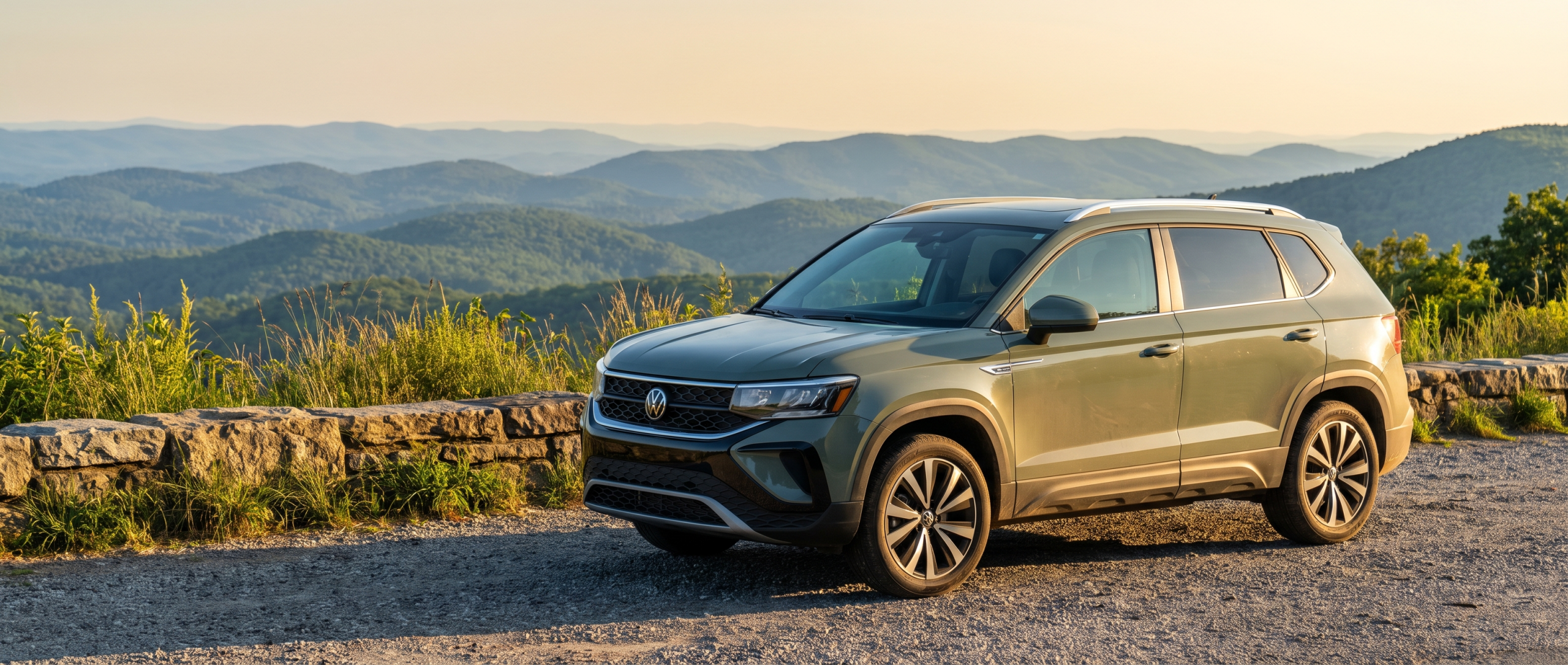
If you’re cross-shopping these two right now, here’s where we land. The 2026 Volkswagen Taos gives you noticeably more interior room and a livelier drive, while the 2026 Toyota Corolla Cross earns better IIHS crash-test marks and stronger gas-only fuel economy. Neither one is a wrong answer. Which is right for you comes down to what you actually need from a compact SUV on Upstate SC roads.
- The Taos carries more: 27.9 cu ft behind the rear seats vs. 24.3 cu ft in the Corolla Cross (gas model), and rear passengers get 37.9 inches of legroom vs. 32.0 inches.
- The Corolla Cross earns IIHS Top Safety Pick status for 2026; the Taos did not earn that recognition in 2026 IIHS ratings.
- The Corolla Cross gas model delivers an EPA-estimated 32 mpg combined (FWD); the Taos FWD returns an EPA-estimated 31 mpg combined.
- The Taos runs a turbocharged 1.5L engine producing 174 hp; the Corolla Cross gas model produces 169 hp from a naturally aspirated 2.0L.
- If you want more room, more driver engagement, and Volkswagen’s German-tuned feel, the Taos is the one. If maximum fuel savings or IIHS accolades are the deciding factor, the Corolla Cross gas (or hybrid) makes the case.
What Is the Real Difference Between These Two?
The biggest difference is one you can’t spot from the curb, because these two look nearly identical in a parking lot yet feel like different cars the moment you drive them back to back, and that gap between how they look and how they behave is exactly why this comparison is worth doing carefully. On paper, the numbers sit close together. In practice, the gap shows up fast.
| Category | 2026 Volkswagen Taos (FWD) | 2026 Toyota Corolla Cross (Gas, FWD) |
|---|---|---|
| Engine | 1.5L Turbo, 174 hp / 184 lb-ft | 2.0L Naturally Aspirated, 169 hp |
| EPA Combined MPG | 31 mpg | 32 mpg |
| EPA City / Highway MPG | 28 / 36 mpg | 29 / 31 mpg |
| Cargo (behind rear seats) | 27.9 cu ft | 24.3 cu ft |
| Max Cargo (seats folded) | 65.9 cu ft | 52.0 cu ft |
| Rear Passenger Legroom | 37.9 in | 32.0 in |
| AWD Available? | Yes (4MOTION) | Yes |
| IIHS 2026 Recognition | Not awarded | Top Safety Pick |
| Towing Capacity | Not rated | 1,500 lbs |
A few of these deserve more than a table cell. The Taos turbo puts its 184 lb-ft of torque on tap earlier in the rev range thanks to the forced induction, and you feel that low-end pull right away in stop-and-go traffic or when you’re merging onto I-85 from a short on-ramp. The naturally aspirated engine in the Corolla Cross is smooth, but you’ll press the accelerator more firmly to get the same response. It isn’t slow. The Corolla Cross just doesn’t feel as effortless.
The cargo gap is real, too. Nearly four extra cubic feet sounds modest until you’re loading mountain bikes or the full weekend kit for Croft State Park. Rear legroom is where the Taos really pulls ahead, and at 37.9 inches versus 32.0 inches, that’s no rounding difference. Adults in the back of a Corolla Cross will feel it on anything longer than a short trip.
Which One Handles Daily Driving in Spartanburg Better?
Both SUVs handle daily Spartanburg driving capably, so neither will leave you wanting on the usual loop of surface streets, the I-85 corridor, and the occasional weekend run toward the Blue Ridge foothills, and where they part ways is in how the drive feels day to day.
The Taos carries Volkswagen’s familiar road feel. There’s weight to the steering, a settledness on the highway, and a suspension tune that soaks up rough pavement without going floaty. Anyone who’s owned a Jetta or a Tiguan will recognize it right away. We notice on our lot that customers coming from German-brand backgrounds tend to appreciate that calibration without us having to spell it out. The whole thing just feels composed in a way that’s hard to put a number on but easy to feel on a winding road.
The Corolla Cross is pleasant in its own way. Light, easy, and uncomplicated to operate, it pairs effortless steering for tight urban driving with comfortable manners on longer highway stretches. It doesn’t excite you, and it was never meant to. One car is tuned to engage you, the other to relax you, and neither approach is wrong.
One data point worth knowing is the highway split. The EPA rates the 2026 Taos FWD at 28 city and 36 highway mpg, while the Corolla Cross gas model comes in at 29 city and 31 highway. The difference matters, since the Taos is actually stronger on the highway number even though it trails a touch in the city figure. For Spartanburg drivers who log more interstate miles on I-85 than city miles, that’s a useful nuance a lot of comparison articles skip.
See Current Volkswagen Specials
Interior Tech and Everyday Practicality
On the practical side, Volkswagen’s engineering philosophy stops being an abstract idea and turns into things you touch every morning, and while both SUVs cover the daily basics well, the Taos leans a bit harder into standard convenience tech where the Corolla Cross keeps some of it on the options sheet.
Standard on every 2026 Taos trim, you’ll find wireless Apple CarPlay and Android Auto. Most gas Corolla Cross trims still need a wired connection. In 2026, that gap matters more than it sounds. Nobody wants to dig for a cable every morning. The Tiguan bumps you up to a larger SUV if you need more, but the Taos handles the technology features at this price point very well.
The Taos also brings a standard Digital Cockpit display (8 inches in S and SE trims, 10.25 inches in the SEL) right in the driver’s line of sight, so navigation and audio info stay in front of you instead of forcing a glance toward the center stack.
Most Corolla Cross trims keep a conventional instrument cluster with a display in the center. It isn’t a flaw, just a different design philosophy on driver information.
We’d rather give that IIHS result a straight acknowledgment than a glossy pivot. The 2026 Taos received marginal and poor ratings in certain IIHS crashworthiness categories. Volkswagen did add rear seatbelt pretensioners and load limiters to 2025 and 2026 Taos models built after January 2025, which addresses rear occupant safety in moderate overlap front crashes. If you’re buying new and checking the build date on your specific vehicle, units built after that date reflect the updated specification. Even so, the Corolla Cross holds the stronger overall IIHS result for 2026, and that’s worth saying plainly.
Fuel Economy: Is the Hybrid Worth Considering?
Fuel economy is the one variable that can genuinely swing this decision, and the reason is the hybrid, since the two gas models sit close together while the Corolla Cross hybrid opens up a mileage advantage the Taos can’t match right now.
Is the hybrid worth considering? For a lot of Upstate SC buyers, yes. The 2026 Corolla Cross comes in two versions, a 169 hp gas model and a hybrid producing 196 combined horsepower, and Toyota rates the hybrid at an EPA-estimated 42 mpg combined, a real step up. The Volkswagen Jetta is the closest Volkswagen option in the efficiency category if you want a German-engineering feel with strong fuel economy in a smaller package, but for this particular comparison, the hybrid Corolla Cross brings something the Taos simply doesn’t offer.
On the gas-only side, the margin is narrow. One mile per gallon combined, 32 versus 31, is a real difference over a year of driving, but it’s not a life-altering one. The highway figure actually favors the Taos, 36 versus 31 mpg, which is a relevant edge for anyone who commutes regularly on I-26 or I-85.
If fuel savings top your list and the hybrid variant fits your life, the Corolla Cross hybrid makes a genuine case for itself, and we’re not going to pretend otherwise. Comparing the two gas models head to head, though, the MPG gap is narrow enough that it shouldn’t be the deciding factor on its own.
So Which One Should You Pick?
Which one you should pick comes down to what your day looks like, and the encouraging part is that both cars will serve you well, so this is less about dodging a mistake and more about matching the SUV to how you drive around Upstate SC.
Choose the 2026 Volkswagen Taos if you regularly carry adults in the back seat, you haul gear for Croft State Park weekends or mountain runs, you value that turbocharged low-end pull in heavy I-85 traffic, or you simply want a compact SUV that feels like a driver’s car rather than an appliance. Check available Taos inventory and reach out to our team to schedule a drive.
Choose the 2026 Toyota Corolla Cross if IIHS safety recognition is a firm requirement, you want the hybrid powertrain for significantly higher fuel economy, or a simpler, lighter driving feel suits your daily pattern.
We’ve driven both. For most Upstate SC use cases, the Taos is the one we’d put a Spartanburg driver in, thanks to the extra room, the added character, and a 4MOTION AWD system that handles the occasional slick morning on the I-26 interchange. But we’ll say it plainly too, the Corolla Cross is a genuinely solid vehicle, and anyone buying one isn’t making a mistake.
Frequently Asked Questions
Does the Volkswagen Taos have more cargo space than the Toyota Corolla Cross?
Yes. The 2026 Volkswagen Taos offers 27.9 cubic feet of cargo space behind the rear seats, compared to 24.3 cubic feet in the 2026 Toyota Corolla Cross gas model. Fold the rear seats flat and that gap grows further: 65.9 cubic feet in the Taos versus approximately 52 cubic feet in the Corolla Cross. Rear-seat legroom also favors the Taos at 37.9 inches compared to 32.0 inches in the Corolla Cross, a difference adult passengers will feel on longer drives.
Is the Toyota Corolla Cross safer than the Volkswagen Taos?
Based on 2026 IIHS ratings, the Toyota Corolla Cross earns IIHS Top Safety Pick status, while the Volkswagen Taos did not receive that recognition in the 2026 IIHS evaluation cycle. The Taos received marginal and poor ratings in certain crash categories. Volkswagen did update the 2025 and 2026 Taos with rear seatbelt pretensioners and load limiters on vehicles built after January 2025 to address rear occupant protection in moderate overlap front crashes. If safety ratings are a firm priority, the Corolla Cross holds the stronger IIHS result for 2026.
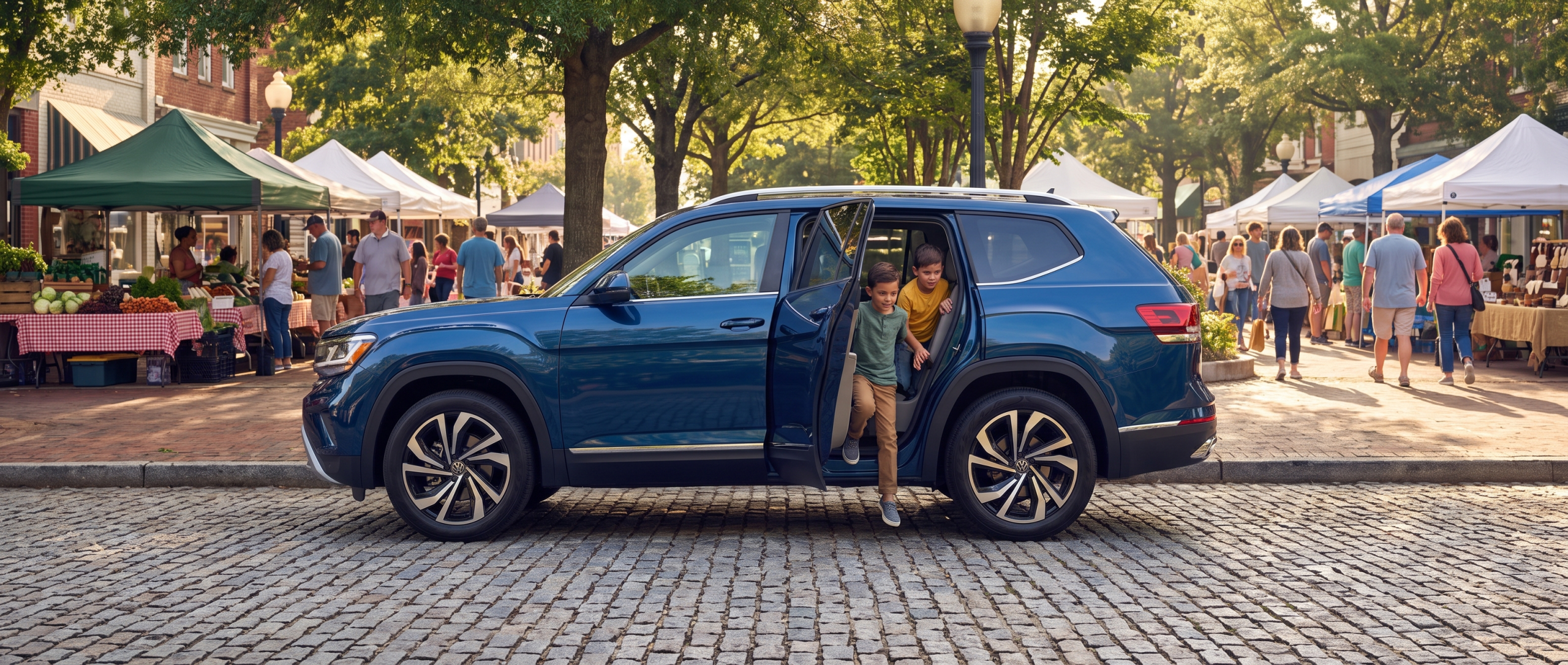
Saturday mornings in downtown Spartanburg move fast. The Hub City Farmers Market fills its lot on Northside before 8:30, the Morgan Square popup pulls 30-plus vendors into the middle of the street grid, and you’re juggling two kids, a double stroller, and a bag of peaches. The right Volkswagen SUV keeps that operation smooth, and the wrong one turns a fun Saturday into a parking puzzle you’re still chewing on at lunch.
So which one fits your family? It comes down to how you carpool and where you park. The the 2026 Volkswagen Atlas wins if you’re carpooling or you need that full third row. Go with the 2026 Volkswagen Tiguan when downtown street parking is your weekly reality and a compact footprint genuinely matters. Both earned IIHS Top Safety Pick+ recognition for 2026.
Where Do You Park and How Early Do You Need to Arrive?
Aim to arrive before 8:15 if the Hub City Farmers Market is your destination, since the nearby lots fill fast and you’ll otherwise circle with restless kids in the backseat, though the later Morgan Square popup and Fifth Third Park game nights give you noticeably more room to breathe. Miss that window and you’re hunting.
| Arrive by | Best spot | Fits the Atlas (200.7 in.)? | Fits the Tiguan (184.4 in.)? | Tip |
|---|---|---|---|---|
| 7:50-8:15 AM | Northside Harvest Park lot (event lot) | Yes | Yes | First come, first served on Saturdays |
| 8:15-9:00 AM | Downtown garage off Magnolia Street | Yes, watch the turn radius | Yes, easy | Multi-level garages have tighter turns; take it slow |
| 9:00+ AM | Side streets east of Morgan Square | Tiguan advantage | Yes, street-length fits well | The Atlas’s 200.7-inch length makes parallel parking tighter here |
| Morgan Square Sunday popup (11 AM-2 PM) | On-street near Daniel Morgan Ave | Atlas fits with patience | Tiguan fits easily | Arrive by 10:40 for stress-free spots |
| Fifth Third Park game nights | Stadium lot on Magnolia | Both fit | Both fit | Lots open well before first pitch |
The size gap is the honest catch here. The Atlas runs 16 inches longer than the Tiguan, and you’ll feel every one of those inches nosing into a spot on a side street off Morgan Square while a stroller brigade crosses behind you. Downtown Spartanburg’s parking is described by the city as “convenient and free,” with multiple garages and lots accessible. Even so, tight-aisle garages favor the shorter Tiguan.
Reading Your Carpool and Getting the Right Fit
The Atlas seats seven, or six once you spec the optional captain’s chairs in the second row, and its second row slides 7.7 inches fore and aft, which is exactly the flexibility you want when a full carpool of school-age kids climbs in and nobody wants to ride scrunched against the door. Behind the third row, Volkswagen lists 20.6 cubic feet of cargo space. Fold the third row and that expands to 55.5 cubic feet. Drop both rows flat and you’re at 96.6 cubic feet.
When families walk our lot on Reidville Road, the conversation comes down to seat count. A Saturday routine with two or three extra kids on board makes the Atlas’s three-row layout the obvious call.
Still, IIHS noted the lower LATCH anchors on the Atlas’s second-row outboard positions sit deep, and latching a child seat there requires notable effort. That’s worth knowing before your first installation day. It isn’t a safety failing (the Atlas still earned IIHS Top Safety Pick+ for 2026), but it is an ergonomic reality.
The Tiguan is a five-seat, two-row SUV for 2026. Volkswagen removed the optional third row from this generation to give the passengers who actually ride more cabin space and legroom. You get 33.8 cubic feet of cargo space behind the rear seats and 69.8 cubic feet with the seat folded flat. At 184.4 inches long, it slots neatly into a standard garage stall. For a crew of two adults and two kids, that shorter footprint pays off every time you park, and the missing third row won’t cost you a thing.
One spec worth flagging before you go. The Atlas’s 2026 engine is a 2.0-liter turbocharged four-cylinder rated at 269 horsepower and 273 lb-ft of torque, per Volkswagen. That torque figure matters for a loaded vehicle getting on and off I-85 with a full cabin and a cargo area packed after the market. It pulls cleanly. You won’t feel the weight.
The Go-Bag and Gear Checklist Before You Leave the Driveway
Getting to the market is only half the job, and a smooth Saturday really turns on the gear you loaded before you backed out of the driveway rather than anything you scramble for once the kids are already restless in the lot.
- [ ] Reusable tote bags (Hub City vendors are produce-heavy; you’ll want them)
- [ ] Stroller loaded and accessible (Atlas: drop the third row before you leave, not in the lot; Tiguan: stroller fits upright with rear seats up at 33.8 cu ft)
- [ ] Snacks and water bottles in a designated bag, not scattered on seats
- [ ] Sunscreen and hats (August in Spartanburg is legitimately hot; market shade is limited)
- [ ] Child carrier or carrier backpack as a stroller backup for crowded stretches near Morgan Square
- [ ] Cash or a loaded card (some vendors are card-only; some are cash-preferred)
- [ ] Parking plan confirmed: know your garage or lot before you arrive, not after
- [ ] Arrival window locked in: 8:15 or earlier for a stress-free spot, every time
- [ ] Hands-free liftgate or key in hand (loading a stroller while holding a toddler is why this feature exists)
The full Volkswagen lineup at Steve White Volkswagen Spartanburg covers both the Atlas and Tiguan with current availability. Our team on Reidville Road keeps it straightforward. We’ll walk you through the configuration that actually matches your Saturday routine, not just the biggest spec number on the page.
Go enjoy the market. The right SUV is the one you don’t think about once you’ve parked.
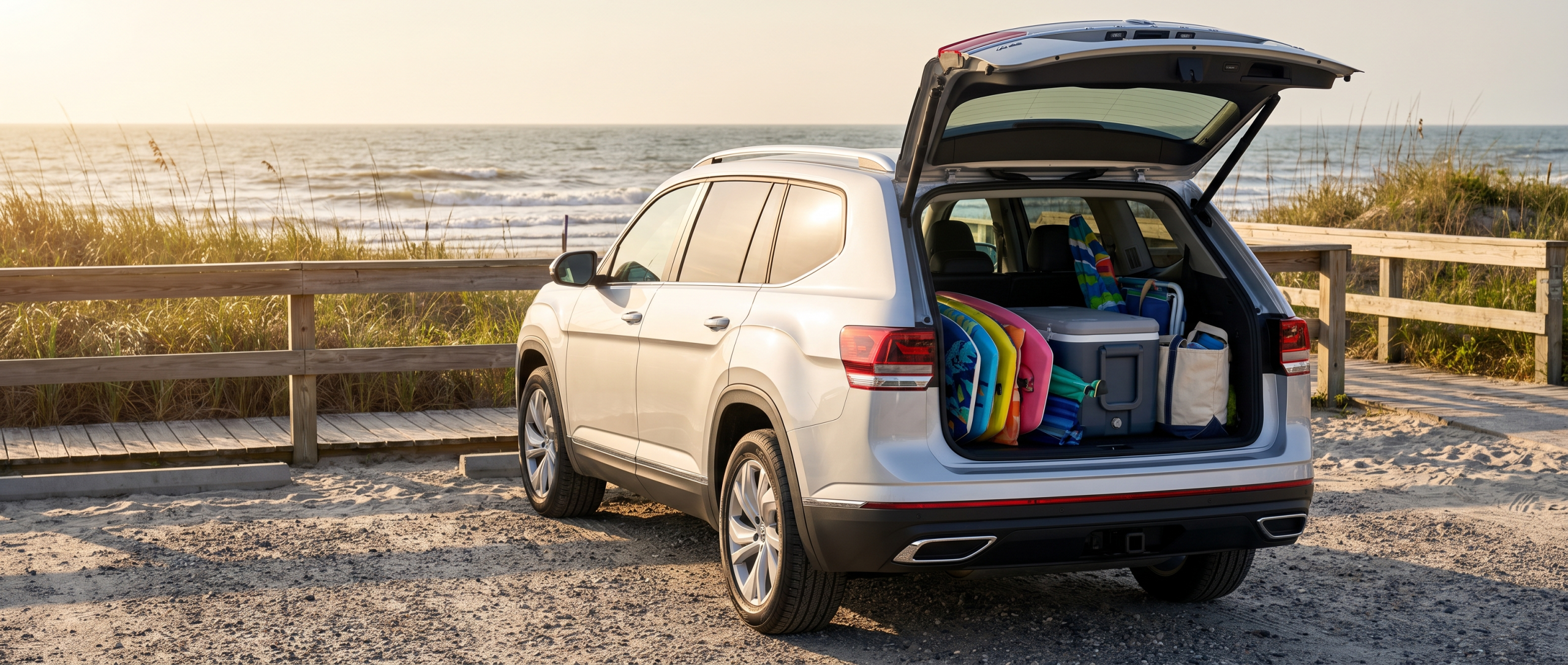
End-of-summer beach trips from Spartanburg aren’t short. Take I-26 east toward the coast and you’re looking at somewhere between three and four hours each way, with a full car, real gear, and kids who will definitely ask about snacks before you clear Newberry County. The question that matters isn’t which Volkswagen looks nice in a beach photo. It comes down to which one handles the specific math of your family, how many seats you actually need, how much cargo you’re actually packing, and whether the fuel economy holds up over a long highway stretch.
For families of five or more who bring the full kit (boogie boards, folding chairs, a full cooler, a stroller), the 2026 Volkswagen Atlas earns it with three configurable rows and a cargo system that scales in stages. For families of four with lighter kit or a preference for a more agile highway drive, the 2026 Tiguan’s flat-load floor and noticeably better gas mileage make it the smarter fit.
How Does the Cargo Logic Actually Work on Each Model?
On both models the cargo logic runs on ‘staged loading,’ which is how each vehicle balances the tension between keeping passengers seated and fitting the gear that makes a beach trip work, and that balance matters far more than horsepower or wheel size once the car is full.
The 2026 Atlas operates on a three-stage system. Volkswagen lists 20.6 cubic feet of trunk space with all seven seats upright. Fold that third row flat in its 50/50 split and you jump to 55.5 cubic feet, with five people still seated comfortably. Drop the second row too and you hit 96.6 cubic feet of maximum cargo volume. That progression matters on a real beach trip. You can seat seven on the way down and still stow a reasonable amount of gear, or you can drop the third row once grandparents join in a separate car and you’re suddenly in true station-wagon space for folding chairs, umbrellas, and a full-size cooler.
The 2026 Tiguan works differently. Volkswagen redesigned the 2026 model to be a dedicated five-passenger SUV. There’s no third-row option. What you get instead is 33.8 cubic feet of cargo space with the seats up and 69.8 cubic feet with both rear seats folded flat, creating what Volkswagen describes as a nearly flat load floor. If your family is four people and the gear list is manageable, that flat floor is genuinely practical. Boogie boards go in without wrestling a seat mechanism. Shorter than the Atlas at 184.4 inches versus 200.7 inches, the Tiguan is also easier to park at beach access lots that aren’t built for three-row behemoths.
| Feature | 2026 Atlas | 2026 Tiguan |
|---|---|---|
| Seating capacity | Up to 7 (or 6 with captain’s chairs) | 5 |
| Cargo behind rear seats | 20.6 cu ft | 33.8 cu ft |
| Cargo with rear seats folded | 55.5 cu ft (3rd row down) or 96.6 cu ft (all down) | 69.8 cu ft |
| Load floor when fully folded | Flat (50/50 third-row split) | Nearly flat |
| EPA highway mpg (FWD) | 27 mpg | 32-34 mpg (trim-dependent) |
| EPA highway mpg (4Motion AWD) | 25-26 mpg (trim-dependent) | 29-30 mpg |
| Towing capacity (when equipped) | Up to 5,000 lbs | Not rated for towing |
| IIHS safety status | 2026 TOP SAFETY PICK | 2026 in production |
| Overall vehicle length | 200.7 in | 184.4 in |
Which One Do You Actually Need for an Upstate SC Beach Run?
For an Upstate beach run, both vehicles get you there in good shape, but the choice really turns on one real-world condition the family SUV roundups tend to skip, which is that the I-26 corridor is almost all highway miles, and a loaded SUV on a long highway stretch will expose the MPG difference in a tangible way.
Check the highway numbers first, since the I-26 run is exactly where they show up. The EPA rates the 2026 Tiguan S at 34 mpg highway (FWD). The 2026 Atlas FWD comes in at 27 mpg highway. The gap is seven miles per gallon. On a 350-mile round trip with five people and gear on board, you’ll feel that gap at the pump. If you’re running 4Motion AWD on the Atlas (standard on upper trims), the highway number drops to 25-26 mpg. The tradeoff is a fair one. The Atlas uses more fuel to haul more people and more gear. If you genuinely need those seven seats, the trade holds up. If you don’t, you’re paying a running cost for capacity you’re leaving empty.
The SC coast in late August can still hand you a rain event. That I-26 stretch through the Midlands isn’t forgiving when the lanes are wet and everyone’s in a hurry to get home.
That said, the Atlas brings something families who’ve done the drive appreciate, Volkswagen’s 4Motion all-wheel drive, available on all trims and standard on upper ones. On the 2026 Tiguan, 4Motion AWD is available but comes with a real fuel economy hit (22/30 mpg city/highway versus 25/32 FWD), so the efficiency advantage of the Tiguan narrows if you opt for AWD.
Our team’s honest take runs like this. Families of four traveling with the standard beach kit fit the Tiguan perfectly and will appreciate how the nearly-flat load floor handles irregular gear. Families of five or six who want everyone in one vehicle, especially with a paddleboard or two in the mix, need the Atlas. The third-row legroom in the Atlas is 33.7 inches, which isn’t luxury space, but it’s real room for kids who aren’t over six feet tall.
See Current Offers on Atlas and Tiguan
One note on the Beach Drive Concept specifically. Neither vehicle is the wrong answer here. Browse our current inventory to see which trims and drivetrains we have available right now, because the Atlas’s sweet spot for this kind of trip is the SE with Technology or higher (you get the towing-capable hitch, the larger fuel tank, and the upgraded driver assistance suite), and those trims are worth comparing against the Tiguan’s SEL configuration.
Quick Terms Worth Knowing
| Term | What it means for you |
|---|---|
| 4Motion AWD | Volkswagen’s all-wheel drive system; distributes power between axles automatically; adds grip in wet or low-traction conditions |
| Staged cargo | The ability to use different load configurations (third row up, third row folded, both rows folded) to balance passengers and gear |
| EPA highway mpg | The federal fuel economy estimate for sustained highway driving; most relevant for a long I-26 run |
| Load floor | The surface you set gear on when rear seats are folded; a flat load floor means less gear sliding and easier packing |
What This Means When You’re Ready to Choose
When you’re ready to choose, the split between the Atlas and the Tiguan comes down to loading architecture rather than prestige or trim level, because one vehicle is built around the idea that you’ll sometimes need every seat and sometimes need all the cargo space, while the other is built around five people and their gear as the right target. One solves it through a three-stage folding system. The other optimizes every cubic foot for usable flatness and gives back efficiency in return.
Both models carry Volkswagen’s IQ.DRIVE driver assistance suite standard, which means Travel Assist, Lane Assist, Front Assist, and Emergency Assist are baked into every trip down I-26. The 2026 Atlas earned the IIHS 2026 TOP SAFETY PICK designation. That counts on a highway where late-summer traffic can be unpredictable.
If you’re on the fence, the right move is a side-by-side walkthrough with your actual gear. We mean that literally. Bring the cooler, the chairs, and the bags to the lot on Reidville Road and we’ll load both vehicles with your real gear so you can see which one closes cleanly without forcing anything, coolers and all. Loading it yourself is the test worth trusting.
Frequently Asked Questions
Does the 2026 Volkswagen Atlas third row actually fit adults on a long trip?
The 2026 Atlas third row offers 33.7 inches of legroom. That’s real, usable space for older kids and shorter adults on a three-to-four-hour drive. Taller adults will find it tighter than the front two rows, but for a family hauling kids to the coast it functions exactly as intended. The 50/50 split also lets you seat two passengers in the third row while still carrying a board bag or a folding wagon in the remaining cargo space.
Is the Volkswagen Tiguan big enough for a family beach trip, or do you really need the Atlas?
For a family of four with standard beach gear (a cooler, a few bags, chairs, and boogie boards), the 2026 Tiguan’s 33.8 cubic feet of cargo space with seats up handles it without folding anything. Fold the rear seats and you get 69.8 cubic feet, which is more usable space than you’d think. The Tiguan is genuinely the better choice for four-person families, and its highway fuel economy makes the I-26 run more efficient. The Atlas earns its size only when you actually need the third row or when you’re towing something.
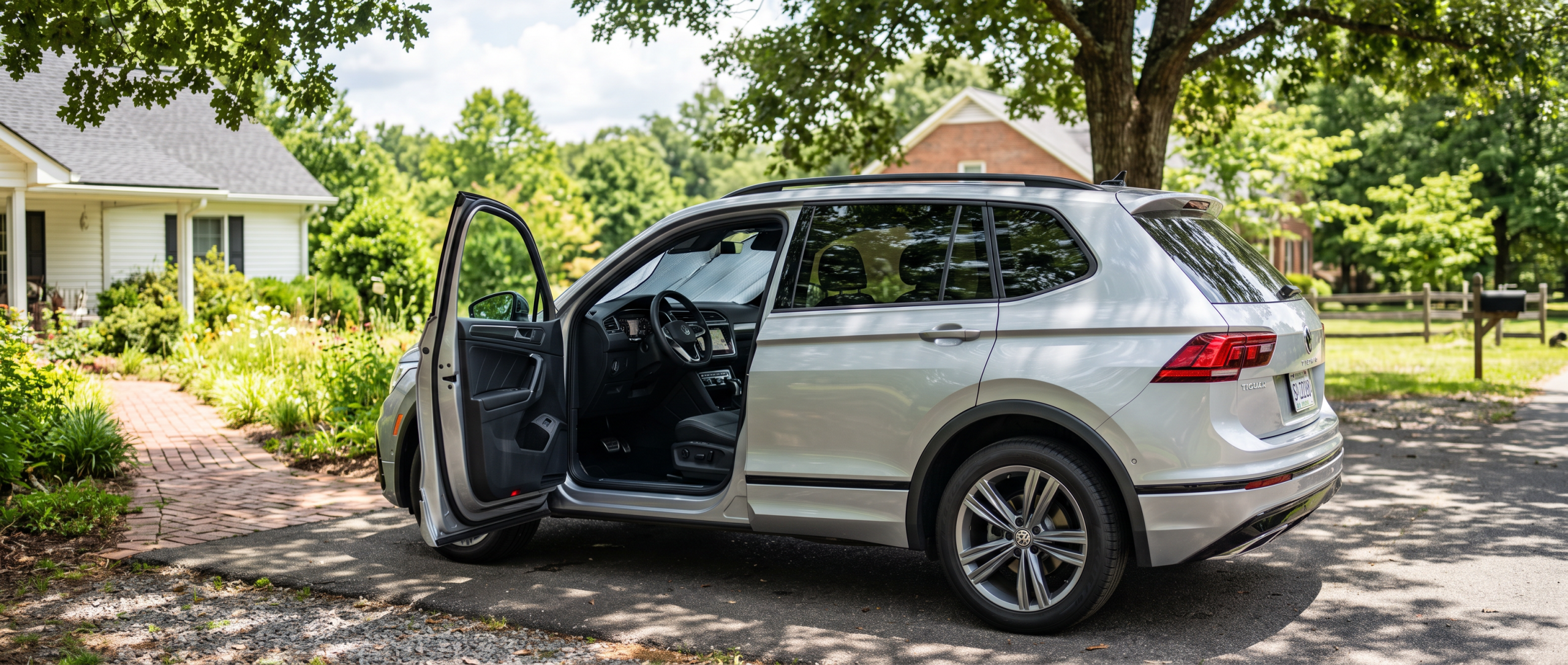
July in Spartanburg is not gentle. Average highs sit at 91 degrees Fahrenheit, the humidity hovers around 68%, and a parked car in direct sun does something easy to underestimate. Per NHTSA, a vehicle’s cabin gains roughly 20 degrees Fahrenheit in as little as 10 minutes. So a car sitting in the Reidville Road lot at noon climbs well above 110 degrees Fahrenheit inside before you’ve finished your lunch run. The honest bottom line runs like this. The single biggest threat to your Volkswagen’s interior value isn’t mileage. It’s those six weeks of Upstate summer heat a cabin isn’t built to shrug off on its own.
Protecting the cabin isn’t complicated. You do need to know which materials are sitting in your car, because the Volkswagen Tiguan, the Atlas, the Jetta, and every other model in the lineup use different upholstery tiers, and each tier has its own weak point in heat and humidity.
What Does Interior “Value” Actually Mean Here?
Interior value here comes down to a plain difference you’ll feel at trade-in, between a cabin that still looks showroom-fresh and one that tells the inspector a story of neglect the moment they open the door. Faded dashboards, tacky door panels, cracked leatherette bolsters, and that particular musty smell that develops when humid air gets trapped in unsealed fabric are the details that quietly cost money later. Good care costs next to nothing now, and it doesn’t take much to stay ahead of.
Spartanburg’s summer adds a layer drivers in drier climates don’t face. Heat alone attacks UV-sensitive plastics and fades dye in fabric. But 68% average humidity means moisture works alongside that heat, softening adhesives, feeding mildew in carpet fibers, and speeding up the drying-and-wetting cycle that eventually causes rubber seals and trim clips to fail. You’re not just fighting the sun. You’re fighting a system.
What Do You Actually Get at Each Volkswagen Trim Level?
What you get at each trim level changes the whole care routine, because a can of leather conditioner does nothing useful on embossed cloth, and a fabric protectant spray on Varenna leather won’t earn its keep. Know your material, then treat it.
| Trim Level (Examples) | Upholstery Material | Heat Vulnerability | Humidity Vulnerability | What It Needs |
|---|---|---|---|---|
| Tiguan S / Jetta base | Embossed cloth | Dye fade, fiber breakdown | Mildew, odor retention | Fabric protectant spray, weekly vacuuming, baking soda deodorize |
| Tiguan SE / Atlas SE | V-Tex leatherette (perforated) | Surface tackiness, seam stress | Minimal if kept clean | UV protectant wipe-down, mild interior cleaner monthly |
| Tiguan SEL R-Line Turbo / Atlas SEL Premium | Varenna leather (real) | Cracking from moisture loss, dye fade | Swells and loses shape if waterlogged | pH-neutral leather conditioner every 6-8 weeks |
| All trims | Soft-touch dash / door panels | Fading, stickiness from off-gassing | Dust adhesion | UV protectant applied to a microfiber cloth, not sprayed directly |
| All trims | Touchscreen / instrument cluster | Glare coating wear | Smudge buildup in humidity | Dry microfiber only; never alcohol-based wipes |
None of that table is guesswork. The 2026 Volkswagen Atlas SE ships with standard perforated V-Tex leatherette (confirmed in the published build specs) while the SEL Premium R-Line moves to Varenna leather. On the compact side, the 2026 Tiguan SE and SE R-Line Black carry V-Tex leatherette, and the Tiguan S stays on cloth. So the practical upshot is simple. If you bought a mid-range trim for that upscale look, V-Tex is easier to keep up in heat than real leather, because it doesn’t depend on retained moisture the way hide does.
Smart Habits That Actually Preserve Your Cabin
Good habits protect a cabin more reliably than any single product, and the piece generic articles skip is sequence, because the order you work in matters as much as what you’re reaching for. The order you do things matters as much as what you use.
Start with the windshield, every time you park. A reflective sunshade isn’t optional in a Spartanburg July. It cuts the direct radiant load on the dashboard and steering wheel, where the worst surface-level damage builds fastest. Feel that tackiness on an unprotected soft-touch dash? The UV-reactive coating is starting to break down, and once it’s gone, it doesn’t come back.
Vacuum before you wipe. Abrasive dust on a cloth seat or leatherette surface acts like sandpaper when you drag a damp cloth across it. Vacuum first. Two minutes with a brush attachment before any cleaning product touches the material, and you’ll dodge the micro-scratches that dull a finish over a summer.
On humidity specifically, crack the windows in shade, not in sun. Leaving windows up in a shaded parking spot (and Croft State Park has plenty of them) traps moisture with heat and builds exactly the conditions mildew needs. A two-inch gap in a shaded spot keeps air moving without inviting direct UV, which is what you’re after. In full sun, keep them up and lean on the sunshade instead.
Bring your Volkswagen in for a service appointment if the cabin air conditioning starts putting out a musty smell. You’ll usually find a saturated cabin air filter behind it. In Spartanburg’s summer humidity, those filters load up faster than the service-interval charts assume.
Schedule a Service Appointment
The Smart Choice: Protect Now or Pay at Trade-In
The smart choice is really a tradeoff of twenty minutes a month now against how the cabin shows at trade-in later, and skipping those minutes doesn’t feel like a decision until the appraisal reflects a cabin that looks worn instead of cared for. Volkswagen interiors, especially the V-Tex leatherette tiers, are durable by design. But no engineering survives sustained UV and heat exposure without basic maintenance.
Where this matters most for Spartanburg drivers is at the premium trim level. A Tiguan or Atlas Cross Sport in SEL trim carries real Varenna leather and a 15-inch touchscreen with a glare coating. Both take neglect badly, in ways you’ll see and measure at resale time. Protecting them protects the premium you already paid.
Cloth-trim drivers aren’t off the hook either. Fabric holds odor and moisture in ways leatherette doesn’t, and an Upstate summer of leaving windows closed on hot afternoons breeds a smell detailing can soften but rarely erase. The fix costs nothing, just twenty seconds of window positioning and a fabric protectant spray applied twice a season.
Your Spartanburg summer doesn’t have to take anything from the cabin you drove home in.
Frequently Asked Questions
Does Volkswagen’s V-Tex leatherette crack in heat the way real leather does?
Not in the same way, and that’s actually one of V-Tex’s genuine advantages in a hot climate. Real leather cracks when it loses moisture (a natural process that Spartanburg’s repeated heat cycles accelerate significantly). V-Tex leatherette is a synthetic material with a polymer surface that doesn’t depend on retained moisture to stay supple. It can become tacky or develop surface sheen from UV exposure over time, but it won’t crack the way untreated hide does. A monthly wipe-down with a UV protectant is all it needs. Drivers stepping up to the Tiguan SE or Atlas SE trims are actually choosing a material that handles Upstate SC summers more forgivingly than the top-trim leather does, though both benefit from attention.
My dashboard already feels tacky after just one summer. Is that normal, or did something go wrong?
That tackiness is a real and common problem, and it’s not a manufacturing defect. The soft-touch coating on Volkswagen dashboards and door panel caps is designed for comfort and appearance, but it’s UV-sensitive. In a South Carolina summer, prolonged direct sun exposure causes the surface coating to begin breaking down, producing that unpleasant sticky texture. It happens faster without a windshield sunshade. The difficult news is that once the coating is gone, it cannot be fully restored. You can clean the residue and apply a UV protectant to slow further degradation, but the original finish is permanently altered. Going forward, a reflective sunshade every time you park in direct sun is the prevention that actually works.
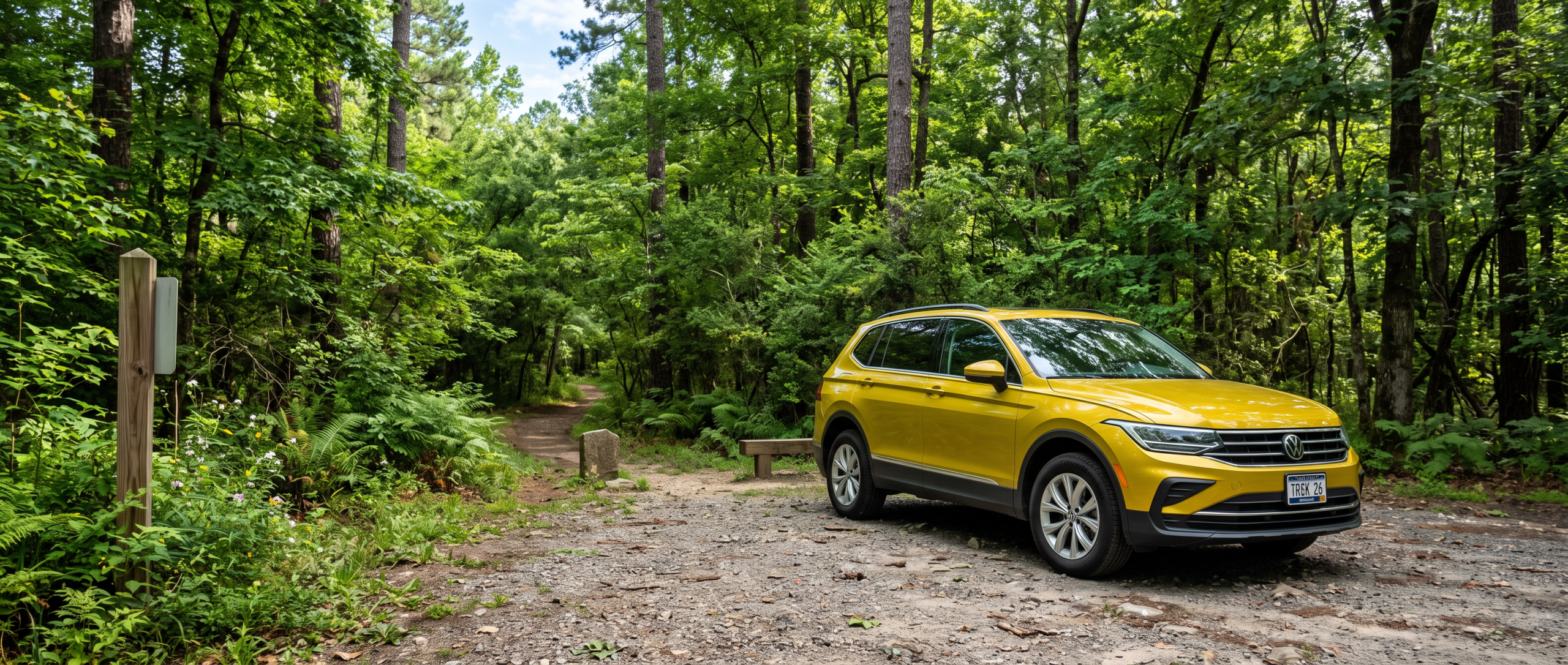
If you’re loading a crate into the back of your Volkswagen before a Saturday morning at Croft State Park, model year matters more than the badge lets on. A used 2019 Tiguan and a 2026 Tiguan aren’t the same vehicle in any dimension that matters to a 70-pound Labrador.
Browse pre-owned Volkswagen SUVs at Steve White Volkswagen Spartanburg
The short version runs like this. Any 2022-and-newer Tiguan and any Atlas from 2018 onward give you the cargo geometry a dog owner actually needs. Older Tiguans (pre-2018, and especially pre-2017) are tighter than they look on paper. We’ll break it down year by year.
- Sweet spot for the Tiguan: 2022-2026 (the fully loaded post-redesign generation with a near-flat load floor and meaningful rear cargo depth)
- Sweet spot for the Atlas: 2018-2026 (purpose-built three-row with real behind-the-third-row clearance for a crate)
- Years to watch on the Tiguan: 2017-2019 (third-row option ate cargo space; some NHTSA-documented complaints about the DSG transmission)
- 2026 Tiguan is a fresh redesign with Volkswagen listing 33.8 cubic feet behind the second row (up significantly from the outgoing generation)
- Hatcher Garden welcomes leashed dogs on its paved 0.4-mile loop; Croft State Park’s official policy allows leashed pets on six-foot leads across most of its 7,054 acres
Which Model Years Are the Sweet Spot for Spartanburg Dog Owners?
For most Spartanburg dog owners the sweet spot lands on the 2022-2026 Tiguan or any Atlas from 2018 on, though the newest 2026 Tiguan sets the benchmark, with Volkswagen listing 33.8 cubic feet of cargo space behind the second row and 69.8 cubic feet with the seats folded flat, a clear jump from the previous generation’s more modest load floor. Hold that number in your head when you’re sizing up a used example.
| Model Year | Cargo Behind 2nd Row | Flat Load Floor | Our Read for Dogs |
|---|---|---|---|
| 2026 Tiguan (current) | 33.8 cu ft | Yes (nearly flat) | Best-in-generation; roomy enough for a 32-inch crate with room for a bag |
| 2022-2025 Tiguan | ~33.8 cu ft | Yes | Same generation as 2026 (pre-facelift); strong dog hauler |
| 2018-2021 Tiguan | ~22 cu ft | Stepped (minor) | Comfortable for medium dogs; a 36-inch crate is tight |
| 2017 Tiguan | ~12 cu ft (with 3rd row) | No (high load floor) | Steer clear for large dogs; 3rd-row model compounds the problem |
| 2009-2016 Tiguan | ~23 cu ft | No | Compact, older safety tech; fine for small dogs, not recommended for crates |
| 2026 Atlas | 20.6 cu ft (3rd row in use) | Yes (rows folded) | 96.6 cu ft fully open; two large crates fit without stacking |
| 2018-2025 Atlas | ~20-21 cu ft (3rd row in) | Yes (rows folded) | Consistent generation; same basic geometry as 2026 |
The 2022-2026 Tiguan is genuinely the pet-owner’s window into this model. Its redesign delivered a cargo area wide and deep enough to take a standard airline-sized crate, and you don’t have to fold the second row first. Good dog cars start there.
See current Tiguan inventory at Steve White Volkswagen Spartanburg
Which Model Years Should You Watch Out For?
The one to watch is the 2017 Tiguan, and the reason is packaging more than reliability, since Volkswagen sold it alongside the 2018 redesign as the “last of the old generation,” and its 7-passenger configuration with the optional third row was almost always the one on dealer lots. With that third row in place, Volkswagen listed a cargo area of roughly 12 cubic feet. About the size of a carry-on bag. Not with a dog crate.
On the reliability front, the 2017-2019 Tiguan drew NHTSA-documented complaints related to its 7-speed DSG dual-clutch transmission, including hesitation on low-speed engagement. You won’t get stranded by that on flat roads, but Upstate South Carolina’s rolling terrain between I-26 and Croft State Park loads a transmission harder at low speed than flat suburban driving does. Get one inspected before you buy.
The 2009-2016 Tiguan generation isn’t a problem vehicle, though it predates Volkswagen’s standard driver-assistance suite. If you’re covering the I-85 corridor to Greenville regularly with a dog in the back, current lane-keeping assist and automatic emergency braking are worth having.
See current Atlas inventory at Steve White Volkswagen Spartanburg
Which Year Fits Which Buyer?
The right year depends less on your dog’s size than on how you use the SUV the other six days of the week, so a weekend hiker and a family of five can land on different answers with the same Labrador in back.
You want a 2022-2026 Tiguan if: You’re a driver who makes solo or two-person trips to Croft State Park on weekends, carries one large dog or two medium ones, and wants a compact-SUV footprint for Reidville Road and downtown Spartanburg parking. Volkswagen lists the 2026 Tiguan at 184.4 inches long and 66.1 inches tall (FWD). It fits in a standard single-car garage, which matters for Upstate SC summers when you don’t want a hot car greeting your dog on the return trip.
You want a 2018-2026 Atlas if: You’re the driver with kids and a dog, or two dogs. The Atlas holds 96.6 cubic feet with both rear rows folded, large enough for two large-breed crates plus a bag of supplies. The 2026 Atlas earned IIHS Top Safety Pick+ status, which matters when you’re running I-85 on a Friday afternoon with the whole family (including the one who can’t buckle up).
The honest tradeoff: The Atlas is the more capable pet hauler, no question. It’s also longer, heavier, and harder on fuel. The EPA rates the 2026 Atlas at 18-20 mpg city and 24-27 mpg highway, depending on drivetrain. The Tiguan is the better daily driver for someone who only needs serious cargo room on weekends.
A quick note on Hatcher Garden. Hatcher Garden covers 10 acres on John B. White Sr. Blvd. The preserve stays open year-round during daylight hours and free to enter, and leashed dogs are welcome on the paved 0.4-mile loop. That loop stays short, so the bigger job is the car that gets your dog there clean and cool, and you’ll feel that more than the walk. Croft State Park, on the south side of Spartanburg, is the bigger adventure, spanning 7,054 acres with official South Carolina State Parks policy allowing leashed pets on a six-foot lead in most outdoor areas, and enough trail to tire out a high-energy dog.
If you’re upgrading from an older Tiguan specifically to get more dog space, knowing your trade-in value before you shop puts you in a better position. The jump from a 2017 to a 2022-2026 generation is substantial in cargo terms.
Browse the current Volkswagen lineup at Steve White Volkswagen Spartanburg
By the Steve White Volkswagen Spartanburg Team | July 2026
Frequently Asked Questions
What’s the real cargo difference between the 2017 and 2022 Volkswagen Tiguan?
The difference is significant. A 2017 Tiguan, especially the 7-passenger version with the optional third row installed, offered roughly 12 cubic feet of cargo space with that row in place. The 2022-2026 Tiguan generation provides 33.8 cubic feet behind the second row, per Volkswagen’s published specs. In plain terms, that’s the gap between squeezing in a small travel crate and comfortably loading a full-sized one.
Are leashed dogs allowed at Hatcher Garden and Croft State Park?
Yes to both, as long as you’ve got a leash. Hatcher Garden’s official rules ban unleashed pets but permit dogs on leash on its paved 0.4-mile loop. Croft State Park, per the South Carolina State Parks official site, allows pets on a leash no longer than six feet in most outdoor areas across its 7,054-acre grounds. Verify current rules directly with each venue before your visit, since policies can change.
Is the 2026 Volkswagen Atlas or 2026 Volkswagen Tiguan better for transporting a large dog?
If cargo space is all that matters, the Atlas wins clearly. With the third row folded, the 2026 Atlas delivers 55.5 cubic feet; with both rear rows folded, it opens to 96.6 cubic feet. The 2026 Tiguan maxes out at 69.8 cubic feet with the second row folded. For one large dog, either works well. For two large dogs in separate crates, the Atlas gives you the margin you’ll want. The Tiguan is the better daily driver if you mostly need the space on weekends.
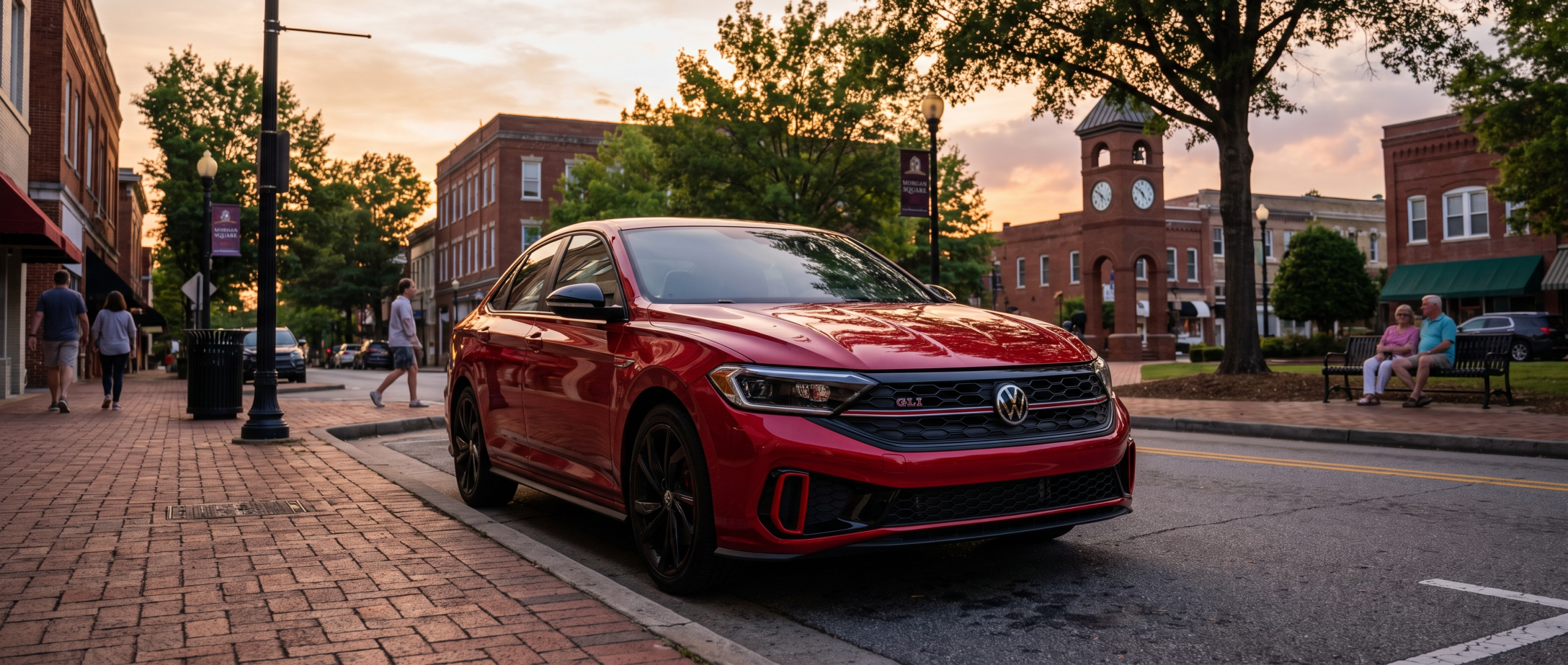
The 2026 Volkswagen Jetta GLI is the last car Volkswagen sells in the United States with a manual gearbox. On its own, that fact turns an ordinary Thursday into something you’ll look forward to.
The Jetta GLI is a genuine performance sedan, not a trim with a spoiler bolted on. Volkswagen drops the same turbocharged 2.0-liter TSI engine that powers the Golf GTI into the Jetta’s four-door body, adds a VAQ limited-slip front differential, tunes the suspension 0.6 inches lower than the standard Jetta, and sends it out with 228 horsepower and 258 lb-ft of torque. On a warm Spartanburg evening, with Morgan Square’s Music on Main waiting downtown and I-85 clear ahead of you, those specs stop reading like numbers on a window sticker and start feeling like a reason you’ll actually use.
What Do the Specs Actually Mean for How It Drives?
They mean more than the raw figures suggest, because the engine handles only part of the job here, and the VAQ differential plus the sport suspension do quiet work you’ll feel through the steering well before any spec on the sheet catches up.
| Spec | 2026 Jetta GLI Autobahn |
|---|---|
| Engine | 2.0L turbocharged TSI inline-4 |
| Horsepower | 228 hp @ 6,500 rpm |
| Torque | 258 lb-ft @ 4,000 rpm |
| Transmission | 6-speed manual (standard) or 7-speed DSG automatic |
| 0-60 mph (DSG) | 5.6 seconds |
| Front suspension | Sport-tuned, 0.6 in. lower than base Jetta |
| Front differential | VAQ electronic limited-slip |
| Front brake rotors | 13.4-inch vented discs |
| Fuel economy (manual, EPA est.) | 26 city / 36 hwy / 30 combined |
| Fuel type | Regular 87-octane unleaded |
| Infotainment | 8-inch screen, wireless App-Connect, 8-speaker audio |
| Adaptive damping | DCC system: Comfort, Normal, Sport modes |
The fuel-type row is easy to skip past on the spec sheet. Volkswagen engineers built the TSI to run on regular 87-octane fuel, not premium. For a car with this much torque on tap at 4,000 rpm, that’s uncommon, and it keeps everyday ownership straightforward.
The VAQ differential is what sets the GLI apart from a Jetta with a sport suspension kit. Standard front-wheel-drive cars push wide in corners because torque flows to the wheel that’s got less grip. The VAQ uses a multi-plate clutch and a hydraulic pump to send torque to the wheel that has more traction. Tighter exits. Less fighting the wheel on a curved on-ramp. Volkswagen’s sport-tuned suspension (lower and stiffer than the base car) puts that work into the steering, and a seat cushion never has to bail you out. You feel every bit of it.
The GLI at Night: Why Spartanburg’s Summer Makes Sense Here
A standard Jetta handles the daily grind as a composed, no-fuss commuter, and the GLI keeps every bit of that competence while adding one thing the base car never bothers to offer, an actual reason to leave the house early on a warm evening. It makes the drive worth as much as the arrival.
Spartanburg’s Music on Main runs every Thursday evening from April through August at Morgan Square, free, 5:30 to 8:30 pm. The event is a city-funded tradition that rewards having a car worth parking nearby, and the GLI earns that walk back to the car. Dual exhaust tips at the rear, 18-inch machined alloy wheels (or gloss black with the optional Black Package), red GLI badges, and a rear lip spoiler that actually earns its keep at speed. You don’t have to say what it is. It says it.
Does a late exit from downtown turn the I-85 merge into a chore? Barely. You’ve got real thrust when you need it. Leaving downtown Spartanburg at 8:30 on a Thursday night means I-85 is moving, and the DSG version’s 5.6-second 0-60 time (per Car and Driver testing) makes the merge feel easy at speed. On the manual, that figure stretches to around 6.0 seconds based on Car and Driver testing of the 2025 equivalent. Either way, the turbo pulls hard from 1,800 rpm, the DCC adaptive damping smooths out Reidville Road’s surface inconsistencies in Comfort mode, and the EPA’s 36-mpg highway rating means the 13.2-gallon tank goes a long way before you notice it.
On a summer evening specifically, the GLI pulls off a few things worth naming.
- The Climatronic dual-zone climate control and ventilated front sport seats handle 90-degree Upstate SC heat before you’ve cleared the parking garage
- The 8-speaker audio system (standard on all 2026 GLIs, restored after a brief 2025 revision) gives the ride a soundtrack that matches the car’s personality
- Physical steering-wheel buttons (returned for 2026 after the 2025 touch-control experiment) keep you focused on the road instead of hunting for volume
- Wireless Apple CarPlay and Android Auto connect in under three seconds so navigation is ready before you leave the space
The Honest Tradeoff: Where the GLI Fits and Where It Doesn’t
The straight version we’d give you here on the lot is that the 2026 GLI is front-wheel drive, with no all-wheel-drive option and no all-road pretension, and that’s fine for most Upstate driving but still worth knowing up front before you fall for the exhaust note. If your life runs through mountain weather, a snowy Blue Ridge winter weekend, or a job that demands serious traction management, the GLI will have you thinking. For some Upstate SC drivers, that’s a real limitation.
For the driver who wants a composed daily car that earns its weekend drives, though, the GLI fits the bill. The Golf GTI shares the same engine and the same performance profile, but it’s a hatchback with less trunk space (14.1 cubic feet in the GLI versus the GTI’s 22.8). If you’re carrying more gear, a golf bag, or someone who needs to get in and out of a rear seat with dignity, the GLI’s four-door sedan shape solves that without asking you to give up the drive.
And if you really need AWD in a performance Volkswagen package, that conversation points toward something further up the lineup. But for the 22-to-40-year-old driver living in Spartanburg, commuting the I-85 corridor, and looking for something that won’t make a Thursday night feel like every other Thursday? The GLI is the specific answer.
Browse our current new inventory to see which configurations are available at Steve White Volkswagen today.
Frequently Asked Questions About the 2026 Volkswagen Jetta GLI
Does the 2026 Jetta GLI require premium fuel?
No. Volkswagen rates the 2026 Jetta GLI to run on regular 87-octane unleaded fuel. The turbocharged 2.0-liter TSI engine is designed to deliver its full 228 hp and 258 lb-ft of torque on regular fuel, and that’s unusual for a performance sedan in this class, which keeps daily driving costs more predictable.
What is the difference between the manual and DSG transmission on the 2026 Jetta GLI, and which should I choose?
Volkswagen prices the six-speed manual and seven-speed DSG automatic identically for 2026. The DSG is marginally quicker in straight-line acceleration (5.6 seconds to 60 mph per Car and Driver versus approximately 6.0 seconds for the manual). The manual is more engaging to drive and returns slightly higher highway fuel economy, with the EPA rating the manual at 36 mpg highway compared to 35 mpg for the DSG. Our take is simple. If you’ve wanted to drive a manual and the GLI appeals to you, take it for a test drive before you decide. It’s a genuinely approachable clutch, and you won’t get another chance to buy a new Volkswagen with three pedals after this generation.
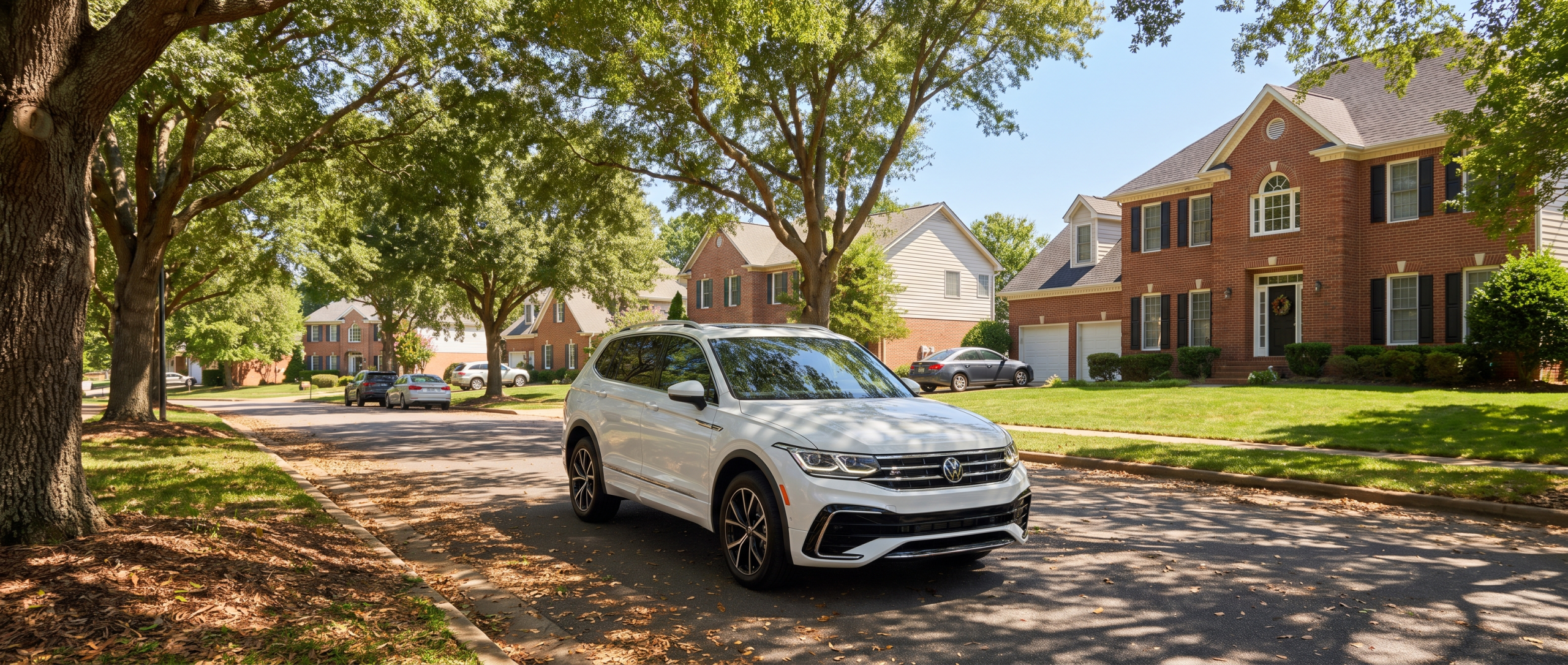
For most Blackstock Road drivers, the Tiguan takes the top spot. It’s well-rounded, it handles the Reidville Road stop-and-go without punishing you, and the redesigned 2026 version brought a real efficiency bump that pays off on that corridor. Your best pick still depends on whether you’re carpooling kids, chasing highway miles to Greenville, or after something with genuine driving feel. We ranked the whole 2026 lineup for life on this stretch of Spartanburg.
See our current Tiguan inventory and judge for yourself.
How We Ranked Them
The four models below earned their spots on three things that matter along the Blackstock Road corridor. We weighed daily commuter efficiency on the Reidville Road and I-26 run, cargo and passenger practicality for the residential family mix here, and the German driving feel that sets a Volkswagen apart from a generic crossover.
| Rank | Model | Best For | Standout Spec |
|---|---|---|---|
| 1 | Tiguan | Everyday commuters + couples | EPA-rated 32 mpg highway (FWD) |
| 2 | Atlas | Families needing a third row | Seats 7, up to 96.6 cu ft cargo |
| 3 | Jetta GLI | Driving enthusiasts, solo commuters | 228 hp, 30 mpg combined (manual) |
| 4 | Taos | Entry-level buyers, urban-sized garage | Up to 36 mpg highway (FWD) |
No. 1 — The 2026 Tiguan: Built for the Reidville Road Rhythm
The Tiguan earns the top spot because the 2026 redesign was aimed squarely at drivers who live the Blackstock and Reidville stop-light routine. It does cap out at five seats. The EPA rates the 2026 Tiguan FWD at 25 city and 32 highway, and the new mild-hybrid option (Volkswagen’s first 48-volt system offered in the US) uses a starter-generator to smooth out exactly the kind of stop-start traffic you hit between Blackstock Road and I-26. Its predecessor never cracked 30 mpg on the highway. The gain is real.
The tradeoff deserves a plain statement. The Tiguan seats five and stops there. If you’ve got three kids and a dog, scroll down to the Atlas section. But for the couple, the young professional, or the small family that doesn’t need a third row, the 201-horsepower 2.0-liter turbo and 8-speed automatic deliver a composed, confidence-inspiring drive a similarly priced mainstream crossover doesn’t match.
At Steve White Volkswagen, the Reidville Road corridor is where that suspension calibration shows itself. Take the Tiguan and the Taos over the same rough patch toward I-26, and the German ride quality separates the two inside the first mile.
Browse the Taos if you want a smaller footprint instead.
No. 2 — The 2026 Atlas: When Blackstock Road Means Three Rows
The Atlas takes second because it’s the only model here with a real third row, and that one fact carries the case. It’s also the hardest of the four to thread through Blackstock Road’s tighter streets. Volkswagen lists the 2026 Atlas with seating for seven and up to 96.6 cubic feet of total cargo capacity when both the second and third rows fold flat.
Behind the third row, you still have 20.6 cubic feet, enough for a full Costco run (yes, that Costco on West Blackstock Road is exactly what we’re talking about). The 2026 Atlas also moved to Volkswagen’s new “Evo4” 2.0-liter TSI engine rated at 269 horsepower and 273 lb-ft of torque, and it’s built in Chattanooga, Tennessee, if American-made production matters to your household.
The size is the honest downside here. The Atlas is big to thread through neighborhood streets, and Blackstock Road’s residential sections aren’t wide. If your driveway is tight or you park on the street, you’ll feel those dimensions. It’s not a dealbreaker. Just worth knowing going in.
For the Upstate SC family making regular runs toward Greenville or heading up SC Highway 11 into the Blue Ridge foothills now and then, the Atlas handles those bigger roads with authority. The I-85 corridor commute feels relaxed in this vehicle in a way a two-row crossover doesn’t quite replicate.
Check Atlas availability here.
No. 3 — The 2026 Jetta GLI: The Commuter That Doesn’t Feel Like a Commuter
The Jetta GLI lands third because it’s the last Volkswagen you can buy in the United States with a six-speed manual gearbox, and for the right driver that fact alone settles the decision. The sedan trunk does limit what you can haul. If that line lands for you, you already know your answer.
For everyone else, the 2026 Jetta GLI sends 228 horsepower and 258 lb-ft of torque to the front wheels through either that 6-speed manual or a 7-speed DSG dual-clutch automatic. The EPA rates it at 30 mpg combined with the manual and 29 mpg combined with the automatic, a legitimate efficiency number for a car that runs like this. The GLI also carries GTI-grade brakes and an electronic limited-slip differential (VAQ), so the Blackstock-to-Reidville stretch you drive twice a day actually gets a bit of personality instead of just existing.
Browse Jetta GLI inventory at Steve White Volkswagen.
The sedan format costs you cargo flexibility. You get 14.1 cubic feet of trunk space, sealed off from the cabin, so a mountain bike or a kayak won’t load the way it would in a hatchback or crossover. Think of it as a driver’s car with adult rear seating and a real trunk.
| Pros | Cons |
|---|---|
| 228 hp with GTI-sourced hardware | Trunk-only cargo (no fold-flat hatch) |
| Last manual Volkswagen available in the US | Front-wheel drive only |
| 30 mpg combined keeps fuel bills reasonable | Firm sport suspension on rough pavement |
| Adaptive suspension standard on Autobahn trim | Single trim level (no budget entry point) |
No. 4 — The 2026 Taos: The Practical Pick for a Smaller Footprint
The Taos fits a specific Blackstock Road driver, the one who wants German engineering, skips the third row, and values easy parking in tighter residential spots. It does give up some punch to earn that. The 2026 Taos runs a 1.5-liter turbocharged four-cylinder at 174 horsepower and 184 lb-ft of torque. FWD models hit up to 36 miles per gallon on the highway according to Volkswagen’s published figures, the highest highway number in this four-vehicle lineup.
The cargo story beats what the Taos’s compact size suggests. Volkswagen lists 27.9 cubic feet behind the rear seats on FWD models, expanding to 65.9 cubic feet with the second row folded. You get a nearly flat load floor for groceries, a weekend bag, and the odd piece of furniture. No drama.
Skip the Taos if quick highway merges matter to you. The 174-horsepower engine is capable but not spirited, and on Reidville Road with the air conditioning running hard in a South Carolina July, it does its job without complaint. You won’t feel the urgency the Tiguan’s 201-horsepower engine gives you merging onto I-26. That 27-horsepower gap shows in daily driving.
The Verdict: Tiguan for Most, Atlas for Families, GLI if You Drive to Feel It
The Tiguan is the right call for most Blackstock Road drivers who want one car for commuting and errands. The Atlas takes over the instant a third row stops being optional, and the Jetta GLI answers for the driver who wants the daily drive to feel like something. Move to the Atlas if three rows are a household necessity. The Jetta GLI earns the third slot for the driver who treats the commute as a reason to enjoy the process. The Taos sits fourth not because it’s a lesser vehicle, but because the Tiguan’s step up in power and interior presence tends to win a back-to-back drive.
We’re right here on Reidville Road, a very short drive from Blackstock Road. Come drive any of these and see which one fits your actual life, not just a ranking on a page.
Connect with us

