

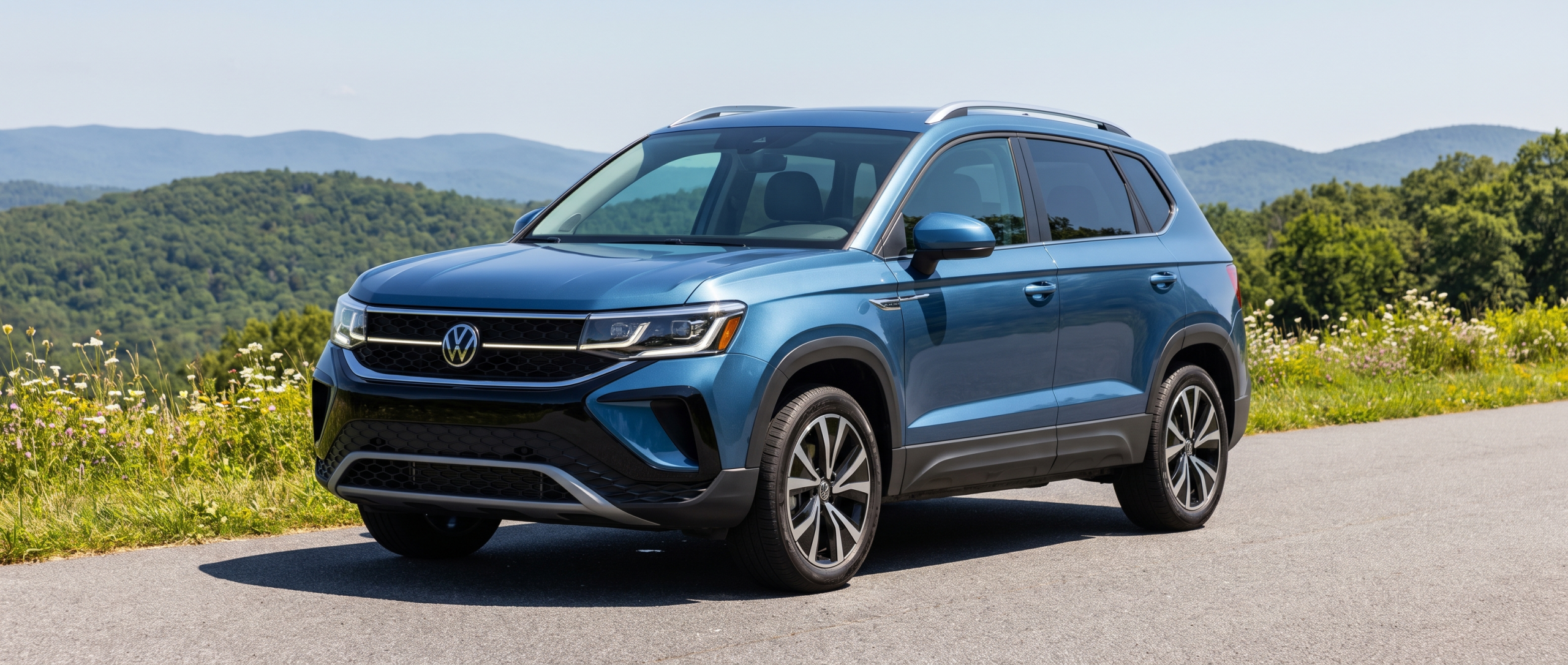
If you’re choosing between VW’s two most popular SUVs and fuel economy matters to you, the answer is clear: the 2026 Taos earns 3 more combined MPG than the base Tiguan in FWD form — and up to 6 more than a Tiguan equipped with 4MOTION AWD. In Spartanburg’s July heat, where the AC compressor is rarely off, that gap is felt at every fill-up on the I-85 corridor.
- The EPA rates the 2026 Taos at 28 city / 36 highway / 31 combined (FWD), versus 25-26 city / 32-34 highway / 28-29 combined for the 2026 Tiguan FWD.
- Add 4MOTION AWD to the Tiguan and combined MPG drops further to 25 — a full 6 mpg below the Taos FWD.
- Both run on regular 87-octane gasoline and share a turbocharged engine philosophy, but the Taos is lighter and smaller, which is where the efficiency edge comes from.
- If you frequently run I-85 between Spartanburg and Greenville, the Taos is the stronger fuel-economy pick. If you need third-row seating or tow capacity, the Tiguan earns its larger footprint.
- Either way, your biggest real-world MPG lever in an Upstate SC summer is how you manage the AC — not which trim level you chose.
the 2026 Taos is the more fuel-efficient of the two by every EPA measure, but that doesn’t make it the right pick for every driver. Here’s what the numbers actually mean on the roads you drive.
What’s the Real MPG Difference Between the Taos and the Tiguan?
Three combined MPG in the real world is not abstract — it adds up across a year of Upstate commuting. The EPA’s 2026 Fuel Economy Guide puts the numbers side by side cleanly, and a couple of things stand out beyond the headline figures.
| Spec | 2026 Taos FWD | 2026 Tiguan S FWD | 2026 Tiguan SE/SE R-Line FWD | 2026 Tiguan 4MOTION AWD |
|---|---|---|---|---|
| City MPG (EPA) | 28 | 26 | 25 | 22 |
| Highway MPG (EPA) | 36 | 34 | 32 | 30 |
| Combined MPG (EPA) | 31 | 29 | 28 | 25 |
| Engine | 1.5L turbo 4-cyl | 2.0L turbo 4-cyl | 2.0L turbo 4-cyl | 2.0L turbo 4-cyl |
| Fuel type | Regular 87 | Regular 87 | Regular 87 | Regular 87 |
| Cargo (behind 2nd row) | Competitive | 69.8 cu ft | 69.8 cu ft | 69.8 cu ft |
The Taos’s efficiency advantage comes from a smaller, lighter 1.5-liter turbocharged engine versus the Tiguan’s 2.0-liter unit. Both use an eight-speed automatic, and both run on regular gasoline — no premium surcharge on either. The Tiguan’s 2.0-liter produces more torque, which is why it can tow up to 1,500 pounds and seat up to seven passengers in higher trims. That capability costs something on the fuel gauge.
One number in the table deserves special attention: the 4MOTION AWD Tiguan at 22 city / 30 highway. If you’ve been eyeing AWD for foul-weather confidence on I-85 and selected a Tiguan, you’re looking at 25 combined — six below the Taos FWD. For most Upstate SC drivers, the terrain and weather rarely require AWD, which makes FWD Tiguan and Taos the more relevant comparison.
Does the Drivetrain Choice Matter More Than the Model on Your Commute?
For most Spartanburg drivers running the I-85 corridor between Greenville and the city, the drivetrain choice within the Tiguan line matters nearly as much as choosing between Tiguan and Taos. The spread between a Tiguan S FWD (29 combined) and a Tiguan 4MOTION AWD (25 combined) is four MPG — almost as large as the gap between the Taos FWD and the Tiguan S FWD.
If your driving is primarily highway miles between exits on I-85, both the Tiguan and the full VW new inventory reward you for staying in FWD. South Carolina’s roads — even the rolling Piedmont terrain south of the Blue Ridge foothills — rarely demand AWD for traction. Snow events are infrequent enough in Spartanburg that the extra drivetrain hardware spends most of the year adding weight without adding grip.
Where FWD genuinely shows up in the real world: the Taos’s smaller 1.5L turbo reaches efficient cruise RPM faster on flat-to-rolling ground, like the long, gradual grades on I-85 south toward Gaffney. The Tiguan’s 2.0L is tuned more for pull — it earns its lower MPG rating when you’re merging at highway speed or hauling passengers.
That said, if you regularly take SC Highway 11 along the Cherokee Foothills National Scenic Highway for weekend drives into the mountains, the Tiguan’s extra torque is more noticeable — and the fuel cost difference narrows a bit in that kind of spirited driving.
Real-World Summer Efficiency: What Spartanburg’s Heat Does to Both Models
July in Spartanburg is not the same as EPA test conditions, and the gap between the window sticker and your gauge cluster is wider than most drivers expect. The main culprit is the AC compressor — not potholes, not altitude.
That’s a significant number to carry around in Upstate SC in July. A 2026 Taos rated at 31 combined can realistically drop into the mid-to-upper 20s on a day of short errands — school drop-off, a stop at a store on Reidville Road, back home — if the AC is working hard to cool a sun-soaked cabin each time. The same dynamic affects the Tiguan.
A few habits that make a measurable difference on either model:
- Park in shade when possible. A cooler cabin on startup means the compressor works for seconds, not minutes, before backing off.
- Vent before blasting. Cracking the windows for 30-60 seconds when you first get in expels the hottest trapped air; the AC then cools a 90-degree cabin instead of a 130-degree one.
- Use the recirculation mode once the cabin is cool. Recirculating already-cooled air requires less compressor effort than conditioning fresh hot air from outside.
- Check tire pressure monthly. SC summer heat causes tire pressure to fluctuate; underinflated tires are among the most consistent fuel-economy reducers on any vehicle, and both the Taos and Tiguan are sensitive to it.
- Maintain your service schedule. A clean air filter and fresh engine oil at the correct viscosity both support the turbocharged engine’s efficiency on either VW.
The Taos’s lighter weight means the AC system is conditioning a smaller volume of cabin air, which gives it a slight real-world edge even beyond its rated MPG advantage — though the difference is subtle compared to the behavioral habits above.
So Which Volkswagen Should You Pick?
The honest answer depends on what you’re actually driving and carrying, not on which number looks better on paper.
Choose the Taos if:
- Your daily driving is the Spartanburg-Greenville I-85 run or urban errands, and you want the most fuel-efficient VW SUV without trading down to a sedan.
- You’re a solo driver or couple who doesn’t need third-row seating.
- Fuel economy is a primary buying criterion — the Taos’s 31 combined is the strongest number in the VW gasoline SUV lineup.
Choose the Tiguan if:
- You regularly carry more than five passengers or need the available third-row seating.
- You want more towing capacity (up to 1,500 pounds) for a small trailer or gear on SC Highway 11.
- Interior cargo volume — 69.8 cubic feet behind the front seats — is a priority over maximizing MPG.
- You prefer the 2.0L engine’s additional torque for highway merging confidence.
If pure fuel economy is the deciding factor, the Taos wins by a clear, documented margin. If capability and passenger space matter more, the Tiguan earns its rating. Most drivers choosing between these two are not on the extreme ends — they’re families or couples who want a practical VW SUV that doesn’t punish them at the pump, and for that reader, the Taos is typically the more satisfying choice in Spartanburg’s driving environment.
Frequently Asked Questions
Does AWD significantly hurt the Tiguan’s fuel economy?
Yes, noticeably. The EPA rates the 2026 Tiguan with 4MOTION all-wheel drive at 22 city / 30 highway / 25 combined, versus 26 city / 34 highway / 29 combined for the base S trim in FWD. That’s a 4 mpg drop in combined efficiency — roughly the same gap as the difference between the Taos FWD and the Tiguan S FWD.
How does summer heat affect my VW’s real-world MPG in Spartanburg?
Air conditioning is the primary culprit. The U.S. Department of Energy notes that under very hot conditions, AC use can reduce fuel economy by more than 25%, particularly on short trips. In practical terms: both the Taos and Tiguan will fall below their EPA combined ratings on a July day full of short in-town errands.
What are the best habits to maximize fuel economy in hot weather?
Parking in shade, venting the cabin before engaging the AC fully, using recirculation mode, keeping tire pressure at spec, and maintaining your service schedule are the most effective ways to recover lost miles per gallon on either VW.
The Jetta is also worth a look if you’re open to a sedan: the EPA rates it at 29 city / 40 highway / 34 combined for the 2026 model year in S trim — the most efficient non-EV in the VW lineup by a notable margin and a strong option for I-85 commuters who don’t need SUV cargo space.
Connect with us

