

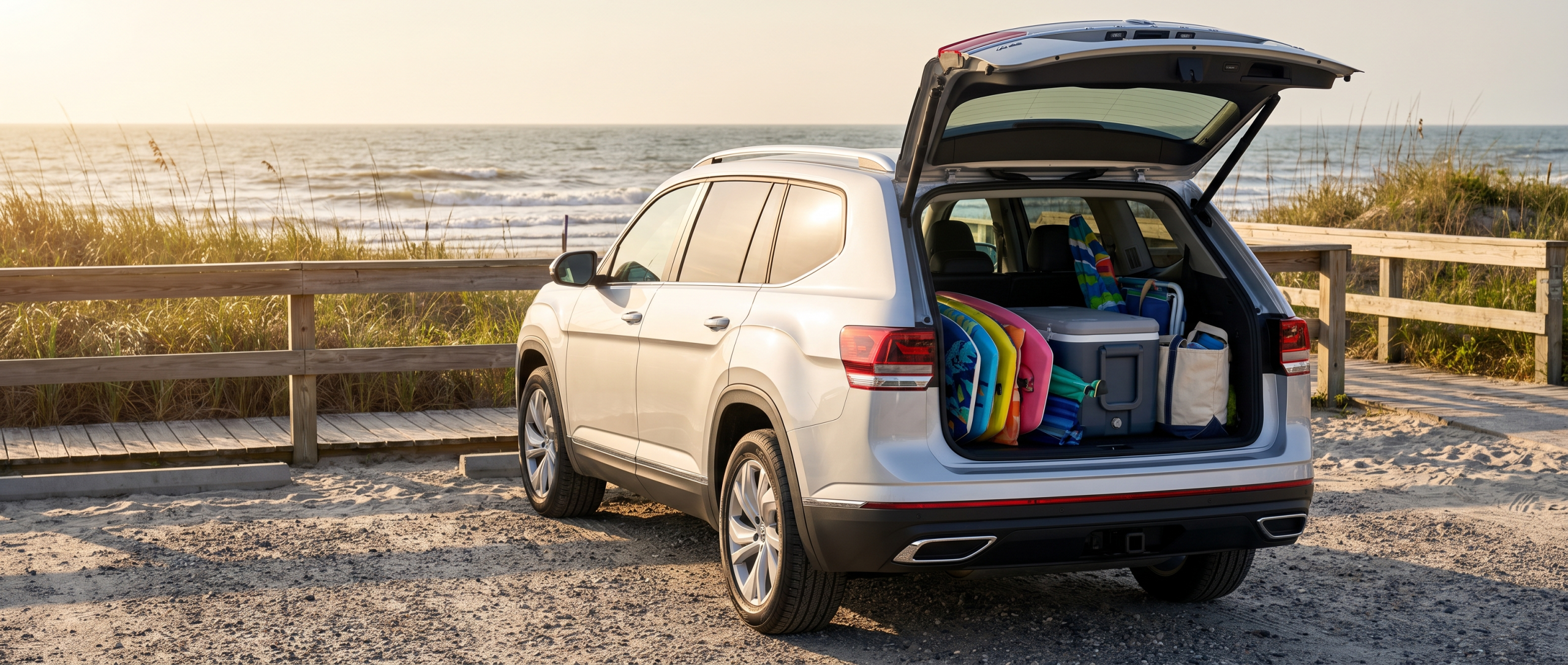
End-of-summer beach trips from Spartanburg aren’t short. Take I-26 east toward the coast and you’re looking at somewhere between three and four hours each way, with a full car, real gear, and kids who will definitely ask about snacks before you clear Newberry County. The question that matters isn’t which Volkswagen looks nice in a beach photo. It comes down to which one handles the specific math of your family, how many seats you actually need, how much cargo you’re actually packing, and whether the fuel economy holds up over a long highway stretch.
For families of five or more who bring the full kit (boogie boards, folding chairs, a full cooler, a stroller), the 2026 Volkswagen Atlas earns it with three configurable rows and a cargo system that scales in stages. For families of four with lighter kit or a preference for a more agile highway drive, the 2026 Tiguan’s flat-load floor and noticeably better gas mileage make it the smarter fit.
How Does the Cargo Logic Actually Work on Each Model?
On both models the cargo logic runs on ‘staged loading,’ which is how each vehicle balances the tension between keeping passengers seated and fitting the gear that makes a beach trip work, and that balance matters far more than horsepower or wheel size once the car is full.
The 2026 Atlas operates on a three-stage system. Volkswagen lists 20.6 cubic feet of trunk space with all seven seats upright. Fold that third row flat in its 50/50 split and you jump to 55.5 cubic feet, with five people still seated comfortably. Drop the second row too and you hit 96.6 cubic feet of maximum cargo volume. That progression matters on a real beach trip. You can seat seven on the way down and still stow a reasonable amount of gear, or you can drop the third row once grandparents join in a separate car and you’re suddenly in true station-wagon space for folding chairs, umbrellas, and a full-size cooler.
The 2026 Tiguan works differently. Volkswagen redesigned the 2026 model to be a dedicated five-passenger SUV. There’s no third-row option. What you get instead is 33.8 cubic feet of cargo space with the seats up and 69.8 cubic feet with both rear seats folded flat, creating what Volkswagen describes as a nearly flat load floor. If your family is four people and the gear list is manageable, that flat floor is genuinely practical. Boogie boards go in without wrestling a seat mechanism. Shorter than the Atlas at 184.4 inches versus 200.7 inches, the Tiguan is also easier to park at beach access lots that aren’t built for three-row behemoths.
| Feature | 2026 Atlas | 2026 Tiguan |
|---|---|---|
| Seating capacity | Up to 7 (or 6 with captain’s chairs) | 5 |
| Cargo behind rear seats | 20.6 cu ft | 33.8 cu ft |
| Cargo with rear seats folded | 55.5 cu ft (3rd row down) or 96.6 cu ft (all down) | 69.8 cu ft |
| Load floor when fully folded | Flat (50/50 third-row split) | Nearly flat |
| EPA highway mpg (FWD) | 27 mpg | 32-34 mpg (trim-dependent) |
| EPA highway mpg (4Motion AWD) | 25-26 mpg (trim-dependent) | 29-30 mpg |
| Towing capacity (when equipped) | Up to 5,000 lbs | Not rated for towing |
| IIHS safety status | 2026 TOP SAFETY PICK | 2026 in production |
| Overall vehicle length | 200.7 in | 184.4 in |
Which One Do You Actually Need for an Upstate SC Beach Run?
For an Upstate beach run, both vehicles get you there in good shape, but the choice really turns on one real-world condition the family SUV roundups tend to skip, which is that the I-26 corridor is almost all highway miles, and a loaded SUV on a long highway stretch will expose the MPG difference in a tangible way.
Check the highway numbers first, since the I-26 run is exactly where they show up. The EPA rates the 2026 Tiguan S at 34 mpg highway (FWD). The 2026 Atlas FWD comes in at 27 mpg highway. The gap is seven miles per gallon. On a 350-mile round trip with five people and gear on board, you’ll feel that gap at the pump. If you’re running 4Motion AWD on the Atlas (standard on upper trims), the highway number drops to 25-26 mpg. The tradeoff is a fair one. The Atlas uses more fuel to haul more people and more gear. If you genuinely need those seven seats, the trade holds up. If you don’t, you’re paying a running cost for capacity you’re leaving empty.
The SC coast in late August can still hand you a rain event. That I-26 stretch through the Midlands isn’t forgiving when the lanes are wet and everyone’s in a hurry to get home.
That said, the Atlas brings something families who’ve done the drive appreciate, Volkswagen’s 4Motion all-wheel drive, available on all trims and standard on upper ones. On the 2026 Tiguan, 4Motion AWD is available but comes with a real fuel economy hit (22/30 mpg city/highway versus 25/32 FWD), so the efficiency advantage of the Tiguan narrows if you opt for AWD.
Our team’s honest take runs like this. Families of four traveling with the standard beach kit fit the Tiguan perfectly and will appreciate how the nearly-flat load floor handles irregular gear. Families of five or six who want everyone in one vehicle, especially with a paddleboard or two in the mix, need the Atlas. The third-row legroom in the Atlas is 33.7 inches, which isn’t luxury space, but it’s real room for kids who aren’t over six feet tall.
See Current Offers on Atlas and Tiguan
One note on the Beach Drive Concept specifically. Neither vehicle is the wrong answer here. Browse our current inventory to see which trims and drivetrains we have available right now, because the Atlas’s sweet spot for this kind of trip is the SE with Technology or higher (you get the towing-capable hitch, the larger fuel tank, and the upgraded driver assistance suite), and those trims are worth comparing against the Tiguan’s SEL configuration.
Quick Terms Worth Knowing
| Term | What it means for you |
|---|---|
| 4Motion AWD | Volkswagen’s all-wheel drive system; distributes power between axles automatically; adds grip in wet or low-traction conditions |
| Staged cargo | The ability to use different load configurations (third row up, third row folded, both rows folded) to balance passengers and gear |
| EPA highway mpg | The federal fuel economy estimate for sustained highway driving; most relevant for a long I-26 run |
| Load floor | The surface you set gear on when rear seats are folded; a flat load floor means less gear sliding and easier packing |
What This Means When You’re Ready to Choose
When you’re ready to choose, the split between the Atlas and the Tiguan comes down to loading architecture rather than prestige or trim level, because one vehicle is built around the idea that you’ll sometimes need every seat and sometimes need all the cargo space, while the other is built around five people and their gear as the right target. One solves it through a three-stage folding system. The other optimizes every cubic foot for usable flatness and gives back efficiency in return.
Both models carry Volkswagen’s IQ.DRIVE driver assistance suite standard, which means Travel Assist, Lane Assist, Front Assist, and Emergency Assist are baked into every trip down I-26. The 2026 Atlas earned the IIHS 2026 TOP SAFETY PICK designation. That counts on a highway where late-summer traffic can be unpredictable.
If you’re on the fence, the right move is a side-by-side walkthrough with your actual gear. We mean that literally. Bring the cooler, the chairs, and the bags to the lot on Reidville Road and we’ll load both vehicles with your real gear so you can see which one closes cleanly without forcing anything, coolers and all. Loading it yourself is the test worth trusting.
Frequently Asked Questions
Does the 2026 Volkswagen Atlas third row actually fit adults on a long trip?
The 2026 Atlas third row offers 33.7 inches of legroom. That’s real, usable space for older kids and shorter adults on a three-to-four-hour drive. Taller adults will find it tighter than the front two rows, but for a family hauling kids to the coast it functions exactly as intended. The 50/50 split also lets you seat two passengers in the third row while still carrying a board bag or a folding wagon in the remaining cargo space.
Is the Volkswagen Tiguan big enough for a family beach trip, or do you really need the Atlas?
For a family of four with standard beach gear (a cooler, a few bags, chairs, and boogie boards), the 2026 Tiguan’s 33.8 cubic feet of cargo space with seats up handles it without folding anything. Fold the rear seats and you get 69.8 cubic feet, which is more usable space than you’d think. The Tiguan is genuinely the better choice for four-person families, and its highway fuel economy makes the I-26 run more efficient. The Atlas earns its size only when you actually need the third row or when you’re towing something.

