

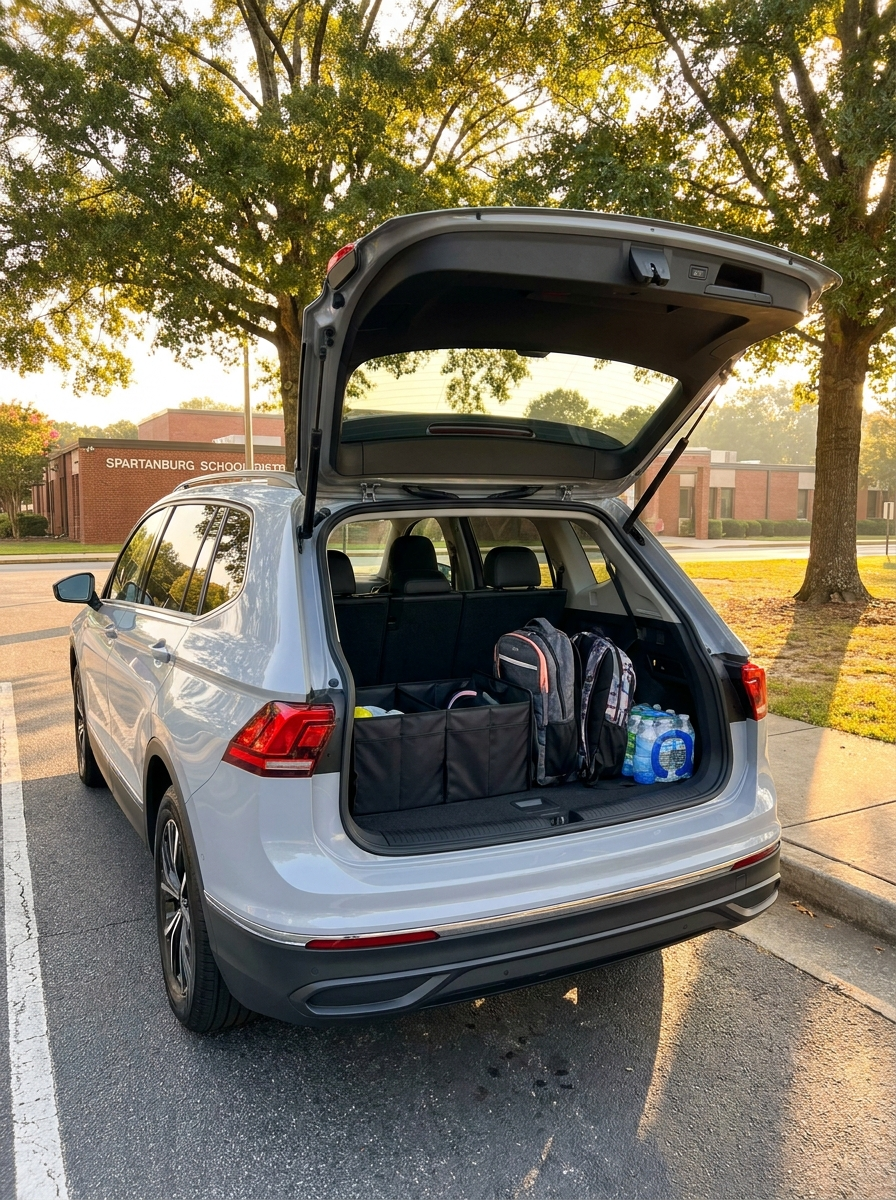
The 2026 Volkswagen Tiguan ships with four 45-watt USB-C ports, 33.8 cubic feet of cargo space behind the rear seats, and 40.2 inches of rear legroom on both rows. Volkswagen lists those figures on its official Tiguan page. Whether the cabin can handle a Spartanburg school year isn’t really in doubt. It can. What’s worth asking is whether you’ve built a system to use what’s already sitting there.
Browse the 2026 Volkswagen Tiguan at Steve White Volkswagen Spartanburg and come in to walk the interior before the school year gets into full swing.
What Do Those Specs Actually Mean for a School-Run Driver?
For a school-run driver, these numbers matter more than they look on paper, but only when you know where they turn up in daily life. The cargo figure sets your backpack layout, the legroom figure sets your seat-back gear, and the port count decides who charges what on the ride to practice.
| Tiguan Feature | Verified Spec | What It Means for School Runs |
|---|---|---|
| Cargo space (seats up) | 33.8 cu ft | Fits 3 full-size backpacks upright with room for a grocery run after pickup |
| Cargo space (rear seats folded) | 69.8 cu ft | Instrument cases, science fair boards, sports equipment fit on a flat floor that loads cleanly |
| Rear legroom | 40.2 in (both rows) | Enough room for a seat-back organizer without kneecapping whoever’s behind the driver |
| USB-C ports | 4 standard (45W fast charge, front and rear) | Two rear charge-only ports are actually in the cabin for passengers with no cable wars |
| Rear-seat configuration | 60/40 split fold | Lets you carry one kid’s cello and two other kids at the same time |
| Infotainment | 12.9-in screen, wireless App-Connect | Navigation syncs to your phone wirelessly with no fumbling at carpool |
| IQ.DRIVE safety suite | Standard (adaptive cruise, lane assist, blind spot monitor) | Matters on that long I-85 stretch to after-school activities |
| EPA fuel economy (FWD) | 26 city / 34 highway / 29 combined | One fewer stop at the pump during a week already packed with pickups |
*Cargo and legroom figures per Volkswagen. EPA fuel economy ratings per fueleconomy.gov for the 2026 Tiguan S FWD.*
One detail from the spec table is easy to miss. The rear charge ports are charge-only, so they draw a little less power than the full-speed front ports. For tablets and phones that just need a top-off between school and practice, that works fine. For a laptop that came home with five percent battery, plug it into one of the front USB-C ports instead.
Building Zones: The Only Organization Framework That Survives Week Two
A zone-based framework is the one that survives past week two of school, and the reason most systems collapse is almost always the same one. There’s no zone logic. Everything goes everywhere, and within ten days the seat-back pocket turns into a trash bag and the trunk becomes a sports graveyard.
The Tiguan’s geometry makes a three-zone system work in ways a shorter, narrower cabin can’t.
Families who need three rows may want to look at the 2026 Volkswagen Atlas, but the Tiguan’s two-row layout gives you a cleaner zone separation if you have one to three kids.
Zone 1: The Cargo Deck (33.8 cu ft)
A collapsible trunk organizer with rigid dividers anchors this zone. Two or three compartments hold one backpack each, upright, so they don’t tip and spill. The third compartment runs for overflow, whether that’s a gym bag, lacrosse gear, or whatever Monday brings. One detail we’ve noticed on the lot (the Tiguan’s cargo floor sits low and the liftgate opening is wide, so backpacks slide in rather than being lifted over a high sill). Handy at the end of a long Tuesday, that.
Zone 2: The Rear Seat (40.2 in of legroom per row)
The Tiguan’s legroom number earns its keep back here. A seat-back organizer (the over-the-headrest style with a tablet sleeve and cup holders) fits on both front seatbacks without pressing into a rear passenger’s knees, because there’s room to spare. Route one rear USB-C cable through the organizer’s port sleeve so the tablet pocket becomes a charging sleeve. Done. No cable draped across somebody’s lunch box.
Zone 3: The Front Cabin
Keep the front for the driver. The 15-watt wireless charging pad handles the driver’s phone (no cable, no fumbling) while the 12.9-inch screen runs the route wirelessly through the connected phone. The front USB-C ports are for adult devices that need serious power fast.
See Current Volkswagen Specials
The One Real Tradeoff to Know Before You Build Your System
The one tradeoff worth knowing is that the Tiguan is a compact SUV, and that’s both its strength and its ceiling. It fits in the school carpool lane, it parks at USC Upstate without a ten-minute search, and it reaches the EPA’s estimated 29 combined mpg on a FWD trim when you’re not running full cargo weight. But 33.8 cubic feet with the seats up isn’t enormous. It’s competitive for the class. It isn’t an Atlas.
If you have three kids in three different sports with equipment that doesn’t fold (hockey bags, a bass guitar, a set of lacrosse sticks) and you need all of that behind the rear seat simultaneously, the Tiguan is going to make you choose. The 60/40 fold solves a lot of it, but you’ll be dropping one seat-back and losing a passenger slot.
The Tiguan fits perfectly for one to three kids, backpacks plus one equipment bag, a grocery run on the way home, and a driver who doesn’t want to spend extra gas money on a three-row SUV they only fill on soccer weekends. The I-85 corridor from Spartanburg toward Greenville is forty miles of highway at speed, and the Tiguan’s EPA highway rating of 34 mpg (FWD) does real work there.
Browse pre-owned Volkswagen inventory if a lightly used Tiguan fits your budget better than a new one.
Who the 2026 Tiguan Is Actually Built For in Upstate SC
The 2026 Tiguan is built for the Spartanburg school-year driver who runs one to two kids between multiple stops, commutes any stretch of I-85 or I-26, and wants a cabin that feels thought-through rather than cavernous and overwhelming. Compact, efficient, and German-engineered in ways that show in the details. The zone-based system described above isn’t a workaround. It’s what the interior was designed to support.
The one group we’d steer a different direction is the family of five with three kids in separate after-school programs, all needing pickup in a tight window, carrying equipment for each. That household probably needs an Atlas with its 96.6 cubic feet of maximum cargo space and three-row seating for seven. No shame in that. Both live on our lot on Reidville Road, and we’ll tell you honestly which one fits the week you’re actually living.
If the Tiguan is your car, put the system in now. Do it before the school year turns your cargo deck into a lost-and-found.
Frequently Asked Questions
Is the 2026 Volkswagen Tiguan large enough for a family with multiple kids?
The 2026 Volkswagen Tiguan offers 33.8 cubic feet of cargo space with the rear seats up and 69.8 cubic feet with them folded, along with 40.2 inches of rear legroom. For one to three children with standard school gear, that’s genuinely comfortable. Families carrying large equipment for multiple kids simultaneously may find the 60/40 split rear seat helps but occasionally creates a tradeoff between passenger seating and cargo. Families needing three rows consistently should consider the 2026 Volkswagen Atlas instead.
Does the 2026 Volkswagen Tiguan charge devices in the back seat?
Yes. Volkswagen includes four USB-C ports standard across all 2026 Tiguan trim levels, each rated at 45 watts of fast charging. Two of those ports are in the rear cabin for passenger use (charge-only function). A 15-watt wireless charging pad is also standard in the front for compatible smartphones. There are no USB-A ports (all four are USB-C, so bring the right cables or adapters for older devices).
Connect with us

