

July in Spartanburg is no joke. Average highs sit at 91 degrees F, and under the hood of a parked car, temperatures routinely climb past 140 degrees F — the threshold where battery electrolyte begins to evaporate, corroding internal lead plates and quietly shaving months off your VW’s battery life. AAA reports fielding nearly 2 million battery-related service calls every summer, and the southern United States is the hardest zone: batteries in the South and Southwest average just 2.5 to 3 years, versus 5 years up north. That gap is real, and it is exactly why protecting your Volkswagen Tiguan — or any VW in your driveway — takes more than hoping for a cool morning.
Here’s the plan: a four-stop Spartanburg day that moves you through the practical battery-care steps a VW driver should actually take in July, tied to real places around Upstate SC. Each stop is a checkpoint. Together they add up to a battery that makes it through summer and into the fall commute without drama.
What’s the Route?
| Stop | When | Where | What to Do | What to Bring |
|---|---|---|---|---|
| 1: The Pre-Drive Check | 7:30 AM | Your driveway | Inspect terminals, confirm battery age | Flashlight, clean rag |
| 2: The Shade Park | 9:00 AM | Croft State Park | Morning trail, car in full tree cover | Sunscreen, water bottle |
| 3: The Service Stop | 11:30 AM | Steve White Volkswagen Spartanburg | Battery load test, terminal cleaning | Your VIN and service history |
| 4: The Cool-Down Loop | 3:00 PM | I-85 / I-26 corridor | 25-plus minute highway run to recharge | Nothing extra — just drive |
The Four Stops in Detail
Stop 1 — The Pre-Drive Check (7:30 AM, Your Driveway)
Most VW battery failures in summer show warning signs before they strand you. The trick is catching them before the first hot errand of the day. Pop the hood while the air is still cool — Spartanburg’s July mornings hover around 70 degrees F, which gives you a window before under-hood temps build.
Look for two things. First, check for white or blue-green buildup around the battery terminals. Heat accelerates corrosion, and corroded terminals restrict the electrical current your VW’s battery management system depends on to charge correctly. Heavy buildup means a service visit is overdue. Second, note the battery’s age. Battery specialists consistently recommend a professional load test after the second year; a battery past three years in a hot-climate market like Spartanburg is living on borrowed time.
One VW-specific detail most generic guides miss: Volkswagen models — including the Atlas, Jetta, and Tiguan — use either AGM (Absorbent Glass Mat) or EFB (Enhanced Flooded Battery) technology rather than a conventional lead-acid unit. AGM batteries power VW’s start-stop system and handle the repeated charge and discharge cycles that stop-and-go driving creates. If yours ever needs replacement, the new battery must be registered to the car’s battery management module by a technician with VW-compatible diagnostic equipment. Installing a standard lead-acid battery in an AGM-spec car causes the smart alternator to charge at the wrong rate, and the replacement fails early. This is a dealer-level step, not a parking-lot swap.
Stop 2 — The Shade Park (9:00 AM, Croft State Park)
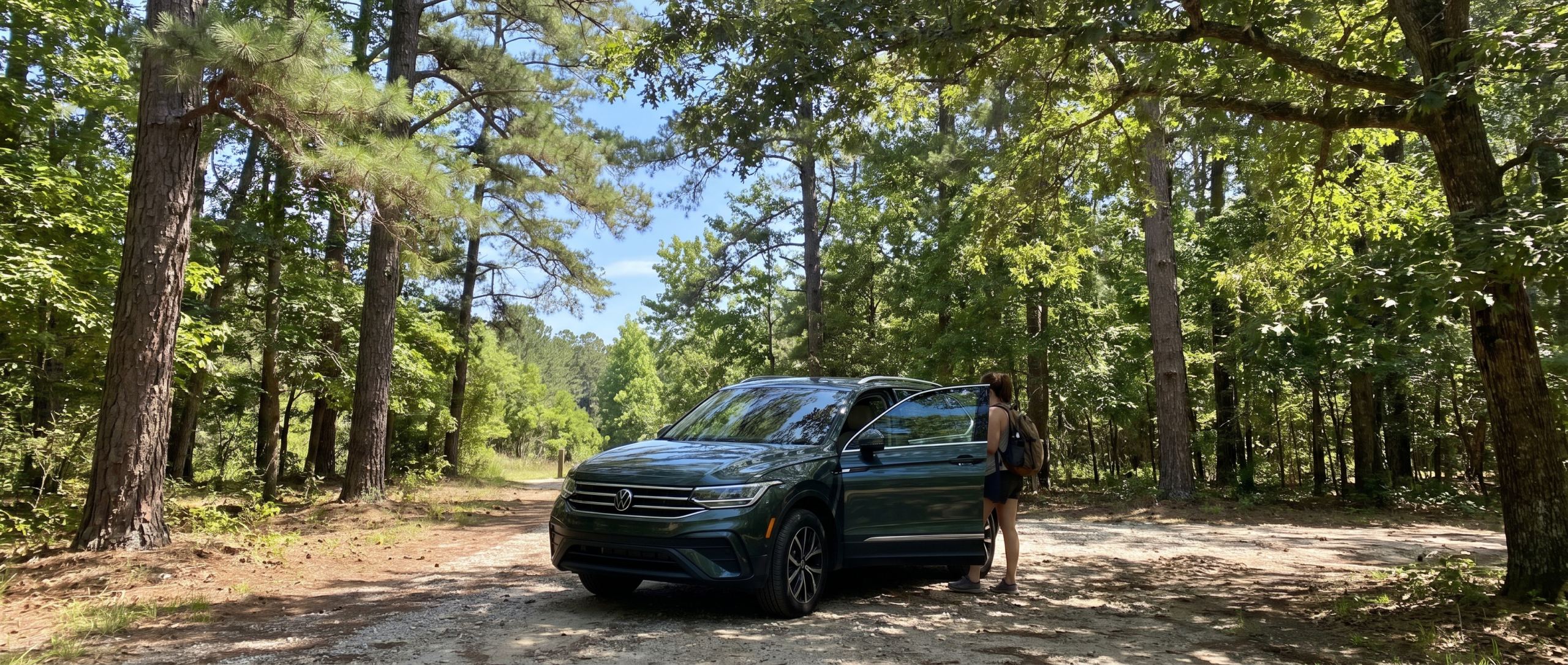
Jetta drivers, Tiguan owners, and anyone else in the VW family will appreciate this one: parking in genuine tree canopy shade can lower under-hood temperatures by more than 20 degrees F compared to an asphalt lot in full sun. That is not a small margin when 140 degrees F is the electrolyte evaporation threshold.
Croft State Park, just south of downtown Spartanburg at 450 Croft State Park Road, covers more than 7,000 acres of wooded piedmont terrain — a former WWII Army training site that now offers over 17 miles of hiking and biking trails, fishing and boating on 165-acre Lake Craig, and dense tree canopy that qualifies as genuine shade. The park is open daily during Daylight Savings Time until 9 PM, so a 9 AM arrival gives you the coolest trail conditions and the best shaded parking spots before the midday crowd.
While you walk the Palmetto Trail passage along Fairforest Creek, your VW sits under tree cover rather than in a reflective parking deck. That two-hour window at lower temperature measurably reduces the chemical stress on the battery. If you have been running the AC hard on the drive in, give the car a brief cool-down at idle before shutting off — it lets the alternator partially recover charge before the battery sits unattended.
Stop 3 — The Service Stop (11:30 AM, Steve White Volkswagen Spartanburg)
Heat damage is cumulative and invisible until it is not. A battery that started summer at 85 percent capacity and has cycled through six weeks of 90-plus-degree days may now sit at 60 percent — enough to start the car fine, but not enough to recover from a long AC-on idle in a hot parking lot. A professional load test measures the battery’s actual state of health under real amperage demand, which is fundamentally different from the voltage reading your dashboard shows.
At Steve White Volkswagen on Reidville Road, the service team uses VW-compatible diagnostic tools — the same systems required to register a new battery to the car’s management module if replacement is needed. That coding step matters specifically for VW drivers because the smart alternator adjusts its output based on the battery type registered in the system. Aftermarket shops without VW scan-tool access frequently skip this step, which is why some owners report a brand-new battery failing within months of an outside-shop swap.
Signs your battery may not survive the summer: the engine cranks slower than usual in the morning, the start-stop system stops engaging on its own, a battery or electrical warning light flickers, or interior lights dim briefly when the AC compressor kicks on. Any one of those is worth a load test before a hot afternoon strands you.
Stop 4 — The Cool-Down Loop (3:00 PM, I-85 / I-26 Corridor)
The afternoon stop is the one most drivers skip — and it is the one that actually recharges the battery after a stop-and-go morning. Short trips under 20 minutes at low speeds use more charge than the alternator can replenish, especially with the AC running at maximum. The fix is deliberate and simple: take a 25-to-30-minute highway run before parking for the rest of the day.
The I-85 / I-26 interchange corridor south of Spartanburg is a practical loop for exactly this purpose — consistent highway speeds, minimal traffic lights, enough miles to let the alternator fully cycle the battery back toward capacity. VW’s battery management system is most efficient at sustained highway speeds above 50 mph, so the interstate is the right venue for a recharge run. Think of it as planned maintenance, not wasted miles.
If you have been sitting at Croft State Park or the dealership for two or more hours with the engine off and the cabin hot, the first stretch should be at highway speed with the AC running — the alternator handles both the cooling load and the battery recovery simultaneously.
Drivers who take only short in-town runs — the school pickup, the Reidville Road grocery stop, the downtown Spartanburg coffee run — are the ones who face a dead battery on a humid August morning that otherwise looked perfectly ordinary. A weekly loop like this one is maintenance.
Tweak It to Your Crew
The four-stop framework adapts to any VW driver and any summer schedule.
Atlas Cross Sport owners carrying a full family load (rear AC zone, rear entertainment screens, multiple USB devices) have a meaningfully higher electrical draw and may benefit from stretching Stop 4 to 35 or 40 minutes on the highway. The principle scales with accessories: more load running, longer recharge time needed.
Golf GTI and Jetta GLI drivers who lean on sport mode and a loud audio system are in the same boat. If you are regularly running high accessory loads on short in-town hops, the weekly highway loop is non-negotiable.
ID. Buzz and other VW EV drivers shift the battery-protection logic slightly: avoid leaving the high-voltage pack at 100 percent charge in a hot parking lot, and limit fast-charging sessions during peak summer heat, as rapid charge cycles in high ambient temperatures accelerate high-voltage battery degradation faster than heat alone.
For any VW with start-stop technology — Tiguan, Atlas, Taos, Jetta GLI — the AGM battery is the single most heat-sensitive component in the car, and Spartanburg’s July is its annual stress test. The morning check, the shaded park stop, the professional load test, and the recharge loop cost you nothing more than a deliberate Saturday. What they buy is a battery that carries you cleanly through summer and into October without a surprise click.
By the Steve White Volkswagen Team | July 2026
Connect with us

