

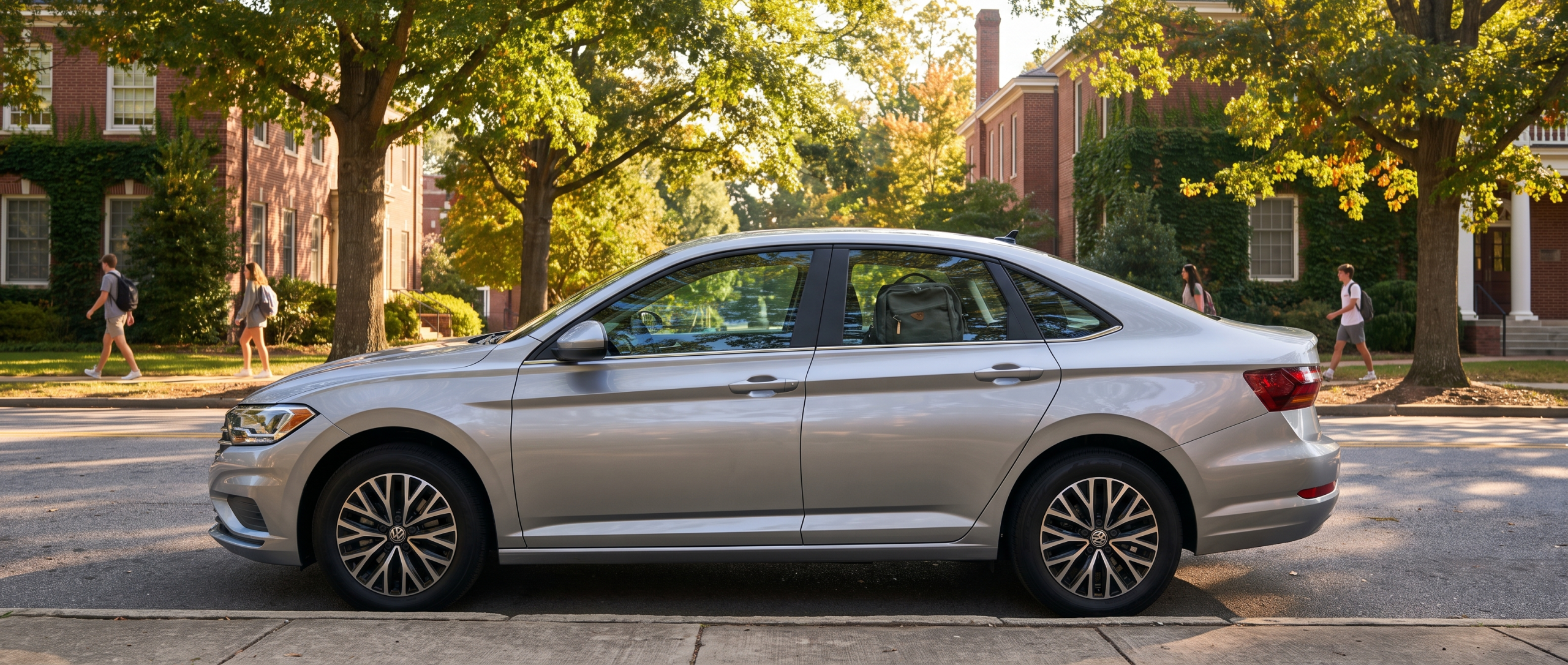
Every August, Spartanburg’s roads shift. Teachers heading to district high schools, students circling for parking near Wofford College, and staff running the I-85 corridor from Greenville to USC Upstate all share the same pavement with different demands. No single model wins every category, and we won’t pretend one does. What you need is a clear look at which 2026 Volkswagen fits the commute you actually run, not a generic ranking someone wrote without knowing Upstate South Carolina.
You’ll get four models here, five decision criteria, verified specs, and one straight tradeoff per pick.
- Fuel-economy priority (long corridor run): The 2026 Jetta hits an EPA-estimated 40 mpg highway on regular gas. Hard to beat for the I-85 stretch.
- Compact footprint + cargo: The 2026 Taos gives you 27.9 cubic feet of cargo behind the rear seats in a body that’s only 175.8 inches long. It fits tight school and campus lots.
- Full safety-tech suite + more room: The 2026 Tiguan carries the complete IQ.Drive package standard, including active blind-spot monitoring and adaptive cruise. Best for drivers who want every assist on the longer runs.
- Driving engagement that survives the commute: The 2026 Golf GTI delivers 241 horsepower and returns 27 mpg combined. It’s the one that makes you look forward to a Monday morning.
- Honest tradeoff: More engagement or cargo usually costs you fuel economy. We lay out exactly where each trade lands.
The 2026 Jetta is worth a look before you read anything else if you’re prioritizing fuel economy on a daily drive across Upstate SC.
What Actually Matters When Choosing a Commuter Volkswagen?
Five variables separate a good commuter pick from a generic one. Fuel economy matters, but so does the parking geometry at your destination, the tech that takes the edge off a route you’ll drive again and again, how much you carry each day, and whether the drive is something you tolerate or something you enjoy. Get all five on the table before you commit to a model.
| Criterion | 2026 Jetta | 2026 Taos | 2026 Tiguan | 2026 Golf GTI |
|---|---|---|---|---|
| EPA fuel economy (combined) | 34 mpg (S trim) | 31 mpg (FWD) | 29 mpg (FWD S) | 27 mpg |
| Best for | Long-distance highway commuter | Tight parking, daily cargo | Safety-tech priority, more cabin room | Driver who wants engagement |
| Key spec | 40 mpg highway, 1.5L turbo | 27.9 cu ft cargo, 175.8 in length | IQ.Drive standard, 33.8 cu ft cargo | 241 hp, VAQ limited-slip diff |
| Main tradeoff | Smallest cargo, sedan only | Less power (174 hp) than Tiguan | Lowest mpg of the four | Lowest city mpg (24), no AWD |
All mpg figures are EPA estimates. Actual results vary by driving habits, load, and route conditions.
Fuel Economy: Where the Jetta Earns Its Reputation
Teachers and staff running a daily corridor from Greenville or points along I-85 know how fast fuel costs compound when you’re driving 180-plus days a year, and the 2026 Jetta S answers that with an EPA rating of 29 city, 40 highway, and 34 combined on regular 87-octane gasoline. That highway number is real and meaningful on a route like I-85 between Greenville and Spartanburg.
The catch is straightforward. The Jetta is a sedan with a 12.8-gallon tank and a relatively modest trunk. If you carry instruments, art supplies, coaching equipment, or anything bulky, you’ll feel the limit. For a solo commuter that’s no deal-breaker. If cargo is part of your daily pattern, it is.
Step up to the Jetta GLI and you’re in a different animal. It runs a 2.0L turbo with 228 horsepower and 258 lb-ft of torque, and the EPA rates it at 26 city / 36 highway / 29 combined. You get more reward on the same corridor and slightly less efficiency. Worth knowing if you’d rather commute with spirited acceleration than chase peak fuel savings.
The 2026 Taos and Tiguan both give you more room. The fuel-economy cost is real, though. We’ll show you where it lands.
Parking Footprint and Cargo: The Taos Case
Parking near Wofford College’s downtown campus is a real conversation, and a smaller footprint earns its keep on the mornings you roll in after 8 with the lots already filling. The 2026 Taos is 175.8 inches long and 72.5 inches wide. The Tiguan is 184.4 inches long and 73 inches wide. On paper that gap looks small, but in a narrow parking structure or a street spot with a bad angle, it’ll matter.
The Taos is also the cargo leader in the lineup for its size. Volkswagen specs it at 27.9 cubic feet behind the rear seats and 65.9 cubic feet with the seats folded. Teachers hauling bins of materials, students moving gear, or staff who carry more than a laptop bag will notice that number. You get more cargo than the Jetta in a body that’s easier to park.
What costs you here is power. The Taos runs a 1.5L TSI four-cylinder making 174 horsepower, and that’s plenty for Spartanburg-area commuting, including the on-ramps along I-85. Decisive highway passing feels less effortless than in the Tiguan or GTI (both bring more punch when you want it). If your drive stacks up highway miles at speed, the Taos still handles it. Just not quick.
The Tiguan’s Safety Suite: IQ.Drive on Every Trim
The 2026 Tiguan ships IQ.Drive standard across the entire lineup, so every driver, whatever trim they pick, gets active blind-spot monitoring, adaptive cruise control with Travel Assist, rear cross-traffic alert, lane assist, front and rear park distance control, and automatic emergency braking. On a repetitive commute route, those features quietly become part of your routine, and you’ll stop thinking of them as a luxury.
The 2026 Tiguan also carries more cargo than the Taos when the seats are folded, 69.8 cubic feet versus 65.9. Behind the rear seats you’re looking at 33.8 cubic feet. The cabin feels genuinely roomier for a Volkswagen compact SUV.
What you give up is fuel economy. The FWD S trim is EPA-rated at 26 city / 34 highway / 29 combined. Add AWD and that drops to 22 city / 30 highway / 25 combined. If your commute is mostly highway miles and fuel economy weighs on the decision, the Tiguan costs you roughly four to five combined mpg against the Jetta, and across a 180-day school year that isn’t a trivial gap. This one earns its place for drivers who want the most safety technology in the largest interior, running shorter or more urban segments where the mpg delta matters less. Call it the safety pick.
Match the Model to How You Actually Drive
The 2026 Golf GTI exists for the driver who wants to enjoy the drive, and if your daily route genuinely doesn’t excite you, that dull stretch carries a real quality-of-life cost across a school year. So we’ll say the part plenty of guides skip. The car you look forward to is worth something.
Its 2.0L turbocharged four-cylinder produces 241 horsepower and 273 lb-ft of torque, paired with a 7-speed DSG dual-clutch automatic. The EPA rates it at 24 city / 32 highway / 27 combined. Volkswagen includes IQ.Drive and adaptive cruise standard. The hatchback shape gives you cargo flexibility a sedan can’t match. Seats five.
The tradeoff is real. At 24 mpg city, it’s the least efficient choice in the stop-and-go around Spartanburg High School or the USC Upstate campus at peak hours. It also skips an AWD option. For a driver whose commute is mostly dry pavement on predictable routes, those tradeoffs stay manageable. For someone chasing maximum efficiency or occasional AWD grip, the GTI isn’t the right tool.
The 2026 Golf GTI is the one we’d point to for a faculty member, administrator, or student who spends most of the drive on open road, values engagement over efficiency, and wants a hatchback that’s genuinely practical without feeling like a compromise.
Frequently Asked Questions
Is the Jetta or the Taos better for a Spartanburg school commute?
It depends on your route and what you carry. The 2026 Jetta gets an EPA-estimated 34 mpg combined and it’s the more efficient choice for a longer highway commute along I-85. The 2026 Taos gives you 27.9 cubic feet of cargo space behind the rear seats in a shorter body, 175.8 inches to the Tiguan’s 184.4, which makes it the better fit if you carry equipment or need to park in tight campus or school lots. Both are practical daily drivers. The Jetta wins on fuel economy, and the Taos wins on cargo and parking geometry.
Does every 2026 Volkswagen come with blind-spot monitoring?
Every 2026 Tiguan includes active blind-spot monitoring as part of the standard IQ.Drive suite. The 2026 Taos and Golf GTI also include blind-spot monitoring standard. The Jetta includes forward collision warning and automatic emergency braking standard, though blind-spot monitoring availability varies by trim. If you’re treating that specific feature as your baseline requirement, the Tiguan or GTI guarantees it at any trim level.
Connect with us

