

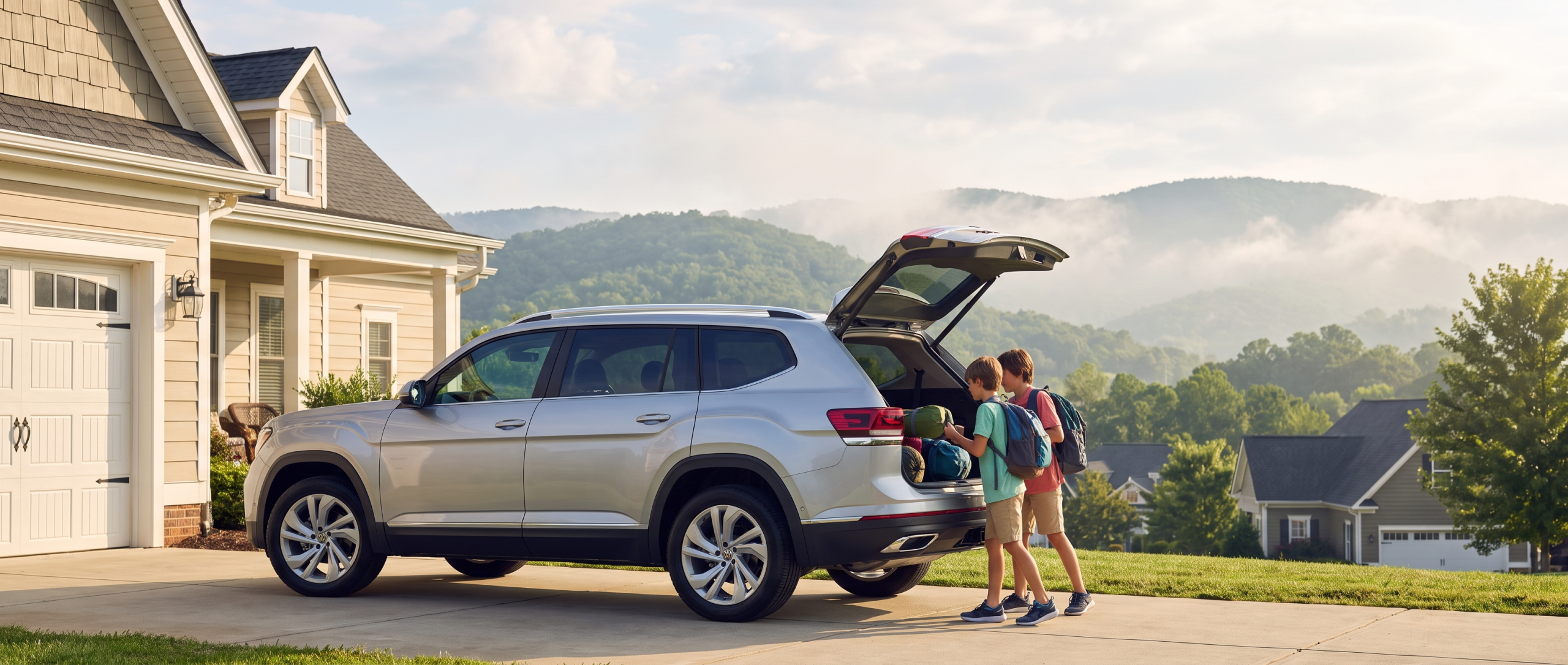
Your commute on I-26 between Inman and Spartanburg is only about 15 miles. But the gear that travels with a busy family — car seats, sports bags, a weekend’s worth of camping kit for Croft State Park, a middle schooler who insists on bringing everything she owns — turns that short run into a serious packaging question. Three 2026 Volkswagen SUVs answer it differently. The right one depends on how many seats you need, how much cargo you’re moving, and whether the 4Motion AWD system is a weekly necessity or a occasional comfort.
- Three rows, seven seats: the 2026 Atlas is the pick — 20.6 cu ft of cargo behind row three, up to 96.6 cu ft with rows two and three folded, towing up to 5,000 lbs when properly equipped.
- Two rows, maximum cargo per seat: the 2026 Atlas Cross Sport gives you 40.3 cu ft behind the rear seats and 77.6 cu ft fully folded, with adult-grade rear legroom of 40.4 inches.
- Compact daily driver for a smaller family: the 2026 Tiguan’s EPA-estimated 26/34/29 mpg (S FWD) makes it the fuel economy leader of the three, and it fits a family of four without the midsize footprint.
- AWD on the I-26 corridor: all three offer 4Motion AWD — it matters most when Upstate SC ice storms roll through in January and February; for dry July commutes it adds peace of mind without a major efficiency penalty.
- Bottom line: count your heads, count your bags, then match the model — the spec table below does the math.
Browse current VW inventory at Steve White Volkswagen Spartanburg
What Actually Matters When Choosing a Family VW for This Route?
The Inman-to-Spartanburg drive via I-26 is one of Upstate SC’s most well-worn daily corridors — and it tests a family SUV in both directions. Morning school runs in stop-and-go surface traffic put a premium on fuel economy and cabin calm. Weekend runs toward the Blue Ridge Mountain foothills, or a Saturday at Croft State Park’s lakes with kayaks on a roof rack, ask for cargo room and confident highway power. Here are the four variables that actually separate these three VW options for a local family.
| Model | Best For | Key Spec | Trade-Off |
|---|---|---|---|
| 2026 Atlas | Families of 5-7; road trips; towing | 96.6 cu ft max cargo; 5,000 lb tow; 20/27/23 mpg (FWD, EPA est.) | Largest footprint; tighter in parking decks |
| 2026 Atlas Cross Sport | Families of 4-5; cargo-over-seats priority | 77.6 cu ft max cargo; 40.4 in rear legroom; 20/27/23 mpg (FWD, EPA est.) | No third row; five-seat ceiling |
| 2026 Tiguan | Smaller families; daily-commute MPG | 69.8 cu ft max cargo (seats folded); 26/34/29 mpg (S FWD, EPA est.) | 5-seat only; less towing (1,500 lbs FWD) |
The decision hinges on one question before anything else: does your household ever need a third row of seats? If the answer is sometimes — grandparents on holidays, a carpool, a sports-team run — the Atlas resolves it cleanly. If the answer is never, the Cross Sport or Tiguan gives back cargo room and real-world fuel savings on the I-26 commute.
Seats and Cargo: Where the Three Models Diverge
The single most concrete difference in this lineup is the seating architecture, and it ripples into every other number.
2026 Atlas
The 2026 Atlas carries up to seven passengers across three rows. Volkswagen lists third-row legroom at 33.7 inches — enough for kids, shorter adults, and the occasional teenager who draws the short straw. Behind that third row sits 20.6 cubic feet of cargo space, which accommodates a decent grocery run or a day bag each. Fold both rear rows flat and the EPA-verified maximum reaches 96.6 cubic feet — the kind of number that handles a Costco run and a soccer gear haul on the same trip. The second row also slides fore and aft 7.7 inches, which makes third-row access easier even with child seats in place.
2026 Atlas Cross Sport
The 2026 Atlas Cross Sport drops the third row and reclaims it as cargo volume. Behind the rear seats: 40.3 cubic feet. Fold them: 77.6 cubic feet. That cargo hold is shaped more usefully than the Atlas’s, too — lower liftover and a squarer load floor mean strollers and bikes load without the awkward angle. Rear passengers in the Cross Sport get 40.4 inches of legroom, which is generous for adults on a longer I-26 run toward Greenville.
2026 Tiguan
The 2026 Tiguan is the compact of the group. VW lists total cargo volume with seats folded at 69.8 cubic feet, and the two-row interior seats five. It no longer offers a three-row option (that configuration was discontinued after the 2024 model year). For a family of three or four whose cargo needs are moderate — bags, a stroller, a few grocery totes — it is a practical, right-sized choice for Reidville Road errands and the Spartanburg school pickup circuit.
See the 2026 Atlas at Steve White Volkswagen Spartanburg
Explore the 2026 Atlas Cross Sport
The Atlas vs. Atlas Cross Sport: What the Numbers Miss
Both Atlas models share the same turbocharged 2.0-liter engine producing 269 horsepower and 273 lb-ft of torque, paired with an eight-speed automatic. The EPA rates both FWD variants identically at 20 city / 27 highway / 23 combined mpg. The 4Motion AWD variants nudge down slightly — the EPA puts AWD Atlas and Cross Sport SE models at 20 city / 26 highway / 22 combined. So fuel economy is not the deciding factor between them.
The deciding factor is whether you ever fill a third row.
Families who have had the grandparents in town for the holidays or who regularly run a five-plus-kid carpool know the moment a seven-seater earns its keep. Families who genuinely run four people and cargo every week will find the Cross Sport’s squarer, lower cargo hold more practical than the Atlas’s deeper, three-row-behind load floor. The Cross Sport’s rear doors are also wider, which makes loading children into rear-facing car seats faster — a real-world detail that a spec sheet does not capture.
- Atlas towing: up to 5,000 lbs when properly equipped — enough for a boat toward Lake Bowen or a camper trailer
- Cross Sport towing: up to 5,000 lbs when properly equipped — same capacity in a slightly sleeker package
- Tiguan towing: 1,500 lbs FWD / 1,800 lbs 4Motion — a different category suited to light utility trailers only
Pros and Cons: 2026 Atlas vs. 2026 Atlas Cross Sport
| Pros | Cons |
|---|---|
| Atlas: third row for 5-7 passengers | Atlas: largest exterior footprint of the three |
| Atlas: 96.6 cu ft max cargo volume (EPA-verified) | Atlas: slightly lower fuel economy than Tiguan on daily commute |
| Cross Sport: more useful cargo floor shape | Cross Sport: five-seat ceiling, no third-row option |
| Cross Sport: 40.4 in rear legroom, adult-friendly | Cross Sport: less max cargo than Atlas (77.6 vs 96.6 cu ft) |
| Both: 5,000 lb tow capacity when properly equipped | Both: AWD drops combined MPG to 22 (EPA est.) |
Match the VW to How Your Family Actually Drives
The I-26 corridor from Inman to Spartanburg is a short, familiar run — but the life packed into that drive changes month to month.
The three-row family has three kids, a consistent carpool obligation, or routinely travels with extended family across I-85 toward Greenville or Charlotte. The 2026 Atlas is built for your life: the third row is real seating, not a penalty box, with 33.7 inches of legroom for kids. The 4Motion AWD option matters when Upstate SC’s Isothermal Belt delivers an ice storm in winter. The active family of four has two kids under 12, a trailer hitch for a small boat or utility trailer, and cargo that swings between soccer season and summer camping. The 2026 Atlas Cross Sport’s low liftover, wide rear doors, and 40.3 cubic feet of accessible cargo suit you better than the Atlas’s deeper, third-row-behind hold. The sleeker roofline also means a roof rack does not turn the vehicle into a barn door at highway speeds. The compact commuter family has a smaller household with one or two kids, and the I-26 commute is a daily priority. The 2026 Tiguan’s EPA-estimated 26 city / 34 highway / 29 combined mpg (S FWD) is meaningfully better than the Atlas siblings on fuel per mile, and the compact footprint navigates tight campus zones around USC Upstate or downtown Spartanburg without the parking-deck anxiety of a midsize SUV.
View the 2026 Tiguan at Steve White Volkswagen Spartanburg
All three come standard with Volkswagen’s IQ.DRIVE suite — forward collision warning, adaptive cruise control, lane assist, and automatic emergency braking — so the safety floor is consistent across the lineup regardless of which model you choose.
Frequently Asked Questions
Does the 2026 Volkswagen Tiguan still come with three rows of seats?
No. Volkswagen discontinued the three-row Tiguan configuration after the 2024 model year. The 2026 Tiguan is a five-seat, two-row compact SUV. Families who need a third row within the VW lineup should consider the 2026 Atlas, which seats up to seven passengers across three rows with 33.7 inches of third-row legroom.
Is 4Motion AWD worth it for Spartanburg-area driving?
For most Upstate SC families commuting between Inman and Spartanburg, FWD handles the majority of dry summer and fall conditions well. The case for 4Motion AWD strengthens in winter: Spartanburg County sits in the Isothermal Belt, a geography where warm air rolling over the Appalachians can create unpredictable temperature swings of 20 degrees or more, bringing unexpected ice on I-26. Volkswagen’s 4Motion system uses an electronically controlled multi-plate clutch that operates in FWD during normal conditions and routes torque to the rear wheels only when sensors detect slip — so it adds confidence without a constant fuel economy penalty. On the 2026 Atlas FWD, the EPA estimates 23 mpg combined; 4Motion SE trims come in at 22 mpg combined — a modest real-world difference for the added winter traction.
Connect with us

