

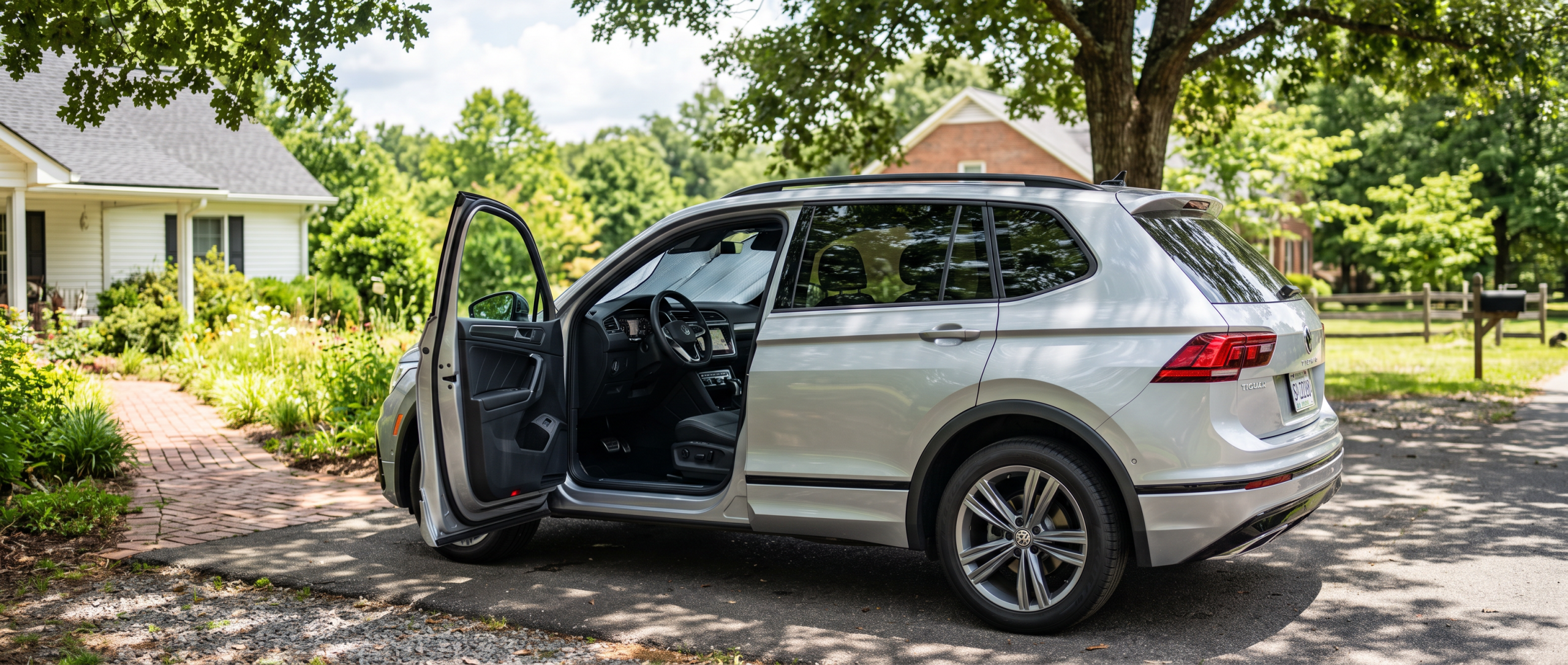
July in Spartanburg is not gentle. Average highs sit at 91 degrees Fahrenheit, the humidity hovers around 68%, and a parked car in direct sun does something easy to underestimate. Per NHTSA, a vehicle’s cabin gains roughly 20 degrees Fahrenheit in as little as 10 minutes. So a car sitting in the Reidville Road lot at noon climbs well above 110 degrees Fahrenheit inside before you’ve finished your lunch run. The honest bottom line runs like this. The single biggest threat to your Volkswagen’s interior value isn’t mileage. It’s those six weeks of Upstate summer heat a cabin isn’t built to shrug off on its own.
Protecting the cabin isn’t complicated. You do need to know which materials are sitting in your car, because the Volkswagen Tiguan, the Atlas, the Jetta, and every other model in the lineup use different upholstery tiers, and each tier has its own weak point in heat and humidity.
What Does Interior “Value” Actually Mean Here?
Interior value here comes down to a plain difference you’ll feel at trade-in, between a cabin that still looks showroom-fresh and one that tells the inspector a story of neglect the moment they open the door. Faded dashboards, tacky door panels, cracked leatherette bolsters, and that particular musty smell that develops when humid air gets trapped in unsealed fabric are the details that quietly cost money later. Good care costs next to nothing now, and it doesn’t take much to stay ahead of.
Spartanburg’s summer adds a layer drivers in drier climates don’t face. Heat alone attacks UV-sensitive plastics and fades dye in fabric. But 68% average humidity means moisture works alongside that heat, softening adhesives, feeding mildew in carpet fibers, and speeding up the drying-and-wetting cycle that eventually causes rubber seals and trim clips to fail. You’re not just fighting the sun. You’re fighting a system.
What Do You Actually Get at Each Volkswagen Trim Level?
What you get at each trim level changes the whole care routine, because a can of leather conditioner does nothing useful on embossed cloth, and a fabric protectant spray on Varenna leather won’t earn its keep. Know your material, then treat it.
| Trim Level (Examples) | Upholstery Material | Heat Vulnerability | Humidity Vulnerability | What It Needs |
|---|---|---|---|---|
| Tiguan S / Jetta base | Embossed cloth | Dye fade, fiber breakdown | Mildew, odor retention | Fabric protectant spray, weekly vacuuming, baking soda deodorize |
| Tiguan SE / Atlas SE | V-Tex leatherette (perforated) | Surface tackiness, seam stress | Minimal if kept clean | UV protectant wipe-down, mild interior cleaner monthly |
| Tiguan SEL R-Line Turbo / Atlas SEL Premium | Varenna leather (real) | Cracking from moisture loss, dye fade | Swells and loses shape if waterlogged | pH-neutral leather conditioner every 6-8 weeks |
| All trims | Soft-touch dash / door panels | Fading, stickiness from off-gassing | Dust adhesion | UV protectant applied to a microfiber cloth, not sprayed directly |
| All trims | Touchscreen / instrument cluster | Glare coating wear | Smudge buildup in humidity | Dry microfiber only; never alcohol-based wipes |
None of that table is guesswork. The 2026 Volkswagen Atlas SE ships with standard perforated V-Tex leatherette (confirmed in the published build specs) while the SEL Premium R-Line moves to Varenna leather. On the compact side, the 2026 Tiguan SE and SE R-Line Black carry V-Tex leatherette, and the Tiguan S stays on cloth. So the practical upshot is simple. If you bought a mid-range trim for that upscale look, V-Tex is easier to keep up in heat than real leather, because it doesn’t depend on retained moisture the way hide does.
Smart Habits That Actually Preserve Your Cabin
Good habits protect a cabin more reliably than any single product, and the piece generic articles skip is sequence, because the order you work in matters as much as what you’re reaching for. The order you do things matters as much as what you use.
Start with the windshield, every time you park. A reflective sunshade isn’t optional in a Spartanburg July. It cuts the direct radiant load on the dashboard and steering wheel, where the worst surface-level damage builds fastest. Feel that tackiness on an unprotected soft-touch dash? The UV-reactive coating is starting to break down, and once it’s gone, it doesn’t come back.
Vacuum before you wipe. Abrasive dust on a cloth seat or leatherette surface acts like sandpaper when you drag a damp cloth across it. Vacuum first. Two minutes with a brush attachment before any cleaning product touches the material, and you’ll dodge the micro-scratches that dull a finish over a summer.
On humidity specifically, crack the windows in shade, not in sun. Leaving windows up in a shaded parking spot (and Croft State Park has plenty of them) traps moisture with heat and builds exactly the conditions mildew needs. A two-inch gap in a shaded spot keeps air moving without inviting direct UV, which is what you’re after. In full sun, keep them up and lean on the sunshade instead.
Bring your Volkswagen in for a service appointment if the cabin air conditioning starts putting out a musty smell. You’ll usually find a saturated cabin air filter behind it. In Spartanburg’s summer humidity, those filters load up faster than the service-interval charts assume.
Schedule a Service Appointment
The Smart Choice: Protect Now or Pay at Trade-In
The smart choice is really a tradeoff of twenty minutes a month now against how the cabin shows at trade-in later, and skipping those minutes doesn’t feel like a decision until the appraisal reflects a cabin that looks worn instead of cared for. Volkswagen interiors, especially the V-Tex leatherette tiers, are durable by design. But no engineering survives sustained UV and heat exposure without basic maintenance.
Where this matters most for Spartanburg drivers is at the premium trim level. A Tiguan or Atlas Cross Sport in SEL trim carries real Varenna leather and a 15-inch touchscreen with a glare coating. Both take neglect badly, in ways you’ll see and measure at resale time. Protecting them protects the premium you already paid.
Cloth-trim drivers aren’t off the hook either. Fabric holds odor and moisture in ways leatherette doesn’t, and an Upstate summer of leaving windows closed on hot afternoons breeds a smell detailing can soften but rarely erase. The fix costs nothing, just twenty seconds of window positioning and a fabric protectant spray applied twice a season.
Your Spartanburg summer doesn’t have to take anything from the cabin you drove home in.
Frequently Asked Questions
Does Volkswagen’s V-Tex leatherette crack in heat the way real leather does?
Not in the same way, and that’s actually one of V-Tex’s genuine advantages in a hot climate. Real leather cracks when it loses moisture (a natural process that Spartanburg’s repeated heat cycles accelerate significantly). V-Tex leatherette is a synthetic material with a polymer surface that doesn’t depend on retained moisture to stay supple. It can become tacky or develop surface sheen from UV exposure over time, but it won’t crack the way untreated hide does. A monthly wipe-down with a UV protectant is all it needs. Drivers stepping up to the Tiguan SE or Atlas SE trims are actually choosing a material that handles Upstate SC summers more forgivingly than the top-trim leather does, though both benefit from attention.
My dashboard already feels tacky after just one summer. Is that normal, or did something go wrong?
That tackiness is a real and common problem, and it’s not a manufacturing defect. The soft-touch coating on Volkswagen dashboards and door panel caps is designed for comfort and appearance, but it’s UV-sensitive. In a South Carolina summer, prolonged direct sun exposure causes the surface coating to begin breaking down, producing that unpleasant sticky texture. It happens faster without a windshield sunshade. The difficult news is that once the coating is gone, it cannot be fully restored. You can clean the residue and apply a UV protectant to slow further degradation, but the original finish is permanently altered. Going forward, a reflective sunshade every time you park in direct sun is the prevention that actually works.

