

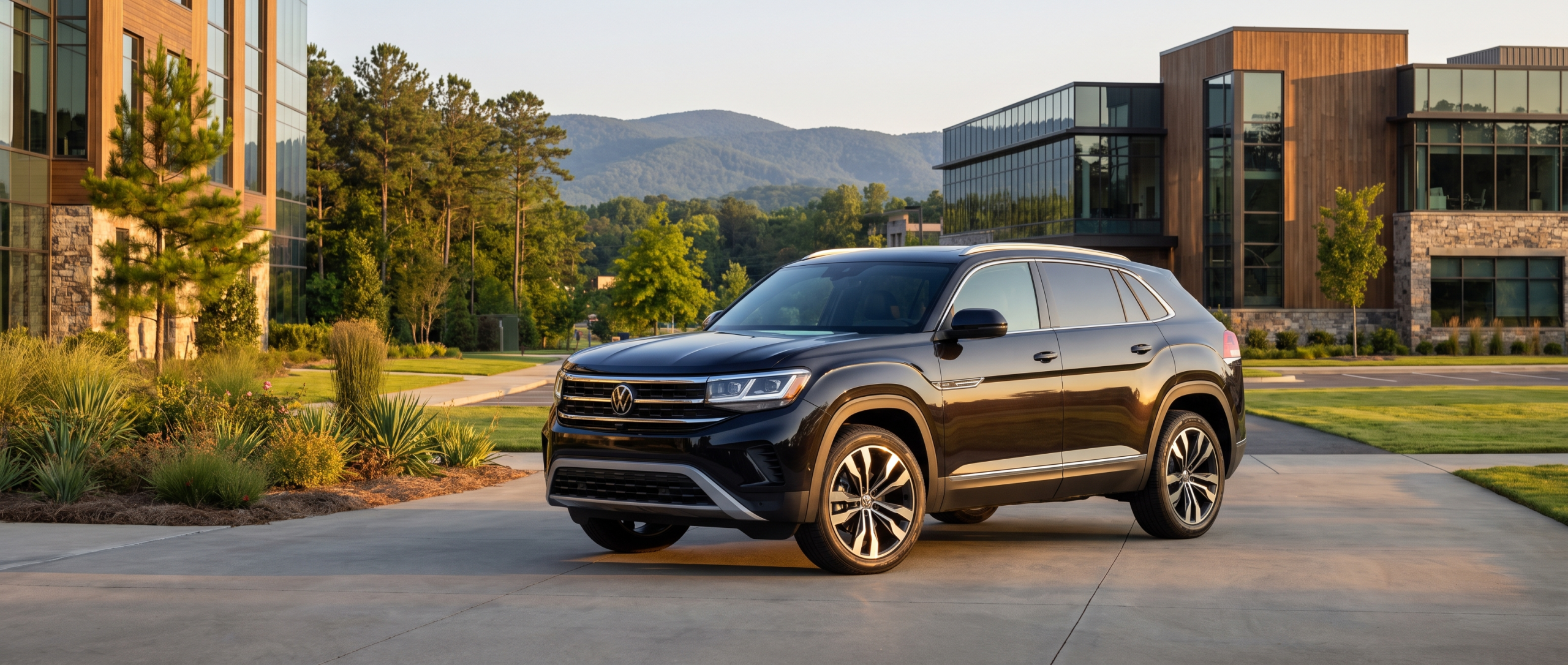
There’s a stretch of I-85 near Spartanburg that locals have long called “the Autobahn,” and that nickname didn’t arrive by accident. German manufacturers including BMW, Michelin, BASF, and Siemens planted roots here decades ago, and today Spartanburg County anchors one of the most German-influenced industrial corridors in the country. So it makes a certain logical sense that the midsize SUV drawing serious attention from Upstate SC professionals drives, feels, and thinks like a German-engineered product. The 2026 Volkswagen Atlas Cross Sport is exactly that.
Browse the 2026 Atlas Cross Sport at Steve White Volkswagen Spartanburg to see current availability on Reidville Road.
What Do the Specs Actually Mean for Your Daily Drive?
Pull these numbers out of the abstract and put them on a real commute, and they start to make sense in a different way.
| Spec | 2026 Atlas Cross Sport | Why It Matters on I-85 |
|---|---|---|
| Engine | 2.0L TSI Turbo, 269 hp / 273 lb-ft | Confident merge power at highway speeds; same output across all five trims |
| Transmission | 8-speed automatic with paddle shifters | Smooth progression; no hunting at highway cruise |
| AWD | 4Motion (opt. SE/SE Tech; std SEL+) | Active traction before wheelspin, not after |
| Drive Modes | Eco, Comfort, Sport, Custom, Snow + Off-Road (4Motion) | Eco on the commute, Sport for SC Highway 11 weekends |
| EPA Fuel Economy (FWD) | 20 city / 26 hwy / 23 combined | Real-world highway number holds on long Greenville-to-Spartanburg runs |
| EPA Fuel Economy (4Motion SE/SE Tech) | 19 city / 26 hwy / 21 combined | One mpg city penalty for AWD capability |
| Rear Legroom | 40.4 inches | Adults fit comfortably; no cramped client conversations |
| Cargo (seats up) | 40.3 cu ft | A full set of golf bags or a week’s worth of luggage |
| Cargo (seats folded) | 77.6 cu ft | Enough for a Croft State Park kayak run or a Costco haul |
| Towing Capacity | Up to 5,000 lbs (properly equipped) | Handles a bass boat or a small camper for Blue Ridge escapes |
| Safety Rating | IIHS Top Safety Pick | Verified independent crash-test recognition |
| Drag Coefficient | 0.34 Cd | Lower than most SUVs in this segment; wind noise is genuinely reduced at speed |
The EPA rates the FWD Atlas Cross Sport at 20 city and 26 highway. That highway figure matters most for Upstate drivers: a Spartanburg-to-Greenville loop runs mostly freeway, and the 26 mpg highway rating holds up in normal conditions. The one honest tradeoff with 4Motion AWD is a one-mpg city dip, down to 19. Worth it? For anyone whose morning commute involves wet I-85 in January, we’d say yes. Drivers who upgrade to 4Motion tend to stop second-guessing it once they’ve used Snow mode in conditions where it earns its keep, and the system activates predictively before wheelspin actually starts rather than reacting after the fact.
See Current Atlas Cross Sport Offers
The IQ.DRIVE Suite: German Engineering Meets the I-85 Commuter
For a Spartanburg professional, the number that shapes the daily experience isn’t 269 horsepower. It’s what Volkswagen’s IQ.DRIVE suite does between the on-ramp and the parking garage.
Every 2026 Atlas Cross Sport trim ships with the full IQ.DRIVE package: adaptive cruise control, lane-keeping assist, forward collision warning with automatic emergency braking, and exit warning assist. Standard. No trim-level shuffle and no upgrade package required to get there.
Put that in the context of a commute running from the eastern Spartanburg suburbs toward the BMW campus in Greer, and adaptive cruise control in stop-and-go traffic stops being a luxury line item. It becomes a fatigue management tool. The lane assist works quietly on the long, straight highway stretches without aggressively pulling at the wheel unless you’re genuinely drifting. That balance between active safety and driver feel is a calibration choice, and it’s a good one. Competing SUVs with correction systems that feel like a tug-of-war are a fair comparison point; the Atlas Cross Sport doesn’t fight you.
A Real Tradeoff: What the Atlas Cross Sport Doesn’t Get Right
Skipping this section wouldn’t serve you well, so we won’t.
The touch-sensitive climate controls are genuinely frustrating. They look clean and modern, but finding the temperature slider with a gloved hand or without looking down is harder than it should be. Multiple automotive reviewers who tested the 2026 model flagged this specifically, and our experience with customers who’ve driven the vehicle backs up the same ergonomic observation. If you adjust your climate constantly, plan to spend your first week getting familiar with the touchscreen menu rather than reaching by feel.
Some interior plastics on lower trims also feel a step below what the pricing would suggest. The SE’s leatherette seats and heated and ventilated fronts are genuinely good. The hard plastic surfaces on door panels and lower dash areas are less so. SEL and above get leather and a memory driver seat; that tier is where the interior fully earns its position.
The two-row-only layout means the Atlas Cross Sport won’t work if you’re regularly hauling more than four adults. That job belongs to the three-row standard Volkswagen Atlas. Know that before you sit down.
| Pros | Cons |
|---|---|
| 269 hp uniform across all five trims | Touch-sensitive climate controls poorly suited for tactile use |
| IIHS Top Safety Pick safety rating | Interior plastics on SE trims below pricing expectations |
| 40.4-in rear legroom (class competitive) | No third row; five-passenger max |
| IQ.DRIVE suite standard on every trim | 4Motion AWD adds cost; not standard until SEL |
| 77.6 cu ft max cargo space | Resale value trails some key segment rivals |
| 0.34 drag coefficient; quiet at highway speed | Touch-screen-controlled drive modes (no physical dial) |
| Wireless CarPlay, Android Auto, 45W USB-C standard | SEL Premium trim required for massage seats |
Who the Atlas Cross Sport Actually Fits in Upstate SC
A recognizable professional profile keeps showing up around the Atlas Cross Sport in Spartanburg. Compact SUVs that feel cramped the moment a client sits in the back seat have run their course. There’s no need for a third row, but 77.6 cubic feet of flat cargo space on a weekend is a different matter. I-85 is a daily reality, and safety shouldn’t require an upgrade package. Plus the vehicle needs to reflect a standard of engineering that feels consistent with the professional environment these buyers work in every day.
That last point carries specific weight in this market. Spartanburg’s largest employers include BMW’s North American manufacturing headquarters and Michelin North America’s US base. Engineers, managers, and technical professionals who spend their days in facilities shaped by German manufacturing philosophy tend to recognize the same philosophy when they drive it home. The Atlas Cross Sport’s 0.34 drag coefficient, its predictive 4Motion AWD engagement, its uniform powertrain across the entire lineup: these are calibration choices, and they’re the kind that show up in the drive rather than just on a spec sheet.
The Volkswagen Tiguan serves the buyer who wants a more compact footprint and optional third-row seating in a smaller package. The Atlas Cross Sport occupies a different lane: bigger cargo, longer wheelbase, more rear legroom, without the bulk and third-row complexity of the full Atlas. For a Spartanburg professional who carries clients, hauls gear for Blue Ridge Mountain foothills weekends, and commutes the I-85 corridor daily, that positioning hits a specific practical target that two-row competitors in this segment often miss.
If you’re weighing whether to step up to the full Volkswagen Atlas for the third row you might use twice a year, consider what you’d trade away: the Cross Sport’s lower, sportier roofline, its slightly sharper cornering character, and a drag coefficient that shows up in wind noise reduction at highway speed. That tradeoff is personal. It’s worth a side-by-side drive before you decide.
Frequently Asked Questions
Is the 2026 Volkswagen Atlas Cross Sport a good choice for professionals who commute on I-85?
For a Spartanburg professional who drives I-85 regularly, the Atlas Cross Sport offers a well-matched set of features: IQ.DRIVE adaptive cruise control and lane assist standard on every trim, a 40.4-inch rear seat for client transport, and 4Motion AWD available for winter-weather commutes. The EPA rates FWD models at 26 mpg highway, and that number holds up on the consistent freeway stretches between Spartanburg and Greenville. The honest limitation is the touch-sensitive climate controls, which take real adjustment to use comfortably without looking away from the road.
Does the Atlas Cross Sport need the third row, or is the standard two-row layout enough?
The Atlas Cross Sport is a five-passenger, two-row SUV by design. If your household regularly seats more than five people, the three-row Volkswagen Atlas is the right choice. For a professional buyer who carries four adults at most and wants the cargo flexibility of 77.6 cubic feet of flat load space, the two-row layout is not a compromise. Without a third-row mechanism, the folded floor sits lower and flatter, and that’s actually what makes the Cross Sport’s cargo area so usable.
Connect with us

