

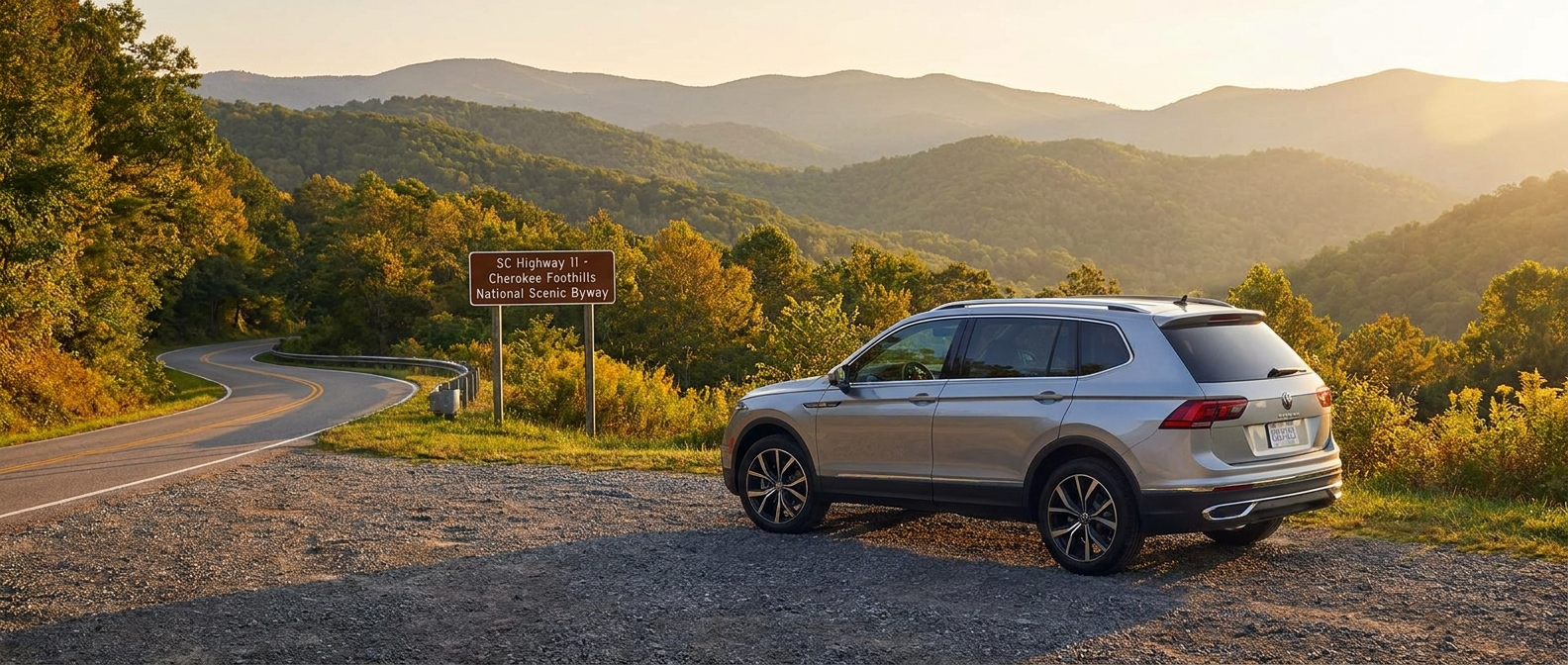
For most Spartanburg households, the answer really comes down to one question. How many rows do you actually need? The 2026 Volkswagen Tiguan is a refined, fuel-efficient five-passenger compact SUV built for couples and two-kid families who want a European driving feel on I-85. The 2026 Honda Pilot is a three-row, eight-seat midsize hauler that outpulls and out-tows the Tiguan at almost every turn. They aren’t really the same vehicle fighting for the same buyer.
Which Vehicle Actually Fits How Your Family Lives?
These two SUVs get cross-shopped constantly, yet they don’t belong in the same class, and the split is simple. One seats five and sips fuel, the other seats up to eight and tows real weight, so the right fit depends far less on badge preference than on how many bodies and how much trailer you move.
Volkswagen dropped the Tiguan’s optional third row when it redesigned the SUV for 2025, so it now seats five, period. The Pilot still carries up to eight passengers, with a stowable center seat on higher trims that turns the second row into a wide two-person bench or a walk-through aisle to the third row. If your household includes three kids, or you regularly carpool Wofford College students on game days, the Pilot handles that with room to spare. The Tiguan does not.
Where the Tiguan hits back is on the daily drive. The EPA rates the 2026 Tiguan S with front-wheel drive at 26 city / 34 highway / 29 combined. The 2026 Pilot with its V6 comes in at 19 city / 27 highway / 22 combined for 2WD. Call it a seven-mile-per-gallon combined gap. On a daily Spartanburg-to-Greenville run on I-85, that difference isn’t abstract. It shows up at every fill-up.
| Decision Factor | 2026 Volkswagen Tiguan | 2026 Honda Pilot |
|---|---|---|
| Seating | 5 passengers | Up to 8 passengers |
| EPA Combined MPG (base/2WD) | 29 mpg (S FWD) | 22 mpg (2WD) |
| Cargo behind rear seats | 33.8 cu ft | 18.6 cu ft (behind 3rd row) |
| Max cargo (seats folded) | 69.8 cu ft | Up to 111.8 cu ft |
| Standard engine | 201 hp turbo 2.0L 4-cyl | 285 hp 3.5L V6 |
| Max tow rating | 1,800 lbs (AWD) | 5,000 lbs (AWD) |
| AWD system | 4MOTION (optional on most trims) | i-VTM4 AWD (available) |
| IIHS safety award | Did not earn TSP (2026) | IIHS Top Safety Pick+ (2025-26) |
| Rows | 2 | 3 |
The Tiguan takes the daily-driver column. The Pilot takes the family-capacity and towing columns. Neither answer is wrong, and the right one depends on your household.
Browse our current Volkswagen Tiguan inventory
Does the Tiguan Have Enough Room, and Is the Pilot Worth the Fuel Cost?
Yes on both counts, with a catch on each side. The Tiguan holds more everyday cargo than its footprint suggests, and the Pilot’s extra capacity is genuinely useful, yet the Pilot pays for that space at the pump, so whether the fuel cost is worth it hinges entirely on how often you fill those three rows.
On cargo, the Tiguan is more capable than it looks. With the rear seats upright, Volkswagen lists 33.8 cubic feet of cargo volume. Fold those seats and you get 69.8 cubic feet. Folded flat, it comfortably swallows a family weekend’s gear for a run down I-26 toward the coast, or a full load for a Saturday at Croft State Park without any creative packing. The Pilot’s raw cargo maximum is larger (up to 111.8 cubic feet with both rows folded), but if you’re using that third row often for passengers, the usable space behind seat row three is just 18.6 cubic feet, which is noticeably tighter than the Tiguan’s everyday 33.8.
The Pilot’s fuel figure is the tradeoff worth naming plainly. At 19 city / 27 highway for 2WD per EPA 2026 ratings, it drinks more than any two-row compact in this conversation. If Spartanburg’s summer heat keeps your AC running full blast from Reidville Road to downtown and back, those city miles will trend toward the lower end. The Tiguan’s 26 city EPA figure is a genuine daily-driver advantage in stop-and-go.
Towing is where the Pilot earns back every mile. Honda lists the 2026 Pilot AWD at a maximum 5,000 pounds of towing capacity. The Tiguan AWD tops out at 1,800 pounds. If you’re pulling a small camper, a bass boat, or a utility trailer up toward the Blue Ridge on SC Highway 11 on a long weekend, those aren’t interchangeable numbers.
| Pros | Cons |
|---|---|
| Volkswagen Tiguan | |
| 29 mpg combined (S FWD, EPA-rated) | Only 5 seats; no third row |
| 33.8 cu ft everyday cargo (seats up) | 1,800-lb tow limit (AWD) |
| 4MOTION AWD optional on most trims | Moderate overlap IIHS rating is Poor |
| 201 hp turbocharged engine, 8-speed auto | Smaller interior vs midsize rivals |
| German-tuned ride quality, 15″ touchscreen on SEL | |
| Honda Pilot | |
| Up to 8 seats, stowable 2nd-row center | 19/27 EPA mpg (2WD); 19/25 AWD |
| 5,000-lb tow capacity (AWD, Honda-listed) | Larger footprint; harder to park |
| IIHS Top Safety Pick+ (2025-26) | V6 runs on regular fuel but uses more of it |
| Up to 111.8 cu ft cargo (seats folded) | Heavier, less driver-focused feel |
See Current Volkswagen Specials
Which SUV Is Safer on Upstate SC Roads?
On crash-test structure the Pilot has the clearer edge, though the Tiguan isn’t unsafe and brings strong standard driver aids. The Pilot holds the current IIHS award and the Tiguan doesn’t, yet both cars post Good scores on several tests, so the gap sits in one specific place worth understanding before you sign anything.
IIHS testing rated the 2026 Volkswagen Tiguan Good on the small overlap front test and Good on the updated side crash test. But it earned a Poor rating on the moderate overlap front test, and that Poor score is what kept it off the IIHS Top Safety Pick list for 2026. The Pilot, by contrast, holds IIHS Top Safety Pick+ status for the 2025-26 model years, with Good ratings across the small overlap front, updated moderate overlap front, and updated side tests. For a family hauling kids on busy Upstate SC corridors, that’s a real difference worth weighing.
Explore financing options at Steve White Volkswagen
The Tiguan does come standard with Volkswagen’s IQ.DRIVE suite, which bundles active blind-spot monitoring and lane assist across all trim levels. On I-85, where merge points come fast, those aids earn their keep every day. But on the structural crash-test score parents weigh hardest, the Pilot wins.
What Makes the Tiguan the Right Call for Many Spartanburg Drivers?
For a two-adult household with one or two kids and more commuting than towing, the Tiguan fits better than its spec sheet suggests, and that’s the call we’d make with you on the lot. It won’t out-haul the Pilot, but it doesn’t need to for that buyer. Interior quality punches above its segment. The 15-inch touchscreen on the SEL R-Line Turbo trim, the walnut wood trim, and the massaging front seats are features that would cost more on most competitors. Its 4MOTION AWD system handles the occasional slick morning on I-85 with confidence, and the turbo 2.0-liter engine responds in a way that feels intentional, not numb.
The Pilot is the right vehicle if your household genuinely fills three rows, or if you’re pulling anything heavier than 1,800 pounds. We’re not going to pretend otherwise. But for the couple or the two-kid family in Spartanburg who wants a vehicle with a genuinely European feel and fuel economy that doesn’t sting at the pump, the Tiguan is a more precise match than the Pilot’s sheer size makes necessary.
Need three rows from a Volkswagen? The Volkswagen Atlas seats up to seven.
Come talk to us. We can show you both seat configurations, walk you through the 4MOTION AWD option, and help you figure out which household your household actually is.
Frequently Asked Questions
Is the 2026 Volkswagen Tiguan big enough for a family?
The 2026 Volkswagen Tiguan seats five passengers and offers 33.8 cubic feet of cargo space with the rear seats up, expanding to 69.8 cubic feet with them folded. It’s a genuinely comfortable fit for two adults and one or two children. Families who regularly need a third row of seating will find the Tiguan too small; those buyers should consider the Volkswagen Atlas, which seats up to seven, or the Honda Pilot.
Does the 2026 Honda Pilot really get bad gas mileage?
The 2026 Pilot’s fuel economy is below average for the SUV segment. The EPA rates the 2026 Pilot at 19 city / 27 highway / 22 combined for 2WD trims and 19 city / 25 highway / 21 combined for non-TrailSport AWD trims. Those figures are lower than the 2026 Volkswagen Tiguan’s EPA-rated 26 city / 34 highway / 29 combined (S FWD trim). The trade-off is that the Pilot carries eight passengers and tows up to 5,000 pounds. If your household uses all that capacity, the fuel cost is a reasonable tax. If it doesn’t, you’re paying for more truck than you need.
Which one is safer: the 2026 Tiguan or the 2026 Honda Pilot?
Per IIHS testing, the 2026 Honda Pilot holds a Top Safety Pick+ rating, earning Good scores in the small overlap front, updated moderate overlap front, and updated side crash tests. The 2026 Volkswagen Tiguan earned Good ratings in the small overlap front and updated side tests but received a Poor rating in the moderate overlap front test, which kept it off the IIHS award list for 2026. Both vehicles include standard driver-assistance technology. Safety-focused buyers should weigh the Pilot’s stronger crash-test record, particularly for families carrying passengers in all rows.
Connect with us

