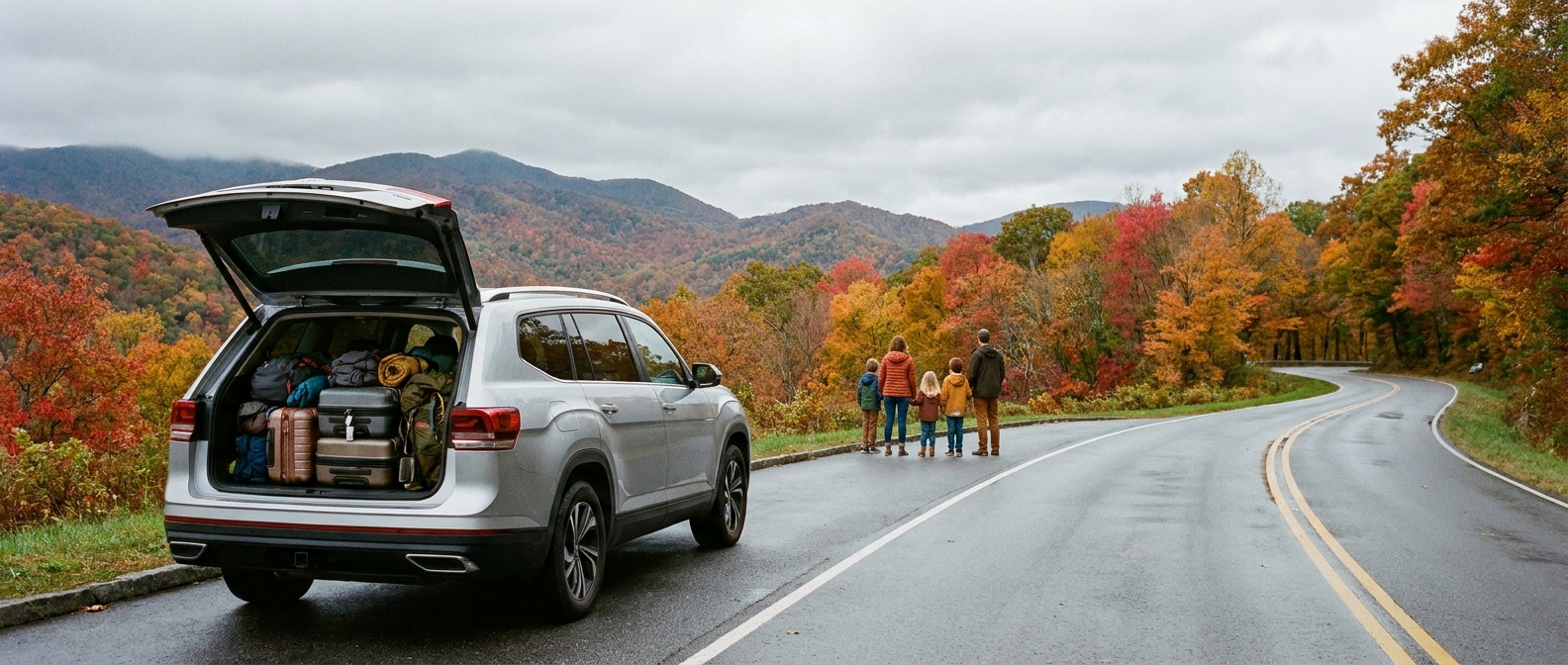

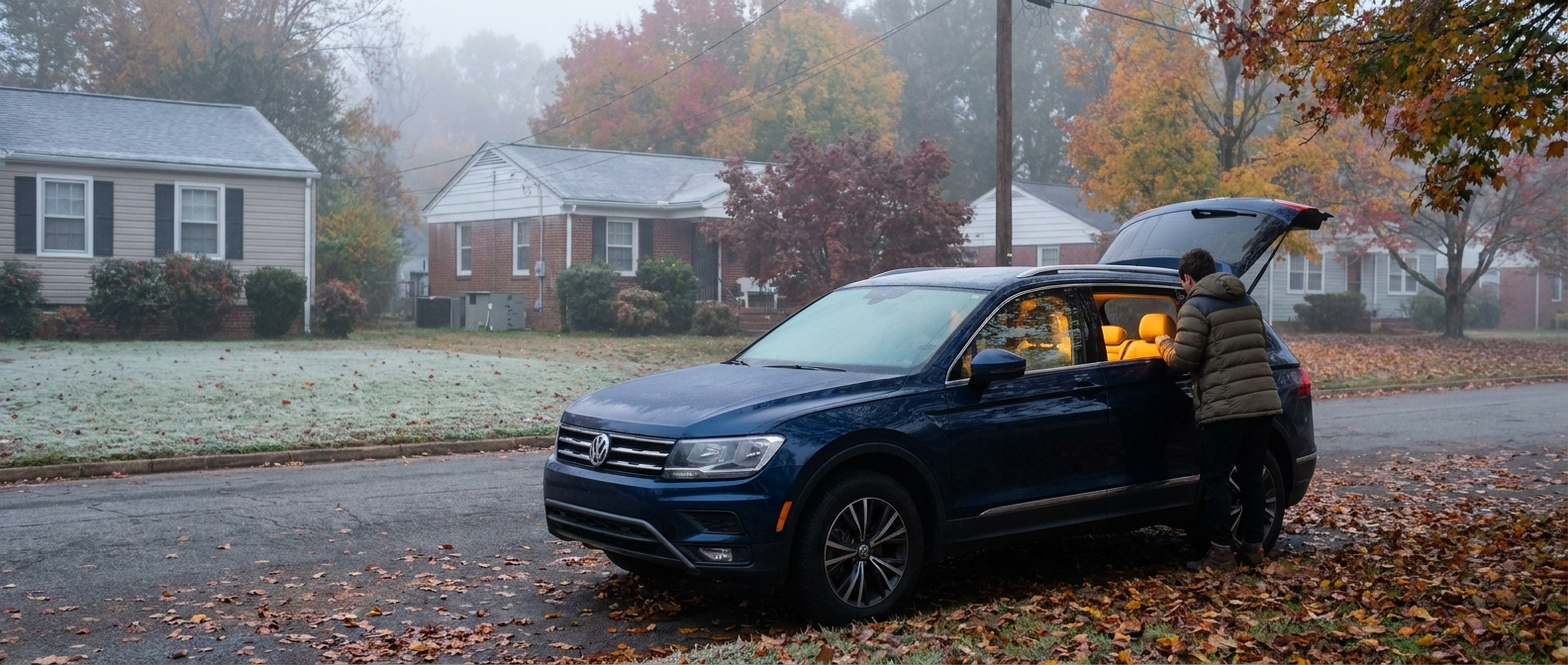
The 2026 Volkswagen Tiguan is the right choice if your family is two adults and two kids who want a composed, German-engineered drive on SC Highway 11 without paying for three rows you'll never use. The Highlander wins the moment a third row actually matters to you, or when a boat trailer enters the picture.
- The 2026 Tiguan no longer offers a third row. It's a pure five-passenger compact SUV with up to 69.8 cubic feet of cargo space.
- The 2026 Highlander seats seven or eight, tows up to 5,000 lbs, and now comes with standard AWD across all gas trims.
- On fuel economy, the EPA-estimated Tiguan FWD returns 26 city / 34 highway vs. the Highlander's 21 city / 28 highway with AWD.
- The Highlander is 10.5 inches longer than the Tiguan, which matters on tight Spartanburg parking decks and curvy mountain roads.
- Pick the Tiguan if your crew is five or fewer and you value driving feel. Pick the Highlander if you need a third row or regularly tow.
Cross-shopping these two looks straightforward, and it rarely is. Both vehicles used to compete in roughly the same space. They don't anymore. The 2026 Volkswagen Tiguan dropped its third row entirely in its recent redesign, which changes the entire premise of this comparison. So here's what you actually need to know before you decide.
What's the Real Difference Between These Two SUVs?
The core difference comes down to size and seating, and you feel it from the driver's seat long before you read a single spec, since the Tiguan is a compact, two-row, five-passenger hauler and the Highlander is a mid-size, three-row rig that seats seven or eight. Everything else flows from that one split.
| Feature | 2026 Volkswagen Tiguan | 2026 Toyota Highlander |
|---|---|---|
| Rows / Seating | 2 rows / 5 passengers | 3 rows / 7-8 passengers |
| Cargo (behind row 2) | 33.8 cu ft | 48.4 cu ft |
| Max cargo (seats folded) | 69.8 cu ft | 84.3 cu ft |
| EPA MPG (AWD, combined) | ~25 MPG | 24 MPG combined |
| Engine output | 201 hp (2.0L turbo) | 265 hp (2.4L turbo) |
| Tow rating | 1,500 lbs | Up to 5,000 lbs |
| AWD availability | Optional (standard on SEL trim) | Standard on all 2026 gas trims |
| Overall length | 184.4 in | 194.9 in |
| Ground clearance | 6.6 in (7.2 in SEL) | 8.0 in |
| NHTSA overall rating | 5 stars | 5 stars |
Both earn five NHTSA stars. Both carry standard automatic emergency braking, lane-keep assist, and adaptive cruise control. Treat that as the floor, not a tiebreaker.
Does Your Family Actually Need a Third Row?
Most of the time the real test is whether the third row earns its keep more than a handful of days a year, and for a two-adult, two-kid household the answer is often no, though a carpool rotation or regular grandparent runs can flip it fast. Work through that first.
The Highlander's third row exists, and whether it's comfortable for adults on a two-hour run up I-85 to Charlotte is a separate question. The row sits low to the floor, and legroom runs tight for anyone with a growth plate that has already closed. For the under-12 set on shorter stretches, it works well, and it gives grandparents or carpool passengers a seat in a pinch. Call that real value if it matches your life.
But the Highlander makes a tradeoff for that row. With all three rows in use, you have 16 cubic feet behind the third row. Picture a large rolling suitcase and not much more. You're making a choice between people and luggage every time you pack for a trip to the Cherokee Foothills National Scenic Highway.
Trade the third row away and the Tiguan hands you a genuinely useful 33.8 cubic feet behind the second row. That's more than double the cargo space behind the third row of the Highlander, and 69.8 cubic feet when you fold the seats down. For a family of four heading to Croft State Park for a weekend, that cargo hold makes the packing conversation a lot shorter.
Fuel Economy, AWD, and the Drive to the Mountains
On fuel the Tiguan holds a real paper edge over the Highlander, and that margin narrows the moment you spec all-wheel drive, so the fair read is a modest highway win for the Tiguan and close to a wash around town. The EPA estimates the Tiguan S with front-wheel drive at 26 city and 34 highway. Add 4MOTION AWD (the all-wheel-drive system of Volkswagen) and those figures shift to approximately 22 city and 29-30 highway. The Highlander gas model with standard AWD is EPA-rated at 21 city and 28 highway, for a combined 24 MPG.
Both numbers are EPA estimates. Your real mileage depends on load, terrain, and how heavy your right foot runs.
Over a 100-mile run down SC Highway 11 through the Blue Ridge foothills, the two trade roughly the same fuel stop. The gap shows up over a year of I-85 commuting between Spartanburg and Greenville, where the highway efficiency of the Tiguan adds up on that daily run.
The 4MOTION AWD of the Tiguan is optional on the S, SE, and SE R-Line Black trims and standard on the top SEL R-Line Turbo. The Highlander's AWD comes standard across all 2026 gas trims. New for 2026, that's a genuine convenience, since you don't have to spec a higher trim just to get traction on a wet Reidville Road morning. Families who want AWD standard across every trim in a larger Volkswagen footprint should look at the Atlas, which is a different conversation for another day.
The Tiguan gives up ground clearance, plain and simple. It sits at 6.6 inches on most trims (7.2 on the SEL R-Line Turbo) versus the Highlander's 8.0 inches. For paved South Carolina roads, Croft State Park's maintained trails, and SC Highway 11 curves, the Tiguan is plenty capable. If you're regularly pulling onto unpaved forest service roads in the upstate, the Highlander's extra clearance and towing muscle start to matter.
Towing, Cargo, and the Real Practicality Question
For towing, the two aren't in the same league, and if a trailer sits anywhere in your plans the Highlander settles it fast, so start there before you weigh anything else about these two SUVs. The Highlander tows up to 5,000 lbs when properly equipped with a gas powertrain. That covers a jet ski, a small camper, or a pontoon boat comfortably. The Tiguan is rated at 1,500 lbs with FWD, enough for a lightweight cargo trailer or a small utility haul. It's not nothing, but it lands in a different category entirely.
With a tow package on your list, there's no comparison to make. The Highlander wins that one before it starts.
Where the Tiguan wins is everyday livability. At 184.4 inches long against the Highlander's 194.9 inches, it's the easier vehicle to live with. A 10.5-inch difference is real in a tight parking garage downtown, real on the switchbacks of SC Highway 11, and real when you're parallel parking near Wofford College on a game day. The Tiguan handles with the precise, connected feel Volkswagen engineering is built around. It's no driving-enthusiast special in the Golf GTI sense, but it has more fun in it than most mid-size three-row SUVs manage.
Both vehicles carry the IQ.DRIVE suite of Volkswagen and Toyota Safety Sense 2.5 suite respectively, covering forward collision warning, automatic emergency braking, pedestrian detection, adaptive cruise control, and lane-keep assist. Safety parity here is real. Our financing team can walk you through trim-by-trim feature details when you're ready to look at the lineup.
So Which One Should You Pick?
Pick by profile and the choice sorts itself out, because the Tiguan rewards a two-row household that values the drive while the Highlander answers a specific set of needs around people and towing that the Tiguan simply can't match. Here's how we'd frame it.
Pick the Tiguan if: Your household is five or fewer people, you're not towing anything heavier than a small utility trailer, and you want a vehicle that feels rewarding to drive rather than one that just moves bodies from point A to point B. The Tiguan is sharper, thriftier on the highway, easier to park, and, we'll say it plainly, more enjoyable to spend time in. For a couple or a small family who mostly loads two rows and appreciates German engineering at a compact-SUV footprint, it fits Upstate South Carolina well.
Pick the Highlander if: You've got three rows of people to move on a regular basis, you're pulling a trailer, or you need AWD locked in at every trim without having to spec up. The 2026 Highlander now delivers standard AWD across all gas grades, real towing capacity, and the reassurance of a genuinely proven midsize platform. The tradeoff is a bigger, heavier vehicle, and a third row best suited to smaller passengers on shorter legs.
Frequently Asked Questions
Does the 2026 Volkswagen Tiguan have a third row?
No. Volkswagen removed the third-row option when it redesigned the Tiguan for the 2025 model year, and that carries into 2026. The 2026 Tiguan is a pure two-row, five-passenger compact SUV with 33.8 cubic feet of cargo space behind the second row and 69.8 cubic feet with the rear seats folded. If your family needs a third row, the Tiguan is not the right vehicle; consider the Volkswagen Atlas, which offers three rows and seating for seven.
Is the Toyota Highlander AWD standard for 2026?
Yes, on all gas-powered trims. Toyota made AWD standard across the 2026 Highlander gas lineup (XLE, XSE, Limited, Platinum), which is a change from prior model years where FWD was available as a base configuration. The Highlander Hybrid models also offer AWD. For the Volkswagen Tiguan, 4MOTION AWD is optional on most trims and comes standard only on the SEL R-Line Turbo.
How much cargo space do these vehicles offer?
The Tiguan provides 33.8 cubic feet behind the second row and 69.8 cubic feet with seats folded. The Highlander offers 48.4 cubic feet behind the third row, 84.3 cubic feet with all seats folded, but only 16 cubic feet of space behind the third row when all seats are in use. For most Spartanburg families traveling with luggage, the cargo configuration of the Tiguan is more practical. Both vehicles are worth your time on a test drive, and they are not interchangeable. Come see the 2026 Volkswagen Tiguan on our lot at Steve White Volkswagen Spartanburg and decide with your own five minutes behind the wheel whether the size, the feel, and the two-row setup match the way your family actually travels.