
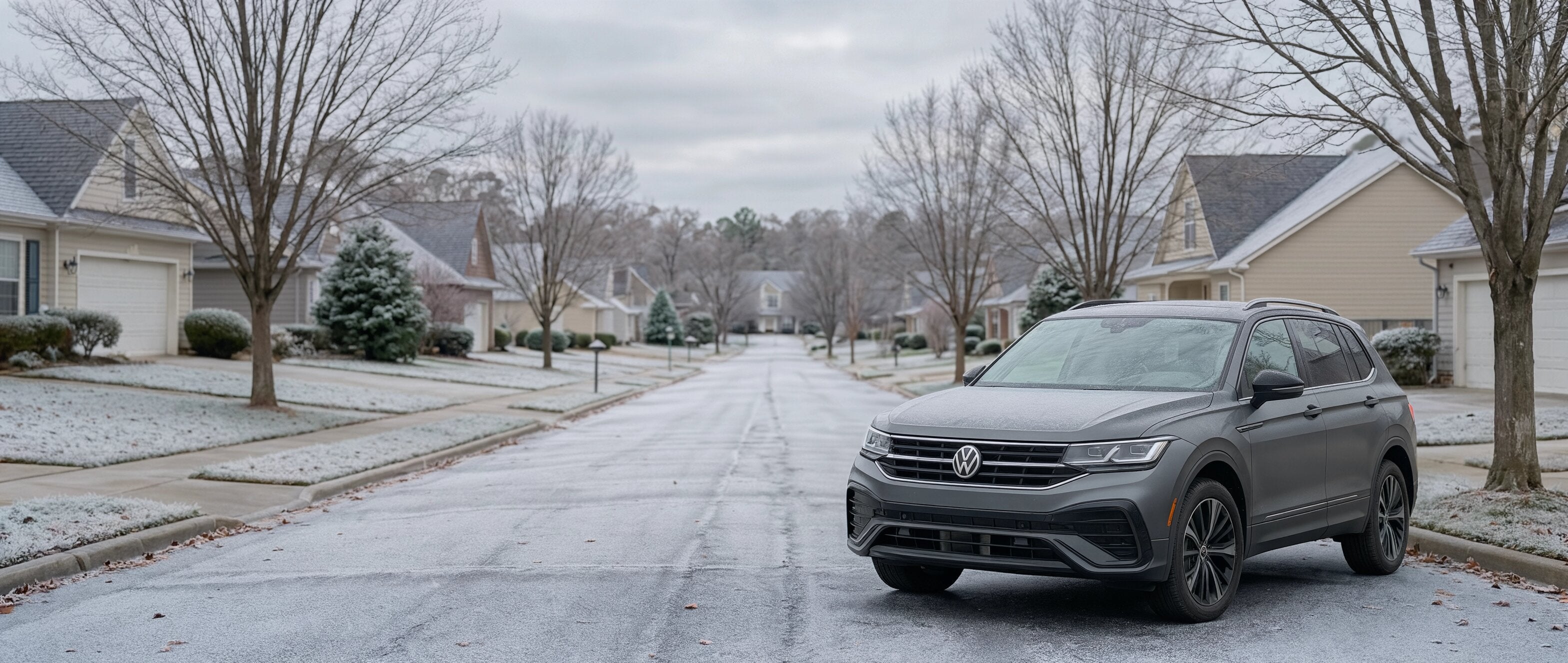
Last January, the Greenville-Spartanburg area saw ice accumulations of up to three-quarters of an inch, overnight lows hitting 15 degrees, and the governor declaring a state of emergency. A Volkswagen that wasn't prepped didn't just face a small headache that week. Picture a stranded-on-I-85 morning instead. Work through this checklist before the next system rolls through Upstate SC.
Browse the 2026 Volkswagen Tiguan on our lot and see which trims come standard with 4MOTION AWD before you start planning your winter setup.
What Goes on the Checklist?
Spartanburg's winter isn't a classic snow-belt situation with months of continuous snowpack, so your checklist has to target a different enemy, and that enemy is ice formed by the freeze, thaw, and refreeze cycle that works over the county's untreated pavement again and again. Overnight temps drop into the teens, everything freezes, the sun comes out for a couple of hours, and then it refreezes overnight on untreated pavement, especially on bridges and overpasses along the I-85 corridor where road crews can't treat as quickly. That freeze-thaw-refreeze cycle is exactly what your prep needs to address.
Print this out, work through it once before December, and you're set.
Volkswagen Winter Prep Checklist. Spartanburg County
- [ ] Check tire pressure cold (see PSI tip below)
- [ ] Inspect tread depth (quarter-test: insert a quarter upside-down into the tread; if you can see the top of Washington's head, it's time)
- [ ] Verify coolant level and confirm coolant type (G13 or G12++ only, not green or blue store-brand)
- [ ] Run a battery load test, especially if the battery is three or more years old
- [ ] Check wiper blades for cracking or skipping; switch to winter blades if needed
- [ ] Top off washer fluid with a winter formula rated below freezing
- [ ] Confirm your spare is inflated (cold drops its pressure too)
- [ ] If your model has 4MOTION AWD, locate the drive mode selector and find Snow Mode before you need it
- [ ] Check brake fluid level and inspect pad condition (ABS and Electronic Stability Control only work as well as the brakes underneath them)
- [ ] Keep a small kit in the vehicle: ice scraper, small blanket, phone charger cable
The Why Behind the Key Items
A checklist without context is just a list of things to feel guilty about not doing, so each item below comes with the reason it earns a spot and why that reason lands harder on Volkswagen vehicles in this particular market. Walk through them once and the whole list stops feeling arbitrary.
Tire Pressure: The One That Catches Everyone Off Guard
Your tires lose about 1 PSI for every 10 degrees Fahrenheit the temperature drops, so a set aired up on a warm September afternoon can read low on a January morning without any puncture or slow leak involved. If your tires were set to 36 PSI at 70 degrees in September, an overnight low in the mid-teens pulls 5 or 6 PSI right out of them. Your TPMS warning light won't even trigger until a tire is roughly 25 percent below the recommended pressure (the federal threshold). So the light comes on, and by the time it does, handling and braking grip are already compromised on a Spartanburg January morning.
Check pressure when the tires are cold. Meaning the car has sat for at least three hours. Use the placard on the inside of your driver's door jamb rather than the number molded into the tire sidewall. Those are two different specs.
The spare gets overlooked easily, and it's sitting in cold air too, so cold drops its pressure the same way it drops the drive tires.
Coolant: This Is the Volkswagen-Specific One
Coolant matters more for Volkswagen owners than for drivers of most other brands, and it genuinely isn't obvious from the outside of the reservoir. Volkswagen uses G13 (purple) or G12++ (pink) coolant formulations that don't interchange with the green or blue coolant at most auto parts stores. Mixing incompatible types can cause precipitation that clogs the cooling system. You can't tell by looking at the reservoir color whether someone has already mixed them. If the level is low, bring it to a shop rather than grab whatever's on the shelf. Close enough does real damage with this one.
Battery: Cold Cuts Capacity
Cold temperatures reduce battery capacity, so a battery that cranks fine all summer can struggle to start the engine when temperatures drop hard overnight. Signs of a weak battery include slow cranking when starting, dimming headlights, or dashboard warning lights. A voltage reading alone won't tell you what you need to know. You want a load test, which applies a draw simulating a cold start and shows you actual capacity under stress. If the battery is three years old or more, test it now rather than in February when you're running late.
4MOTION AWD and Snow Mode: Know What You Have
4MOTION AWD helps significantly with acceleration traction on ice and sleet, though the benefit lives entirely in getting you moving and never in getting you stopped on a glazed road. In normal driving, many Volkswagen models with 4MOTION operate primarily in front-wheel drive to improve fuel efficiency. When the system detects wheel slip or reduced traction, it automatically engages the rear wheels. On a Spartanburg ice morning, that engagement happens fast and without any input from you. The genuine advantage shows up right there.
The limitation is just as real, and worth stating flat. Because all-wheel-drive systems do not add traction during braking, 4MOTION on all-season tires cannot overcome the rubber compound limitations of non-winter tires when stopping on ice. AWD gets you moving. It does not stop you faster. If the roads are glazed, give yourself extra space no matter what drivetrain you're on.
For models like the 2026 Tiguan and 2026 Atlas equipped with 4MOTION and Active Control, there's also a Snow Mode worth knowing. Snow Mode makes the accelerator pedal less sensitive, preventing abrupt acceleration that can cause drive wheels to lose traction on slick surfaces. The transmission shifts earlier into higher gears, typically beginning in second gear rather than first, which is exactly the right behavior when you're pulling away from a stop on a glassy I-85 on-ramp at 7 a.m.
Schedule a winter service check with our team and we'll run a battery load test, verify the coolant, and check your tire pressure all at one visit.
Item | Why It Matters: The Quick Reference
| Checklist Item | Why It Matters for Upstate SC Winters |
|---|---|
| Tire pressure (cold check) | Physics drops ~1 PSI per 10 degrees F; Spartanburg's teen-overnight lows can pull 5+ PSI from a properly set tire |
| Tread depth check | Ice and sleet demand maximum rubber contact; worn tread is the leading cause of unplanned roadside stops in winter conditions |
| Coolant type verification | Volkswagen G13/G12++ is not compatible with generic formulas; mixing clogs the cooling system |
| Battery load test | Cold reduces battery capacity; a voltage reading alone misses marginal batteries that fail on cold starts |
| Snow Mode activation | Softens throttle response and starts transmission in second gear, the right behavior for icy acceleration |
| TPMS awareness | The federal warning threshold is roughly 25% below recommended PSI; by the time the light is on, handling is already affected |
| Wiper blades | Streaking or skipping on a frozen windshield on I-26 at highway speed is not a minor inconvenience |
| Spare tire pressure | Spare sits in cold air too; a flat spare is useless when you need it |
Your Print-and-Go Winter Recap
If you do nothing else before December, start with four moves. Check tire pressure cold on a 40-degree morning, confirm your coolant type before topping anything off, run a battery load test if you're on year three or later, and find Snow Mode on your display before you're sitting on ice wondering where the button is.
Spartanburg County's winter prep story really comes down to those few steps. The county sees one or two hard ice events a season rather than eight months of snowpack, and the drivers who handle them well are the ones who thought through five things in November.
We're on Reidville Road and our service team can run through every item on this checklist in one visit.
Frequently Asked Questions
Does 4MOTION AWD mean I don't need winter tires in Spartanburg?
No, and we'll be direct about that. 4MOTION improves traction during acceleration and helps maintain stability when cornering on slick surfaces. It does not reduce stopping distances on ice. All-season tires on a 4MOTION vehicle still have the same compound limitations in freezing temperatures that any all-season tire has. If you're on a street-to-highway Spartanburg commute and you want the most capable winter setup, 4MOTION paired with winter tires is the combination that actually addresses both acceleration traction and braking grip. The AWD alone handles one half of that equation.
Why did my TPMS light come on overnight after the temperature dropped?
Physics explains it almost every time, and a puncture is rarely the cause. Tire pressure drops approximately 1 PSI for every 10 degrees Fahrenheit the temperature falls, and the TPMS warning threshold is roughly 25 percent below the recommended pressure (the federal standard). An overnight drop from 55 degrees to the mid-20s in Spartanburg can pull 3 to 4 PSI from a properly inflated tire, enough to push one tire just below that threshold. Check the pressure on all four tires cold in the morning, inflate to the spec on your driver's door jamb, and the light should clear. If it comes back after inflating, then look for a slow leak.