
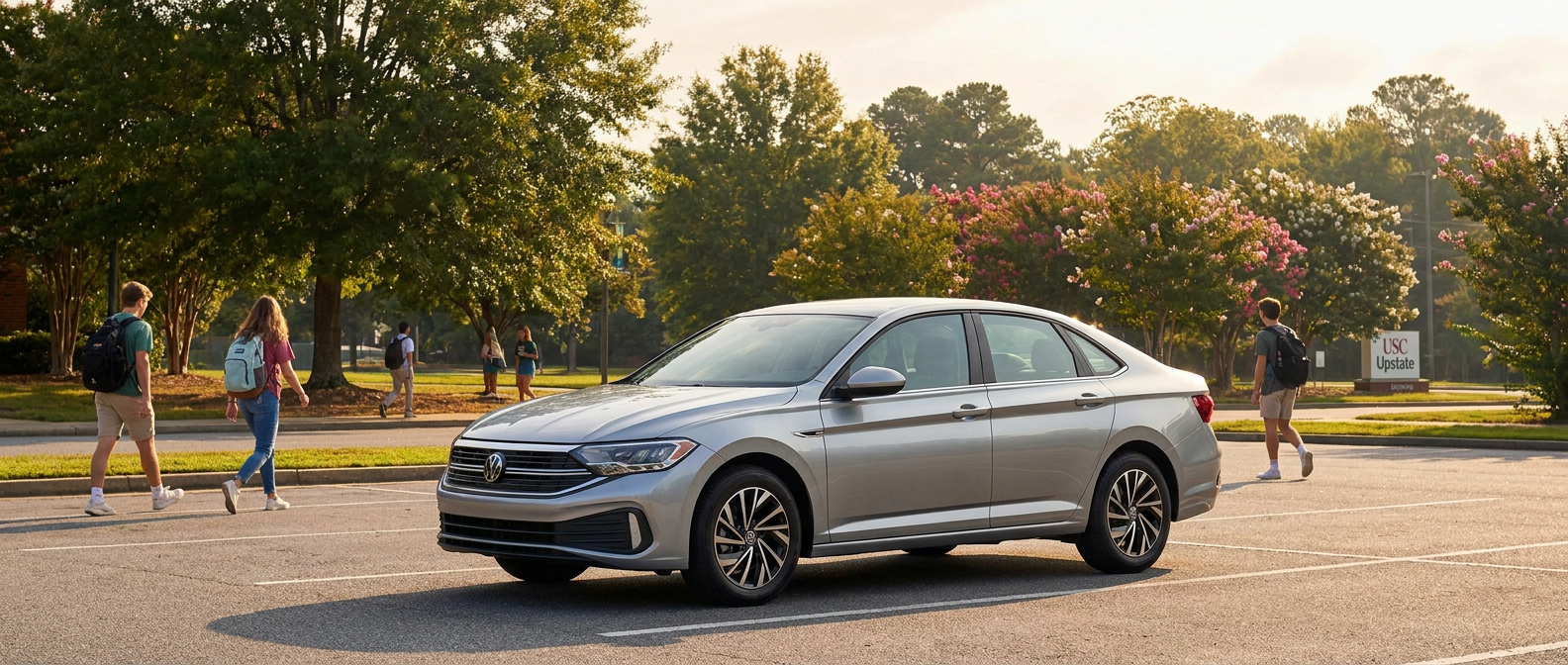
The 22-mile run on I-26 from Woodruff into Spartanburg is genuinely easy driving, but picking the wrong car for it still costs you real money and real frustration over a semester. The 2026 Volkswagen Jetta is probably the most efficient choice in our lineup for a solo student commuter. Need cargo room without giving up much at the pump? That's where the 2026 Volkswagen Taos comes in. And the 2026 Volkswagen Tiguan makes sense if you're hauling more than just a backpack. This checklist helps you figure out which one matches your situation before you walk in, so the conversation on our lot is about specifics instead of basics.
What Goes on the Checklist?
Work through these eight items in order, and each one narrows the field before you ever set foot on the lot.
- Daily mileage and fuel cost reality (How many days per week are you driving?) Five round trips from Woodruff to Spartanburg is about 220 miles per week. At the EPA-estimated 34 mpg combined for the 2026 Jetta, that's a little over six gallons per week on regular 87-octane. Know this number before you walk in.
- Parking situation on campus (USC Upstate is primarily a commuter campus, which means the lots fill up.) A compact sedan fits more easily into the tighter spots on University Way than a full-size SUV does. Sedans and subcompact crossovers park without drama. Bigger vehicles need a plan.
- How much gear travels with you (A laptop bag fits in any of our models.) A music equipment case, art supplies for studio classes, or two roommates' worth of laundry won't. Know your load before you pick a body style.
- Who else drives it (A car shared with a parent or a roommate has different needs than one only you touch.) A manual transmission on the Jetta GLI, for instance, needs everyone in the household comfortable driving stick.
- Road conditions you'll actually face (I-26 between Woodruff and Spartanburg is well-maintained interstate.) You don't need all-wheel drive for this commute in normal conditions. But if you're also driving to family in the upstate foothills in winter, that calculus changes.
- Budget for ownership, not just purchase (Factor in insurance, younger drivers pay more on sportier models, fuel, and the Volkswagen service intervals.) We can walk you through what first-year ownership realistically looks like.
- Financing pre-approval status (Get pre-approved before you arrive.) It shortens the process considerably and gives you a real budget ceiling instead of a guess.
- Trade-in value of your current vehicle (If you're upgrading from a high-school car, get its trade-in value in writing before you shop.) That number directly affects what you can spend.
Why Each Checklist Item Actually Matters
Fuel costs on I-26 are measurable, and they show up on a student budget fast. The EPA rates the 2026 Jetta S at 29 city and 40 highway mpg on regular fuel. Step over to the 2026 Taos FWD and you're at 28 city and 36 highway. The 2026 Tiguan S FWD runs 26 city and 34 highway. Over a full academic year, those differences compound into a real gap. We've seen students overlook this and focus only on how a car looks (understandable), but a Jetta that saves you fuel over two semesters is money worth keeping.
Parking is a hard operational constraint here. Check the campus lots on University Way, because they're busy during peak hours and a sedan or subcompact crossover like the Taos slots into almost any space without overthinking it. The Tiguan isn't large by any standard, but it's a compact SUV whose width matters in a packed row, so plan your parking before you commit to a body style.
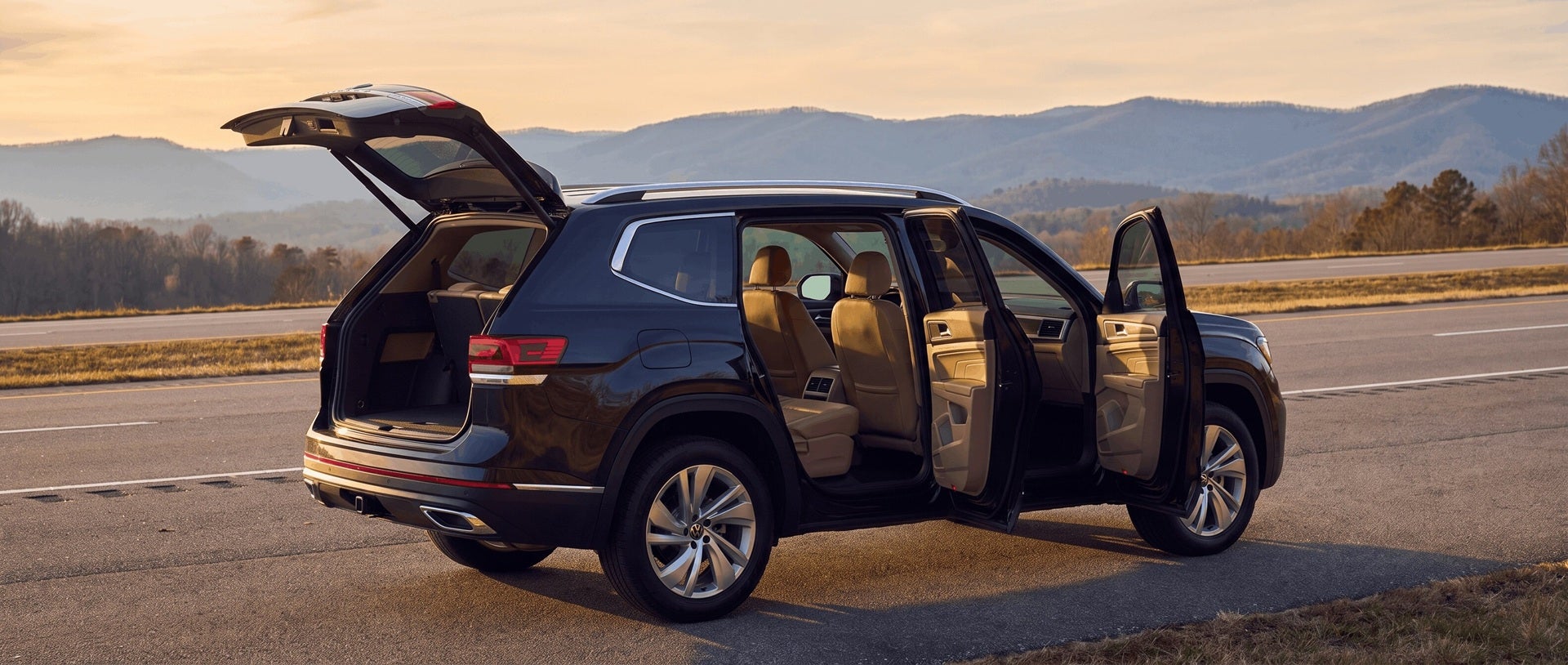
Cargo volume numbers do the talking. The 2026 Taos offers up to 65.9 cubic feet of maximum cargo volume with the rear seats folded (more than enough for a semester's worth of moves or a significant instrument case). Its bigger sibling, the Tiguan, goes up to 69.8 cubic feet measured from behind the front seats. A Jetta is a sedan, so it's trunk-only at 14.1 cubic feet. A sedan can't carry what a crossover can. If you need flexible interior space, look at the Taos or the Tiguan. Travel light and the Jetta trunk is fine.
Sharing a car changes the math. The Jetta GLI is genuinely fun (228 horsepower on a compact sedan platform with great German driving feel), but the six-speed manual transmission is a dealbreaker if a parent also drives the car now and then. The automatic-equipped standard Jetta removes that friction. Know your household before you decide on trim.
All-wheel drive on I-26 is rarely necessary but occasionally right. Upstate South Carolina winters are mild compared to the mountains, and the I-26 corridor from Woodruff clears quickly after ice events. For the straight commute, front-wheel drive handles it. If your life also involves driving up into the Blue Ridge foothills on weekends or visiting family in areas that ice over harder, the available 4MOTION all-wheel drive on the Taos SEL or the Tiguan is worth the conversation. Just know the fuel economy tradeoff. The EPA rates the Taos AWD at 28 mpg combined versus 31 combined for the FWD version.
| Checklist Item | Why It Matters for This Commute |
|---|---|
| Weekly mileage estimate | Sets your real fuel cost floor; the Jetta at 34 mpg combined is the most efficient of the three |
| Parking footprint | Sedan and subcompact crossover fit standard spots without planning; compact SUV needs awareness |
| Cargo requirement | Jetta trunk is 14.1 cu ft; Taos reaches 65.9 cu ft folded; Tiguan reaches 69.8 cu ft from front |
| Household drivers | Manual transmission (Jetta GLI) only if everyone is comfortable; automatics simplify shared ownership |
| Winter driving needs | I-26 corridor is mild; 4MOTION AWD available on Taos SEL and Tiguan if foothills driving applies |
| Pre-approval in hand | Tightens budget before the lot; shortens the visit; removes the guessing |
| Trade-in value confirmed | Real number changes what is affordable; get it in writing first |
| Fuel type expectation | All three models run regular 87-octane, not premium |
Get Pre-Approved Before You Visit
Your Print-and-Go Recap Before You Come In
Run through this before your visit to Steve White Volkswagen Spartanburg, and you'll be ready to make a decision instead of just starting one.
- Calculate your weekly mileage. Woodruff to Spartanburg is roughly 22 miles each way on I-26. Multiply by your actual driving days per week.
- Decide on body style (Sedan (Jetta) for efficiency and compact parking; subcompact SUV (Taos) for cargo flexibility; compact SUV (Tiguan) for maximum interior room.)
- Confirm who drives it and whether a manual transmission works for the household.
- Check your parking situation (campus lot, apartment, or shared driveway; know the footprint you're working with).
- Decide whether AWD is actually needed (for the I-26 commute alone, front-wheel drive is the right call for most students; AWD makes sense if foothills or mountain driving is part of the regular routine).
- Get pre-approved (takes a few minutes and gives you a real number).
- Value your trade-in (so that figure's already in hand when you arrive).
- Know your timeline (the fall semester's already underway; if you need the car for commuting now, tell us that upfront and we'll work around your schedule).
We're on Reidville Road, which puts us at about the midpoint between Woodruff and USC Upstate if you're coming up I-26. Stop in during the week when it's quieter, tell us your checklist answers, and we'll get you into the right car for the right run. Efficiently.
Frequently Asked Questions
What is the most fuel-efficient Volkswagen for a Woodruff-to-Spartanburg commute?
The 2026 Jetta is the most fuel-efficient option in our lineup for this commute. The EPA rates it at 29 city and 40 highway mpg on regular 87-octane gasoline, with a 12.8-gallon tank that gives a combined range of around 449 miles. For a solo commuter covering roughly 22 miles each way on I-26, the Jetta wins.
Do I need all-wheel drive for driving between Woodruff and Spartanburg in winter?
For the I-26 corridor between Woodruff and Spartanburg specifically, front-wheel drive handles typical Upstate South Carolina winter conditions well. The corridor clears quickly after ice events. If your routine also includes driving into the Blue Ridge foothills or areas that see more sustained ice, the available 4MOTION all-wheel drive on the Taos SEL or the Tiguan is worth considering. For the daily commute alone, you'll do fine without it.