

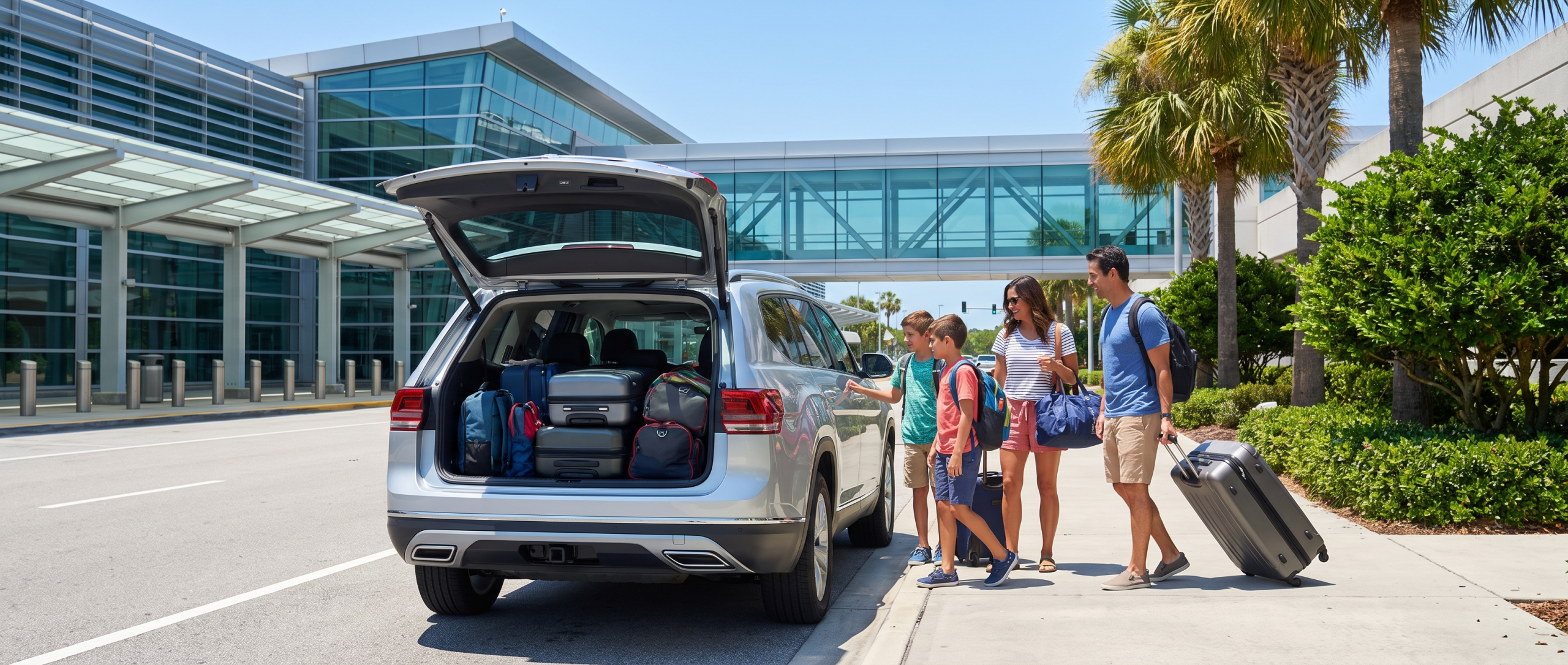
The Atlas earns the top spot for Spartanburg families heading to Greenville-Spartanburg International Airport this summer — and the reason is specific. GSP’s curbside operates as an active-loading-and-unloading zone only, which means fast, efficient bag transfer matters more than you might expect. The Atlas delivers 20.6 cubic feet of accessible cargo room behind its third row and a low, square load floor that lets you pull suitcases without climbing in. Pair that with the 26-mile I-85 corridor drive from Reidville Road and the Upstate SC summer heat, and you have a real use case, not a generic ranking.
Every pick below is evaluated against the same four airport-run criteria: cargo access, passenger space, I-85 highway efficiency, and summer cabin comfort for the whole family.
How These Four VW Models Compare for the GSP Run
| Rank | Model | Best For | Cargo (seats up) | Combined MPG (EPA est.) |
|---|---|---|---|---|
| 1 | Atlas | Big families, 7 seats | 20.6 cu ft | 23 mpg (FWD) |
| 2 | Tiguan | Couples, small families | 26.5 cu ft | 29 mpg (FWD S) |
| 3 | Taos | Solo or duo with carry-ons | 27.9 cu ft | 31 mpg (FWD) |
| 4 | Jetta | Light packers, 2-hour I-85 cruisers | n/a (sedan) | ~35 mpg (hwy est.) |
The Atlas: Three Rows and a Cargo Floor That Loads Fast
When the whole family travels — grandparents, car seats, checked bags, and a stroller — the Atlas is the one VW that handles all of it without compromising anyone’s legroom. Volkswagen built the 2026 Atlas with 20.6 cubic feet of cargo space behind the third row and up to 96.6 cubic feet when both rear rows are folded. The third row’s 50/50 split and the second row’s 60/40 design mean you can carry five adults and still load two rolling suitcases behind the third row without the gate-check shuffle.
The EPA rates the 2026 Atlas FWD at 20 city / 27 highway / 23 combined. Over the 26-mile I-85 run from Spartanburg, the 18.6-gallon tank barely registers the trip. Standard Climatronic three-zone automatic climate control is a genuine asset in an Upstate SC July — the driver can hold 68 degrees up front while rear-seat passengers hold their own zone, so nobody is fighting the vents on the way home from a 6 a.m. international connection.
The Atlas’s low, square cargo opening and standard roof rails are load-bearing advantages at curbside. You are not hoisting bags over a high lip or sliding them through a narrow aperture.
The Tiguan and Taos make sense for smaller parties — see their sections below.
The Tiguan: The Compact Choice With Surprising Cargo
Two adults and a summer’s worth of carry-on luggage fill the Tiguan’s cabin without reaching its limits. The 2026 Tiguan redesign (third generation, launched for 2025) dropped the old optional third row and redirected that space into a deeper, more usable two-row layout — the result is 26.5 cubic feet behind the rear seats, more loadable volume than the Atlas despite being a full class smaller. Wide-opening rear doors and 60/40-split folding rear seats add to the practical picture.
That 34-highway figure runs smoothly on I-85 between Spartanburg and the airport. Heated front seats and available panoramic sunroof round out the summer-travel comfort story. For a couple or a family of three checking one bag each, the Tiguan covers the trip without the bulk of a full three-row hauler.
The Taos: When You’re Traveling Light and Watching Fuel
A weekend trip for two, a couple of carry-on rollers, and 26 miles of Interstate — that is the Taos scenario. The 2026 Volkswagen Taos earns an EPA-estimated 28 city / 36 highway / 31 combined with FWD, the highest combined figure of any gas-powered SUV in the VW lineup. It runs on regular 87-octane fuel, which matters at the pump when summer gas prices climb. The 13.2-gallon tank and 36-mpg highway rating give you an estimated 475-mile highway range without a stop.
Cargo behind the rear seats measures 27.9 cubic feet in FWD models — deceptively large for a subcompact SUV and enough room for two checked-bag-sized rollers. Rear legroom measures 37.9 inches, so a taller teenager in the back seat does not spend the I-85 run knees-to-chin.
The one honest limitation: the Taos carries five and handles luggage for five only when you fold the rear seat flat. For a family of five with bags, the Atlas is the more honest choice.
- The Atlas three-zone climate system holds separate temperatures for front and rear passengers
- The Tiguan’s wide rear doors help with child seat installation and removal in tight airport lanes
- The Taos FWD holds an estimated 475-mile highway range on a single tank of regular fuel
- The Jetta’s sedan trunk keeps bags secure in covered storage — useful in GSP’s surface lots
The Jetta: The Efficient Two-Hour Cruiser for Light Packers
Not every GSP trip requires an SUV. A couple flying carry-on only, a solo driver dropping off a family member, or a professional traveler with one rolling bag — those are Jetta scenarios. The 2026 Volkswagen Jetta is a German-tuned compact sedan with a trunk that keeps luggage out of sight in economy and valet parking, a composed highway ride on I-85, and fuel efficiency that makes the round trip cost very little at the pump.
The Jetta’s 1.5-liter turbocharged engine sends power through an 8-speed automatic and delivers strong highway cruising range. Its highway fuel economy figure exceeds most compact sedans in the class — making the Spartanburg-to-GSP-and-back run genuinely inexpensive on gas. Adaptive cruise control comes standard on upper trims, which makes the 26-mile highway leg feel relaxed in summer traffic.
The Jetta fits the driver who values the German refinement of a sedan and simply does not need three rows of seats for a two-person summer trip.
Connect with us

