

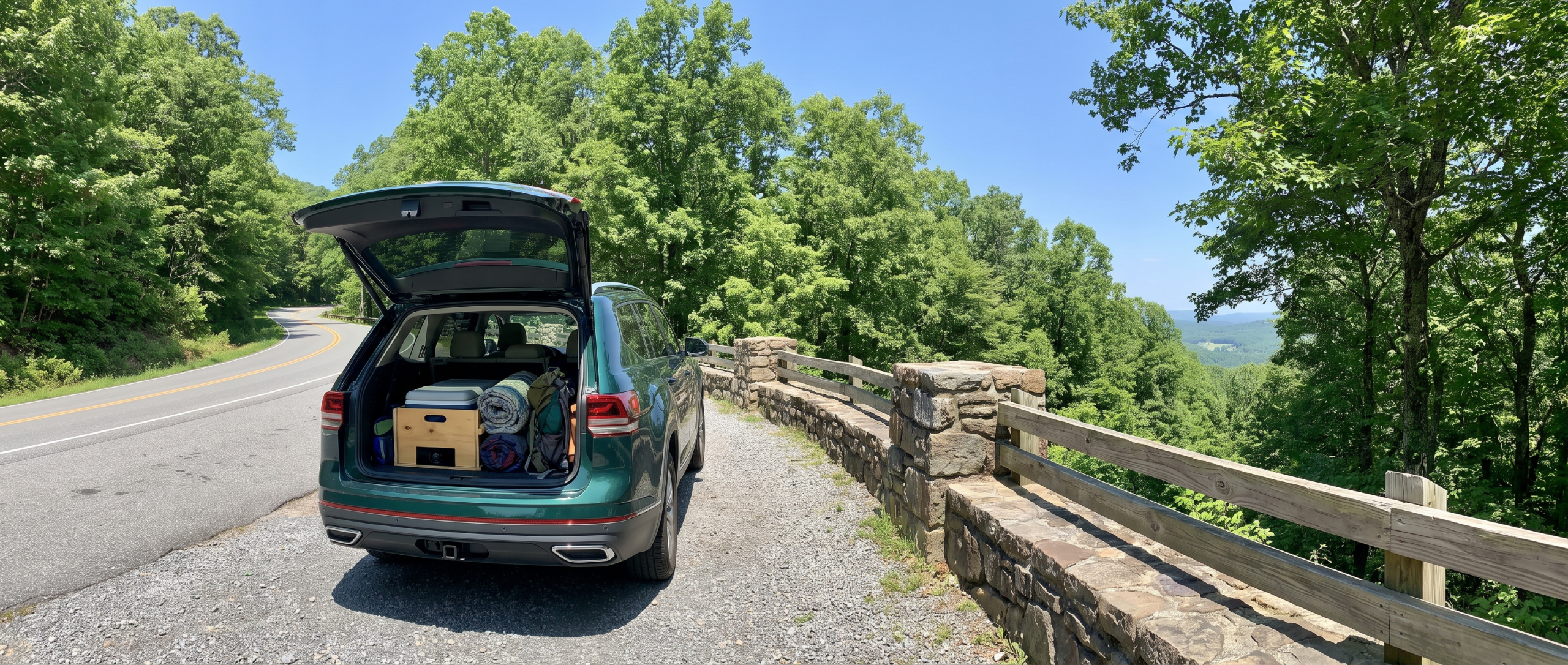
SC Highway 11 — the Cherokee Foothills National Scenic Byway — runs 120 miles through Upstate South Carolina from the Georgia line near Lake Hartwell all the way to Gaffney, passing peach orchards, state parks, and views of the Blue Ridge foothills that most I-85 drivers never see. It is one of the most naturally rich drives in the Southeast, and it starts practically in your backyard. The setup that determines how well the trip goes, though, happens before you back out of the driveway. Volkswagen’s current lineup — from the three-row Atlas to the redesigned Tiguan to the electric ID. Buzz — gives Upstate drivers real cargo flexibility, a capable climate system, and standard driver assistance features that make a summer day trip feel genuinely effortless. This guide walks you through the full pre-trip setup, so the first thing you encounter on SC 11 is a mountain view, not a scramble for sunscreen at the bottom of the luggage pile.
What You Need Before You Start
A successful setup is mostly a planning task, not a gear-acquisition task. Before you touch the liftgate, have these items confirmed or in hand.
| Item | Why It Matters for a Spartanburg Summer Trip |
|---|---|
| Final headcount and seat configuration | Determines whether row 2 or row 3 folds; sets the cargo floor height on the Atlas |
| Full tank of fuel | Atlas FWD EPA-estimated 27 mpg highway means roughly 500 miles on a full tank; SC 11 is 120 miles with limited gas options mid-route |
| Cabin air filter status | Upstate SC summer pollen and humidity load the filter quickly; a clogged filter strains the Climatronic system |
| Tire pressure (cold) | Summer heat increases tire pressure roughly 1 psi per 10 degrees F; check cold before loading |
| Travel Assist on or confirmed | Atlas and Tiguan standard IQ.DRIVE suite includes Travel Assist for highway segments; confirm it is enabled in the driver profile |
| Cargo anchors and tie-down loops located | Atlas cargo floor has integrated tie-down hooks; know where they are before loading heavy items |
| Phone mount or dashboard navigation ready | SC 11 has limited cell coverage in stretches; download the offline map before departure |
Setting Up Your VW Cargo Zone in Five Steps
This is the step that most drivers skip until they are already in the parking lot at the trailhead, surrounded by bags that will not close. Do this at home, on a flat surface, before the cooler goes in.
Step 1: Decide your configuration and lock in the seats.
The number of passengers traveling determines everything that follows. In the Atlas, leaving the third row up gives you substantial cargo space — enough for a soft cooler, two medium duffels, and a day-pack. Fold the third row flat and that expands significantly, the practical sweet spot for a family of four with full luggage. If you are traveling as a couple or hauling gear for a multi-day trip, folding both rear rows opens extensive load floor space. The Atlas third row uses a 50/50 split fold, so you can keep one rear seat up for a passenger or a dog while the other half stays flat. Make this call first and do not change it mid-pack.
In the 2025 Tiguan, the two-row layout is already decided for you: substantial space behind the rear seats for a weekend trip with all five seats occupied, or expandable space with the 60/40-split rear row folded. The Tiguan’s cargo floor sits notably flat when the rear seats fold, which matters when sliding in a hard-shell luggage case or a long bike bag.
Step 2: Place the heaviest items at the floor, forward of the axle line.
Coolers, tool kits, and full water jugs go in first, centered low, and pushed as far forward in the cargo zone as the configuration allows. This keeps the vehicle’s handling balance stable on SC 11’s curves and prevents the cargo from shifting forward under hard braking — an issue that becomes uncomfortable at highway speeds on the I-85 approach to the byway.
Step 3: Build vertically in the soft-goods zone.
Once the heavy anchor items are down, stack soft bags and pillows vertically against the cargo side walls. Packing cubes or compression bags compress clothing efficiently and let you stack without losing stability. Leave the center lane clear from liftgate to seatback so rear visibility stays unobstructed and so any item grabbed on the road is accessible without a full unpack.
Step 4: Set the Climatronic climate system for summer conditions.
In Upstate SC in late June, interior cabin temperature after parking in direct sun can spike well above 110 degrees F within minutes. Before departure — or immediately on startup — set the three-zone Climatronic (Atlas) or the dual-zone climate system (Tiguan) to max cooling for the first five minutes, then dial back to a sustainable setting once the cabin reaches a comfortable temperature. Crucially, set rear zone controls separately for any passengers in row 2 or row 3; the Atlas Climatronic three-zone system lets each zone run independently so the driver is not overcooling to compensate for a warm back seat. For ID. Buzz drivers: the cabin pre-conditioning feature allows you to cool the vehicle from a companion app while still plugged in, preserving range before you even start the drive.
Step 5: Run through the IQ.DRIVE settings in the vehicle menu.
The Atlas, Tiguan, and ID. Buzz all carry Volkswagen’s IQ.DRIVE suite as standard equipment. Before leaving, confirm Travel Assist is active (it combines adaptive cruise control with lane-keeping assist for highway segments), check that Front Assist collision warning sensitivity is set to your preference, and verify the Emergency Assist feature is enabled. On the SC 11 corridor itself, the byway has significant stretches of two-lane road with limited visibility on curves — you will be in a primarily driver-engaged mode, not highway assist mode — but the I-85 segments connecting Spartanburg to the byway are exactly the scenario Travel Assist is designed for.
Your Road-Trip Checklist Before Pulling Out of the Driveway
Print this or save it to your phone. Run through it the evening before, not morning-of.
- [ ] Seat configuration locked in (third row up, half-fold, or fully flat)
- [ ] Heaviest items loaded first, tied down with cargo anchors
- [ ] Soft goods packed vertically, center lane clear to liftgate
- [ ] Climatronic rear zones set independently; or ID. Buzz pre-conditioned via app
- [ ] Full fuel tank confirmed
- [ ] Tire pressure checked cold before loading
- [ ] IQ.DRIVE Travel Assist confirmed active in driver profile
- [ ] Offline map of SC Highway 11 downloaded (cell coverage is patchy mid-route)
- [ ] Cabin air filter checked — summer pollen in Upstate SC clogs filters fast
- [ ] Emergency roadside kit accessible (not buried under the cooler)
- [ ] Sunscreen and water in the front cabin, not the cargo zone
- [ ] Tie-down hooks used for any heavy item in the load
Book a pre-trip service check at Steve White VW
A Quick Recap Before You Head Out
The setup process above takes about 20 minutes the first time and closer to five on return trips once it becomes habit. The core sequence is always the same: configuration before packing, heavy items anchored first, climate set proactively, and IQ.DRIVE confirmed. That sequence applies whether you are loading the Atlas for a full family run down SC 11 toward Table Rock or fitting the Tiguan for a solo overnight. The Cherokee Foothills Scenic Byway is a genuinely distinctive drive — it has been featured in publications including National Geographic and Southern Living — and the vehicles in the VW lineup are well-suited to the way Spartanburg and Upstate SC drivers actually use them: real cargo room, capable standard tech, and a European road manner that holds together on a two-lane with elevation changes. All that said, none of it matters if the cooler is blocking the rearview mirror on exit from Reidville Road.
Connect with us

