
Fall in Upstate SC is subtle. No ice, no real snow season, and the leaves are only just turning on SC Highway 11 through the Blue Ridge foothills. Subtle is exactly what makes this season tricky for tires. Spartanburg County overnight lows are already touching the upper 40s in October, and by November they'll average around 42 degrees Fahrenheit. Call it a 30-degree swing from our summer highs. Physics takes that swing and quietly steals 2-3 PSI from every tire on your Volkswagen, and no warning light appears on the dash to tell you. Most online guides skip that part entirely, and it's the part we watch play out every fall on the service drive at Steve White Volkswagen Spartanburg.
Below, let's keep this to what actually matters, in plain terms.
- Pressure first: Check PSI against your door-jamb placard (not the tire sidewall). Recommended cold inflation varies from 36 to 41 PSI depending on your Volkswagen model and trim.
- Tread reality: The legal minimum is 2/32 of an inch, but 4/32 is the threshold that gives you wet-road confidence in fall rain. A quarter works better than a penny for catching it in time.
- TPMS won't save you: The indirect TPMS system in Volkswagen vehicles triggers at roughly 25% below its stored baseline. A seasonal 2-3 PSI drop won't light the dash. Manual checks matter.
- Sidewall check: Five years of South Carolina summer heat accelerates rubber oxidation. Check for cracking before it becomes a roadside problem.
- Rotation timing: Fall is the right moment to rotate if you're within 1,000 miles of the interval, so wear is even before winter rain arrives.
What actually matters when choosing fall tire care for your Volkswagen?
Four variables do the heavy lifting in fall tire care for your Volkswagen, and they operate together as one system, so skipping any single one of them leaves the other three unable to fully cover the gap it opens before the winter rain arrives. Our service team runs this same checklist whenever a Volkswagen comes in. It's the starting point.
| Check | Best For | Key Spec | Honest Tradeoff |
|---|---|---|---|
| Cold inflation pressure | Every Volkswagen, every fall | Door-jamb placard (varies: 36 PSI on the 2026 Atlas and Jetta; 36-41 PSI on the 2026 Tiguan and Taos by trim) | Specs differ more across the lineup than most drivers expect. One generic PSI covers none of them correctly. |
| Tread depth (penny + quarter test) | Anyone driving in fall rain | 4/32" for wet roads; 2/32" is the NHTSA legal floor | Penny test only catches 2/32". A quarter reveals the safer 4/32" threshold while you still have time to act. |
| Sidewall integrity | Vehicles with tires over 4-5 years old | Visual check: no cracks, bulges, or embedded objects on all four tires plus the spare | South Carolina summer heat and UV exposure accelerate rubber oxidation. A tire that passes tread depth can still have compromised sidewall structure. |
| TPMS reset status | After any inflation adjustment | The indirect TPMS system in Volkswagen vehicles reads wheel-speed differentials via the ABS sensors. It needs a manual reset after you inflate | The TPMS warning threshold is roughly 25% below the stored baseline. That's well below where a 2-3 PSI fall drop lands. A yellow TPMS light in fall means you're already well behind. |
The Tiguan and the Atlas both run the indirect TPMS design shared across Volkswagen vehicles. Your door placard's PSI changes with trim and tire size, and the system itself doesn't know what your target pressure is. It only knows when rotation rates diverge enough to flag a problem. So trust the gauge, not the light.
Cold inflation pressure: why your door jamb is the only number that matters
Your door-jamb placard is the one number worth trusting for cold inflation pressure, because the figure molded into the tire sidewall is simply the maximum the casing can safely hold, and that ceiling sits well above the target Volkswagen set for your specific car. Plenty of shops default to 32 or 35 PSI across makes because it's convenient, and that's exactly where underinflation sneaks in.
On 2026 Volkswagen vehicles, the spread runs wider than you'd guess:
- 2026 Atlas: 36 PSI front and rear across all trims
- 2026 Tiguan: ranges from 36 to 41 PSI depending on trim and tire size (the 2026 Tiguan SEL runs 36 PSI on its 235/55R18 tires; the Comfortline 4Motion runs 41 PSI on 215/65R17s)
- 2026 Taos: 36 to 41 PSI depending on trim
- 2026 Jetta: 36 PSI
Those differences matter. An Atlas inflated to the Tiguan Comfortline's 41 PSI spec will show accelerated center-tread wear. A Tiguan filled to a generic 35 PSI default runs underinflated, which generates heat through sidewall flexion, the mechanism behind tire failure well before you'd ever notice an outcome.
Fall timing matters here because of the Spartanburg temperature swing. Tire pressure drops about 1 PSI for every 10-degree Fahrenheit decrease in temperature, per established physics. Spartanburg County overnight lows in October average around 47 degrees Fahrenheit, set against summer highs that hit 90 degrees Fahrenheit back in July. A tire you inflated correctly in July can reach a cold October morning reading 2-3 PSI low. On the I-85 corridor, where wet pavement and highway speeds combine in fall rain, that loss isn't trivial.
Check pressure cold, fill to your placard spec, then reset the TPMS system so it relearns the new baseline. The reset procedure varies a little by model year. Our service team can walk you through it, or we'll handle the reset during a fall inspection.
You'll want a few habits in mind as you work through the checklist:
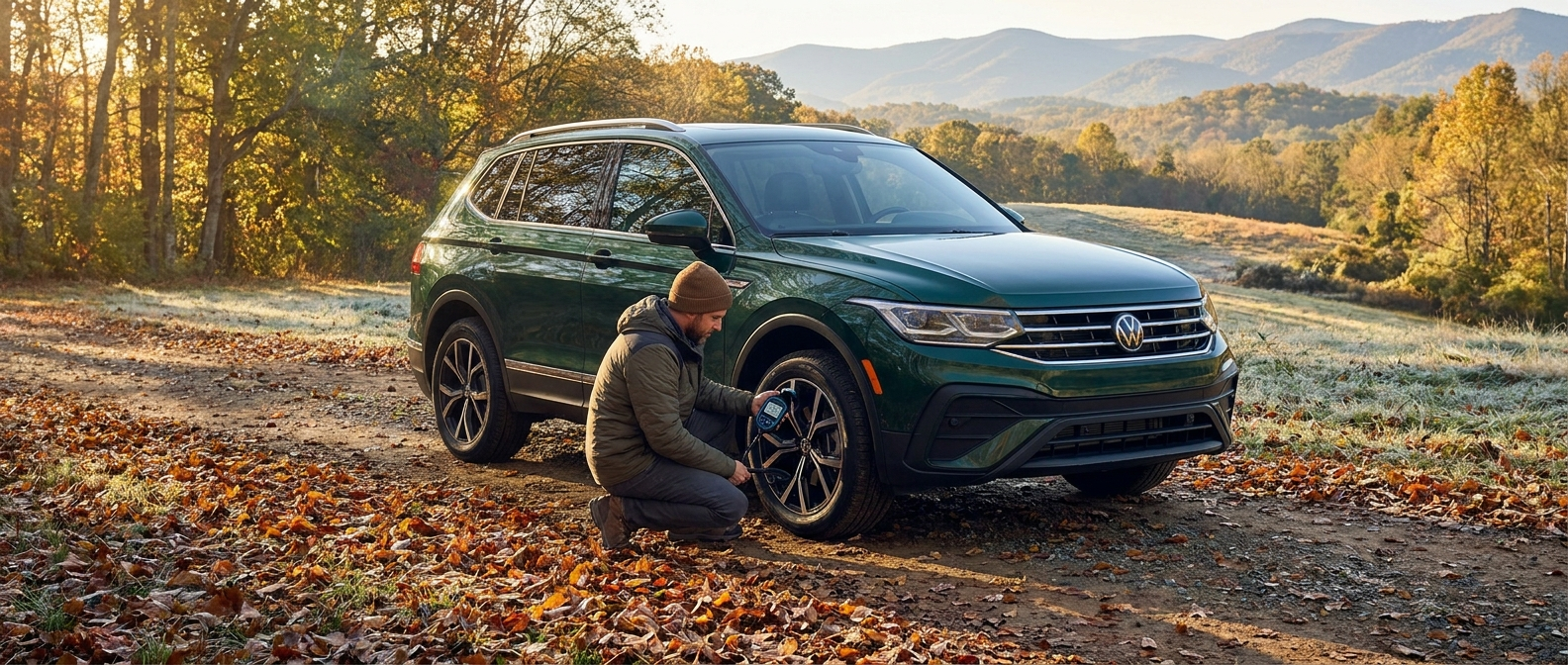
- Keep a quality digital gauge in the door pocket. Pencil gauges drift and read low. A digital gauge accurate to 0.5 PSI is inexpensive, and it'll take the guesswork out.
- Check pressure in the morning before the day's first drive, well before any errands.
- The spare needs pressure too (it's easy to forget until the morning you actually need it).
- Rotate tires at the same time if you're within about 1,000 miles of your interval. Uneven wear heading into the rainy months means uneven traction across the four corners.
- If your TPMS light does come on after filling, drive a few miles at normal speed. Indirect systems often need a short reset drive before they'll clear the light.
Match your tire gear to how you actually drive in Upstate SC
The fall equipment question worth weighing in Spartanburg County rarely comes down to dedicated winter tires, and it has far more to do with whether the all-seasons already on your car still grip the way they used to. Both deserve a look, but the second one matters more in our climate. That's where we'd start.
South Carolina doesn't demand dedicated winter tires the way the mountain states do. All-season tires still have a lifespan measured in tread depth as much as in miles, and fall is when the rubber on summer-driven vehicles reveals the cumulative wear of the hotter months. The Jetta and Taos are common daily drivers in Upstate SC, and both run all-season equipment from the factory. If your tread sits at or near 4/32 of an inch, you're entering the range where wet stopping distances start to lengthen in fall rain, even before the tread reaches the legal floor.
NHTSA sets the replacement floor at 2/32 of an inch, which you can check with the penny test. Insert a penny into the tread groove with Lincoln's head pointing down and toward you. If you can see the top of his head, you're at or below the legal minimum. For fall prep, the quarter test does more for you. Insert a quarter the same way, and if you can see the top of Washington's head, you're at 4/32 of an inch or less. That's the wet-road warning zone.
The honest tradeoff is simple enough. All-season tires in good condition handle Upstate SC fall and winter conditions well. Once tread drops below 4/32, replacing before the new year isn't really optional, and the question becomes timing. Do it now, or accept reduced wet-road grip until you do.
Frequently Asked Questions
Does the TPMS in Volkswagen vehicles light up when tires lose pressure in fall?
Not necessarily. The indirect TPMS system in Volkswagen vehicles monitors wheel-speed differentials through the ABS sensors rather than reading actual PSI. It flags a warning when one or more wheels spin at a noticeably different rate, which typically happens at roughly 25% below the stored pressure baseline. A 2-3 PSI drop from overnight fall temperatures falls well short of that threshold, which means your tires can be meaningfully underinflated on a cold Spartanburg morning without a single warning light appearing. That's why we recommend a manual check with a gauge every time the overnight temperatures drop significantly, rather than waiting for the TPMS to flag it.
What's the difference between the penny test and the quarter test for tread depth?
Both use coins as tread depth gauges. The penny test checks for the NHTSA legal minimum of 2/32 of an inch. Insert a penny with Lincoln's head pointing down, and if you can see the top of his head, the tire is at or below the legal floor and should be replaced. The quarter test checks the more useful safety threshold of 4/32 of an inch. Insert a quarter the same way, and if you can see Washington's head, you're in the range where wet-road stopping distances begin to lengthen noticeably. For fall driving in Spartanburg County, the quarter test is the more practical check, because it catches the wear zone before you've already hit the legal minimum.