
If you've been weighing a used Volkswagen in Upstate SC, here's a detail most buying guides skip. Some model years carry more baggage than the trunk can hold, and the wrong one spends October in a service bay instead of on the paved loop at browse our pre-owned Volkswagen inventory.
At Steve White Volkswagen Spartanburg, we watch these cars come and go every season. A Golf GTI that rolls in looking immaculate but wearing a complaint-heavy 2017 build date is a different story from a clean 2020 or 2021 at the same asking figure. Fall is the one season when Spartanburg's light turns genuinely special, and Hatcher Garden's mix of conifer evergreens and turning hardwoods rewards a camera and a well-chosen car. So let's sort out which years to target, which to leave on the lot, and why.
- Golf GTI sweet spot: 2020 and 2021 (Mk7.5 generation, fewest NHTSA complaints across the tracked decade)
- Jetta sweet spot: 2021-2023 (seventh-generation stability after the 2019 model's documented transmission and reliability issues)
- Tiguan sweet spot: 2022-2024 (second-generation refinement; the 2018 carried the highest single-year recall count for the nameplate)
- Years to watch across all three: 2017-2019 Golf GTI (high complaint volume); 2018-2019 Tiguan (13 NHTSA recall campaigns each year); 2019 Jetta (NHTSA recall 23V604, ignition switch)
- Hatcher Garden is free, open dawn to dusk, and the fall palette peaks in mid-to-late October. Right now is the window
Which model years are the sweet spot for a used Golf GTI?
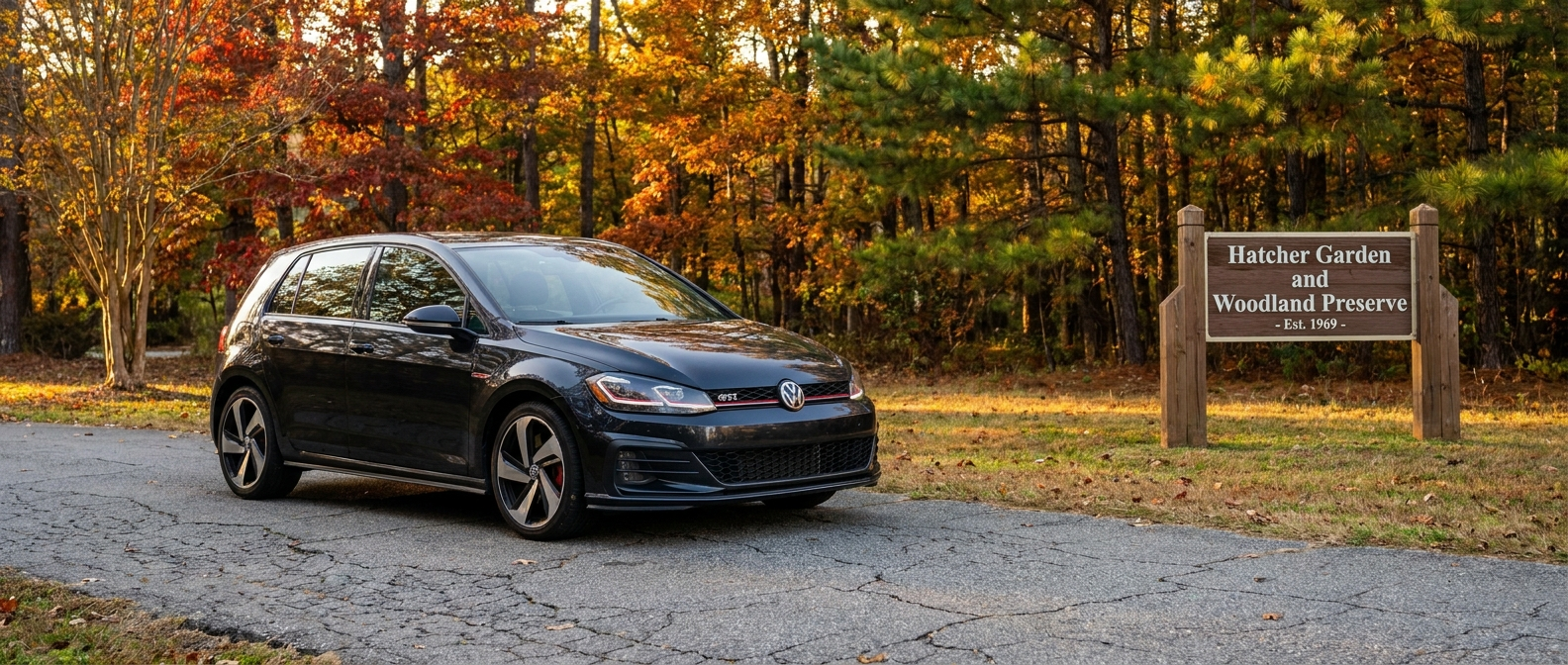
The 2020 and 2021 Golf GTI are the years we steer drivers toward first, since NHTSA's own complaint database shows the 2020 drew the fewest owner complaints of any Golf GTI year tracked across the 2016-2026 decade, with the 2021 a close second behind it. Both belong to the Mk7.5 generation, which Volkswagen facelifted in 2018 with revised LED taillights, a wider digital instrument cluster option, and the same turbocharged 2.0-liter EA888 engine, a proven unit with a longer service history than the Mk8 that replaced it for 2022.
That matters at Hatcher Garden for a practical reason. The one-mile paved loop at the garden works beautifully as a low-speed photo approach. You drive up, park along the edge, and the conifer collection's 200-plus species hand you an evergreen backdrop while the surrounding hardwoods turn amber and rust. A 2020 or 2021 GTI in Tornado Red or Deep Black Pearl reads sharply against that mix. The Mk7.5 also sits lower than a crossover, a proportional stance that keeps the garden's gazebo, stone bridges, and waterfall in the background rather than cropped out.
| Model Year | Generation | NHTSA Complaint Signal | What to Look For |
|---|---|---|---|
| 2016-2017 | Mk7 | Highest complaint volume (232 in 2017 alone per NHTSA) | Engine and electrical complaints; approach cautiously |
| 2018-2019 | Mk7.5 | Moderate; 2019 carries ignition switch recall 23V604 | Confirm recall completed via VIN before purchase |
| 2020-2021 | Mk7.5 | Cleanest years in the decade per NHTSA data | Sweet spot: settled platform, resolved recalls |
| 2022 | Mk8 | Second-highest complaint volume in tracked range | New platform growing pains; wait for used prices to reflect risk |
| 2023-2024 | Mk8 | Lower than 2022; Mk8 maturing | Solid if budget allows; confirm no open campaigns |
The 2022 Golf GTI is the one year we'd slow down on. It logged the second-highest complaint count in the decade per NHTSA data, reflecting the Mk8's first year in the US market. New-generation launches do that. It's not necessarily a deal-breaker long term, but for a used buyer who wants the most settled version of the car, 2020 or 2021 is the cleaner call today.
Which years should you watch out for on the Tiguan and Jetta?
The 2018 Tiguan is the year to watch most closely, because NHTSA records show that model year generated the highest single-year recall count in the Tiguan nameplate's history, a recall density heavy enough to slow a used purchase down no matter how clean the car looks sitting on the lot. The 2019 Tiguan carried 13 NHTSA recall campaigns of its own, covering airbags, fuel systems, structural concerns, and suspension. Skip both if cleaner options at similar mileage sit nearby.
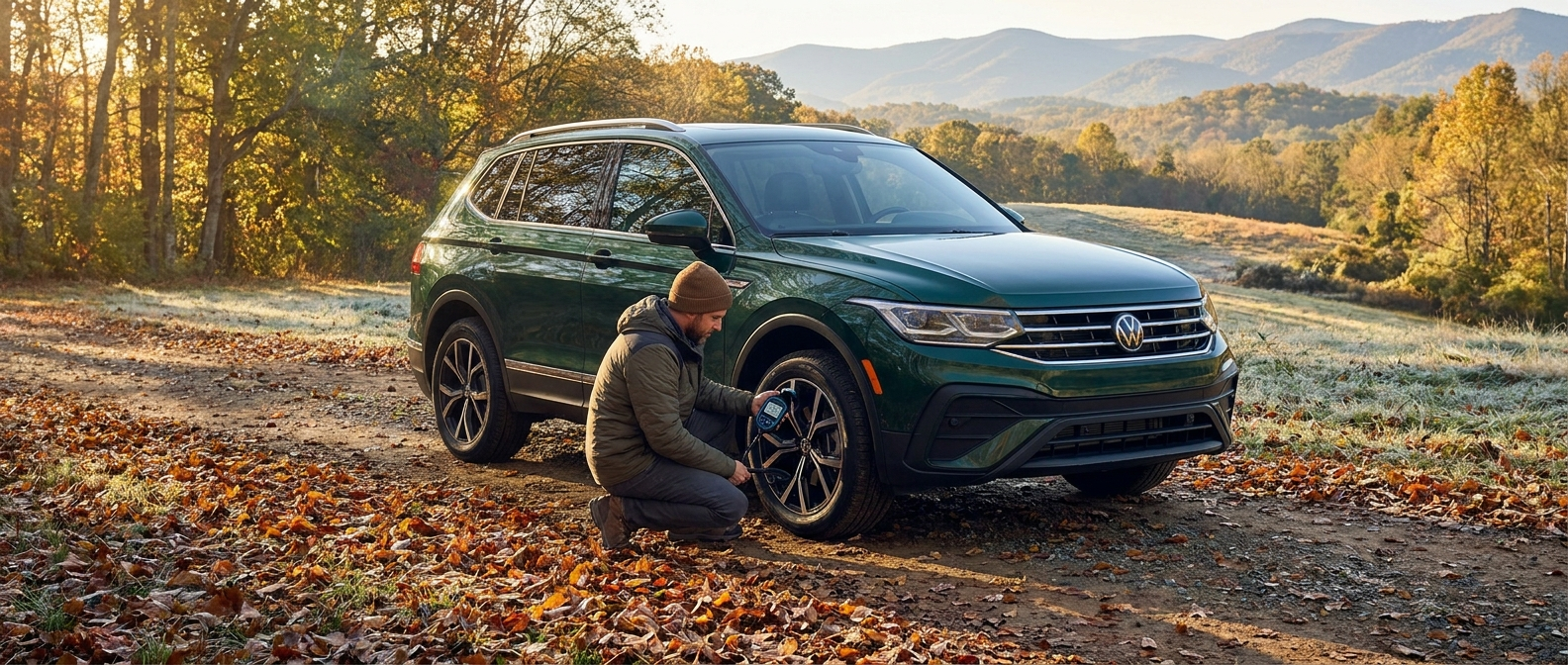
The Tiguan in its 2022-2024 range is a different vehicle in terms of resolved complexity. By then the second generation had found its footing, recall counts dropped noticeably against the 2018-2019 cluster, and the interior refinements from the 2021 refresh carried into those years. For fall photoshoots, the proportions of the Tiguan work better than you'd expect in a compact SUV. Wide enough to anchor a frame against Hatcher Garden's pond and gazebo, it never overwhelms the scene the way a three-row would.
For the Jetta, NHTSA issued recall 23V604 covering 2019 and 2020 Jetta vehicles with ignition switches manufactured between September 2018 and December 2019. A used 2019 Jetta isn't automatically a pass, but confirm via VIN that the campaign was closed out. The seventh-generation Jetta launched for 2019, and the first year of a new generation (this is common across the industry) almost always surfaces in the complaint record. The 2021 and newer Jetta is where the platform settled.
Browse the Jetta lineup if the sedan proportion is what you're after. At Hatcher Garden the low roofline of a sedan actually reads well against the canopy paths and wooden bridges. It doesn't fight the scene.
What should a buyer actually look for by year?
By this point the photoshoot framing stops being cute and turns genuinely useful, since the Volkswagen vehicles that hold their looks at a place like Hatcher Garden tend to be the well-maintained ones, not simply the ones wearing a strong model year. A 2020 GTI that skipped oil changes is not the same car as a 2020 GTI with full service records. The model-year data tells you where to start the search. The VIN check and service history close it.
Here's how we'd match the year to the buyer:
Used Golf GTI buyer who wants the driving experience with the cleanest history: Target 2020 or 2021. The EA888 engine responds well to regular maintenance, and the Mk7.5 platform is well understood by independent shops and by our service team if you want Volkswagen-trained hands on it going forward.
Compact SUV buyer who wants Tiguan practicality without early-generation headaches: Target 2022 or 2023. You'll pay a modest premium over a 2018, but the 2018 carries a recall history that the 2022 doesn't. That gap shows up on resale, too.
Sedan buyer drawn to the value proposition of the German engineering of the Jetta: The 2021 and 2022 Jetta is the settled version of the seventh generation. Avoid the 2019 unless the ignition-switch recall is confirmed resolved. From 2021 on, it's a more straightforward used buy.
All three fit the Hatcher Garden context, each for its own reason. The GTI reads athletic against the garden's stone-and-wood bridge details. The width of a Tiguan pairs well with the broader pond overlooks, and the clean sedan lines of the Jetta work in the dappled shade of the conifer paths. Our pre-owned inventory changes regularly, so if you're shopping this fall window, now is the practical moment to look.
Frequently Asked Questions
Which used Volkswagen Golf GTI years have the cleanest NHTSA complaint record?
The 2020 and 2021 Golf GTI drew the fewest owner complaints of any years tracked across the 2016-2026 range per NHTSA complaint data. Both belong to the Mk7.5 generation and represent the most complaint-settled version of the platform in the used market today.
Is the 2018 Volkswagen Tiguan a good used buy?
The 2018 Tiguan is one we approach cautiously. Per NHTSA records, it generated the highest single-year recall count across the Tiguan nameplate's tracked history. If you're comparing a 2018 against a 2022-2024 example at similar mileage, the 2022 carries a meaningfully shorter recall history and is the cleaner starting point.
Is Hatcher Garden actually a practical photoshoot location for a used car outing in fall?
Yes, in a real and specific way. Hatcher Garden and Woodland Preserve is free, open dawn to dusk every day of the year, and features a one-mile paved loop with ponds, waterfalls, stone and wooden bridges, a gazebo, and a conifer collection of more than 200 species. In mid-to-late October the surrounding hardwoods turn while the conifers stay green, which gives you layered color rather than a one-note backdrop. Parking is on-site and unrestricted.