
Spartanburg's cool season sits closer to an EV range sweet spot than to an EV range problem, and that's the bottom line for ID.4 drivers here. The hardest cold-weather penalty on the ID.4 kicks in below freezing. Our winters mostly don't go there. Plan the charge right, and a cool Upstate SC commute becomes one of the better real-world cases for this car.
That said, there's a real tradeoff. We'll name it plainly.
Where Do You Charge and When?
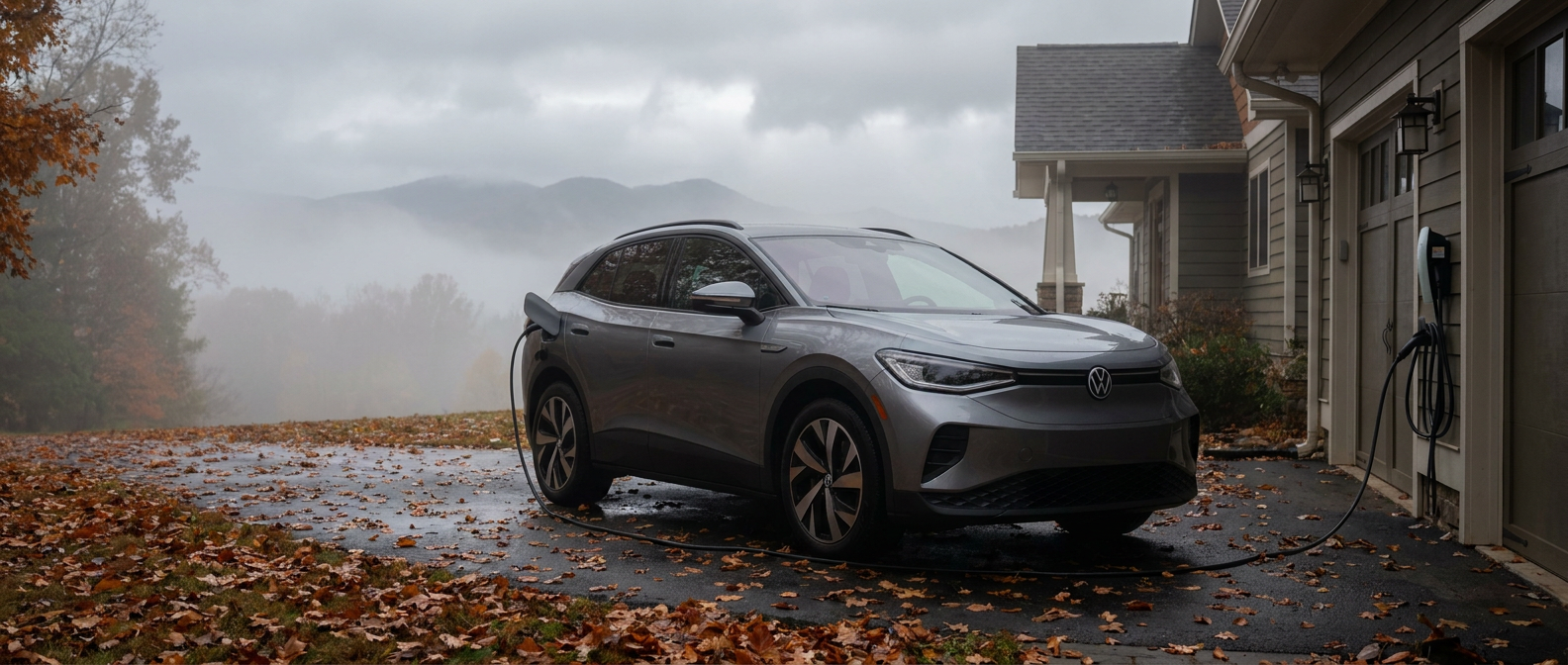
Charge at home on Level 2 overnight and you'll cover almost any Upstate SC commute before you back out of the driveway, with the Tesla Supercharger at Winchester Place standing by for the long days when a daily top-up isn't enough. Get the timing right and the rest is just driving.
Spartanburg's cool season runs from late November through late February, with average daily highs in the mid-50s Fahrenheit and overnight lows that typically sit in the mid-30s. The EPA rates the 2026 Volkswagen ID.4 Pro at 291 miles of range under ideal conditions. Real-world driving data at sustained temperatures in the 40-55 degree Fahrenheit range, which is where Spartanburg spends most of its cool months, points to about a 10% efficiency reduction at those temps. A 10% dip isn't anywhere near the 25-35% loss that occurs below 32 degrees Fahrenheit. Spartanburg's average January low is around 34 degrees Fahrenheit. Deep cold snaps happen, but extended hard freezes stay the exception, not the rhythm.
The table below maps out the practical charge decision you'll make as an Upstate SC commuter.
| Scenario | Charge location | Timing | Realistic range at departure | Key move |
|---|---|---|---|---|
| Daily I-85 or I-26 commute, under 60 mi round trip | Home Level 2 (240V) | Overnight, 7-8 hours | 240-270 mi | Schedule charge to finish near your alarm, not midnight |
| Long day: Spartanburg to Greenville and back with errands | Home Level 2; Supercharger as backup | Top up at home; fast charge only if under 100 mi remaining | Full day covered comfortably | Tesla Supercharger at Winchester Place, 8 stalls, 24/7, off I-26 |
| Cold snap forecast below 35 degrees Fahrenheit | Home Level 2 with app preconditioning | Precondition 20-30 min before departure | Recovers roughly 10-15 mi vs a cold-soaked battery | Battery warms on grid power, not your driving range |
| Road trip: Charlotte, Asheville, or the coast | Home full charge night before | Charge to 90%; plan one fast-charge stop | 260-plus miles usable; one 30-min stop handles most trips | NACS port is standard on the 2026 ID.4 |
The 2026 Volkswagen ID.4 ships with a NACS charge port as standard equipment, so the Tesla Supercharger network in Spartanburg opens to you as a native connector. You'll find 8 stalls at 2100 Winchester Place off I-26, rated up to 250 kW. No adapter negotiation. The DC fast charge rate of the ID.4 tops out at 175 kW, so on a 250 kW stall it charges at its full capability, about 10% to 80% in about 30 minutes.
The Honest Tradeoff, and How It Plays Out Here
The one genuine tradeoff on the Pro and Pro S is the resistive cabin heater, which pulls more energy from the battery in the cold than a heat pump would, yet even on Spartanburg's hardest freezing mornings you'll still have plenty of range left for a normal commute.
Look at the mechanism for a second. The 2026 Volkswagen ID.4 Pro and Pro S use a resistive cabin heater rather than a heat pump (the heat pump is available on the Pro S Plus trim). Resistive heating warms the cabin quickly but it draws more energy from the battery than a heat pump does. On a 50 degree Fahrenheit morning, the hit to a 50-mile round-trip commute is modest, and you'll barely feel it. On a 28 degree Fahrenheit morning after the car has cold-soaked overnight, plan on around a 20% range reduction. At 291 EPA miles, that still leaves well over 230 miles available on the hardest mornings Spartanburg typically sees.
Translate that to an actual commute. A 60-mile daily round trip uses about 20% of the battery in normal conditions. Add the coldest realistic reduction and you're at about 25% consumed for the day. A lot of margin. We pay closer attention to this math when a driver covers 120-plus miles daily, or when home charging is Level 1 only. A standard wall outlet adds about 4-5 miles per hour of charge, which works for short commutes with discipline. A Level 2 home setup makes the calculation comfortable and routine.
The Tiguan is the Volkswagen that Upstate commuters compare against the ID.4 most often at this budget range. It brings AWD, a familiar gas powertrain, and a wide refueling network, so it's a legitimate alternative. The Taos comes up too, especially for solo drivers who want a smaller footprint and lower ownership cost. We're not going to pretend one answer fits everyone. The ID.4 wins on energy cost per mile and on the daily-commute experience once charging is dialed in. But both the Tiguan and the Taos earn a real conversation if your charging situation is uncertain.
The 2026 Volkswagen ID.4 is a compact SUV with 30.3 cubic feet of cargo space behind the rear seats. It'll hold a full week of groceries, a set of commuter gear, or a weekend bag for two. Not a van. Right-sized for the dual-income Spartanburg household running the I-85 corridor daily.
Your Pre-Season Upstate SC EV Commute Checklist
Run through this list well before November and your cool-season charging routine will hold steady through February, provided you handle the one item that's easy to skip, which is measuring your own actual round-trip commute mileage instead of estimating it. Do that part first.
Book a pre-season service check to confirm your charging connections are clean and the battery's thermal management is operating normally.
- [ ] Set a scheduled departure charge in the Volkswagen ID.4 app, targeting 80% and finishing near your alarm time
- [ ] Enable battery preconditioning in the app for any morning forecast below 40 degrees Fahrenheit, which warms the battery on grid power before you unplug rather than on your range
- [ ] Save the Winchester Place Tesla Supercharger off I-26 as a fast-charge location in your app
- [ ] Know your actual round-trip commute mileage. Not an estimate. The real number, from your driveway to your destination and back.
- [ ] Set your regular daily charge ceiling to 80%, then bump it to 90% the night before a trip over 150 miles round trip
- [ ] On cold mornings, use the heated front seats before running the cabin heater at full blast. It costs less energy and warms you just as fast.
- [ ] Plan your first cold morning as a data run, not a stress test. Drive the commute, check how much range you actually used, and calibrate from there.
One pattern we stand behind: an EV commute turns frustrating mainly when the car runs on Level 1 charging and the margin gets estimated instead of measured. The ID.4 on a proper Level 2 home setup removes that variable entirely. The commute becomes genuinely routine once that's handled. That version of the car earns its keep.
Talk through the financing options at Steve White Volkswagen before you settle on a trim level; it's worth doing early. The step from Pro to Pro S brings the heated steering wheel and enhanced IQ.DRIVE driver-assist features. On a dark, cool I-85 commute in January, that heated wheel is less of a luxury than it sounds on a spec sheet.
You'll enjoy the drive this winter.
*By the Steve White Volkswagen Team | October 2026*