
Blog

Hauling Your Daily Life in the 2026 Volkswagen ID.4: An Upstate Commuter's Reality Check

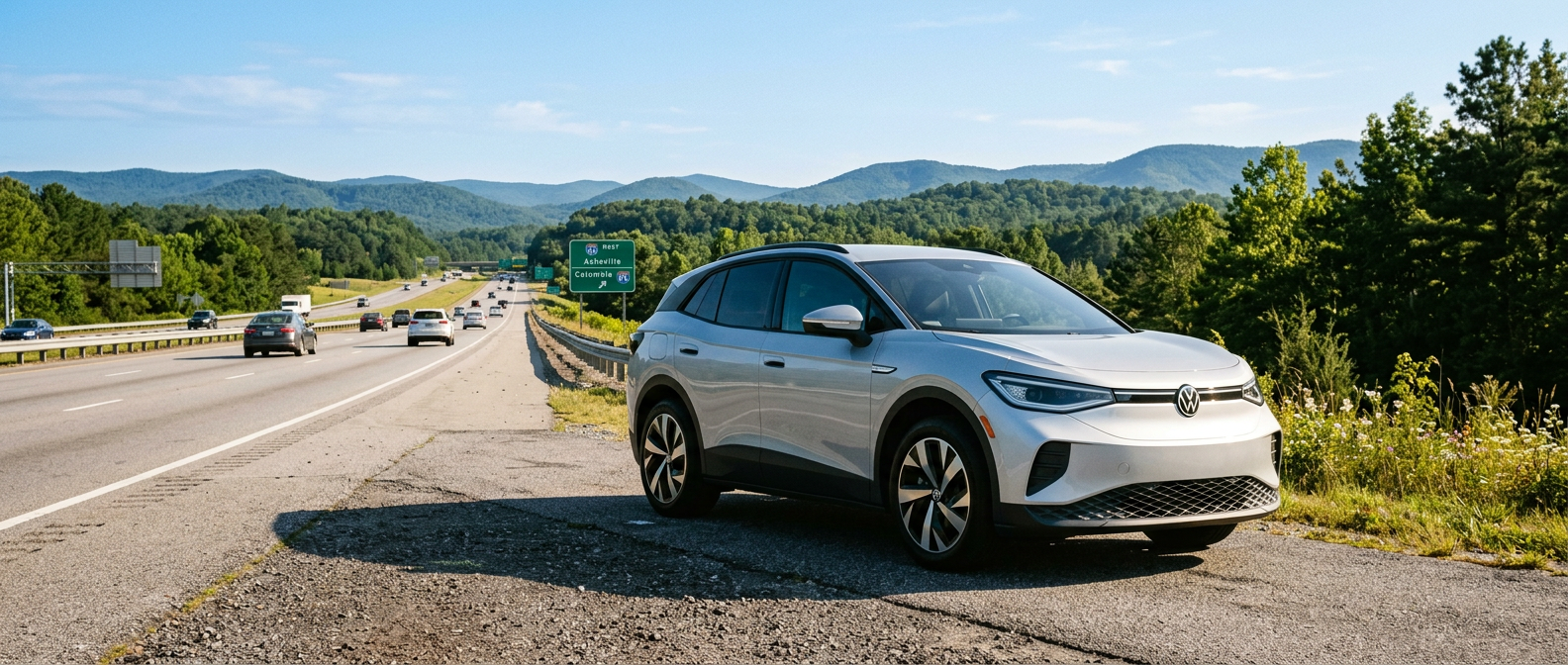
2026 Volkswagen ID.4 on an Upstate South Carolina highway with Blue Ridge foothills in the background

If your daily drive runs along I-85 between Spartanburg and Greenville, the 2026 Volkswagen ID.4 soaks up that commute without touching a quarter of its EPA-estimated range. Below is the honest breakdown of what works, what's genuinely limited, and why this model year shifts the math for Upstate drivers.

Browse our current Volkswagen inventory

Will It Cover My Commute? The Numbers That Actually Matter

Yes, and by a wide margin on most Upstate routes, because the 2026 Volkswagen ID.4 Pro (rear-wheel drive) earns an EPA-estimated 291 miles of range on its 82 kWh battery, while the AWD trims rate at 263 miles. The Spartanburg-to-Greenville corridor runs roughly 30 miles each direction. A 60-mile round trip eats about 21 percent of the Pro's rated range at a steady highway pace. Plenty stays in reserve.

What matters more than the headline number is what fits inside it. The table below maps real Upstate commute scenarios against verified 2026 ID.4 specs, so you can see exactly where your daily life lands.

Daily-Driver ScenarioRelevant Spec (2026 ID.4)Does It Fit?
Spartanburg to Greenville round trip (~60 mi)291 mi EPA range (RWD Pro)Uses ~21% of rated range; 79% in reserve
Spartanburg to Anderson and back (~90 mi)291 mi EPA rangeUses ~31%; no charging stop needed
Grocery run + weekend gear in the cargo area30.3 cu ft behind rear seatsYes; comparable to a mid-size SUV hold
Folding tables, full Costco haul, bulk cargo64.2 cu ft seats folded (60/40 split)Yes; flat load floor, wide liftgate
Long narrow gear with rear passengers (Pro S)Ski pass-through on Pro S trimFits paddleboards or ski bags; outboard seats still usable
Full overnight top-up at home on Level 211 kW onboard charger; ~7.5-8 hrsArrives full every morning if plugged in at bedtime
Quick charge at Supercharger near I-26175 kW DC fast; 10-80% in ~30 minYes; NACS Supercharger confirmed near I-26 west of Spartanburg
Light trailer (kayak, utility, small boat)2,700 lb tow rating (AWD trims)Yes on AWD trims only; not for heavier loads

The EPA rates the RWD 2026 Volkswagen ID.4 Pro at 291 miles. Volkswagen lists the onboard Level 2 charger at 11 kW. A full top-up runs roughly 7.5 to 8 hours. Plug in before bed, and you wake up to a full battery. For most Upstate commute weeks, that's the entire charging story.

How to Load the ID.4 for Your Real Routine

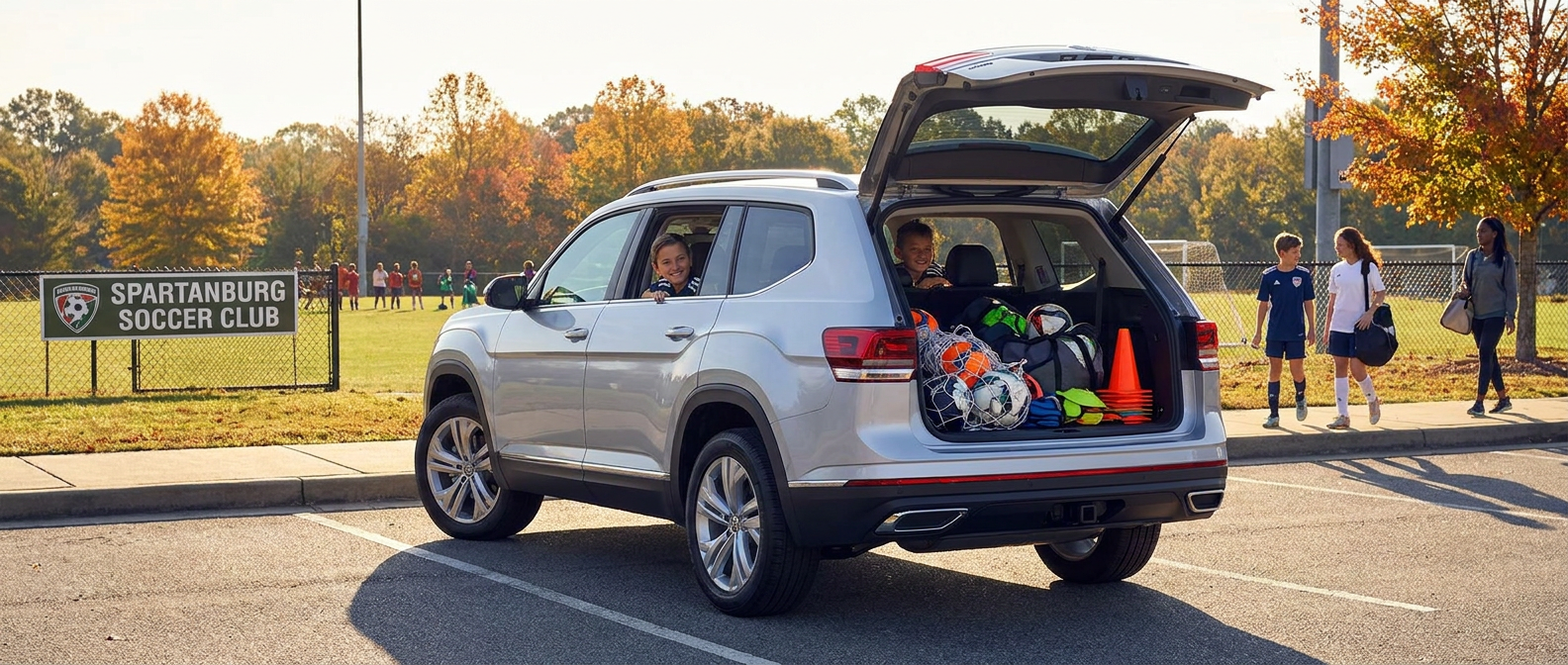
Loading the ID.4 for a real week goes smoother than the raw spec suggests, since 30.3 cubic feet behind the rear seats swallows a full grocery haul, a sports bag, and a folding stroller without anyone playing luggage Tetris at the liftgate. Fold those rear seats flat and you jump to 64.2 cubic feet, enough for a set of golf clubs, a full-size cooler, and whatever an Upstate weekend throws together on short notice.

Explore financing options for the ID.4

A few things worth knowing before you settle on a trim:

  • The 2026 Volkswagen ID.4 doesn't have a front trunk (frunk), a real difference from some competitors. You're working with one cargo zone, so plan where your valuables go, glovebox included.
  • The 60/40 split rear seats fold to a flat load floor with no raised hump. Long items slide straight in from the liftgate.
  • Pro S trims add a ski pass-through in the rear seatback, so you can carry long narrow items (paddleboard bags, fishing rod cases, ski poles) while still seating two adults in the outboard rear positions.
  • On select trims, the liftgate opens hands-free with a foot-kick sensor under the rear bumper. You'll appreciate it when you're carrying four bags from a Reidville Road errand run and can't free a hand.
A note from our team: Stand at the ID.4's liftgate next to a comparable gas-powered compact crossover, and the wider opening and flatter load floor make real-world loading noticeably less awkward. None of that shows up on a spec sheet, though you'll feel it the first time you load a week's worth of gear.

The 2026 Charging Upgrade That Actually Matters for Upstate Drivers

The 2026 charging change is the single upgrade that reshapes daily-driver math around here, and while most reviews skim right past it, Upstate South Carolina drivers get a real payoff from the new port standard lining up with fast chargers already sitting along the routes you use. That deserves a slower read for this market.

Every ID.4 in the lineup now carries the standardized NACS (North American Charging Standard) port for 2026, which opens access to Tesla Supercharger locations designated as NACS Partner Sites. A Supercharger sits confirmed near I-26 on the west side of Spartanburg. The I-85 corridor through the Upstate also meets the federal NEVI 50-mile fast-charging station standard, so fast chargers show up at regular intervals along the routes most Spartanburg commuters lean on.

Volkswagen puts the DC fast-charge rate at 175 kW, enough to move the battery from 10 to 80 percent in about 30 minutes. Call it a lunch stop.

For a daily driver, though, home charging handles the commute week on its own, and the Supercharger network turns into a backstop you're glad exists, more than one you're leaning on.

Here's a print-and-go checklist for making the 2026 ID.4 work as your primary vehicle in Upstate SC:

  • Plug in every night at home using the included 2-in-1 ZEV3 Mobile EV Charging Cable (now standard on all 2026 trims)
  • Set scheduled charging in the ID.4's infotainment so it tops off by your departure time
  • Locate the two nearest NACS Supercharger stations on your regular commute corridors before your first road trip
  • If you plan to tow a kayak trailer or utility trailer, confirm you're on an AWD trim (2,700 lb rating)
  • Test the hands-free liftgate on the lot before settling on a trim level. It's a small detail that adds up over years of daily use.

Find out what your current vehicle is worth

Explore Your Financing Options

The Honest Tradeoffs, and Where the ID.4 Still Makes Sense

The 2026 Volkswagen ID.4 isn't the most engaging thing to drive, and Volkswagen tuned it for composure over enthusiasm, so if you want a car that rewards you for carving a corner on SC Highway 11 through the Cherokee Foothills, you'll want to look at other options. What the ID.4 does well is soak up 50 miles of interstate in near-silence, seat five adults without squeezing anyone, and arrive fully charged each morning because you plugged it in the night before.

The no-frunk limitation is genuine. Its touchscreen-dependent interior takes some getting used to. And the 2026 model year no longer qualifies for the federal EV tax credit, a real financial variable that belongs in your conversation with our team before you sign anything.

Where this car fits is a specific profile. You're driving 40 to 90 miles a day on I-85 or I-26, you've got a charging spot at home or at work, and you want the lower-maintenance case for an electric drivetrain alongside German interior quality and genuine cargo versatility. If that matches you, the 2026 Volkswagen ID.4 is the right tool for the job.

The range covers the commute with room to spare, the cargo handles the real load, and the NACS network closes the infrastructure gap that made earlier Volkswagen EVs harder to recommend for this market. Job done.

Schedule a service appointment

By the Steve White Volkswagen Spartanburg Team | August 2026
Steve White Volkswagen Spartanburg

2671 Reidville Rd, Spartanburg, SC 29301

(864) 585-2492

Recommended Posts

2026 Volkswagen Tiguan in a Spartanburg SC parking lot near WestGate Mall

Your Volkswagen Fit Checklist for Drivers Near WestGate and Spartanburg Regional

The route between WestGate Mall on West Blackstock Road and Spartanburg Medical Center on East Wood Street sounds simple. In practice it's anything but. You're navigating one of the busiest commercial corridors in Upstate South Carolina, swapping between a sprawling surface lot and a multi-deck hospital parking structure, and doing it regularly. Browse our current Volkswagen inventory to see what's on the lot right now, but read this first. The right model for this particular driving life isn't just the one you like. The one that clears the checklist below is what you're after. What Goes on the Checklist? Five questions decide which Volkswagen fits your WestGate-to-Spartanburg-Regional life, and working through each one before you set foot in a showroom saves you a test drive spent chasing the wrong car. Work through each one honestly. The Checklist Parking geometry (does the car fit the Spartanburg Regional structured deck and the WestGate surface lot without white-knuckle maneuvering?) Commute fuel economy (will the EPA highway rating hold up across your I-85 or I-26 corridor run?) Cargo room for your actual load (weekly Costco haul, scrubs bag plus lunch bag, or full family gear?) Passenger count (is a second or third row a real need, or are you paying for space you never use?) AWD or FWD (Upstate SC winters bring ice events on I-85 that the forecast calls wrong; how risk-averse are you?) So that's it. Five filters. Every Volkswagen in our lineup clears at least three of them. None clears all five the same way. What each one does and doesn't do comes next. The Reasoning Behind Each Item The Volkswagen Jetta is the answer when fuel economy and parking ease matter most and you're driving solo or with a single passenger, though it asks you to give up real cargo depth to get there. The Volkswagen Jetta earns an EPA rating of 29 city / 40 highway mpg with the 1.5-liter turbo and eight-speed automatic. That highway number is the highest in the Volkswagen lineup. On a daily run down I-26 from the WestGate corridor toward downtown Spartanburg, or a longer haul on I-85 toward Greenville or Anderson, you'll feel that efficiency every fill-up. The downside is straightforward. The trunk's a sedan trunk. Your Costco run will fill it, and add a stroller and it's genuinely tight. Step up to The Volkswagen Taos when you need an SUV footprint without committing to a larger vehicle. The 2026 Taos earns an EPA-estimated 28 city / 36 highway mpg (FWD), only marginally below the Jetta, and its compact dimensions slot it into the Spartanburg Regional parking deck without the anxiety a full-size SUV creates. The real tradeoff is cargo depth behind the second row. It's smaller than it looks. If you're a Costco-plus-Target-on-the-same-trip driver, the Taos works. If you're loading pediatric gear for three kids, the Atlas is the correct answer. For drivers who want a compact SUV that feels substantial, The Volkswagen Tiguan is where a lot of our team's conversations land. The 2026 Tiguan's base 2.0L turbo delivers 201 horsepower, and the EPA rates FWD models at up to 26 city / 34 highway mpg. The rebuilt 2026 body is noticeably quieter inside than the previous generation, which matters on a long I-85 stretch. There's no third row here. Volkswagen made that call deliberately, and if three rows are non-negotiable, keep reading. The Volkswagen Atlas is the answer if three rows are the actual requirement. The EPA rates The Volkswagen Atlas FWD at 20 city / 27 highway mpg. That number stands, no dressing it up. You trade efficiency for the ability to carry seven people, and for a lot of Spartanburg families with school-aged kids, that trade makes complete sense on the weekend even if the daily commute is solo. The Atlas is a long vehicle. In the structured decks at Spartanburg Medical Center, tight pull-in angles are real, so know your comfort level with that before you commit. A note from our team: Spartanburg's ice events tend to hit the I-85 corridor in January and February. AWD is available on both the Tiguan and Atlas, and FWD handles most Upstate SC winters just fine. But if your shift starts at 5 a.m. and the overnight forecast was "partly cloudy," 4MOTION gives you a margin that matters on an on-ramp. Item-by-Item: What Each Model Delivers Checklist Item Jetta Taos Tiguan Atlas Parking ease (tight decks) Excellent Very Good Good Challenging EPA highway mpg 40 36 34 (FWD) 27 (FWD) Cargo room (practical) Moderate Good Better Best Passenger count 5 5 5 7 AWD available No Yes Yes Yes The Volkswagen Golf GTI earns a separate mention because it doesn't fit the matrix above. It isn't an SUV, and it won't carry a family's weekend gear. But if you're a Spartanburg Regional nurse practitioner whose shift ends at 7 p.m. and the drive home on I-85 is where you decompress, the 2026 Golf GTI's 241-horsepower 2.0-liter turbo and 24 city / 32 highway mpg make a real case. German engineering's hot-hatch formula hands you a genuine driver's car that still costs you nothing extra to fill. That's the GTI's pitch, and it's an honest one. See Current Volkswagen Offers A Print-and-Go Recap Before You Visit Bring this list to the showroom, because the answers you already have will make the conversation with our team at Steve White Volkswagen Spartanburg on Reidville Road faster and sharper than starting from scratch. We'll walk you through each question in person. Parking geometry: If you use a structured deck regularly (Spartanburg Regional, hospital campus), the Jetta and Taos are the easiest choices. The Tiguan is manageable. The Atlas requires confidence. Commute economy: I-26 and I-85 corridor drivers who prioritize fuel cost should look at the Jetta first (EPA-estimated 40 highway mpg), then the Taos (EPA-estimated 36 highway mpg). Cargo reality: Weekend Costco runs and family gear point toward the Tiguan or Atlas. Solo or couple's daily driving fits the Jetta or Taos without compromise. Passenger count: Three rows are only on the Atlas. Every other Volkswagen in the lineup seats five. AWD availability: Available on the Taos, Tiguan, and Atlas. Not available on the Jetta or Golf GTI. The Golf GTI: Only for drivers who genuinely value the driving experience on a daily commute. Not a family hauler. No pretense about what it is. Come in with your checklist answers and we'll find your car. That's really how it works. Frequently Asked Questions Which Volkswagen is easiest to park in Spartanburg Regional's hospital campus decks? The 2026 Volkswagen Jetta and the 2026 Volkswagen Taos are the most manageable choices for structured parking decks. Both carry compact overall dimensions that handle tight pull-in angles without difficulty. The 2026 Volkswagen Tiguan is a step larger but still workable for most drivers. The 2026 Volkswagen Atlas is noticeably long and wide and can feel challenging in multi-deck hospital structures with tight turning radii. Is a Volkswagen good for daily commuting on the I-26 or I-85 corridor near Spartanburg? Yes, and the efficiency gap across models is real. The EPA rates the 2026 Volkswagen Jetta at 40 highway mpg, making it the most fuel-efficient option in the lineup for corridor driving. The 2026 Volkswagen Taos follows at an EPA-estimated 36 highway mpg. Both the Tiguan and Atlas deliver lower highway ratings but add cargo space and, on AWD trims, extra all-weather traction for the ice events that periodically hit the I-85 corridor in Upstate South Carolina. Explore Financing Options Steve White Volkswagen Spartanburg 2671 Reidville Rd, Spartanburg, SC 29301 (864) 585-2492

2026 Volkswagen Atlas Cross Sport parked at a Blue Ridge foothills trailhead in Spartanburg, SC, rear cargo area open on a summer morning

When the Kids Leave, the Car Should Fit the Life You Actually Have Now

In this article Why Does the Atlas Cross Sport Fit Here? The Cargo Math Is the Honest Case for This Vehicle The Honest Tradeoff: This Isn't the Right Call for Everyone The Powertrain Fits an Upstate Driving Pattern The third row earned its keep back when you needed it. These days you fold it flat to load a bike, and you do that more and more while the row sits empty between errands. If that sounds like your week, you're driving the wrong vehicle. We see it plenty here at Steve White Volkswagen Spartanburg. Couples and empty nesters who've outgrown the logic of a seven-seat SUV, but aren't ready to give up the space, the confidence, or the feel of a real Volkswagen. The 2026 Atlas Cross Sport fits that moment exactly. The 2026 Volkswagen Atlas Cross Sport gives Spartanburg empty nesters full-size cargo capability and a refined two-row cabin without the family-hauler proportions (the right-sizing move when your regular passengers are now a partner, weekend gear, and maybe a dog). Why Does the Atlas Cross Sport Fit Here? Spartanburg puts you about 90 minutes from the Blue Ridge and roughly as far from the coast on I-26, and both of those runs are the kind that actually happen now that your calendar isn't locked around school schedules, so the fair question is whether your vehicle was built for the life you have or the one you used to have. Those trips aren't theoretical anymore. They're the weekend now. Spartanburg Condition or Use The Feature That Handles It Why It Matters Here Blue Ridge foothills runs on SC Highway 11 4Motion AWD with Snow and Off-Road drive modes Handles fall and winter surface changes on the Cherokee Foothills Scenic Highway I-26 coast run to Charleston EPA-rated 27 mpg highway (FWD) / 26 mpg (AWD) A full tank comfortably covers the corridor with room to spare Croft State Park gear hauls (bikes, kayaks, camping) 40.3 cu.ft. cargo behind rear seats; 77.6 cu.ft. with seats folded Carries two full-size bikes or a weekend's worth of gear without a trailer Pulling a small camper or utility trailer Up to 5,000 lbs braked towing capacity (SE with Technology and above) Handles enclosed trailers and lighter campers (a real number from Volkswagen, not an asterisk) Long drives without fatigue Heated and ventilated front seats standard across all trims Matters on a three-hour run on a South Carolina August afternoon Daily Spartanburg driving without losing the luxury feel 12-inch floating touchscreen and 10.25-inch Digital Cockpit Pro standard Cabin tech that holds its own against what you'd find in vehicles costing significantly more The Cargo Math Is the Honest Case for This Vehicle The Cross Sport carries more cargo in its two-row layout than most seven-seaters manage with the third row still up, and that's the quiet fact the brochure tends to skip. Volkswagen rates the 2026 Atlas Cross Sport at 40.3 cubic feet behind the rear seats and 77.6 cubic feet with the second row folded. That 40.3 number sits behind two people, not a third row of seat hardware eating into space you'd rather use. The geometry does real work. The load floor sits flat once the seats fold. Browse our current Atlas Cross Sport inventory to see which trims are in stock (the SEL and above add a panoramic sunroof and leather seating, the configuration for buyers who've done their time in cloth-and-plastic family vehicles and want something that feels earned). Drivers who come in after years in three-row SUVs often tell us the Cross Sport's second row surprises them. With no third row eating into the packaging, Volkswagen slid that seat rearward. Legroom in the second row measures 40.4 inches, generous enough for adults, grandkids included. When the grandkids visit, the back seat's genuinely comfortable for them too. You keep the utility. You just stop pretending it's a daily need. Tip: If you plan to run SC Highway 11 regularly in the fall, the Snow drive mode and 4Motion AWD are worth selecting at the time of purchase. AWD becomes standard from the SEL trim upward, so you won't need to add it as an option. Next step: Our team on Reidville Road can walk you through the trim comparison in person. The jump from SE with Technology to SEL is where the features that matter at this stage (leather, panoramic sunroof, seat memory) tend to consolidate. Worth 20 minutes of your time before you decide. The Honest Tradeoff: This Isn't the Right Call for Everyone If you regularly seat six or seven adults for extended trips, holiday travel, carpooling a group, or a reunion where everyone rides together, the three-row Volkswagen Atlas is the better vehicle, and we'd rather tell you that plainly than let you find out on your own. It exists for exactly that use case. The Cross Sport swaps that third row for a sloping roofline, a sleeker silhouette, and a cabin that puts more of the emphasis on the front two seats. Volkswagen designed it that way on purpose. The tradeoff pays off when your regular load is two people and gear instead of a full seating chart. Spartanburg hands you plenty of reasons to put that cargo space to work. Croft State Park's 7,054 acres of trails and lakes sit about ten minutes south of town. The Blue Ridge Mountain foothills are visible from here on a clear morning. Those drives happen in a Cross Sport better than they happen in something you bought for a family configuration you no longer need. The Powertrain Fits an Upstate Driving Pattern The 2026 Atlas Cross Sport runs a turbocharged 2.0-liter four-cylinder making 269 horsepower and 273 lb-ft of torque through an eight-speed automatic, and that's a genuine mid-size powertrain with no small-SUV engine hiding under a big badge, which shows up more on Upstate grades than the spec sheet lets on. The torque number matters for Upstate drivers because the I-85 corridor between Spartanburg and Greenville has enough grade variation and merge situations that you'll want power on tap before you fully press the pedal, not three seconds after. EPA ratings put the FWD version at 20 city and 27 highway. The AWD models (SE and SE with Technology AWD) come in at 20 city and 26 highway. On a run from Spartanburg to Charleston on I-26, 27 highway mpg in an SUV this size is a real number. Drive Mode Select is standard on all trims and gives you Eco, Comfort, Sport, Custom, and Snow settings. Explore financing options before your visit. Knowing your numbers before you walk in saves time, and it tends to make the conversation a calmer one. The SEL adds 4Motion AWD as standard, the configuration worth having when you're thinking about fall runs through the foothills. See Current Volkswagen Atlas Cross Sport Offers Steve White Volkswagen Spartanburg 2671 Reidville Rd, Spartanburg, SC 29301 (864) 585-2492

2026 Volkswagen Atlas with open liftgate at a Spartanburg-area youth baseball complex, loaded with sports gear

4 Volkswagen Vehicles That Make Practice Night at Tyger River Park Actually Work

In this article The Ranking at a Glance 1. Volkswagen Atlas: The Tyger River Park Workhorse 2. Volkswagen Tiguan: The Smart Compact for Smaller Families 3. Volkswagen ID. Buzz: Electric, Sliding Doors, and More Space Than It Looks 4. Volkswagen Taos: The Fuel-Efficient Answer for the One-Athlete Family Which One Actually Fits Your Family? If you've driven out to Tyger River Park on a Tuesday evening, you already know the drill. Thirteen fields spread across 137 acres means the lots fill faster than the first inning ends, gear bags seem to multiply on their own, and an Upstate South Carolina afternoon storm can turn the grassy overflow lot into something that demands more traction than a typical family SUV expects to find. So the vehicle you show up in matters. We measured the 2026 Volkswagen lineup against what Spartanburg practice-night parents actually deal with, and here's where we landed. The 2026 Volkswagen Atlas is the clearest fit for a multi-kid family hauling full loads, though three other models earn a serious look depending on your squad size. The Ranking at a Glance Here's how the Volkswagen lineup stacks up against the specific demands of a Tyger River Park practice routine, weighing cargo room, passenger count, fuel efficiency, and the parking reality of a 137-acre regional complex. Rank Model Best For Standout Spec 1 Atlas Multi-kid families, full gear loads 96.6 cu ft max cargo, 7 seats, tows up to 5,000 lb 2 Tiguan Small families wanting German efficiency EPA-est. 26/34 mpg city/hwy (FWD), 69.8 cu ft folded 3 ID. Buzz EV-ready parents who value sliding doors EPA-est. 234 miles range, 145.5 cu ft max cargo 4 Taos Solo-athlete households watching fuel costs EPA-est. 28/36 mpg city/hwy (FWD), 65.9 cu ft folded 1. Volkswagen Atlas: The Tyger River Park Workhorse The Atlas answers the practice-night problem better than anything else Volkswagen builds, giving you three rows, seven seats, and cargo room that makes a pickup feel modest, though you pay for all that capability with the largest footprint on this list once the lots tighten up. Behind the third row, the 2026 Atlas carries 20.6 cubic feet according to Volkswagen. You'll fit a full equipment bag and a cooler back there without touching the seats. Fold that row down and you're at 55.5 cubic feet. Clear both rear rows and the maximum reaches 96.6 cubic feet. Those numbers stop feeling abstract the first time you load four kids' worth of gear after a late tournament game. Under the hood, the 2026 Atlas runs a 2.0-liter TSI engine making 269 horsepower and 273 lb-ft of torque through an eight-speed automatic, and Volkswagen offers 4Motion all-wheel drive on every trim. On SE with Technology trim and above, it's rated to tow up to 5,000 pounds with the standard hitch, which helps if a tournament weekend ever involves a camper or utility trailer, and the EPA rates FWD models at 20 city and 27 highway. The one catch is size. As the largest vehicle on this list, the Atlas shows it in the tighter lots, and Tyger River's busiest tournament days pack the rows. Get there before the overflow starts and think about where you park. You gain maximum family capability and give up a little parking-lot agility. For a family of five or more with two kids in different sports, we think that's exactly the right trade. Browse the Atlas at Steve White Volkswagen Spartanburg 2. Volkswagen Tiguan: The Smart Compact for Smaller Families The Tiguan is the pick when you want genuine German engineering in something that still parks like a normal car on a crowded Tuesday, and the trade is capacity, since it seats five across two rows instead of the seven the Atlas gives you. Five seats, two rows, and a cargo layout that surprises people. Behind the rear seats, you'll find 33.8 cubic feet, per Volkswagen. Fold those seats nearly flat and the space opens to 69.8 cubic feet. You'll fit a bat bag, a folding camp chair, and still have room left over. Fuel economy is where the Tiguan earns points on this list. The EPA estimates the 2026 Tiguan FWD at 26 city and 34 highway. If your practice nights mean repeated Reidville Road runs, that efficiency compounds quickly. The top SEL R-Line Turbo trim pushes output to 268 horsepower, and 4Motion all-wheel drive is available across the lineup. Wet grass and damp asphalt in a lot that's overflowed onto a field? Upstate's summer storm season is real. Asking about 4Motion when you configure your trim is worth a few minutes of that conversation. We'll be direct about the seating. The 2026 Tiguan is a five-passenger vehicle. Volkswagen removed the optional third row in the recent redesign, trading that seat for better rear legroom and a more refined interior. If you regularly fill seven seats, the Tiguan isn't your vehicle. For a family of four, or parents with one athlete and a sibling in tow, it's sharp and composed in a way that makes the post-practice drive home feel less like work. See the 2026 Tiguan lineup 3. Volkswagen ID. Buzz: Electric, Sliding Doors, and More Space Than It Looks The ID. Buzz earns its spot here for more than the retro looks, since it's a three-row, six- or seven-seat hauler whose sliding rear doors solve a real problem at a packed regional complex, though it asks something of you in return that a gas model won't. Pull into a crowded row at Tyger River, and those sliding doors mean zero worry about flinging a panel into the next driver's vehicle. That's a genuine daily benefit, not a novelty. The 2025 ID. Buzz carries an EPA-estimated 234 miles of range on the rear-wheel-drive version, powered by a 91 kWh battery. Behind the third row you get 18.6 cubic feet, a bit tighter than the Atlas. Fold the third row and that opens to 75.5 cubic feet. Clear both rear rows and Volkswagen's maximum cargo figure reaches 145.5 cubic feet. The interior also includes a sliding center console (Volkswagen calls it the Buzz Box) that moves between the front seats and can be removed entirely to create a walk-through path from the driver's position to the second row. With younger kids, that walk-through isn't a gimmick. You'll use it. The tradeoff is worth weighing before the retro shape wins you over. The ID. Buzz makes the most practical sense when you can charge at home. Spartanburg's public charging is growing, but building a practice-night routine around public chargers adds friction to an already busy schedule. If you can plug in overnight, those runs to Dillard Road won't cost you a drop of gas. If home charging isn't in place yet, answer that question first before this vehicle makes sense. See Current Volkswagen Specials Buying Caution: 4Motion all-wheel drive is available across most of this Volkswagen lineup, but it isn't always standard on the trim you're eyeing. On the 2026 Atlas, it's standard on upper trims and available on the SE. On the 2026 Tiguan and Taos, it's available throughout but standard only at the top trim. Upstate South Carolina's July and August storm season creates legitimately slick parking conditions at outdoor sports facilities. Confirm the specific trim's drivetrain before you finalize any decision. The 2026 Atlas is the only vehicle in the Volkswagen lineup rated to tow up to 5,000 pounds, seat seven passengers, and deliver up to 96.6 cubic feet of maximum cargo volume. No other model in this lineup reaches that combination. 4. Volkswagen Taos: The Fuel-Efficient Answer for the One-Athlete Family The Taos is the answer when the operation is smaller, built for the one-athlete, one-gear-bag, twice-a-week trip to Tyger River, and it wins this list on fuel economy, though the tradeoff you accept is that it carries no tow rating at all. The EPA rates the Taos FWD at 28 city and 36 highway, the strongest gasoline fuel economy in this lineup. Behind the rear seats you have 27.9 cubic feet, per Volkswagen. Fold those seats and the space opens to 65.9 cubic feet. You'll fit a full equipment bag and a backpack without any creative loading required. Under the hood, the Taos runs a 1.5-liter turbocharged four-cylinder making 174 horsepower and 184 lb-ft of torque through an eight-speed automatic. Four Motion AWD is available, standard only on the top SEL trim. One thing to flag plainly is the tow rating. The Taos carries no tow rating, so if any part of your plan involves pulling a trailer, look at the Tiguan or Atlas instead. For the practice-night-only parent who isn't towing anything and wants a lighter fuel budget, that limitation is completely irrelevant. The Taos is the right-sized tool for the right-sized job. It parks easily, feels composed on the highway section of I-85, and still carries the German engineering quality that makes Volkswagen worth choosing over a generic compact crossover. If one player, one bag, and 36 mpg on the way home sounds like your Tuesday, this is your pick. View the 2026 Taos at Steve White Volkswagen Spartanburg Which One Actually Fits Your Family? The right call comes down to how many seats you fill and how much you haul, so match the vehicle to the job rather than the badge. Multi-kid families filling all three rows and loading a trunk's worth of gear? That's an Atlas situation. Full stop. Small family of four who wants to minimize fuel stops and still load comfortably? The Tiguan is sharper and more practical than it looks on paper. You have home charging set up, one or two kids, and you'd rather stop paying for gasoline entirely? The ID. Buzz earns that conversation in person. One athlete, straightforward gear, tightest fuel budget in the group? The Taos does the job cleanly. Our team at Steve White Volkswagen Spartanburg on Reidville Road can put you in any of these and let you feel the actual difference before you decide. The right answer depends on how many seats you're filling, how much you're hauling, and whether a plug-in makes sense for where you park at home. We'd rather you leave in the vehicle that fits your Tuesday nights than the one that sounds impressive in a ranking table. By the Steve White Volkswagen Spartanburg Team | August 2026 Value Your Current Vehicle Steve White Volkswagen Spartanburg 2671 Reidville Rd, Spartanburg, SC 29301 (864) 585-2492