
Blog

Summer Car Wash Checklist for Volkswagen Owners in Spartanburg

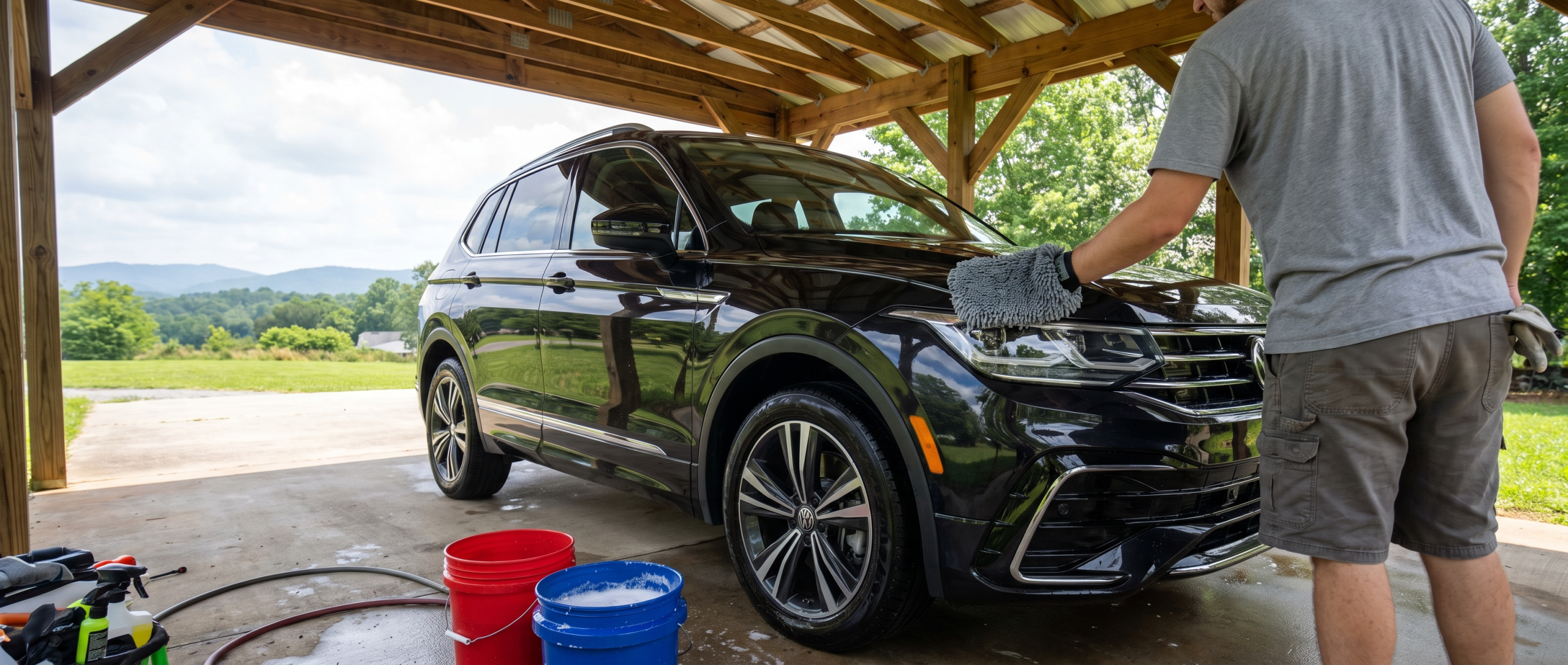
2026 Volkswagen Tiguan hand wash with two-bucket method in Spartanburg SC summer morning shade

Spartanburg's July heat can turn a well-meaning driveway wash into the very thing that damages your paint. The fix is timing and technique.

Tiguan owners, Atlas owners, and Jetta commuters (plus anyone else parked under the Upstate SC sun) all face the same combination. Average July highs reach 91 degrees F, relative humidity sits around 68%, and afternoon pop-up thunderstorms soak a car then evaporate before you think to dry it. That triple threat is what this checklist is built around.

What Goes on the Summer Wash Checklist?

Work through these ten items in order, top to bottom, and you'll protect the clear coat rather than scuff it; skipping the first two steps is what sets up the water spots and surface residue that show up on otherwise clean cars in our service bay. The order matters.

The 10-Point Volkswagen Summer Wash Checklist

  1. Choose your time window. Wash before 9 a.m. or after 7 p.m. Surface temps above roughly 77 degrees F speed up soap evaporation and bake mineral deposits into the clear coat before you can rinse them off.
  2. Pre-rinse from top to bottom. Knock the loose dirt, pollen, and brake dust off before any mitt touches the paint. Skip this and you'll grind that debris straight into the clear coat.
  3. Set up two buckets. One holds your pH-neutral car shampoo solution. The other holds clean rinse water only. Rinse the mitt in the clean bucket between panels, and grit guards in both buckets trap what comes off.
  4. Wash panel by panel, top down. Roof and glass first, rocker panels and bumpers last. Use straight, overlapping passes with a microfiber mitt. Circular motions leave circular swirl marks.
  5. Rinse each panel before the soap dries. In Spartanburg's summer heat, soapy water left on a hot panel for even a couple of minutes leaves residue that fights off a second rinse.
  6. Remove bird droppings and sap immediately. These bond to hot paint faster than anything else out there. A damp microfiber cloth and a little detailer spray handles fresh spots. Wait a day or more in 90 degrees F heat and you'll risk etching the clear coat permanently.
  7. Dry with a large microfiber towel using blotting motions. Don't drag. Don't reach for a terry cloth or chamois. Blot and lift. Water spots come from mineral deposits left by evaporation, and they're a lot harder to remove once the afternoon sun bakes them on.
  8. Clean the wheels separately. Brake dust is corrosive and acidic. Use a dedicated pH-neutral wheel cleaner and a soft brush. Never reuse the paint mitt on the wheels.
  9. Apply a paint sealant or wax after washing. Synthetic paint sealants generally hold up three to six months in sustained summer heat. Traditional carnauba wax lasts closer to four to six weeks. Either one protects the clear coat from UV breakdown and makes the next rinse easier.
  10. Apply UV protectant to rubber trim and plastic. Black trim and door seals dry out and fade faster in sustained heat. A trim protectant with UV inhibitors takes about two minutes and adds real longevity.

Why the Upstate SC Summer Makes Each Item Non-Negotiable

Every item on that list earns its spot because of Upstate summer physics, and the reasons break into three groups (heat, pollen, and storm water), so once you see what each one does to the paint, the checklist stops feeling fussy and starts feeling obvious.

Jetta drivers commuting the I-85 corridor and families loading an Atlas for Croft State Park are dealing with the same physics. Spartanburg's July average high reaches 91 degrees F. The metal surface of your hood or roof routinely hits 140 to 160 degrees F by midday. Wash water and shampoo hit that surface and flash-evaporate, leaving behind the minerals and soap compounds that create the water spots you'll see even after a thorough wash. That's items 1 and 5.

The pollen and sap window is a separate problem. Spartanburg's proximity to the Blue Ridge foothills brings heavy tree pollen in spring and into early summer, and pine sap can coat a car overnight near any stand of pines. Pollen left on hot, humid paint starts bonding chemically within hours, especially when dew or afternoon humidity keeps it damp against the surface. That's why item 6 says immediately and not "soon."

The afternoon thunderstorm cycle is the trickiest part. A quick storm looks like a free rinse. It isn't. Storm runoff picks up road oil, pollen, and atmospheric pollutants as it falls, then sits on a hot surface and bakes as the car heats back up in post-storm sun. If you can't dry the car within roughly 30 minutes of a summer storm, a quick pass with a microfiber and detailer spray is worth doing.

A note on technique: The two-bucket method is the single most effective thing a home washer can do to prevent swirl marks. One bucket with pH-neutral shampoo, one with clean rinse water, and a microfiber mitt with grit guards in both. Rinse the mitt in the clean water after every panel. The dirt that causes most swirl marks stays in the rinse bucket instead of riding back onto the paint.
Checklist ItemWhy It Matters in Spartanburg's Summer
Wash before 9 a.m. or after 7 p.m.Surface temps above 77 degrees F cause soap to evaporate and etch before rinsing
Two-bucket method with grit guardsKeeps abrasive dirt in the rinse bucket, not back on the paint
pH-neutral car shampoo onlyDish soap strips wax and ceramic coatings, leaving the clear coat exposed
Panel-by-panel rinsingPrevents soap from drying on hot metal between wash and rinse passes
Immediate sap and dropping removalHigh heat accelerates etching; fresh spots lift cleanly, day-old ones may not
Separate wheel toolsBrake dust is acidic; reusing the paint mitt transfers corrosive particles
Microfiber blot-dry (no drag)Dragging traps remaining grit and creates fine scratches in the clear coat
Paint sealant every 3 to 6 monthsSynthetic sealants outlast summer wax (4 to 6 weeks) under sustained UV and heat
UV trim protectantBlack plastic and rubber oxidize and fade in sustained 90 degrees F+ exposure
Post-storm detailer sprayStorm runoff deposits road oil and pollen; evaporation bakes it onto hot paint

Schedule a Detail or Service Appointment

Your Print-and-Go Recap

Tape this recap to the garage wall or keep it on your phone, because the timing and the two-bucket setup are the parts that're easy to skip when you're already sweating in the driveway, and they're the two that matter most for the paint.

Before you start: Is it before 9 a.m. or after 7 p.m.? Is the car in shade, or at least out of direct midday sun? Are both buckets set up with grit guards?

Washing: Pre-rinse from the roof down. Wash panel by panel with straight passes. Rinse each panel before you move on. Wheels get their own tools, always. Bring it to our service team if it's been more than a season since a full detail.

Drying and protection: Blot dry right away with microfiber. Check for sap, bird droppings, or bug residue and spot-treat now. Apply sealant or wax if it's been more than a few months. Hit the trim and rubber with UV protectant.

After a storm: Don't assume the rain did the work. Wipe down with a microfiber and detailer spray within 30 minutes if you can.

One tradeoff worth naming up front. This checklist takes real time. A two-bucket hand wash done right runs 45 to 60 minutes. Drive-through washes are faster, but the spinning brushes in older-style tunnels are how a lot of swirl marks get into paint. A touchless wash is a solid middle ground for maintenance washes between full hand-wash sessions, especially during the weeks when Spartanburg's afternoon heat makes driveway timing tough.

Frequently Asked Questions

What time of day is best for washing a Volkswagen in Spartanburg's summer?

Early morning, before 9 a.m., is the best window. The car's surface is coolest then, which keeps soap and rinse water from evaporating before you can remove them. That flash evaporation is what leaves water spots and soap residue baked into the clear coat. Late evening after 7 p.m. works as a second choice, as long as you dry the car completely before overnight humidity settles on the surface.

Is it okay to use dish soap to wash my car?

It isn't a good idea. Dish soaps are built to cut grease aggressively, and they do the same thing to the wax or paint sealant on your clear coat, stripping the protective layer right off. A pH-neutral car-specific shampoo cleans well without breaking down the protection you need through the summer months. It's a simple switch, and it protects a real investment.
Steve White Volkswagen Spartanburg

2671 Reidville Rd, Spartanburg, SC 29301

(864) 585-2492

Recommended Posts

2026 Volkswagen Atlas three-row family SUV on an Upstate South Carolina highway near Gaffney and Spartanburg

The Tiguan Seats Your Whole Family: True or False for Upstate SC Drivers?

Shopping for a Volkswagen roomy enough for the whole family on the Gaffney-to-Spartanburg run? Odds are you've landed on the Tiguan, and that's the right instinct pointed the wrong way. We'll be straight with you. The 2026 Tiguan no longer offers a third row. Volkswagen pulled that option entirely in the 2025 redesign, and it hasn't come back. Families who need seven seats in the 2026 Volkswagen lineup have exactly one answer, and it's the Atlas. The short version The myth: The Tiguan is a seven-passenger family SUV suitable for large-family use on the Gaffney-Spartanburg corridor. Reality 1: The 2026 Volkswagen Tiguan seats five. Volkswagen dropped the optional third row with the 2025 redesign. Reality 2: The 2026 Volkswagen Atlas is the lineup's three-row SUV, with 33.7 inches of third-row legroom and up to 96.6 cubic feet of cargo space. Reality 3: The Atlas Cross Sport is the two-row alternative for couples or smaller families who want Atlas-level build quality in a shorter body. Reality 4: The 2026 Atlas earned IIHS Top Safety Pick status, per the Volkswagen site. Reality 5: Both the Atlas and the Tiguan run on regular unleaded and use 4Motion all-wheel drive, available for wet stretches of I-85 through Cherokee County. The 23-mile stretch of I-85 between Gaffney and Spartanburg is a straightforward highway run. Still, it's a daily commitment with a car full of kids, and the wrong choice has a way of announcing itself at the rental-counter minivan aisle. We want you in the right seat well before that happens. Take a look at the 2026 Atlas in our inventory to see what three-row Volkswagen family life actually looks like. Does the Tiguan Still Seat Seven in 2026? No, the 2026 Tiguan doesn't seat seven, and the point matters enough to earn its own section before we get to anything else. Volkswagen dropped the optional third row in the 2025 redesign, so a five-seat cabin is what you're working with today. The Common Claim What's Actually True in 2026 "The Tiguan can seat up to 7 passengers" The 2026 Tiguan seats 5. Volkswagen removed the optional third row with the 2025 redesign (verified: Volkswagen model page and independent dealer spec sheets). "The Tiguan is the family SUV in the Volkswagen lineup" For families of 5 or fewer, yes. For 6 or 7, the 2026 Atlas is the only option in the lineup. "The Tiguan has the same cargo space as the Atlas" The 2026 Tiguan offers 33.8 cu-ft with rear seats up. The 2026 Atlas offers 20.6 cu-ft behind its third row, and 55.5 cu-ft with that row folded, on top of the passenger space. "4Motion AWD is standard on all Volkswagen family SUVs" On the 2026 Atlas, 4Motion is available (standard on upper trims). On the Tiguan, 4Motion is optional on lower trims and standard only on the top SEL R-Line Turbo. "The Tiguan gets better mileage than the Atlas" True, but the gap is specific: the EPA rates the Tiguan S FWD at 26 city / 34 highway, the Atlas FWD at 20 city / 27 highway. If you're running I-85 daily in a 5-passenger family, that efficiency difference is real. "The Atlas is the heavy, slow option" Both the 2026 Atlas and Tiguan use turbocharged 2.0-liter engines. The Atlas produces 269 horsepower. The standard Tiguan makes 201 horsepower. The Atlas is not slow. "Volkswagen safety scores are comparable across all SUVs" The 2026 Atlas is an IIHS Top Safety Pick, per Volkswagen. The 2026 Tiguan carries a full suite of standard driver assists but has not received the same designation for 2026. Every figure in that table traces back to the EPA, Volkswagen, or IIHS. None of it's our opinion. What This Actually Means for the Gaffney-to-Spartanburg Run The I-85 corridor between Gaffney and Spartanburg runs about 23 miles of highway, so no, it isn't a grueling commute, but it's a daily repetition that adds up fast once you're loading three kids into a vehicle that was never built for three rows. The 2026 Tiguan earns its spot in the lineup without apology. For a couple, a small family, or someone running that I-85 stretch solo five days a week, the EPA rates it at 26 city and 34 highway in FWD configuration. You'll see a legitimate efficiency edge over the Atlas there, and cabin quality took a real step forward with the 2025 redesign. Second-row legroom measures 40.2 inches front and back, which is genuine adult space. For five people, you're getting a well-sorted, comfortable car that handles Upstate SC roads with the confidence European suspension tuning tends to bring. The tradeoff here is simple and non-negotiable. If you need a sixth or seventh seat, the Tiguan can't help you. The 2026 Atlas is built for the exact family making that Gaffney run with a full load. Volkswagen lists third-row legroom at 33.7 inches, which isn't minivan-class, but it's a genuine seat for a school-age kid. Second-row passengers get 37.6 inches of legroom. The 60/40 second-row bench slides up to 7.7 inches fore and aft, so you can open up third-row access without evicting everyone from the middle. On the days you're hauling soccer gear instead of people, 55.5 cubic feet behind that second row swallows it cleanly. 4Motion on the Atlas makes specific sense here. Cherokee County and Spartanburg County both see ice events in winter, and the widened stretch of I-85 through that corridor (SCDOT expanded it to six lanes between mile markers 80 and 98 in Cherokee County) moves fast. Having 4Motion engaged when conditions turn on that open highway is a very different experience from wishing you'd had it. The Atlas Cross Sport offers a middle path. Same 269-horsepower turbocharged engine as the full Atlas Same 4Motion all-wheel drive option Identical cabin quality and EPA fuel economy of 20 city / 27 highway FWD Two rows instead of three, shorter overall footprint, more maneuverable in tight spaces Better fit for four-person families who want Atlas-level build without the longer body View Current Volkswagen Specials The 2026 Volkswagen Atlas is the only three-row SUV in the current Volkswagen lineup. The 2026 Tiguan seats five, full stop. On the lot: A fair question to settle before you buy is whether the 2026 Tiguan can still be had with a third row. The spec sheet answers that one fast. What we tell families holds up. If the third row is a hard requirement, the Atlas is the vehicle, and the second-row sliding bench makes that third-row access better than it sounds on paper. So Which Volkswagen Should Your Family Actually Drive Between Gaffney and Spartanburg? Your right call comes down to headcount more than preference, and the answer splits three ways, with five seats or fewer pointing you toward the Tiguan, six or seven toward the Atlas, and a shorter two-row footprint toward the Cross Sport that's just as capable. Five passengers or fewer, daily I-85 commute: The 2026 Tiguan is the better fit. The EPA's 26 city / 34 highway figure in FWD trim adds up over a year on regular unleaded. A 12.9-inch infotainment screen, standard heated front seats, and real physical steering-wheel buttons instead of capacitive touch make it an easy daily driver. Add 4Motion and those numbers drop to 22 city / 30 highway, so weigh whether you actually need AWD for a flat, well-maintained highway run. Six or seven passengers, or heavy cargo loads: The 2026 Atlas is your answer. Volkswagen rates it at 5,000 pounds of towing capacity with a properly equipped hitch, standard on SE with Technology and above. Families hauling trailers down to Lake Hartwell or up SC Highway 11 toward the Blue Ridge on weekends will feel the difference. The IIHS Top Safety Pick designation isn't a marketing line; it comes from independent crash testing. Five passengers, prefer a shorter footprint: The Atlas Cross Sport carries the same powertrain and 4Motion option in a two-row body that's more maneuverable. Same EPA figures as the Atlas SE. No cargo or power compromise. Just no third row. The wrong choice is the one you make without knowing the cargo space and passenger layout of the Tiguan have changed. That's the one myth here worth correcting. Explore financing options before you visit us on Reidville Road, and we'll walk through which configuration makes the most sense for your specific family. Frequently Asked Questions { "@context": "https://schema.org", "@type": "FAQPage", "mainEntity": [ { "@type": "Question", "name": "Does the 2026 Volkswagen Tiguan have a third row?", "acceptedAnswer": { "@type": "Answer", "text": "No. Volkswagen removed the optional third row from the Tiguan with the 2025 redesign, so the 2026 Tiguan is a two-row, five-passenger SUV. If you need seven seats in the current Volkswagen lineup, the 2026 Atlas is the model you'll want to look at." } }, { "@type": "Question", "name": "Is the 2026 Volkswagen Atlas safe for family highway driving?", "acceptedAnswer": { "@type": "Answer", "text": "Yes. The 2026 Atlas earned IIHS Top Safety Pick status, per Volkswagen, so it's a confident pick for family highway miles. Standard IQ.DRIVE driver-assist technology includes adaptive cruise control, lane-keeping assist, and automatic emergency braking across the lineup. Both the Atlas and Tiguan run on regular unleaded and offer 4Motion all-wheel drive for added confidence on mixed-condition stretches like I-85 through Cherokee County." } } ] } Does the 2026 Volkswagen Tiguan have a third row? No. Volkswagen removed the optional third row from the Tiguan with the 2025 redesign, so the 2026 Tiguan is a two-row, five-passenger SUV. If you need seven seats in the current Volkswagen lineup, the 2026 Atlas is the model you'll want to look at. Is the 2026 Volkswagen Atlas safe for family highway driving? Yes. The 2026 Atlas earned IIHS Top Safety Pick status, per Volkswagen, so it's a confident pick for family highway miles. Standard IQ.DRIVE driver-assist technology includes adaptive cruise control, lane-keeping assist, and automatic emergency braking across the lineup. Both the Atlas and Tiguan run on regular unleaded and offer 4Motion all-wheel drive for added confidence on mixed-condition stretches like I-85 through Cherokee County. Get Pre-Approved Today Steve White Volkswagen Spartanburg 2671 Reidville Rd, Spartanburg, SC 29301 (864) 585-2492 { "@context": "https://schema.org", "@type": "AutoDealer", "name": "Steve White Volkswagen Spartanburg", "url": "https://www.spartanburgvw.com", "telephone": "(864) 585-2492", "address": { "@type": "PostalAddress", "streetAddress": "2671 Reidville Rd", "addressLocality": "Spartanburg", "addressRegion": "SC", "postalCode": "29301" } } { "@context": "https://schema.org", "@type": "Article", "headline": "The Tiguan Seats Your Whole Family: True or False for Upstate SC Drivers?", "publisher": { "@type": "Organization", "name": "Steve White Volkswagen Spartanburg" }, "datePublished": "2026-09-16", "dateModified": "2026-09-16" }

2026 Volkswagen Tiguan in a Spartanburg SC parking lot near WestGate Mall

Your Volkswagen Fit Checklist for Drivers Near WestGate and Spartanburg Regional

The route between WestGate Mall on West Blackstock Road and Spartanburg Medical Center on East Wood Street sounds simple. In practice it's anything but. You're navigating one of the busiest commercial corridors in Upstate South Carolina, swapping between a sprawling surface lot and a multi-deck hospital parking structure, and doing it regularly. Browse our current Volkswagen inventory to see what's on the lot right now, but read this first. The right model for this particular driving life isn't just the one you like. The one that clears the checklist below is what you're after. What Goes on the Checklist? Five questions decide which Volkswagen fits your WestGate-to-Spartanburg-Regional life, and working through each one before you set foot in a showroom saves you a test drive spent chasing the wrong car. Work through each one honestly. The Checklist Parking geometry (does the car fit the Spartanburg Regional structured deck and the WestGate surface lot without white-knuckle maneuvering?) Commute fuel economy (will the EPA highway rating hold up across your I-85 or I-26 corridor run?) Cargo room for your actual load (weekly Costco haul, scrubs bag plus lunch bag, or full family gear?) Passenger count (is a second or third row a real need, or are you paying for space you never use?) AWD or FWD (Upstate SC winters bring ice events on I-85 that the forecast calls wrong; how risk-averse are you?) So that's it. Five filters. Every Volkswagen in our lineup clears at least three of them. None clears all five the same way. What each one does and doesn't do comes next. The Reasoning Behind Each Item The Volkswagen Jetta is the answer when fuel economy and parking ease matter most and you're driving solo or with a single passenger, though it asks you to give up real cargo depth to get there. The Volkswagen Jetta earns an EPA rating of 29 city / 40 highway mpg with the 1.5-liter turbo and eight-speed automatic. That highway number is the highest in the Volkswagen lineup. On a daily run down I-26 from the WestGate corridor toward downtown Spartanburg, or a longer haul on I-85 toward Greenville or Anderson, you'll feel that efficiency every fill-up. The downside is straightforward. The trunk's a sedan trunk. Your Costco run will fill it, and add a stroller and it's genuinely tight. Step up to The Volkswagen Taos when you need an SUV footprint without committing to a larger vehicle. The 2026 Taos earns an EPA-estimated 28 city / 36 highway mpg (FWD), only marginally below the Jetta, and its compact dimensions slot it into the Spartanburg Regional parking deck without the anxiety a full-size SUV creates. The real tradeoff is cargo depth behind the second row. It's smaller than it looks. If you're a Costco-plus-Target-on-the-same-trip driver, the Taos works. If you're loading pediatric gear for three kids, the Atlas is the correct answer. For drivers who want a compact SUV that feels substantial, The Volkswagen Tiguan is where a lot of our team's conversations land. The 2026 Tiguan's base 2.0L turbo delivers 201 horsepower, and the EPA rates FWD models at up to 26 city / 34 highway mpg. The rebuilt 2026 body is noticeably quieter inside than the previous generation, which matters on a long I-85 stretch. There's no third row here. Volkswagen made that call deliberately, and if three rows are non-negotiable, keep reading. The Volkswagen Atlas is the answer if three rows are the actual requirement. The EPA rates The Volkswagen Atlas FWD at 20 city / 27 highway mpg. That number stands, no dressing it up. You trade efficiency for the ability to carry seven people, and for a lot of Spartanburg families with school-aged kids, that trade makes complete sense on the weekend even if the daily commute is solo. The Atlas is a long vehicle. In the structured decks at Spartanburg Medical Center, tight pull-in angles are real, so know your comfort level with that before you commit. A note from our team: Spartanburg's ice events tend to hit the I-85 corridor in January and February. AWD is available on both the Tiguan and Atlas, and FWD handles most Upstate SC winters just fine. But if your shift starts at 5 a.m. and the overnight forecast was "partly cloudy," 4MOTION gives you a margin that matters on an on-ramp. Item-by-Item: What Each Model Delivers Checklist Item Jetta Taos Tiguan Atlas Parking ease (tight decks) Excellent Very Good Good Challenging EPA highway mpg 40 36 34 (FWD) 27 (FWD) Cargo room (practical) Moderate Good Better Best Passenger count 5 5 5 7 AWD available No Yes Yes Yes The Volkswagen Golf GTI earns a separate mention because it doesn't fit the matrix above. It isn't an SUV, and it won't carry a family's weekend gear. But if you're a Spartanburg Regional nurse practitioner whose shift ends at 7 p.m. and the drive home on I-85 is where you decompress, the 2026 Golf GTI's 241-horsepower 2.0-liter turbo and 24 city / 32 highway mpg make a real case. German engineering's hot-hatch formula hands you a genuine driver's car that still costs you nothing extra to fill. That's the GTI's pitch, and it's an honest one. See Current Volkswagen Offers A Print-and-Go Recap Before You Visit Bring this list to the showroom, because the answers you already have will make the conversation with our team at Steve White Volkswagen Spartanburg on Reidville Road faster and sharper than starting from scratch. We'll walk you through each question in person. Parking geometry: If you use a structured deck regularly (Spartanburg Regional, hospital campus), the Jetta and Taos are the easiest choices. The Tiguan is manageable. The Atlas requires confidence. Commute economy: I-26 and I-85 corridor drivers who prioritize fuel cost should look at the Jetta first (EPA-estimated 40 highway mpg), then the Taos (EPA-estimated 36 highway mpg). Cargo reality: Weekend Costco runs and family gear point toward the Tiguan or Atlas. Solo or couple's daily driving fits the Jetta or Taos without compromise. Passenger count: Three rows are only on the Atlas. Every other Volkswagen in the lineup seats five. AWD availability: Available on the Taos, Tiguan, and Atlas. Not available on the Jetta or Golf GTI. The Golf GTI: Only for drivers who genuinely value the driving experience on a daily commute. Not a family hauler. No pretense about what it is. Come in with your checklist answers and we'll find your car. That's really how it works. Frequently Asked Questions Which Volkswagen is easiest to park in Spartanburg Regional's hospital campus decks? The 2026 Volkswagen Jetta and the 2026 Volkswagen Taos are the most manageable choices for structured parking decks. Both carry compact overall dimensions that handle tight pull-in angles without difficulty. The 2026 Volkswagen Tiguan is a step larger but still workable for most drivers. The 2026 Volkswagen Atlas is noticeably long and wide and can feel challenging in multi-deck hospital structures with tight turning radii. Is a Volkswagen good for daily commuting on the I-26 or I-85 corridor near Spartanburg? Yes, and the efficiency gap across models is real. The EPA rates the 2026 Volkswagen Jetta at 40 highway mpg, making it the most fuel-efficient option in the lineup for corridor driving. The 2026 Volkswagen Taos follows at an EPA-estimated 36 highway mpg. Both the Tiguan and Atlas deliver lower highway ratings but add cargo space and, on AWD trims, extra all-weather traction for the ice events that periodically hit the I-85 corridor in Upstate South Carolina. Explore Financing Options Steve White Volkswagen Spartanburg 2671 Reidville Rd, Spartanburg, SC 29301 (864) 585-2492

2026 Volkswagen Atlas Cross Sport parked at a Blue Ridge foothills trailhead in Spartanburg, SC, rear cargo area open on a summer morning

When the Kids Leave, the Car Should Fit the Life You Actually Have Now

In this article Why Does the Atlas Cross Sport Fit Here? The Cargo Math Is the Honest Case for This Vehicle The Honest Tradeoff: This Isn't the Right Call for Everyone The Powertrain Fits an Upstate Driving Pattern The third row earned its keep back when you needed it. These days you fold it flat to load a bike, and you do that more and more while the row sits empty between errands. If that sounds like your week, you're driving the wrong vehicle. We see it plenty here at Steve White Volkswagen Spartanburg. Couples and empty nesters who've outgrown the logic of a seven-seat SUV, but aren't ready to give up the space, the confidence, or the feel of a real Volkswagen. The 2026 Atlas Cross Sport fits that moment exactly. The 2026 Volkswagen Atlas Cross Sport gives Spartanburg empty nesters full-size cargo capability and a refined two-row cabin without the family-hauler proportions (the right-sizing move when your regular passengers are now a partner, weekend gear, and maybe a dog). Why Does the Atlas Cross Sport Fit Here? Spartanburg puts you about 90 minutes from the Blue Ridge and roughly as far from the coast on I-26, and both of those runs are the kind that actually happen now that your calendar isn't locked around school schedules, so the fair question is whether your vehicle was built for the life you have or the one you used to have. Those trips aren't theoretical anymore. They're the weekend now. Spartanburg Condition or Use The Feature That Handles It Why It Matters Here Blue Ridge foothills runs on SC Highway 11 4Motion AWD with Snow and Off-Road drive modes Handles fall and winter surface changes on the Cherokee Foothills Scenic Highway I-26 coast run to Charleston EPA-rated 27 mpg highway (FWD) / 26 mpg (AWD) A full tank comfortably covers the corridor with room to spare Croft State Park gear hauls (bikes, kayaks, camping) 40.3 cu.ft. cargo behind rear seats; 77.6 cu.ft. with seats folded Carries two full-size bikes or a weekend's worth of gear without a trailer Pulling a small camper or utility trailer Up to 5,000 lbs braked towing capacity (SE with Technology and above) Handles enclosed trailers and lighter campers (a real number from Volkswagen, not an asterisk) Long drives without fatigue Heated and ventilated front seats standard across all trims Matters on a three-hour run on a South Carolina August afternoon Daily Spartanburg driving without losing the luxury feel 12-inch floating touchscreen and 10.25-inch Digital Cockpit Pro standard Cabin tech that holds its own against what you'd find in vehicles costing significantly more The Cargo Math Is the Honest Case for This Vehicle The Cross Sport carries more cargo in its two-row layout than most seven-seaters manage with the third row still up, and that's the quiet fact the brochure tends to skip. Volkswagen rates the 2026 Atlas Cross Sport at 40.3 cubic feet behind the rear seats and 77.6 cubic feet with the second row folded. That 40.3 number sits behind two people, not a third row of seat hardware eating into space you'd rather use. The geometry does real work. The load floor sits flat once the seats fold. Browse our current Atlas Cross Sport inventory to see which trims are in stock (the SEL and above add a panoramic sunroof and leather seating, the configuration for buyers who've done their time in cloth-and-plastic family vehicles and want something that feels earned). Drivers who come in after years in three-row SUVs often tell us the Cross Sport's second row surprises them. With no third row eating into the packaging, Volkswagen slid that seat rearward. Legroom in the second row measures 40.4 inches, generous enough for adults, grandkids included. When the grandkids visit, the back seat's genuinely comfortable for them too. You keep the utility. You just stop pretending it's a daily need. Tip: If you plan to run SC Highway 11 regularly in the fall, the Snow drive mode and 4Motion AWD are worth selecting at the time of purchase. AWD becomes standard from the SEL trim upward, so you won't need to add it as an option. Next step: Our team on Reidville Road can walk you through the trim comparison in person. The jump from SE with Technology to SEL is where the features that matter at this stage (leather, panoramic sunroof, seat memory) tend to consolidate. Worth 20 minutes of your time before you decide. The Honest Tradeoff: This Isn't the Right Call for Everyone If you regularly seat six or seven adults for extended trips, holiday travel, carpooling a group, or a reunion where everyone rides together, the three-row Volkswagen Atlas is the better vehicle, and we'd rather tell you that plainly than let you find out on your own. It exists for exactly that use case. The Cross Sport swaps that third row for a sloping roofline, a sleeker silhouette, and a cabin that puts more of the emphasis on the front two seats. Volkswagen designed it that way on purpose. The tradeoff pays off when your regular load is two people and gear instead of a full seating chart. Spartanburg hands you plenty of reasons to put that cargo space to work. Croft State Park's 7,054 acres of trails and lakes sit about ten minutes south of town. The Blue Ridge Mountain foothills are visible from here on a clear morning. Those drives happen in a Cross Sport better than they happen in something you bought for a family configuration you no longer need. The Powertrain Fits an Upstate Driving Pattern The 2026 Atlas Cross Sport runs a turbocharged 2.0-liter four-cylinder making 269 horsepower and 273 lb-ft of torque through an eight-speed automatic, and that's a genuine mid-size powertrain with no small-SUV engine hiding under a big badge, which shows up more on Upstate grades than the spec sheet lets on. The torque number matters for Upstate drivers because the I-85 corridor between Spartanburg and Greenville has enough grade variation and merge situations that you'll want power on tap before you fully press the pedal, not three seconds after. EPA ratings put the FWD version at 20 city and 27 highway. The AWD models (SE and SE with Technology AWD) come in at 20 city and 26 highway. On a run from Spartanburg to Charleston on I-26, 27 highway mpg in an SUV this size is a real number. Drive Mode Select is standard on all trims and gives you Eco, Comfort, Sport, Custom, and Snow settings. Explore financing options before your visit. Knowing your numbers before you walk in saves time, and it tends to make the conversation a calmer one. The SEL adds 4Motion AWD as standard, the configuration worth having when you're thinking about fall runs through the foothills. See Current Volkswagen Atlas Cross Sport Offers Steve White Volkswagen Spartanburg 2671 Reidville Rd, Spartanburg, SC 29301 (864) 585-2492