
Blog

Volkswagen Taos vs. Toyota Corolla Cross for Spartanburg Drivers

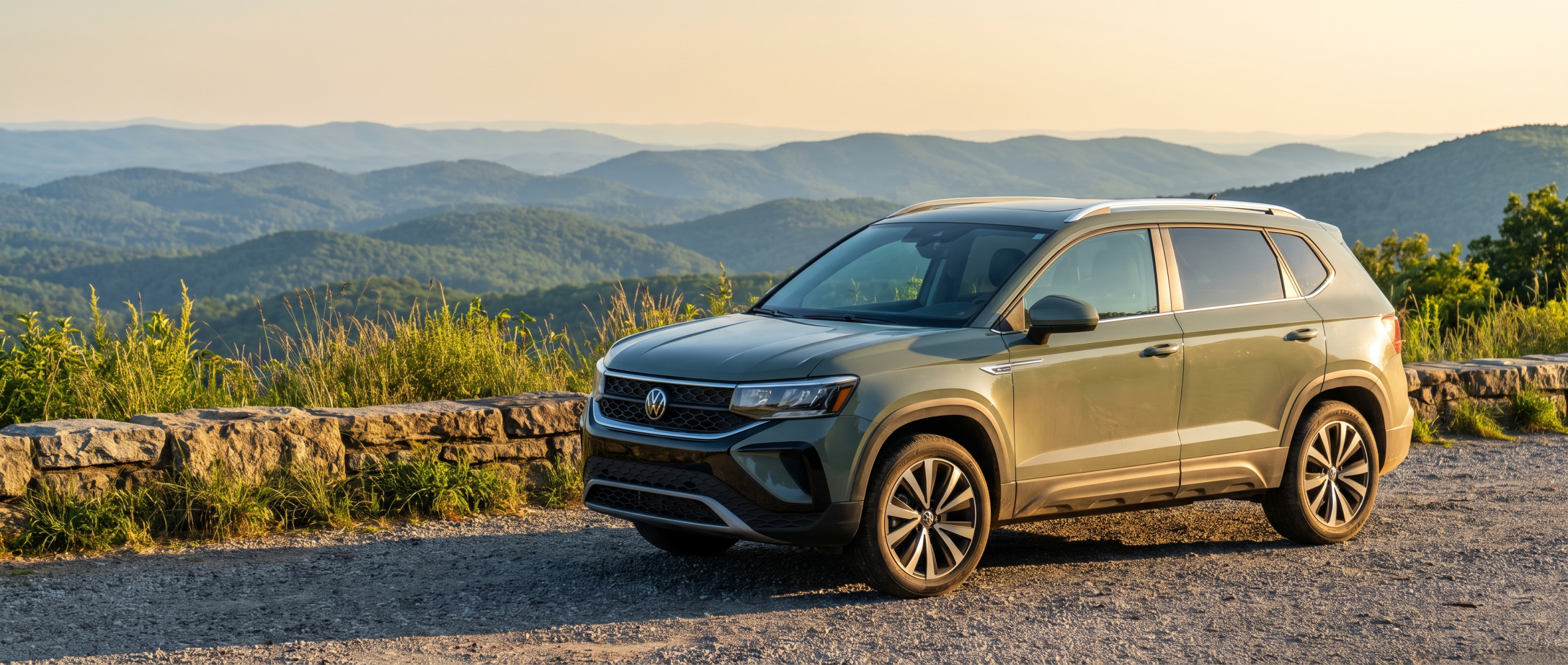
A 2026 Volkswagen Taos parked at a scenic Upstate South Carolina overlook with Blue Ridge foothills visible in the background, late-summer afternoon light, subtle green hills, no other vehicles

If you're cross-shopping these two right now, here's where we land. The 2026 Volkswagen Taos gives you noticeably more interior room and a livelier drive, while the 2026 Toyota Corolla Cross earns better IIHS crash-test marks and stronger gas-only fuel economy. Neither one is a wrong answer. Which is right for you comes down to what you actually need from a compact SUV on Upstate SC roads.

The short version
  • The Taos carries more: 27.9 cu ft behind the rear seats vs. 24.3 cu ft in the Corolla Cross (gas model), and rear passengers get 37.9 inches of legroom vs. 32.0 inches.
  • The Corolla Cross earns IIHS Top Safety Pick status for 2026; the Taos did not earn that recognition in 2026 IIHS ratings.
  • The Corolla Cross gas model delivers an EPA-estimated 32 mpg combined (FWD); the Taos FWD returns an EPA-estimated 31 mpg combined.
  • The Taos runs a turbocharged 1.5L engine producing 174 hp; the Corolla Cross gas model produces 169 hp from a naturally aspirated 2.0L.
  • If you want more room, more driver engagement, and Volkswagen's German-tuned feel, the Taos is the one. If maximum fuel savings or IIHS accolades are the deciding factor, the Corolla Cross gas (or hybrid) makes the case.

What Is the Real Difference Between These Two?

The biggest difference is one you can't spot from the curb, because these two look nearly identical in a parking lot yet feel like different cars the moment you drive them back to back, and that gap between how they look and how they behave is exactly why this comparison is worth doing carefully. On paper, the numbers sit close together. In practice, the gap shows up fast.

Category2026 Volkswagen Taos (FWD)2026 Toyota Corolla Cross (Gas, FWD)
Engine1.5L Turbo, 174 hp / 184 lb-ft2.0L Naturally Aspirated, 169 hp
EPA Combined MPG31 mpg32 mpg
EPA City / Highway MPG28 / 36 mpg29 / 31 mpg
Cargo (behind rear seats)27.9 cu ft24.3 cu ft
Max Cargo (seats folded)65.9 cu ft52.0 cu ft
Rear Passenger Legroom37.9 in32.0 in
AWD Available?Yes (4MOTION)Yes
IIHS 2026 RecognitionNot awardedTop Safety Pick
Towing CapacityNot rated1,500 lbs

A few of these deserve more than a table cell. The Taos turbo puts its 184 lb-ft of torque on tap earlier in the rev range thanks to the forced induction, and you feel that low-end pull right away in stop-and-go traffic or when you're merging onto I-85 from a short on-ramp. The naturally aspirated engine in the Corolla Cross is smooth, but you'll press the accelerator more firmly to get the same response. It isn't slow. The Corolla Cross just doesn't feel as effortless.

The cargo gap is real, too. Nearly four extra cubic feet sounds modest until you're loading mountain bikes or the full weekend kit for Croft State Park. Rear legroom is where the Taos really pulls ahead, and at 37.9 inches versus 32.0 inches, that's no rounding difference. Adults in the back of a Corolla Cross will feel it on anything longer than a short trip.

The single deciding factor: if rear-seat comfort and cargo room matter for your regular use, the Taos wins that comparison decisively. If IIHS safety recognition or the option of a high-efficiency hybrid powertrain is your priority, the Corolla Cross earns it.

Which One Handles Daily Driving in Spartanburg Better?

Both SUVs handle daily Spartanburg driving capably, so neither will leave you wanting on the usual loop of surface streets, the I-85 corridor, and the occasional weekend run toward the Blue Ridge foothills, and where they part ways is in how the drive feels day to day.

The Taos carries Volkswagen's familiar road feel. There's weight to the steering, a settledness on the highway, and a suspension tune that soaks up rough pavement without going floaty. Anyone who's owned a Jetta or a Tiguan will recognize it right away. We notice on our lot that customers coming from German-brand backgrounds tend to appreciate that calibration without us having to spell it out. The whole thing just feels composed in a way that's hard to put a number on but easy to feel on a winding road.

The Corolla Cross is pleasant in its own way. Light, easy, and uncomplicated to operate, it pairs effortless steering for tight urban driving with comfortable manners on longer highway stretches. It doesn't excite you, and it was never meant to. One car is tuned to engage you, the other to relax you, and neither approach is wrong.

One data point worth knowing is the highway split. The EPA rates the 2026 Taos FWD at 28 city and 36 highway mpg, while the Corolla Cross gas model comes in at 29 city and 31 highway. The difference matters, since the Taos is actually stronger on the highway number even though it trails a touch in the city figure. For Spartanburg drivers who log more interstate miles on I-85 than city miles, that's a useful nuance a lot of comparison articles skip.

See Current Volkswagen Specials

Interior Tech and Everyday Practicality

On the practical side, Volkswagen's engineering philosophy stops being an abstract idea and turns into things you touch every morning, and while both SUVs cover the daily basics well, the Taos leans a bit harder into standard convenience tech where the Corolla Cross keeps some of it on the options sheet.

Standard on every 2026 Taos trim, you'll find wireless Apple CarPlay and Android Auto. Most gas Corolla Cross trims still need a wired connection. In 2026, that gap matters more than it sounds. Nobody wants to dig for a cable every morning. The Tiguan bumps you up to a larger SUV if you need more, but the Taos handles the technology features at this price point very well.

The Taos also brings a standard Digital Cockpit display (8 inches in S and SE trims, 10.25 inches in the SEL) right in the driver's line of sight, so navigation and audio info stay in front of you instead of forcing a glance toward the center stack.

Most Corolla Cross trims keep a conventional instrument cluster with a display in the center. It isn't a flaw, just a different design philosophy on driver information.

Per IIHS 2026 ratings, the Toyota Corolla Cross earns the Top Safety Pick designation. The Volkswagen Taos did not earn that recognition in the 2026 IIHS evaluation cycle.

We'd rather give that IIHS result a straight acknowledgment than a glossy pivot. The 2026 Taos received marginal and poor ratings in certain IIHS crashworthiness categories. Volkswagen did add rear seatbelt pretensioners and load limiters to 2025 and 2026 Taos models built after January 2025, which addresses rear occupant safety in moderate overlap front crashes. If you're buying new and checking the build date on your specific vehicle, units built after that date reflect the updated specification. Even so, the Corolla Cross holds the stronger overall IIHS result for 2026, and that's worth saying plainly.

Fuel Economy: Is the Hybrid Worth Considering?

Fuel economy is the one variable that can genuinely swing this decision, and the reason is the hybrid, since the two gas models sit close together while the Corolla Cross hybrid opens up a mileage advantage the Taos can't match right now.

Is the hybrid worth considering? For a lot of Upstate SC buyers, yes. The 2026 Corolla Cross comes in two versions, a 169 hp gas model and a hybrid producing 196 combined horsepower, and Toyota rates the hybrid at an EPA-estimated 42 mpg combined, a real step up. The Volkswagen Jetta is the closest Volkswagen option in the efficiency category if you want a German-engineering feel with strong fuel economy in a smaller package, but for this particular comparison, the hybrid Corolla Cross brings something the Taos simply doesn't offer.

On the gas-only side, the margin is narrow. One mile per gallon combined, 32 versus 31, is a real difference over a year of driving, but it's not a life-altering one. The highway figure actually favors the Taos, 36 versus 31 mpg, which is a relevant edge for anyone who commutes regularly on I-26 or I-85.

If fuel savings top your list and the hybrid variant fits your life, the Corolla Cross hybrid makes a genuine case for itself, and we're not going to pretend otherwise. Comparing the two gas models head to head, though, the MPG gap is narrow enough that it shouldn't be the deciding factor on its own.

So Which One Should You Pick?

Which one you should pick comes down to what your day looks like, and the encouraging part is that both cars will serve you well, so this is less about dodging a mistake and more about matching the SUV to how you drive around Upstate SC.

Choose the 2026 Volkswagen Taos if you regularly carry adults in the back seat, you haul gear for Croft State Park weekends or mountain runs, you value that turbocharged low-end pull in heavy I-85 traffic, or you simply want a compact SUV that feels like a driver's car rather than an appliance. Check available Taos inventory and reach out to our team to schedule a drive.

Choose the 2026 Toyota Corolla Cross if IIHS safety recognition is a firm requirement, you want the hybrid powertrain for significantly higher fuel economy, or a simpler, lighter driving feel suits your daily pattern.

We've driven both. For most Upstate SC use cases, the Taos is the one we'd put a Spartanburg driver in, thanks to the extra room, the added character, and a 4MOTION AWD system that handles the occasional slick morning on the I-26 interchange. But we'll say it plainly too, the Corolla Cross is a genuinely solid vehicle, and anyone buying one isn't making a mistake.

Frequently Asked Questions

Does the Volkswagen Taos have more cargo space than the Toyota Corolla Cross?

Yes. The 2026 Volkswagen Taos offers 27.9 cubic feet of cargo space behind the rear seats, compared to 24.3 cubic feet in the 2026 Toyota Corolla Cross gas model. Fold the rear seats flat and that gap grows further: 65.9 cubic feet in the Taos versus approximately 52 cubic feet in the Corolla Cross. Rear-seat legroom also favors the Taos at 37.9 inches compared to 32.0 inches in the Corolla Cross, a difference adult passengers will feel on longer drives.

Is the Toyota Corolla Cross safer than the Volkswagen Taos?

Based on 2026 IIHS ratings, the Toyota Corolla Cross earns IIHS Top Safety Pick status, while the Volkswagen Taos did not receive that recognition in the 2026 IIHS evaluation cycle. The Taos received marginal and poor ratings in certain crash categories. Volkswagen did update the 2025 and 2026 Taos with rear seatbelt pretensioners and load limiters on vehicles built after January 2025 to address rear occupant protection in moderate overlap front crashes. If safety ratings are a firm priority, the Corolla Cross holds the stronger IIHS result for 2026.
Steve White Volkswagen Spartanburg

2671 Reidville Rd, Spartanburg, SC 29301

(864) 585-2492

Recommended Posts

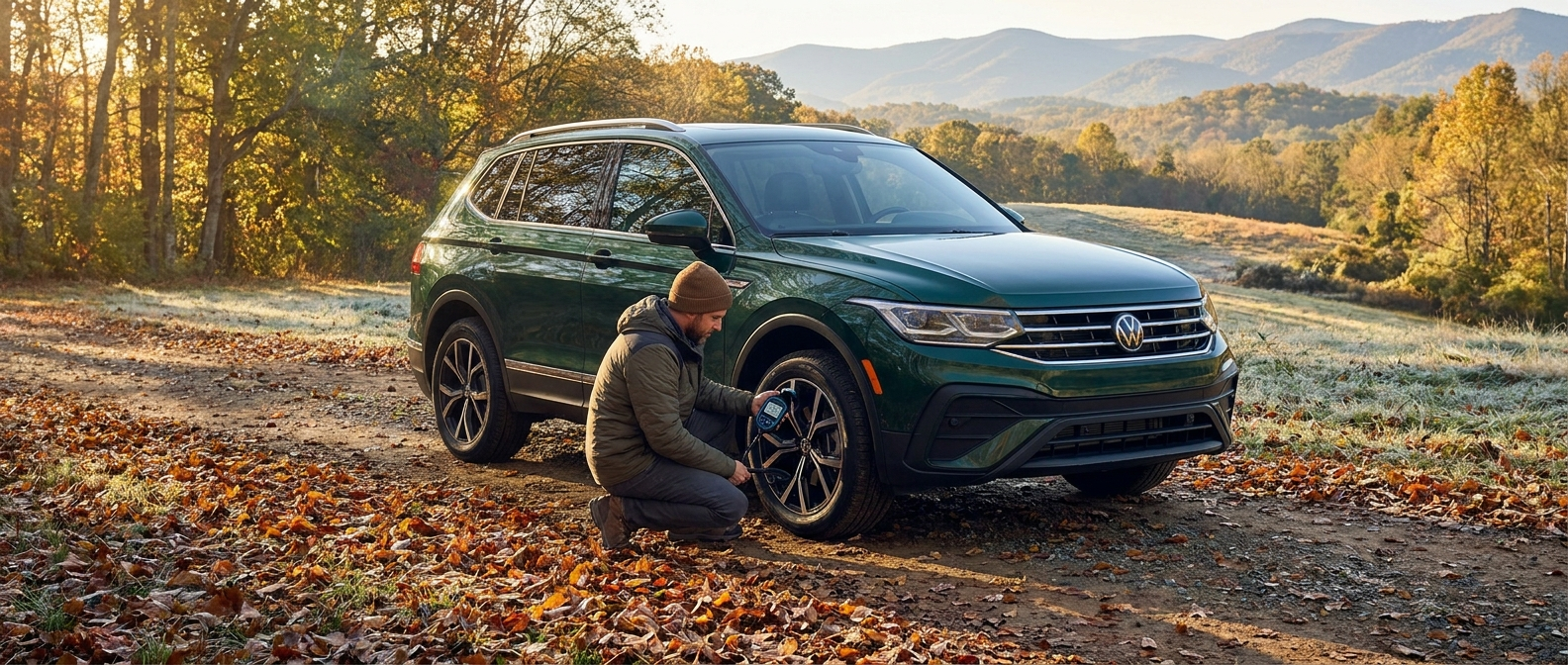
2026 Volkswagen Tiguan tire pressure check on a fall morning in Spartanburg County, SC

Fall Tire Tips for Volkswagen Drivers in Spartanburg County

Fall in Upstate SC is subtle. No ice, no real snow season, and the leaves are only just turning on SC Highway 11 through the Blue Ridge foothills. Subtle is exactly what makes this season tricky for tires. Spartanburg County overnight lows are already touching the upper 40s in October, and by November they'll average around 42 degrees Fahrenheit. Call it a 30-degree swing from our summer highs. Physics takes that swing and quietly steals 2-3 PSI from every tire on your Volkswagen, and no warning light appears on the dash to tell you. Most online guides skip that part entirely, and it's the part we watch play out every fall on the service drive at Steve White Volkswagen Spartanburg. Below, let's keep this to what actually matters, in plain terms. The short version Pressure first: Check PSI against your door-jamb placard (not the tire sidewall). Recommended cold inflation varies from 36 to 41 PSI depending on your Volkswagen model and trim. Tread reality: The legal minimum is 2/32 of an inch, but 4/32 is the threshold that gives you wet-road confidence in fall rain. A quarter works better than a penny for catching it in time. TPMS won't save you: The indirect TPMS system in Volkswagen vehicles triggers at roughly 25% below its stored baseline. A seasonal 2-3 PSI drop won't light the dash. Manual checks matter. Sidewall check: Five years of South Carolina summer heat accelerates rubber oxidation. Check for cracking before it becomes a roadside problem. Rotation timing: Fall is the right moment to rotate if you're within 1,000 miles of the interval, so wear is even before winter rain arrives. What actually matters when choosing fall tire care for your Volkswagen? Four variables do the heavy lifting in fall tire care for your Volkswagen, and they operate together as one system, so skipping any single one of them leaves the other three unable to fully cover the gap it opens before the winter rain arrives. Our service team runs this same checklist whenever a Volkswagen comes in. It's the starting point. Check Best For Key Spec Honest Tradeoff Cold inflation pressure Every Volkswagen, every fall Door-jamb placard (varies: 36 PSI on the 2026 Atlas and Jetta; 36-41 PSI on the 2026 Tiguan and Taos by trim) Specs differ more across the lineup than most drivers expect. One generic PSI covers none of them correctly. Tread depth (penny + quarter test) Anyone driving in fall rain 4/32" for wet roads; 2/32" is the NHTSA legal floor Penny test only catches 2/32". A quarter reveals the safer 4/32" threshold while you still have time to act. Sidewall integrity Vehicles with tires over 4-5 years old Visual check: no cracks, bulges, or embedded objects on all four tires plus the spare South Carolina summer heat and UV exposure accelerate rubber oxidation. A tire that passes tread depth can still have compromised sidewall structure. TPMS reset status After any inflation adjustment The indirect TPMS system in Volkswagen vehicles reads wheel-speed differentials via the ABS sensors. It needs a manual reset after you inflate The TPMS warning threshold is roughly 25% below the stored baseline. That's well below where a 2-3 PSI fall drop lands. A yellow TPMS light in fall means you're already well behind. The Tiguan and the Atlas both run the indirect TPMS design shared across Volkswagen vehicles. Your door placard's PSI changes with trim and tire size, and the system itself doesn't know what your target pressure is. It only knows when rotation rates diverge enough to flag a problem. So trust the gauge, not the light. Cold inflation pressure: why your door jamb is the only number that matters Your door-jamb placard is the one number worth trusting for cold inflation pressure, because the figure molded into the tire sidewall is simply the maximum the casing can safely hold, and that ceiling sits well above the target Volkswagen set for your specific car. Plenty of shops default to 32 or 35 PSI across makes because it's convenient, and that's exactly where underinflation sneaks in. On 2026 Volkswagen vehicles, the spread runs wider than you'd guess: 2026 Atlas: 36 PSI front and rear across all trims 2026 Tiguan: ranges from 36 to 41 PSI depending on trim and tire size (the 2026 Tiguan SEL runs 36 PSI on its 235/55R18 tires; the Comfortline 4Motion runs 41 PSI on 215/65R17s) 2026 Taos: 36 to 41 PSI depending on trim 2026 Jetta: 36 PSI Those differences matter. An Atlas inflated to the Tiguan Comfortline's 41 PSI spec will show accelerated center-tread wear. A Tiguan filled to a generic 35 PSI default runs underinflated, which generates heat through sidewall flexion, the mechanism behind tire failure well before you'd ever notice an outcome. The door-jamb placard is the only source of the correct PSI for your exact Volkswagen. The tire sidewall shows the maximum the tire can hold. They're not the same number, and treating them as interchangeable is one of the easiest tire-pressure mistakes to make. Fall timing matters here because of the Spartanburg temperature swing. Tire pressure drops about 1 PSI for every 10-degree Fahrenheit decrease in temperature, per established physics. Spartanburg County overnight lows in October average around 47 degrees Fahrenheit, set against summer highs that hit 90 degrees Fahrenheit back in July. A tire you inflated correctly in July can reach a cold October morning reading 2-3 PSI low. On the I-85 corridor, where wet pavement and highway speeds combine in fall rain, that loss isn't trivial. Timing the check correctly: Always check pressure cold, before you drive or after the car's been parked at least three hours. Tires warm up as you drive, and they'll read artificially high. A cold reading against your door-jamb number is your only accurate comparison. Check pressure cold, fill to your placard spec, then reset the TPMS system so it relearns the new baseline. The reset procedure varies a little by model year. Our service team can walk you through it, or we'll handle the reset during a fall inspection. You'll want a few habits in mind as you work through the checklist: Keep a quality digital gauge in the door pocket. Pencil gauges drift and read low. A digital gauge accurate to 0.5 PSI is inexpensive, and it'll take the guesswork out. Check pressure in the morning before the day's first drive, well before any errands. The spare needs pressure too (it's easy to forget until the morning you actually need it). Rotate tires at the same time if you're within about 1,000 miles of your interval. Uneven wear heading into the rainy months means uneven traction across the four corners. If your TPMS light does come on after filling, drive a few miles at normal speed. Indirect systems often need a short reset drive before they'll clear the light. Match your tire gear to how you actually drive in Upstate SC The fall equipment question worth weighing in Spartanburg County rarely comes down to dedicated winter tires, and it has far more to do with whether the all-seasons already on your car still grip the way they used to. Both deserve a look, but the second one matters more in our climate. That's where we'd start. South Carolina doesn't demand dedicated winter tires the way the mountain states do. All-season tires still have a lifespan measured in tread depth as much as in miles, and fall is when the rubber on summer-driven vehicles reveals the cumulative wear of the hotter months. The Jetta and Taos are common daily drivers in Upstate SC, and both run all-season equipment from the factory. If your tread sits at or near 4/32 of an inch, you're entering the range where wet stopping distances start to lengthen in fall rain, even before the tread reaches the legal floor. NHTSA sets the replacement floor at 2/32 of an inch, which you can check with the penny test. Insert a penny into the tread groove with Lincoln's head pointing down and toward you. If you can see the top of his head, you're at or below the legal minimum. For fall prep, the quarter test does more for you. Insert a quarter the same way, and if you can see the top of Washington's head, you're at 4/32 of an inch or less. That's the wet-road warning zone. The honest tradeoff is simple enough. All-season tires in good condition handle Upstate SC fall and winter conditions well. Once tread drops below 4/32, replacing before the new year isn't really optional, and the question becomes timing. Do it now, or accept reduced wet-road grip until you do. Frequently Asked Questions Does the TPMS in Volkswagen vehicles light up when tires lose pressure in fall? Not necessarily. The indirect TPMS system in Volkswagen vehicles monitors wheel-speed differentials through the ABS sensors rather than reading actual PSI. It flags a warning when one or more wheels spin at a noticeably different rate, which typically happens at roughly 25% below the stored pressure baseline. A 2-3 PSI drop from overnight fall temperatures falls well short of that threshold, which means your tires can be meaningfully underinflated on a cold Spartanburg morning without a single warning light appearing. That's why we recommend a manual check with a gauge every time the overnight temperatures drop significantly, rather than waiting for the TPMS to flag it. What's the difference between the penny test and the quarter test for tread depth? Both use coins as tread depth gauges. The penny test checks for the NHTSA legal minimum of 2/32 of an inch. Insert a penny with Lincoln's head pointing down, and if you can see the top of his head, the tire is at or below the legal floor and should be replaced. The quarter test checks the more useful safety threshold of 4/32 of an inch. Insert a quarter the same way, and if you can see Washington's head, you're in the range where wet-road stopping distances begin to lengthen noticeably. For fall driving in Spartanburg County, the quarter test is the more practical check, because it catches the wear zone before you've already hit the legal minimum. Schedule a Fall Tire Inspection Steve White Volkswagen Spartanburg 2671 Reidville Rd, Spartanburg, SC 29301 (864) 585-2492

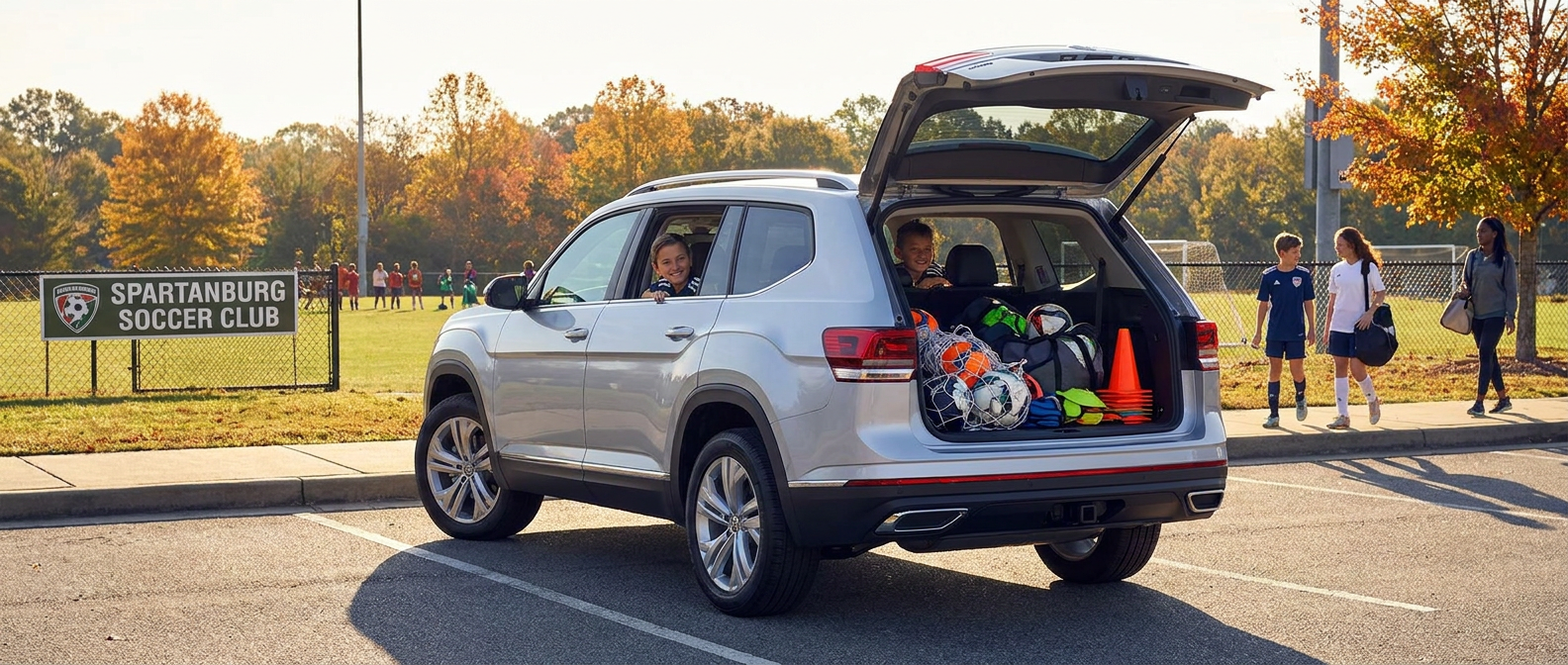
2026 Volkswagen Atlas rear hatch open with soccer gear at a Spartanburg SC soccer field

3 Best Volkswagen Models for Busy Spartanburg Parents

In this article How These Three Rank for School-Run and Soccer-Field Duty The Atlas: Built for the Full Carpool Load The Atlas Cross Sport: More Cargo, Same Engine, Five Seats The Tiguan: The Right Pick When Space Isn't the Priority Which One Is Actually Right for Your Family? One spec worth correcting before you build a carpool shortlist is the old idea that the Tiguan offers a third row. It used to. The 2026 Tiguan does not. If you're pricing out carpool runs on Reidville Road and you haven't looked at the current lineup closely, that single detail reshapes this decision. Our top pick for most Upstate SC families running a genuine carpool is the 2026 Volkswagen Atlas. It seats seven, hauls 20.6 cubic feet of cargo with everyone aboard, and tows up to 5,000 pounds when soccer weekend becomes a camping weekend. That said, it's not the right fit for every driveway or every family. So here's the straight version. How These Three Rank for School-Run and Soccer-Field Duty We ranked these three on the four measures that decide a school-pickup-and-practice vehicle, meaning passenger count, cargo behind the last row, fuel efficiency, and the one feature each does best, so you'll see where each one wins and where it asks you to give something up. Rank Model Best For Seats Cargo (all seats up) EPA Combined MPG 1 Atlas Full carpool (6-7 passengers) 7 20.6 cu ft 23 mpg (FWD) 2 Atlas Cross Sport Family of 5 + gear 5 40.3 cu ft Up to 23 mpg 3 Tiguan One family, tight spaces 5 33.8 cu ft 26 mpg combined *EPA fuel economy figures per fueleconomy.gov for the 2026 model year.* The Atlas: Built for the Full Carpool Load Seven seats make the Atlas the carpool pick, and it backs that up with 20.6 cubic feet of cargo behind the third row and a tow rating up to 5,000 pounds, though you trade away some ease of parking to get all of it. If you're the parent driving five kids home from Dorman or Spartanburg High after a Tuesday practice, it's the only Volkswagen that fits them all. Volkswagen lists the 2026 Atlas cargo hold at 20.6 cubic feet behind the third row with everyone seated. That doesn't sound like much until you realize it swallows a soccer bag, a folded lawn chair, and a cooler without anyone losing a seat. Fold the third row and you're at 55.5 cubic feet; fold both rear rows and you reach 96.6 cubic feet of flat cargo space. The 2.0-liter TSI engine puts out 269 horsepower and 273 lb-ft of torque, which means merging onto I-85 with six passengers doesn't feel like a prayer. It feels like a car. The tradeoff is size. Parking it in a tight pickup line at a Spartanburg elementary school takes a bit more attention than a compact crossover does. With 4MOTION all-wheel drive (standard on most trims above the base SE), the EPA rates fuel economy at 20 city / 26 highway for the SE 4MOTION. That's real-world math worth knowing on a school run. Buying caution: If your household consistently carries five or fewer people and rarely hauls more gear than two soccer bags, you may be paying for third-row capacity you'll fold down and never use. The Atlas Cross Sport gives you more cargo per seat for a two-row family. The Atlas Cross Sport: More Cargo, Same Engine, Five Seats The Cross Sport is the cargo pick for a two-row family, dedicating all its rear volume to the trunk for 40.3 cubic feet behind the second row against 20.6 in the three-row Atlas, and that extra room costs you the seventh seat you can't add back. Close to twice the space with every seat full is what you gain. The 2026 Atlas Cross Sport shares the 2.0-liter TSI engine of the Atlas rated at 269 horsepower and 273 lb-ft of torque, along with the same 4MOTION AWD option. You'll notice the roofline sits a bit lower and the silhouette looks sportier. Maximum cargo expands to 77.6 cubic feet when the rear seats fold down, and Volkswagen quotes that figure on their official site. A seventh passenger won't fit, and that's the trade you're making. But if your carpool caps at your two kids plus two friends, and you're tired of complaints about a cramped trunk, the Cross Sport is the vehicle your Saturday mornings have been waiting for, trunk and all. Pros / Cons for the Atlas Cross Sport Pros Cons 40.3 cu ft cargo with seats up (vs 20.6 in the Atlas) Only 5 seats. No carpool of 7 Same 269 hp engine as the full Atlas Lower roofline means slightly reduced headroom for tall rear passengers Sportier exterior profile Missing the pass-through console of the Atlas for long cargo items 4MOTION AWD available for wet Upstate SC mornings Slightly less total max cargo than full-size competitors See Current Volkswagen Specials The Tiguan: The Right Pick When Space Isn't the Priority The 2026 Volkswagen Tiguan is the right call when space isn't your priority, a five-seat, two-row SUV built to park easier and ride more refined day to day, with one catch worth stating plainly, the optional third row disappeared in the 2025 redesign. For families who remember the old three-row Tiguan, we'll be direct, that version is gone from the current lineup. What replaced it works better for the family that doesn't need that row. Volkswagen boosted the cargo area to 33.8 cubic feet behind the second row (up from the cramped configuration of the previous generation). The rear-seat legroom is 40.2 inches, which matches the front-row legroom exactly. Kids have actual room. The 12.9-inch touchscreen and IQ.DRIVE driver assistance suite are standard across every 2026 Tiguan trim. Carbuzz confirms the EPA fuel economy at 23 city / 30 highway / 26 combined mpg for the base 2.0-liter (201 horsepower) configuration. For a family of four that drives a lot of highway miles between Greenville and Spartanburg, that fuel-efficiency edge is meaningful, and you'll feel it in real driving. The limit is five seats. If a neighbor's kid ever needs a ride, someone's getting left behind. For families whose carpool duty is light and whose priority is a more maneuverable daily driver, the Tiguan earns its place on this list. For everyone else, step up to the Atlas or the Cross Sport. Explore financing options at Steve White Volkswagen Which One Is Actually Right for Your Family? The Atlas wins when carpool size is the variable in play, since it seats seven, keeps real cargo behind all of them, and tows gear on the weekends, with the bulk costing you a bit in tight parking lots. You'll recognize it as the Volkswagen built for the family whose Saturday turns up a third kid who needed a ride. Go with the Atlas Cross Sport when you're consistently a family of five and you want more usable trunk space than the three-row Atlas delivers with its last row up. Same power, more cargo per seat, cleaner roofline. The Tiguan wins when your family of four values fuel efficiency and a vehicle that fits more comfortably in tighter spaces. It's a refinement upgrade from a compact crossover, not a carpool solution. We're at Steve White Volkswagen on Reidville Road, and we've watched this decision hinge on the fall carpool season more than anything else. The regret that's easy to land in is buying the smaller vehicle and then wishing for more seats at the first school-year carpool request. Buy for the life you actually live in October, not the one you're temporarily living in July. Value Your Trade-In Steve White Volkswagen Spartanburg 2671 Reidville Rd, Spartanburg, SC 29301 (864) 585-2492

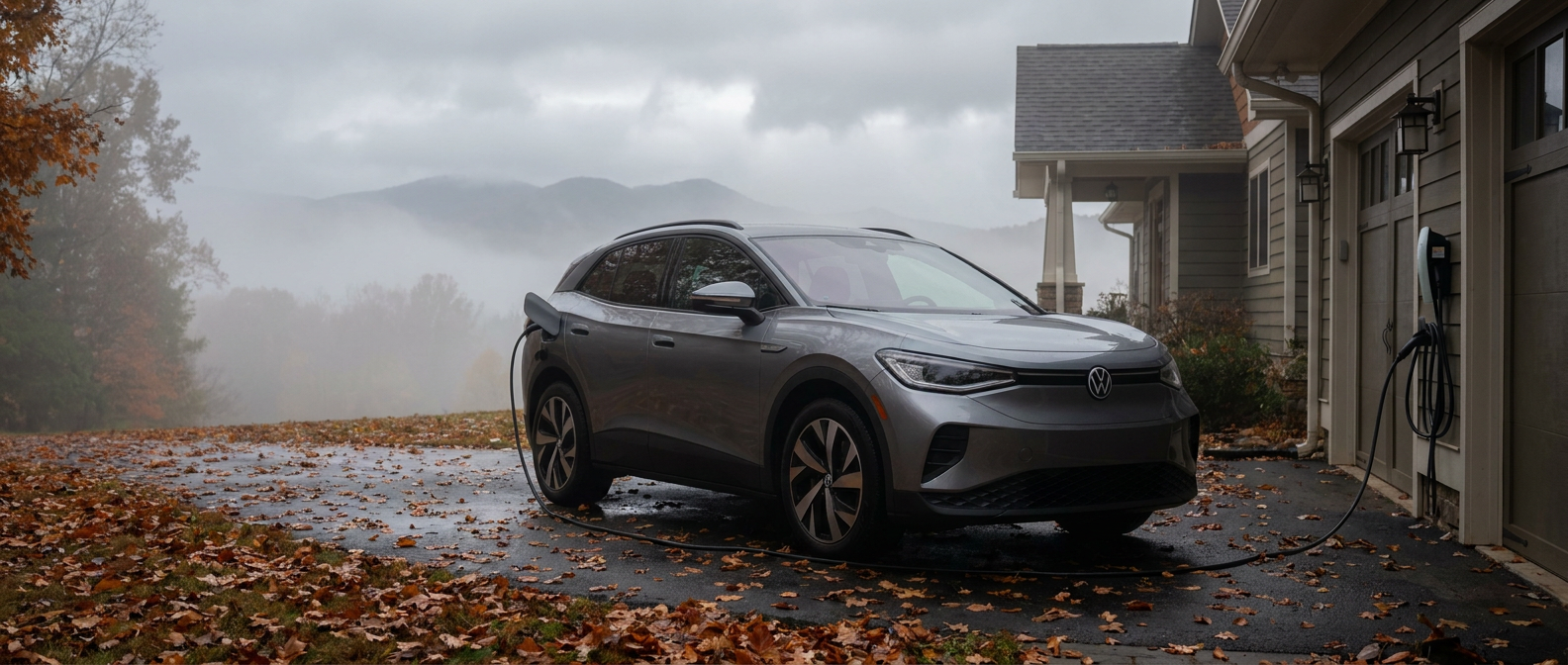
2026 Volkswagen ID.4 on a cool autumn morning in Spartanburg, South Carolina, with Blue Ridge foothills in the background

Volkswagen ID.4 Cool-Weather Commuting Guide for Spartanburg Drivers

Spartanburg's cool season sits closer to an EV range sweet spot than to an EV range problem, and that's the bottom line for ID.4 drivers here. The hardest cold-weather penalty on the ID.4 kicks in below freezing. Our winters mostly don't go there. Plan the charge right, and a cool Upstate SC commute becomes one of the better real-world cases for this car. That said, there's a real tradeoff. We'll name it plainly. Where Do You Charge and When? Charge at home on Level 2 overnight and you'll cover almost any Upstate SC commute before you back out of the driveway, with the Tesla Supercharger at Winchester Place standing by for the long days when a daily top-up isn't enough. Get the timing right and the rest is just driving. Spartanburg's cool season runs from late November through late February, with average daily highs in the mid-50s Fahrenheit and overnight lows that typically sit in the mid-30s. The EPA rates the 2026 Volkswagen ID.4 Pro at 291 miles of range under ideal conditions. Real-world driving data at sustained temperatures in the 40-55 degree Fahrenheit range, which is where Spartanburg spends most of its cool months, points to about a 10% efficiency reduction at those temps. A 10% dip isn't anywhere near the 25-35% loss that occurs below 32 degrees Fahrenheit. Spartanburg's average January low is around 34 degrees Fahrenheit. Deep cold snaps happen, but extended hard freezes stay the exception, not the rhythm. The table below maps out the practical charge decision you'll make as an Upstate SC commuter. Scenario Charge location Timing Realistic range at departure Key move Daily I-85 or I-26 commute, under 60 mi round trip Home Level 2 (240V) Overnight, 7-8 hours 240-270 mi Schedule charge to finish near your alarm, not midnight Long day: Spartanburg to Greenville and back with errands Home Level 2; Supercharger as backup Top up at home; fast charge only if under 100 mi remaining Full day covered comfortably Tesla Supercharger at Winchester Place, 8 stalls, 24/7, off I-26 Cold snap forecast below 35 degrees Fahrenheit Home Level 2 with app preconditioning Precondition 20-30 min before departure Recovers roughly 10-15 mi vs a cold-soaked battery Battery warms on grid power, not your driving range Road trip: Charlotte, Asheville, or the coast Home full charge night before Charge to 90%; plan one fast-charge stop 260-plus miles usable; one 30-min stop handles most trips NACS port is standard on the 2026 ID.4 The 2026 Volkswagen ID.4 ships with a NACS charge port as standard equipment, so the Tesla Supercharger network in Spartanburg opens to you as a native connector. You'll find 8 stalls at 2100 Winchester Place off I-26, rated up to 250 kW. No adapter negotiation. The DC fast charge rate of the ID.4 tops out at 175 kW, so on a 250 kW stall it charges at its full capability, about 10% to 80% in about 30 minutes. The Honest Tradeoff, and How It Plays Out Here The one genuine tradeoff on the Pro and Pro S is the resistive cabin heater, which pulls more energy from the battery in the cold than a heat pump would, yet even on Spartanburg's hardest freezing mornings you'll still have plenty of range left for a normal commute. Look at the mechanism for a second. The 2026 Volkswagen ID.4 Pro and Pro S use a resistive cabin heater rather than a heat pump (the heat pump is available on the Pro S Plus trim). Resistive heating warms the cabin quickly but it draws more energy from the battery than a heat pump does. On a 50 degree Fahrenheit morning, the hit to a 50-mile round-trip commute is modest, and you'll barely feel it. On a 28 degree Fahrenheit morning after the car has cold-soaked overnight, plan on around a 20% range reduction. At 291 EPA miles, that still leaves well over 230 miles available on the hardest mornings Spartanburg typically sees. Translate that to an actual commute. A 60-mile daily round trip uses about 20% of the battery in normal conditions. Add the coldest realistic reduction and you're at about 25% consumed for the day. A lot of margin. We pay closer attention to this math when a driver covers 120-plus miles daily, or when home charging is Level 1 only. A standard wall outlet adds about 4-5 miles per hour of charge, which works for short commutes with discipline. A Level 2 home setup makes the calculation comfortable and routine. The Tiguan is the Volkswagen that Upstate commuters compare against the ID.4 most often at this budget range. It brings AWD, a familiar gas powertrain, and a wide refueling network, so it's a legitimate alternative. The Taos comes up too, especially for solo drivers who want a smaller footprint and lower ownership cost. We're not going to pretend one answer fits everyone. The ID.4 wins on energy cost per mile and on the daily-commute experience once charging is dialed in. But both the Tiguan and the Taos earn a real conversation if your charging situation is uncertain. The 2026 Volkswagen ID.4 is a compact SUV with 30.3 cubic feet of cargo space behind the rear seats. It'll hold a full week of groceries, a set of commuter gear, or a weekend bag for two. Not a van. Right-sized for the dual-income Spartanburg household running the I-85 corridor daily. Charging reality check. At the Winchester Place Supercharger, the ID.4 charges at its own 175 kW maximum. Plan a 30-minute stop and you're back on the road with well over 150 miles added. That covers Spartanburg to Greenville and back twice over. Daily charge discipline. Set your regular daily charge ceiling to 80% in the app. Volkswagen and battery engineers broadly recommend this for long-term battery health, bumping to 90% the night before a longer drive. Set it once and you're done for the season. Your Pre-Season Upstate SC EV Commute Checklist Run through this list well before November and your cool-season charging routine will hold steady through February, provided you handle the one item that's easy to skip, which is measuring your own actual round-trip commute mileage instead of estimating it. Do that part first. Book a pre-season service check to confirm your charging connections are clean and the battery's thermal management is operating normally. [ ] Set a scheduled departure charge in the Volkswagen ID.4 app, targeting 80% and finishing near your alarm time [ ] Enable battery preconditioning in the app for any morning forecast below 40 degrees Fahrenheit, which warms the battery on grid power before you unplug rather than on your range [ ] Save the Winchester Place Tesla Supercharger off I-26 as a fast-charge location in your app [ ] Know your actual round-trip commute mileage. Not an estimate. The real number, from your driveway to your destination and back. [ ] Set your regular daily charge ceiling to 80%, then bump it to 90% the night before a trip over 150 miles round trip [ ] On cold mornings, use the heated front seats before running the cabin heater at full blast. It costs less energy and warms you just as fast. [ ] Plan your first cold morning as a data run, not a stress test. Drive the commute, check how much range you actually used, and calibrate from there. One pattern we stand behind: an EV commute turns frustrating mainly when the car runs on Level 1 charging and the margin gets estimated instead of measured. The ID.4 on a proper Level 2 home setup removes that variable entirely. The commute becomes genuinely routine once that's handled. That version of the car earns its keep. Talk through the financing options at Steve White Volkswagen before you settle on a trim level; it's worth doing early. The step from Pro to Pro S brings the heated steering wheel and enhanced IQ.DRIVE driver-assist features. On a dark, cool I-85 commute in January, that heated wheel is less of a luxury than it sounds on a spec sheet. You'll enjoy the drive this winter. *By the Steve White Volkswagen Team | October 2026* See Current Volkswagen ID.4 Offers Steve White Volkswagen Spartanburg 2671 Reidville Rd, Spartanburg, SC 29301 (864) 585-2492