
Blog

Why the Volkswagen Taos Fits Downtown Spartanburg | Steve White Volkswagen

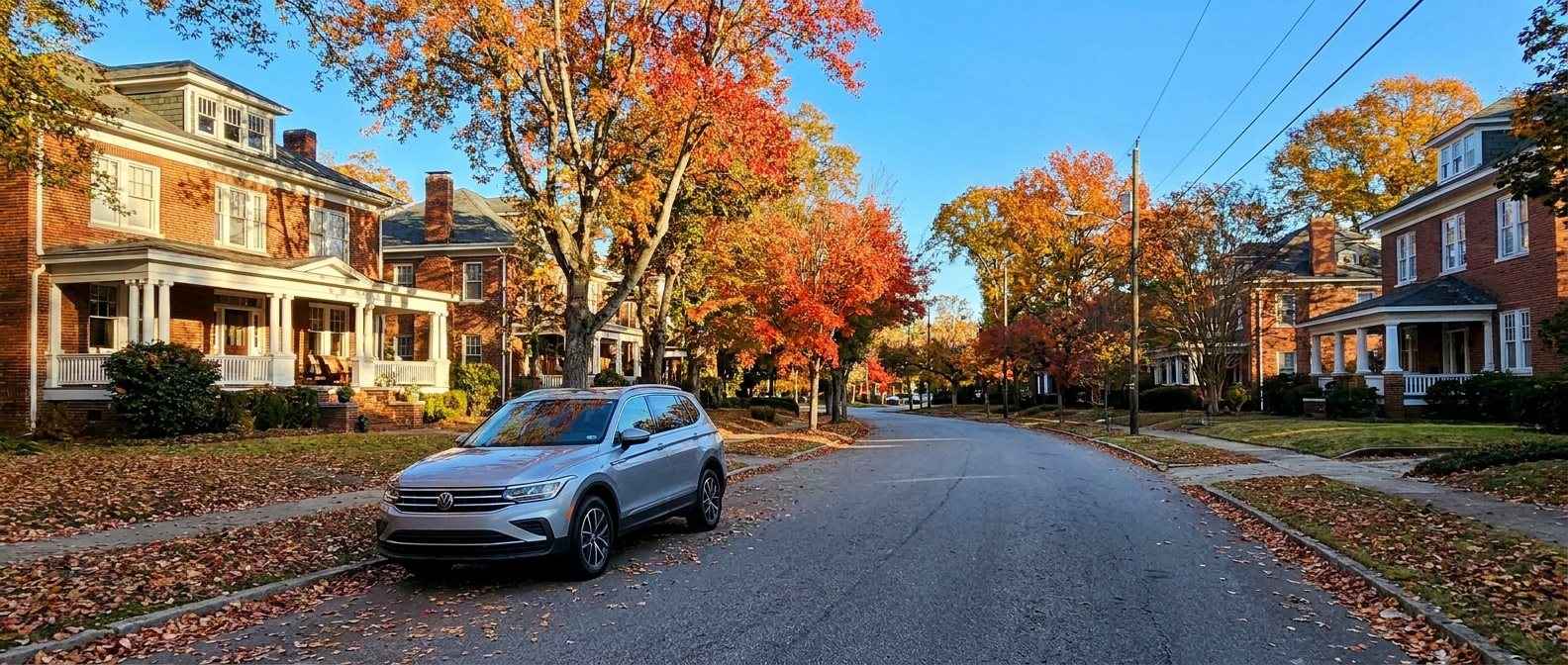
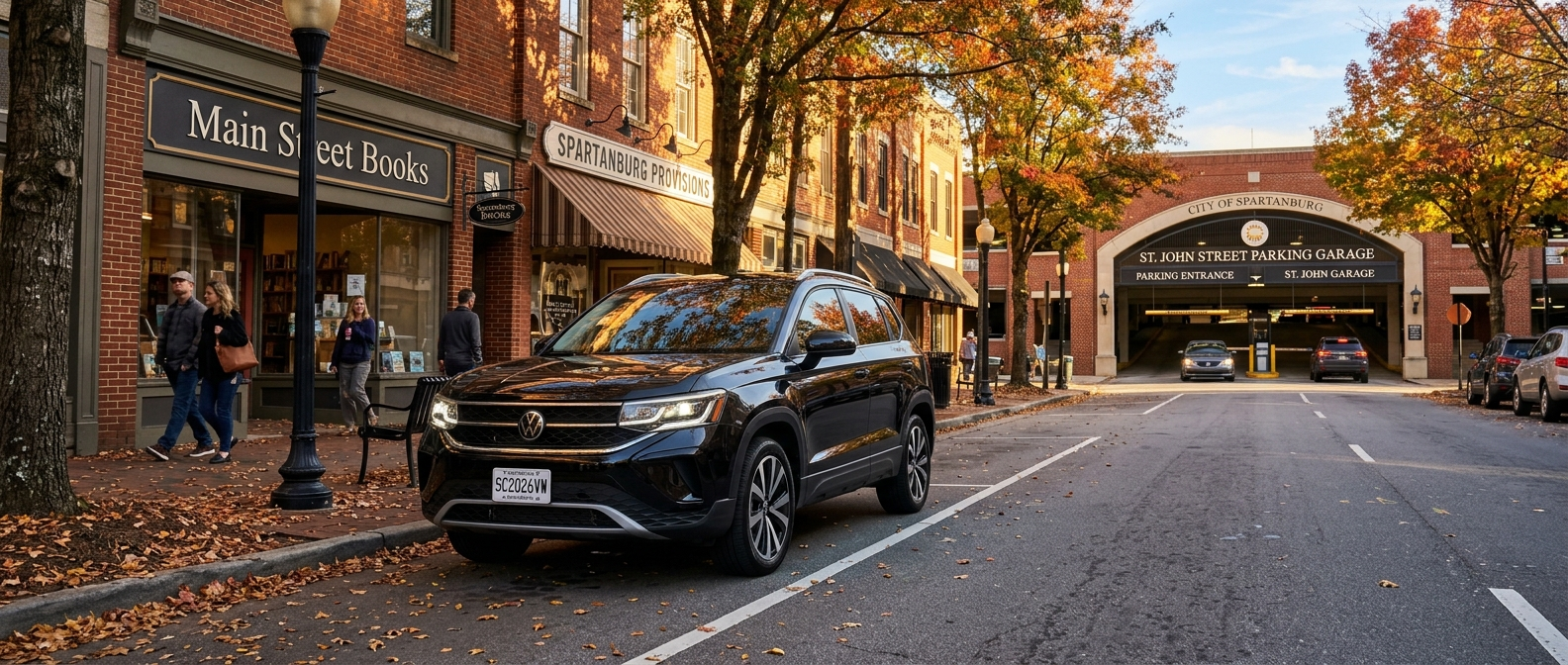
2026 Volkswagen Taos parked on a downtown Spartanburg street near a parking garage entrance

East Main Street just lost a lane. The surface lot next to Morgan Square is gone. And if you've tried to thread a full-size SUV into the Dunbar Street garage during a lunch rush lately, you already know the punchline. Downtown Spartanburg is physically getting tighter, not more forgiving, and the vehicle you drive into it every day should reflect that reality.

The 2026 Volkswagen Taos fits. At 175.9 inches long with a 35-foot turning circle, it maneuvers where larger crossovers hesitate. The EPA rates the front-wheel-drive Taos at 28 city and 36 highway mpg. Those numbers earn their keep on a commute full of Morgan Square loops and stop-and-go on East Main. And IQ.DRIVE, the full Volkswagen driver-assistance suite with Forward Collision Warning, Pedestrian Detection, and Blind Spot Monitoring, comes standard on every single 2026 trim. You don't upgrade into that package. It comes standard on every 2026 trim.

The 2026 Volkswagen Taos carries a 35-foot turning circle, a 175.9-inch overall length, and standard IQ.DRIVE on every trim, a spec combination built for the exact street grid and parking structures Spartanburg's downtown is becoming.

Browse the 2026 Volkswagen Taos at Steve White Volkswagen Spartanburg

Does the Taos Actually Fit Spartanburg's Downtown?

Yes, it fits, and the sharper question is whether a larger SUV does. The Taos maps cleanly onto the conditions you'll actually meet downtown, from a shrinking lane count on East Main to the ramp turns inside the Dunbar Street garage, where a longer crossover starts dragging its front quarter.

Downtown Spartanburg ConditionThe Taos Feature That Handles ItWhy It Matters Here
East Main Street road diet (4 lanes to 3, on-street parallel parking added)175.9-in length, 72.5-in widthA shorter, narrower body slips into parallel spots and negotiates tighter travel lanes with less repositioning
Dunbar, Kennedy, and Magnolia Street parking garages with ramp turns35-foot curb-to-curb turning circleGarages designed for standard sedans and compacts; the Taos turns easily where a longer crossover drags its front quarter
Mixed pedestrian, cyclist, and vehicle traffic on Main StreetStandard IQ.DRIVE Pedestrian and Cyclist Detection + Automatic Emergency BrakingThe system monitors the sidewalk-adjacent zone constantly; useful when Wofford College students are crossing mid-block
Stop-and-go commute on Reidville Road and I-585 to downtownEPA-rated 28 mpg city (FWD)Above-average city fuel economy for the segment means stop-and-go drains less per mile than you'd expect
Project Core construction zones with lane narrowing and traffic pattern shiftsRear Cross-Traffic Alert + Active Blind Spot MonitorHelps when backing out of angled spots with concrete barriers and construction vehicles reducing sightlines
After-5 pm street parking along Broad StreetRearview camera standard + Park Distance ControlLow-speed backing into on-street spots with traffic flowing behind you

None of that is coincidental, and you'll feel it from the driver's seat. The Taos was designed for the American urban market, and Spartanburg's downtown is mid-transformation in the exact ways that reward a 35-foot turning radius over a 38-foot one.

The Powertrain Does Real Work in City Conditions

The powertrain does more real work than the horsepower figure implies, and that comes down to where the torque lands rather than how much sits at peak. The 2026 Taos makes 174 horsepower with 184 lb-ft of torque at just 1,750 rpm, so the engine pulls well before you're halfway through the rev range. Paired with the 8-speed automatic, it's responsive off a traffic light in a way that older Taos buyers who dealt with the pre-2025 dual-clutch transmission genuinely notice as an improvement. The launch is cleaner.

The limitation is real, and it shows on the interstate. Merging onto I-85 from Reidville Road every day at speed with a full load, the Taos asks more of the throttle than the Tiguan does. It gets there, but it's working. For city blocks and connector roads into downtown, it's plenty. For regular interstate passing, it's fine. For aggressive highway driving week after week, consider whether the Tiguan gives you more margin.

None of that is a knock. The Taos makes the right tradeoff for the right driver. If most of your mileage is downtown Spartanburg, USC Upstate runs, and Reidville Road stop-and-go with the occasional I-26 weekend trip, the Taos earns its keep on fuel economy alone, more than you'd guess. The EPA figures of 28 city and 36 highway (FWD) sit above the segment average for comparable subcompact crossovers. On fuel, the Taos wins.

See Current Taos Offers at Steve White Volkswagen

From the 2026 press materials of Volkswagen: The 2026 Taos carries IQ.DRIVE as standard equipment across the entire lineup, including Forward Collision Warning, Automatic Emergency Braking with Pedestrian Monitoring, Active Blind Spot Monitor, Lane Assist, Travel Assist, Adaptive Cruise Control with stop-and-go, and Rear Cross-Traffic Warning.

IQ.DRIVE Is More Useful in a City Than Most Drivers Expect

Adaptive cruise and lane assist get filed as highway tools, yet on downtown Spartanburg streets it's the lower-speed pieces of IQ.DRIVE that carry the load. Front Assist's Automatic Emergency Braking with Pedestrian Detection scans actively at the speeds you're actually driving near Morgan Square and the Chapman Cultural Center. Those speeds are where it counts.

Rear Cross-Traffic Warning catches what your mirrors miss when you're backing out of a Magnolia Street garage spot with a concrete pillar at your left shoulder. The Blind Spot Monitor with Active Lane Assist is the one we'd point to for the I-585 corridor. The merge from Reidville Road onto I-585 northbound puts you across two lanes fast, and a standard Blind Spot warning with steering feedback is exactly the assist you want in that window.

All of this comes on the base S trim. You don't have to spend up to the SE or SEL to get it. Standard safety tech at the entry point is genuinely unusual in this class, and it shifts the value math toward the Taos for drivers who want the assists without paying for leather seats to reach them.

See all available Taos trims in current inventory

The Interior Fits More Than the Parking Space Does

The Taos reads small from the curb and carries bigger than it looks once you're inside. Volkswagen lists 37.9 inches of rear legroom, enough for two adults to sit comfortably, and front headroom comes in at 40.7 inches without the panoramic roof. Cargo runs 27.9 cubic feet behind the rear seats and folds to 65.9 with the second row down.

None of that reaches large-SUV territory. Croft State Park lies southeast of Spartanburg. For the driver hauling a couple of bikes there on a Saturday and then threading the Chapman Cultural Center block on a weeknight, the Taos lands in the practical range. The 8-inch floating touchscreen with wireless App-Connect is standard, and the physical climate and audio knobs keep you from hunting through menus in traffic. The engineers of Volkswagen made the right call.

The tradeoff worth naming plainly is the middle seat. If you regularly carry three adults in the back, the 37.9-inch rear legroom works, but a third adult in the center will feel it on longer drives. The Taos is a 4-person car that can do 5 occasionally. If your life needs five-across comfort routinely, the 40.2 inches of rear legroom of the Tiguan is a real difference, not a rounding error.

Explore financing options at Steve White Volkswagen Spartanburg

Who This Vehicle Is Actually For

Picture a specific Spartanburg driver, because the 2026 Volkswagen Taos fits one well and the wrong one poorly. It suits someone navigating downtown streets and parking garages more than twice a week, running the Reidville Road corridor daily, occasionally taking I-26 to Greenville or I-85 toward Anderson, and wanting German engineering without the footprint or fuel cost of the Tiguan. It's the entry point to the Volkswagen lineup that doesn't feel like a compromise once you're in it.

The Taos isn't for the driver who tows, who carries a crew of five adults regularly, or who wants the confidence of a larger body on faster rural stretches of SC Highway 11. Those drivers should look at what the Atlas can do.

For the downtown Spartanburg driver, though, the numbers line up in a way that's hard to argue with. Count them. A 35-foot turning circle, a 175.9-inch body, 31 mpg combined (FWD), and a full safety suite that doesn't require an upgrade to access.
Steve White Volkswagen Spartanburg

2671 Reidville Rd, Spartanburg, SC 29301

(864) 585-2492

Recommended Posts

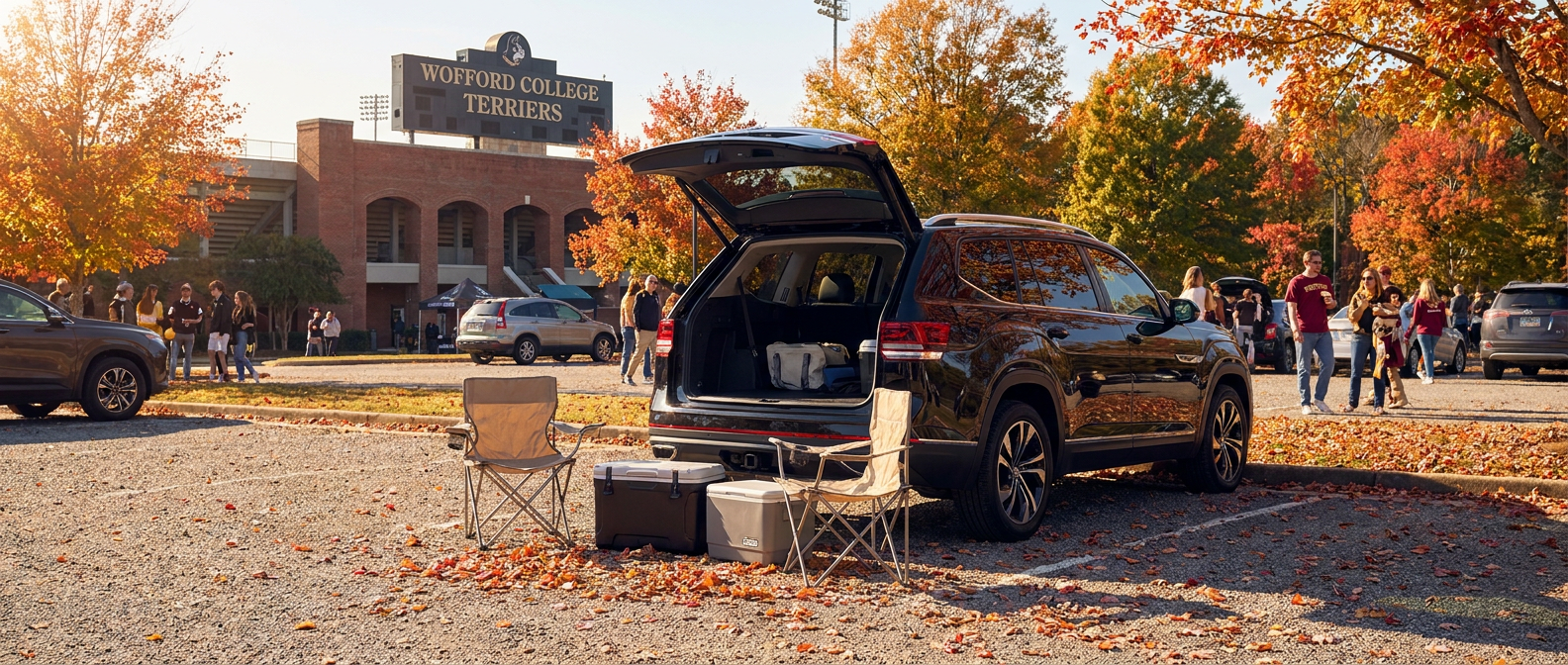
2026 Volkswagen Atlas with liftgate open at a Spartanburg autumn tailgate, showing rear cargo space loaded with gear

Volkswagen SUVs for Tailgates and Family Weekends in Spartanburg

Picture a shopper on Reidville Road eyeing the Atlas or the Tiguan. They run a quick mental comparison against a domestic three-row and say something like, "Volkswagen is a great driving car, but I need something more practical for hauling gear." The instinct is completely reasonable, but for the 2026 lineup it's mostly a myth. Volkswagen lists the 2026 Atlas with a 5,000-pound towing rating and up to 96.6 cubic feet of cargo space. No European soft-roader spec sheet reads like that. You get a legitimate family-weekend vehicle with a refined cabin on top. The tricky part is that the right Volkswagen SUV for a tailgate at Wofford's Gibbs Stadium is a different answer than the right one for a gear-loaded run to Croft State Park. So let's sort that out with real numbers. The short version The myth: Volkswagen SUVs trade utility for European driving feel, leaving them short on towing and cargo for real weekends. The reality: the 2026 Atlas is rated for up to 5,000 lb of towing and up to 96.6 cu ft of cargo, on its standard 4-cylinder engine. The 2026 Atlas Cross Sport offers 77.6 cu ft of max cargo and the same 5,000-lb tow rating (with the factory hitch on qualifying trims) in a sportier two-row body. The 2026 Tiguan tops out at 1,800 lb of towing and 69.8 cu ft. Useful for a smaller crew, not for a trailer. Picking the wrong model for your actual weekend is the real mistake. The guide below matches each SUV to the use case it actually handles. Is the "Volkswagen Isn't Practical" Reputation Earned? Fair question, and the honest answer is that the reputation fit the old Atlas lineup better than it fits the 2026 one, since before the 2024 redesign a 5,000-pound tow rating required the 3.6-liter V6 and the base 4-cylinder simply couldn't reach it. The base 4-cylinder was capped at 2,000 pounds back then, and that limitation is where much of the reputation comes from. Does the old reputation still hold? Not for the 2026 Atlas, because Volkswagen moved the 5,000-pound rating to every trim and every drivetrain on the standard turbocharged 4-cylinder engine. Below is the myth-vs-reality breakdown for all three Volkswagen SUVs at Spartanburg's Steve White Volkswagen. The Claim What the 2026 Specs Actually Show Source "Volkswagen can't tow anything useful" Atlas tows up to 5,000 lb (all trims, FWD or 4MOTION AWD); Atlas Cross Sport tows up to 5,000 lb (with factory hitch on SE w/Technology and above); Tiguan tows up to 1,800 lb (4MOTION) Volkswagen (vw.com) "The cargo is too small for a real family" Atlas: up to 96.6 cu ft max / 55.5 behind 2nd row / 20.6 behind 3rd row; Atlas Cross Sport: up to 77.6 cu ft max / 40.3 behind rear seats; Tiguan: up to 69.8 cu ft max / 33.8 behind rear seats Volkswagen (vw.com) "You need AWD to make these useful" AWD (4MOTION) improves the Tiguan tow rating from 1,500 to 1,800 lb; on the Atlas and Atlas Cross Sport, the 5,000-lb rating holds regardless of drivetrain Volkswagen (vw.com) "The Atlas still needs the V6 for real towing" The V6 is gone. The 2026 Atlas runs one engine: the 2.0L turbo making 269 hp and 273 lb-ft of torque, rated at 5,000 lb on every trim Volkswagen (vw.com) "The Tiguan is just as capable as the Atlas for hauling" The tow ceiling of the Tiguan is 1,800 lb, which is 3,200 lb less than the Atlas; useful for a small utility trailer, not a camper or boat Volkswagen (vw.com) The myth isn't entirely wrong about the Tiguan. 1,800 pounds is a genuine ceiling, and if you're towing anything substantial, the Tiguan will disappoint. But stretching the numbers of the Tiguan across every Volkswagen SUV is where the reputation gets overstated. Matching the Right Model to Your Actual Spartanburg Weekend The right pick changes with the weekend, because the spec gap between these three SUVs is wide enough to matter in the real world, and a tailgate at Wofford asks for something different than a trailer run to Croft State Park around Upstate SC. The Wofford tailgate scenario (Gibbs Stadium parking lots, fall Saturdays, family of five, cooler plus folding gear) lands squarely in Atlas Cross Sport territory. The two-row body gives you a flat load floor and 40.3 cubic feet of accessible cargo behind the rear seats when all five seats are occupied. You can load a 54-quart cooler, a pop-up canopy, chairs, and a bag of charcoal without folding a seat. The rear liftgate opens wide, and the available 115-volt outlet on select trims lets a small grill run on vehicle power. The Atlas Cross Sport sits lower and parks more easily in tighter campus lots than the three-row Atlas, which matters when the Verandah Lot fills early. The Croft State Park gear-haul scenario (2 lakes, trail access, kayaks or a utility trailer) is where the three-row Atlas earns its keep. Volkswagen rates it at up to 5,000 pounds of towing capacity when properly equipped, enough for a small fishing boat or a loaded utility trailer. The 4MOTION AWD system adds low-speed traction on Croft's unpaved access roads and gravel launches. And if the whole family is coming, 20.6 cubic feet behind the third row still swallows duffel bags and a cooler for seven passengers. The SC Highway 11 scenic run (Cherokee Foothills National Scenic Highway, 100 miles of curves and elevation change, camping gear) is where the Tiguan makes sense if you're not towing. The more agile two-row body, 33.8 cubic feet of cargo behind the rear seats, and the optional 4MOTION AWD give a couple or small family of four a genuinely enjoyable mountain drive without the Atlas footprint. Its 1,800-pound tow rating covers a small camper trailer or a motorcycle carrier. What it won't do is haul a boat or a loaded four-place camper. So if the trailer is coming on that SC-11 run, the Atlas is the honest answer. Weekend Use Case Best Fit Why Wofford tailgate, family of 5, cooler + gear Atlas Cross Sport Flat load floor, 40.3 cu ft behind seats, easier campus parking Croft State Park boat/trailer haul Atlas (3-row) 5,000 lb towing, 4MOTION AWD, trail access traction SC Hwy 11 scenic run, couple or 4 Tiguan Agile on curves, right-sized cargo, AWD available 7-passenger family + trailer + gear Atlas (3-row) Only one here with 3 rows and 5,000-lb towing Solo or duo camping, no trailer Tiguan or Atlas Cross Sport Cargo is sufficient; Tiguan more nimble The 2026 Atlas moved its 5,000-lb towing rating to every trim. FWD and 4MOTION AWD alike, when Volkswagen dropped the V6 at the 2024 redesign. That's the spec most shoppers are still working from the old version of. Insider note: When shoppers line the Atlas up against domestic three-row SUVs on towing, the 5,000-lb figure matches what most competing midsize three-rows offer. The Volkswagen spec doesn't lose that race. Where the Atlas does concede is max payload, which Volkswagen lists at 1,102 lb. So if you're towing near the max AND carrying seven people with gear, the total combined weight needs to stay within the Gross Combined Weight Rating. A quick conversation with our team before you load up is worth the five minutes. See Current Volkswagen Offers So Which Volkswagen SUV Should You Actually Drive Home? If any kind of trailer is part of your weekend, the Atlas is the only Volkswagen SUV in our lineup that handles it without compromise, and if there's no trailer in the picture, the Cross Sport or the Tiguan usually makes the smarter, easier-to-park choice. Full stop. The Atlas Cross Sport reaches the same 5,000-pound towing rating in select trims, but you give up the third row and roughly 19 cubic feet of maximum cargo. That tradeoff is worth naming plainly. A family of six or seven has no good answer in the Tiguan or the Cross Sport. If the weekend is a tailgate or a gear run without a trailer, the Atlas Cross Sport is the sleeper pick. It's easier to maneuver, the cargo floor beats crawling over a third row, and it keeps the same refined driving feel without the three-row footprint. The Tiguan is the right call when the passenger count is four or fewer and the drive itself is part of the point. SC Highway 11 in October with the foliage out is a genuinely good drive in a well-sorted compact SUV. Come in and tell us what your actual Saturday looks like, and we'll point you at the right one. Browse our inventory to see what's on the lot, or give us a call before you make the trip down Reidville Road. Frequently Asked Questions Can the 2026 Volkswagen Atlas actually tow 5,000 pounds? Yes, and this is the spec that surprises people most. Volkswagen rates every trim of the 2026 Atlas at 5,000 pounds of towing capacity when properly equipped, including the FWD and 4MOTION AWD versions, all running the standard 2.0-liter turbocharged engine producing 269 horsepower and 273 lb-ft of torque. The rating moved from V6-only to a standard 4-cylinder setup at the 2024 redesign. A factory-approved trailer hitch and trailer brakes are required to reach that figure, and the 1,102-pound payload rating means the total combined weight of passengers, cargo, and trailer needs to stay within the vehicle's Gross Combined Weight Rating. Is the Tiguan big enough for a family tailgate in Spartanburg? For a smaller crew of four to five with standard tailgate gear (a cooler, chairs, a bag or two), yes. The 2026 Tiguan offers 33.8 cubic feet of cargo space behind the rear seats and expands to 69.8 cubic feet with the seats folded. For a couple or a small family, it works as a solid tailgate vehicle. Where it falls short is towing. Its tow ceiling is 1,800 pounds maximum with 4MOTION AWD (1,500 with FWD), so it won't pull a camper or a boat trailer. If a trailer's involved, the Atlas is the right call. Explore Financing Options Steve White Volkswagen Spartanburg 2671 Reidville Rd, Spartanburg, SC 29301 (864) 585-2492

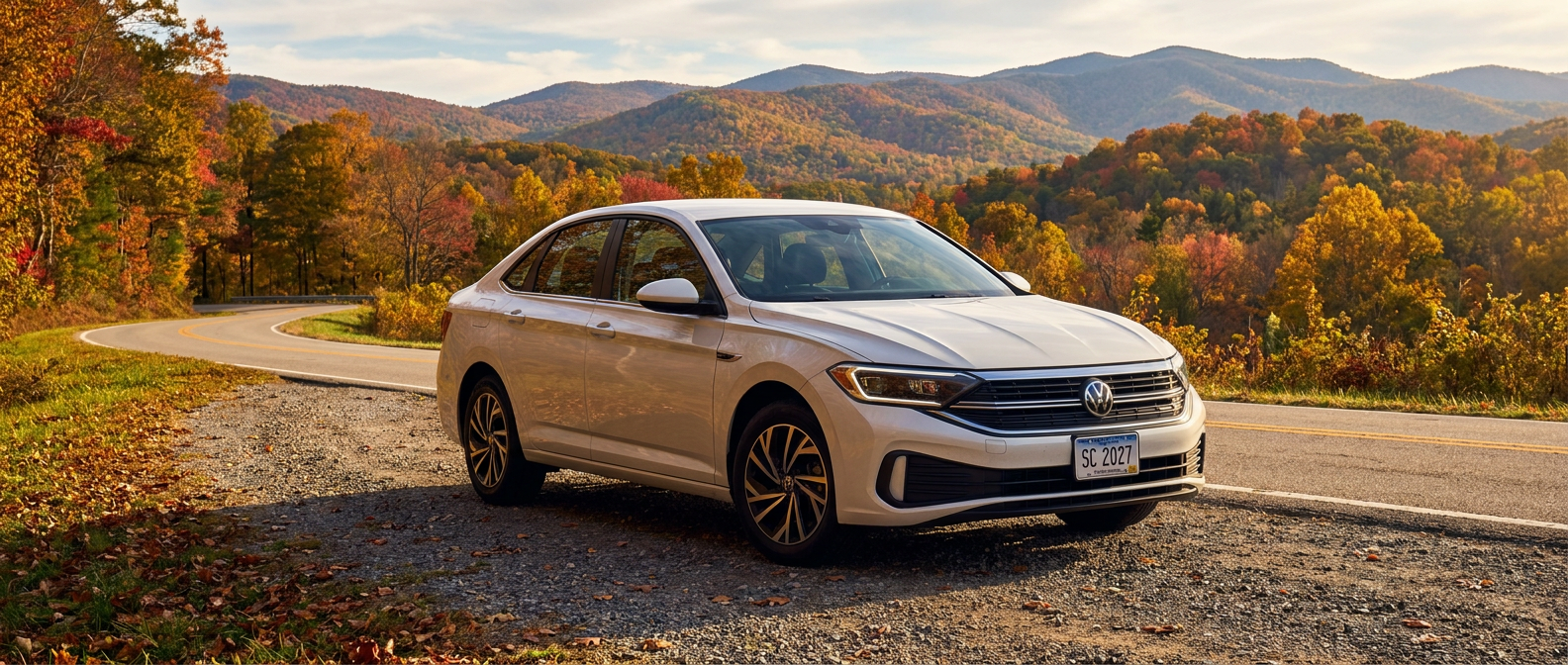
2027 Volkswagen Jetta on an Upstate South Carolina road near the Blue Ridge foothills

Volkswagen Jetta vs. Mazda3 for Spartanburg Commuters

In this article How far will your commute budget go in each car? Where does each car put its passengers? What safety technology comes standard? The honest case for the Mazda3 Plan your decision this way If your daily routine puts you on I-85 between Spartanburg and Greenville, the question isn't which compact sedan photographs better in a brochure. The real test is which one makes that run easier, cheaper, and less fatiguing over the long haul. We've spent real time with both cars here at Steve White Volkswagen Spartanburg, and the fair answer is they're genuinely different tools built for slightly different drivers. One of them probably fits your commute better than the other, and it isn't always the one you'd guess. Start with the bottom line. The 2027 Volkswagen Jetta wins on highway fuel economy, rear legroom, and standard safety tech at every trim level. The 2026 Mazda3 wins on available AWD, a sportier feel at the wheel, and a premium cabin vibe in its higher trims. Neither is the wrong answer. They're just not equivalent answers. Browse our current Jetta inventory How far will your commute budget go in each car? The number that shapes everything else for a daily driver is how much fuel the car drinks over a year of commuting, and on that measure the 2027 Jetta pulls clearly ahead of the Mazda3 once you point it down the interstate. The EPA rates the 2027 Jetta at 29 city / 40 highway mpg on regular 87-octane gasoline, and that 40-mpg highway figure holds across all four standard trims (S, Sport, SE, and SEL). No cherry-picked number from the lightest trim on the most favorable test cycle. The figure stays consistent. The 2026 Mazda3 sedan with the naturally aspirated 2.5-liter engine lands at 27 city / 36 highway / 30 combined mpg, per EPA ratings. Still solid. But the highway number trails by 4 mpg, and the highway is where Upstate SC commuters actually spend their time. Spec 2027 Volkswagen Jetta (S/Sport/SE/SEL) 2026 Mazda3 Sedan (2.5 S FWD) Engine 1.5L turbo 4-cylinder 2.5L naturally aspirated 4-cylinder Horsepower 158 hp 186 hp Torque 184 lb-ft 186 lb-ft Transmission 8-speed automatic 6-speed automatic EPA City mpg 29 27 EPA Highway mpg 40 36 EPA Combined mpg 33-34 30 Fuel grade required Regular (87) Regular (87) Rear legroom 37.4 in 35.1 in Trunk volume 14.1 cu ft 13.2 cu ft Standard safety suite IQ.DRIVE (all trims) i-Activsense (all trims) AWD available No Yes (select trims) The Mazda3 does have more horsepower (186 vs. 158), and you'll feel it if you like a spirited merge onto I-85. The engine of the Jetta delivers its 184 lb-ft of torque low in the rev range, which feels more useful in stop-and-go Reidville Road traffic than a naturally aspirated engine that needs revs to get moving. Both cars run on regular fuel, so you're not paying a premium for performance. The EPA rates the 2027 Jetta at 40 mpg highway on regular 87-octane across all four standard trims, four mpg more than the 2026 Mazda3 Sedan's EPA-rated 36 mpg highway. Where does each car put its passengers? Both sedans seat four adults comfortably up front, but the back seat is where they separate, and the Jetta wins it by a clear margin thanks to a couple of extra inches of rear legroom you can feel on a longer ride. The Jetta has 37.4 inches of rear legroom. The Mazda3 sedan comes in at 35.1 inches. That 2.3-inch difference doesn't sound like much until you've been the person in back on a 45-minute commute. If you're carpooling coworkers, shuttling kids from Wofford College or USC Upstate on weekends, or just regularly putting two adults in the back, the Jetta is noticeably roomier back there. The Mazda3's interior quality is excellent, and the materials feel a step above base trims of the Jetta, though it fits the back seat tighter. We'd call that a real tradeoff worth weighing. Trunk space also favors the Jetta, 14.1 cubic feet versus 13.2 in the Mazda3 sedan. Neither is cavernous, but the Jetta gives you a bit more room for groceries, gym bags, or gear when you're heading toward SC Highway 11 and the Cherokee Foothills for the weekend. What safety technology comes standard? Both cars take standard safety tech seriously, and each one ships its full driver-assist suite on the base trim rather than locking the good features behind a pricier upgrade, so you start protected no matter which sedan you drive home. Every trim of the 2027 Volkswagen Jetta comes with IQ.DRIVE. The suite of Volkswagen includes adaptive cruise control with stop-and-go, forward collision warning with automatic emergency braking and pedestrian monitoring, lane-keeping assist, active blind-spot monitoring, and rear traffic alert. You don't have to pay to unlock it on a higher trim. All of it rides on the base S. Worth noting: The 2026 Mazda3 includes Mazda's i-Activsense suite as standard, which covers automatic emergency braking, blind-spot monitoring, and radar cruise control with stop-and-go. Both cars are well-equipped from the start, so you're not sacrificing safety either way. The difference comes down to the Travel Assist feature of the Jetta, which adds semi-automated driving assistance that earns its keep on long I-85 hauls. The 2027 Volkswagen Jetta also earned a five-star overall safety rating from NHTSA. For commuters logging serious highway miles, that rating is meaningful context. See Current Volkswagen Offers The honest case for the Mazda3 We'd be doing you a disservice if we only pressed the case of the Jetta here, because the Mazda3 earns real consideration in two specific situations where it clearly outpoints the Jetta, and both are worth naming plainly before you decide. First, if you want available AWD, the Mazda3 Carbon Edition and Turbo Premium Plus trims offer all-wheel drive through Mazda's i-ACTIV AWD system, while the Jetta has no AWD option at all. Upstate SC winters are mild by northern standards, but ice events hit I-85 every few seasons. If that truly worries you, the Mazda3 is the only one of these two that can address it. Second, the drive can matter as much as the destination. The Mazda3 has a more engaging steering feel and a sportier suspension tune. It won't pretend to be a performance car, but next to the composed, comfortable highway ride of the Jetta, the Mazda3 is the more entertaining machine on a winding road. The Jetta is tuned to make 40,000 miles of I-85 feel easy. The Mazda3 is tuned to make those miles feel a little more alive. Personal preference drives that call. Plan your decision this way Choosing between these two really comes down to how you weight highway efficiency and back-seat space against all-weather grip and steering feel, and here's the simple framework we'd hand a Spartanburg driver standing on our lot and trying to decide which sedan to take home. Pick the 2027 Volkswagen Jetta if: highway fuel economy is your top priority, you regularly carry adults in the back seat, you want every safety feature included without a trim upgrade, or you want a 40-mpg German-engineered sedan with a roomy trunk and a composed long-haul ride. Pick the 2026 Mazda3 if: you want available AWD for the occasional icy Upstate SC morning, you care about a more spirited driving feel, or you want the premium interior quality that Mazda's higher trims deliver. We'll make one concession plainly. The Jetta doesn't offer AWD. For most Spartanburg commuters on I-85, front-wheel drive with 40 mpg highway is the better everyday trade. But if AWD matters to you, the Jetta isn't your car, and we'd rather tell you that than sell you the wrong one. When you're ready to put the 2027 Jetta through its paces on Reidville Road and back, or explore its GLI sibling if the sport side calls to you. We're here Monday through Friday, 9 to 7. Explore financing options Frequently Asked Questions Does the 2027 Volkswagen Jetta get good gas mileage for a daily commute? Yes. The EPA rates the 2027 Volkswagen Jetta at 29 mpg city and 40 mpg highway on regular 87-octane fuel, across all four standard trims (S, Sport, SE, and SEL). That 40-mpg highway figure holds no matter which trim you choose, and it runs on regular gasoline, not premium. For Spartanburg commuters putting real miles on I-85, that figure ranks among the strongest highway efficiency numbers in the non-hybrid compact sedan segment. Does the Volkswagen Jetta have more backseat room than the Mazda3? It does. The 2027 Volkswagen Jetta offers 37.4 inches of rear legroom, compared to 35.1 inches in the 2026 Mazda3 sedan. That 2.3-inch difference shows up in real use, especially if you're regularly carrying adults in the back seat for a commute or weekend run toward the Blue Ridge foothills. The trunk of the Jetta also runs slightly larger at 14.1 cubic feet versus 13.2 in the Mazda3 sedan. Is the Mazda3 a better choice if I want AWD? If AWD is a real priority for you, the Mazda3 is the right pick between these two. The 2026 Mazda3 offers Mazda's i-ACTIV all-wheel drive on its Carbon Edition and Turbo Premium Plus trims. The 2027 Volkswagen Jetta is front-wheel drive only. No AWD option exists in the Jetta lineup. For most Spartanburg-area commuters, front-wheel drive with 40 mpg highway handles the daily routine well. But if Upstate SC ice conditions are a real concern for you, the Mazda3 addresses them and the Jetta does not. Value Your Trade-In Steve White Volkswagen Spartanburg 2671 Reidville Rd, Spartanburg, SC 29301 (864) 585-2492

2026 Volkswagen Tiguan parked near WestGate Spartanburg SC in October with fall foliage

Getting More from Every Trim: Volkswagen Value Near WestGate This October

The right Volkswagen for drivers near WestGate isn't the one with the longest spec list. The one that fits is the one whose feature tier matches your real driving life. The 2026 Volkswagen lineup spans a wide range of capability. On one end, the EPA rates the Jetta at 29 city / 40 highway mpg from a 1.5-liter turbocharged four-cylinder. On the other end, the Tiguan SEL R-Line Turbo pushes 268 horsepower through the same EA888 engine family that Volkswagen has been refining for years. Those aren't just different vehicles. They stand for different decisions about what you're paying for and what you'll actually use on Reidville Road, I-85, and the morning run between Spartanburg and Greenville. Getting your money's worth means weighing those tradeoffs plainly. That's what this guide is for. The 2026 Tiguan is where most Upstate SC buyers land, and we'll start there, but the table below puts the whole lineup in front of you first. What Do You Actually Get at Each Tier? Strip away the marketing language and the Volkswagen lineup breaks into clear tiers based on what you gain at each step up. Tier Model What You Actually Get Who It's For Efficiency-first sedan Jetta (S / Sport / SE / SEL) EPA-rated 29/40 mpg city/hwy; 1.5L turbo, 158 hp; 8-in touchscreen standard; rear-seat pretensioners added for 2026 I-85 and I-26 commuters who want German cabin quality at compact-car running costs Entry SUV, real efficiency Taos FWD EPA-rated 28/36 mpg city/hwy; 1.5L turbo, 174 hp; compact footprint; 4Motion AWD optional (25/33 mpg) First-SUV buyers who want the raised ride and cargo flexibility without the fuel bill of a larger crossover Compact SUV sweet spot Tiguan S / SE EPA-rated 26/34 mpg city/hwy; 2.0L turbo, 201 hp; optional third row; IQ.DRIVE driver assistance standard at SE Growing families or couples who need seven-seat flexibility and want adaptive cruise, lane centering, and emergency braking standard Compact SUV performance Tiguan SEL R-Line Turbo 268 hp via EA888 evo5 2.0L turbo; 4Motion AWD standard; sport suspension; 22/29 mpg city/hwy Drivers who want the Tiguan footprint but want to feel the engine every time they merge Three-row family SUV Atlas (SE / SEL) EPA-rated 20/27 mpg city/hwy; 269 hp; up to 96.8 cu ft cargo; 4Motion AWD available Families who need genuine seven-seat capacity and want the wide, airy Volkswagen cabin with room for gear and passengers Hot hatch daily driver Golf GTI (S / SE / Autobahn) EPA-rated 24/32/27 mpg city/hwy/combined; 241 hp, 273 lb-ft torque; 7-speed DSG; standard limited-slip differential Enthusiast drivers who want 241 horsepower and still 32 mpg on the highway That lays out the framework. The step up only earns its keep where you'll actually feel it. What decides your tier near WestGate? For most drivers it comes down to one practical question, whether you're mostly driving solo or regularly hauling people and cargo. Matching Trim to Your Actual Upstate SC Routes October in Spartanburg means shorter days, the occasional cold start, and football-traffic Saturday evenings that can turn a 10-minute drive into a 30-minute one. Stop-and-go like that separates a cabin you want to be in from one you're just tolerating. The 2026 Jetta earns its place for commuters in a very specific way. That EPA estimate of 29 city / 40 highway doesn't come from a stripped econobox. It pairs a proper 1.5-liter turbocharged four-cylinder with an 8-speed automatic, and a key 2026 update standardized that rating across all trim levels, including the SE, which adds the sunroof most buyers want. The tradeoff is simple enough. A Jetta is a sedan. If your weekends involve loading gear for a day at Croft State Park or the Blue Ridge foothills, the trunk will eventually frustrate you. But if your life is mostly the I-26 corridor back and forth five days a week, nothing else in the Volkswagen lineup costs less to run per mile. The 2026 Atlas sits at the opposite end of the value equation. Three rows and up to 96.8 cubic feet of maximum cargo space mean it effectively replaces a minivan for Upstate SC families. The 269-horsepower 2.0-liter turbo keeps it from feeling sluggish despite the size. The fuel reality is 20 city / 27 highway on the FWD trim, and that's the cost of hauling seven people, not a flaw. For a family making the I-85 run to Charlotte or the I-26 stretch toward the coast with everyone aboard, the interior space earns that trade. On the Tiguan trim ladder: Stepping from the base S to the SE adds more real content than the step looks like on paper. IQ.DRIVE driver assistance (adaptive cruise with stop-and-go, lane centering, emergency braking) becomes standard at the SE. For anyone running the I-85 corridor between Spartanburg and Greenville in stop-and-go traffic, that suite pays for itself in reduced fatigue well before the first oil change. Next step: If you've narrowed it down to two models but aren't sure which trim to drive, our team on Reidville Road can put you in both back-to-back. An hour answers what a table can't. The Smart Choice Depends on One Honest Tradeoff The Taos is the most underestimated value in this Volkswagen lineup, and its fuel economy is exactly why. Its 28/36 EPA rating on the FWD version makes it the most fuel-efficient gas-powered SUV Volkswagen sells, and the compact footprint parks near WestGate without a second thought. The 4Motion AWD version drops to 25/33 mpg and adds real traction confidence for wet weather on SC Highway 11 and the foothills routes. Worth naming plainly, 4Motion costs you roughly 3 mpg combined. Whether that's worth it depends on how often you actually drive those routes in rain. The Golf GTI is the enthusiast answer, and it offers the most performance per dollar in the lineup. The EPA rates the 2026 Golf GTI at 24 city / 32 highway on 241 horsepower and 273 lb-ft of torque. A standard electronically controlled limited-slip differential gives it steering feel that no crossover in this price range can match. The downside is real. You get 19.9 cubic feet of cargo space with the rear seats up. A GTI isn't a family hauler. But for a driver who wants a Volkswagen that genuinely rewards the curves on SC Highway 11 on Saturday without destroying the fuel budget Monday morning, nothing else in the lineup does that job as well. Our take from standing on this lot is simple. Most buyers who come in focused on the Tiguan leave in the Tiguan. It's the right size for Upstate SC life. What's left to decide is which Tiguan, the SE with IQ.DRIVE for the commuter, or the SEL R-Line Turbo for the driver who wants 268 horsepower and means it. Side by side, those two feel like completely different vehicles. See October Offers at Steve White Volkswagen Spartanburg October is a good time to look at the Volkswagen lineup in Spartanburg. The weather finally cooperates for a real test drive, and the lot is active across all models. Whatever your driving life looks like, a daily commute on I-85, weekend runs toward the foothills, or hauling the whole family, there's a trim in this lineup that earns its keep for exactly that. We're on Reidville Road in Spartanburg. We'd rather show you than tell you. Frequently Asked Questions Which 2026 Volkswagen gets the best fuel economy for a Spartanburg commuter? The 2026 Jetta leads the lineup. The EPA rates it at 29 city / 40 highway mpg across all trim levels using a 1.5-liter turbocharged four-cylinder, and that rating is consistent whether you choose the base S or the SEL with the sunroof. For drivers spending most of their miles on I-85 or I-26, that 40 mpg highway figure is the practical headline. The Taos FWD is the closest SUV alternative at 28/36 mpg, a reasonable choice if you need the elevated ride height and additional cargo space of a crossover but don't want to give up much efficiency. Is it worth stepping up from the base Tiguan to a higher trim for Upstate SC driving? For most Upstate SC buyers, yes. Specifically because of IQ.DRIVE driver assistance. On the 2026 Tiguan, adaptive cruise control with stop-and-go and lane-centering assistance become standard at the SE trim. For anyone who regularly drives I-85 between Spartanburg and Greenville in congested traffic, that suite meaningfully reduces fatigue on the commute. If what you're after is outright power, the SEL R-Line Turbo takes output from 201 to 268 horsepower via the EA888 evo5 engine, though the EPA rating shifts from 26/34 to 22/29 mpg on its standard 4Motion AWD configuration. Both are legitimate answers. They just serve different priorities. Explore Financing Options at Steve White Volkswagen Steve White Volkswagen Spartanburg 2671 Reidville Rd, Spartanburg, SC 29301 (864) 585-2492