

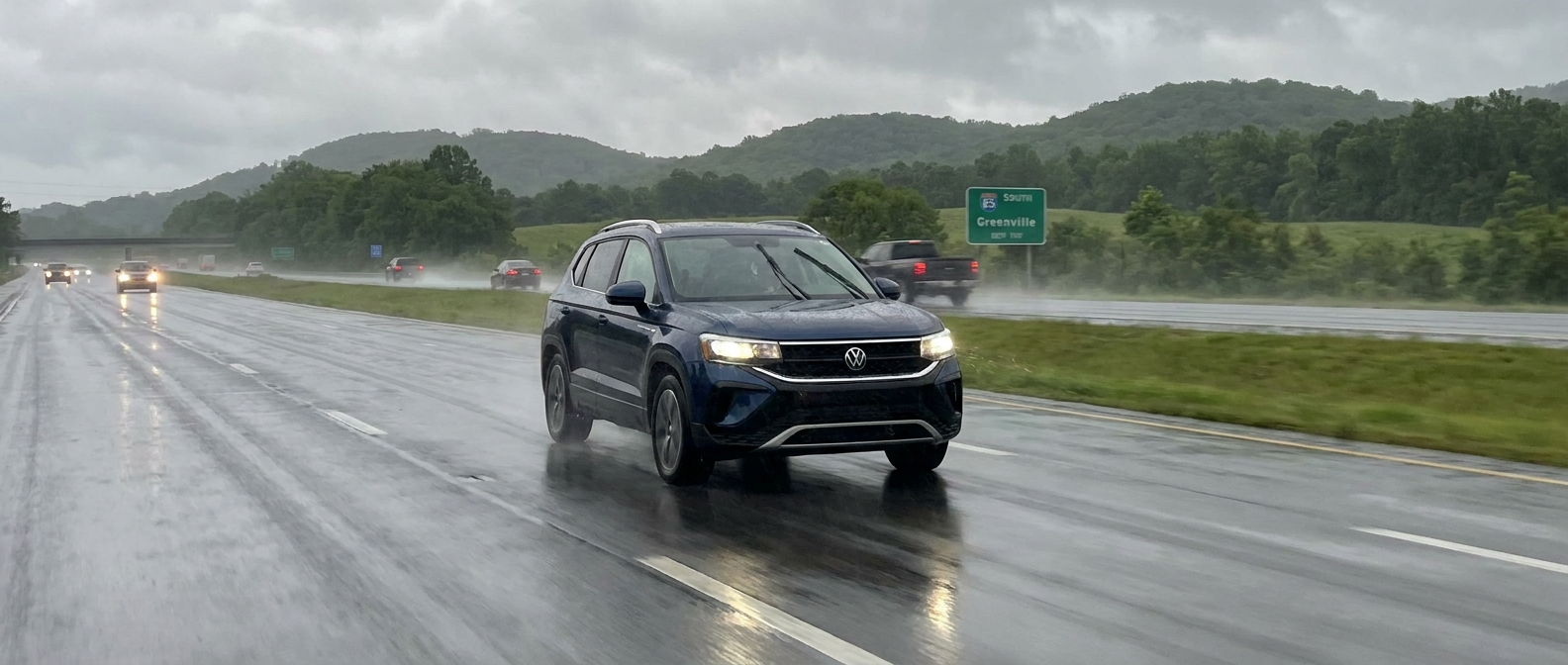
A fair question to settle before you pick a Taos has nothing to do with paint or trim. It comes down to one thing, whether you actually need the AWD. Good question, and the answer tends to catch folks off guard. For a lot of Upstate SC drivers, you probably don’t need it. Still, “probably” is carrying real weight in that sentence, and the nuance pays off before you decide.
Browse the 2026 Volkswagen Taos lineup at Steve White Volkswagen Spartanburg
How Does Volkswagen’s 4MOTION All-Wheel Drive Actually Work?
Volkswagen’s 4MOTION isn’t a traditional always-on all-wheel-drive setup, and that surprises plenty of Taos shoppers, because the car runs on its front wheels most of the time and only routes power to the rear when the road actually asks for it, which reshapes your FWD-versus-AWD decision more than you’d think. Most shoppers picture it backwards.
Under the skin, the 2026 Taos 4MOTION uses an electronically controlled torque-coupling clutch. Cruise on dry pavement and the car behaves essentially like a front-wheel-drive vehicle. The moment its sensors catch wheel slip or a spike in traction demand, the system pushes up to 50 percent of available torque rearward in milliseconds. You never flip a switch. It reads the road for you.
All of that behavior is why the FWD-versus-AWD choice gets more nuanced than a simple “more is better” framing. The system is reactive and efficient by design, not a permanent drag on your fuel economy.
Here the two configurations line up across the specs that matter most for an Upstate SC daily driver.
| Spec | FWD (1.5T, 8-speed auto) | 4MOTION AWD (1.5T, 8-speed auto) |
|---|---|---|
| EPA fuel economy | 28 city / 36 hwy / 31 combined | 25 city / 33 hwy / 28 combined |
| Fuel tank capacity | 13.2 gallons | 14.5 gallons |
| Est. combined range | ~409 miles | ~406 miles |
| Cargo (seats up) | 27.9 cu ft | 24.9 cu ft |
| Cargo (seats folded) | 65.9 cu ft | 60.2 cu ft |
| NHTSA overall safety | 4 out of 5 stars | 4 out of 5 stars |
| NHTSA rollover resistance | 5 stars (17.4% rollover risk) | 5 stars (14.7% rollover risk) |
| 4MOTION standard? | No | Yes (SEL) or available (S, SE, SE Black) |
| Trims offering 4MOTION | N/A | S, SE, SE Black, SEL |
A few numbers stand out here. Both configurations earn 4 stars overall, per the NHTSA’s testing of the 2026 Taos. The AWD model shows a lower rollover risk percentage, which tracks with the lower center of gravity the added hardware brings. The cargo difference (3 fewer cubic feet with seats up, about 5.7 fewer with seats folded) is worth weighing if you’re tight on hauling space. The gap is small but real.
Which Drivetrain Do Duncan and Lyman Drivers Actually Need?
For most Upstate driving, the FWD Taos covers you fine, and only a few habits (wet-weather merging, gravel launches, hauling a full load) tip the scale toward 4MOTION, so the answer leans less on where you live and more on how and what you haul in a given week.
Upstate South Carolina isn’t a Snowbelt market. Duncan and Lyman don’t get the sustained ice and snow that would push AWD from nice-to-have into necessary.
Our winter arrives in short, sharp bursts rather than months of frozen road. If snow were the only argument for 4MOTION, we’d steer you toward the FWD and the savings. Snow just isn’t the deciding factor here.
The FWD Taos makes great sense for a solo commuter or a couple running the I-85 corridor into Greenville or Spartanburg, parking in structured lots, and leaning on fuel efficiency plus maximum cargo flexibility. The EPA rates FWD at 28 city / 36 highway, which is strong for a non-hybrid compact SUV. Keep all 27.9 cubic feet behind the rear seat, and you’ve got real utility.
Flip to 4MOTION when your household adds a new driver, when you tow a kayak trailer or bikes to Lyman Lake on gravel launch-area roads, or when you just want more confidence in the wet with the system working quietly in the background. Range between the two is basically a wash (409 miles FWD vs. 406 miles AWD, per the EPA estimates), even though combined MPG runs 3 points lower for AWD, because the AWD model carries a larger 14.5-gallon tank.
One limitation is worth stating plainly. The 2026 Taos carries no tow rating, per Volkswagen. Need to pull a boat trailer to the lake? The Volkswagen Tiguan steps up with a 1,800-pound tow capacity and is worth a conversation. And if you really need third-row seating for a bigger family, the full Volkswagen inventory on our lot includes the Atlas, which sits in a different category entirely.
| Driver profile | Better fit |
|---|---|
| Daily I-85 commuter, dry roads prioritized | FWD (better MPG, more cargo room) |
| Household with a newer driver, wet I-85 driving | 4MOTION (reactive traction confidence) |
| Weekend trips to Lyman Lake, gravel access | 4MOTION (predictive torque transfer on loose surfaces) |
| Budget-focused first Volkswagen buyer | FWD (meaningful combined MPG advantage) |
| Needs towing capability | Consider Tiguan (not Taos) |
See Current Volkswagen Taos Offers
Quick Glossary: Taos Tech Terms Explained
| Term | What it means in plain language |
|---|---|
| 4MOTION | Volkswagen’s branded all-wheel-drive system; uses a torque-coupling clutch to send power rearward on demand |
| Torque coupling | The electronically controlled clutch mechanism that decides, in milliseconds, how much power goes to the rear axle |
| IQ.Drive | Volkswagen’s suite of standard driver-assistance tech on all 2026 Taos trims: adaptive cruise, lane-centering, emergency braking, blind-spot monitoring |
| 8-speed automatic | The transmission used on all 2026 Taos trims, FWD and AWD alike, a change from the 7-speed dual-clutch used on earlier AWD Taos models |
What This Means When You’re Ready to Move on a Taos
When you come in undecided, our take is that the 2026 Taos is a seriously capable compact SUV either way, so the real decision is the drivetrain, and it costs you something in both directions, more cargo and city MPG with FWD, or traction that reacts before you feel the slip with 4MOTION. Choose FWD and you gain 3 cubic feet of cargo and stronger city MPG (handy if you load up every weekend). Choose 4MOTION and you get traction that reacts before you feel the slip, which counts for more on wet South Carolina asphalt than it would in a drier climate.
Plenty stays the same between the two. Both carry the 1.5-liter turbo making 174 horsepower and 184 pound-feet of torque, the standard IQ.Drive safety suite on every trim, the digital cockpit, and the 4-star NHTSA overall safety rating. The Taos earns that rating no matter which axle is doing the work.
Where our team leans comes down to your commute. If you’re on I-85 most mornings between Duncan and Spartanburg and you want a compact SUV that won’t rattle you in an August downpour, 4MOTION is worth the conversation. If you’re a solo driver mostly on dry roads with a tight budget, the FWD’s fuel-efficiency case is real and worth a serious look. Come in and we’ll put both in the same conversation, no pressure.
Explore financing options at Steve White Volkswagen Spartanburg
By the Steve White Volkswagen Spartanburg Team | August 2026
Frequently Asked Questions
Does the 2026 Volkswagen Taos 4MOTION stay in AWD all the time?
No. The 4MOTION system in the 2026 Taos operates primarily in front-wheel drive under normal cruising conditions. The electronically controlled torque-coupling clutch engages the rear axle automatically when sensors detect wheel slip or a demand for additional traction, distributing up to 50 percent of torque rearward. You don’t activate it manually (it works in the background without any input from the driver).
Is the FWD Taos a meaningful step down in safety compared to the 4MOTION model?
Not in the crash-test data. Per NHTSA testing, both the FWD and 4MOTION versions of the 2026 Taos earn the same overall 4-star safety rating. Both also earn 5 stars for rollover resistance, though the AWD model shows a slightly lower rollover risk percentage (14.7 percent versus 17.4 percent for FWD), likely due to the additional weight of the AWD hardware lowering the center of gravity. The standard IQ.Drive safety suite (including forward collision warning, automatic emergency braking, and blind-spot monitoring) comes on every Taos trim regardless of drivetrain.
What’s the real-world fuel economy difference between FWD and 4MOTION?
The EPA estimates 31 combined MPG for FWD and 28 combined for 4MOTION, a 3-point difference. However, the AWD model carries a larger 14.5-gallon fuel tank compared to the FWD’s 13.2 gallons, so the estimated range (409 miles FWD vs. 406 miles AWD) is nearly identical in practice. FAQ:
Does the 2026 Volkswagen Taos 4MOTION stay in AWD all the time?
No. The 4MOTION system in the 2026 Taos operates primarily in front-wheel drive under normal cruising conditions. The electronically controlled torque-coupling clutch engages the rear axle automatically when sensors detect wheel slip or a demand for additional traction, distributing up to 50 percent of torque rearward. You don’t activate it manually (it works in the background without any input from the driver).
Is the FWD Taos a meaningful step down in safety compared to the 4MOTION model?
Not in the crash-test data. Per NHTSA testing, both the FWD and 4MOTION versions of the 2026 Taos earn the same overall 4-star safety rating. Both also earn 5 stars for rollover resistance, though the AWD model shows a slightly lower rollover risk percentage (14.7 percent versus 17.4 percent for FWD), likely due to the additional weight of the AWD hardware lowering the center of gravity. The standard IQ.Drive safety suite (including forward collision warning, automatic emergency braking, and blind-spot monitoring) comes on every Taos trim regardless of drivetrain.
What’s the real-world fuel economy difference between FWD and 4MOTION?
The EPA estimates 31 combined MPG for FWD and 28 combined for 4MOTION, a 3-point difference. However, the AWD model carries a larger 14.5-gallon fuel tank compared to the FWD’s 13.2 gallons, so the estimated range (409 miles FWD vs. 406 miles AWD) is nearly identical in practice.
Connect with us

