
Blog

Volkswagen Tiguan Trade-In Value in Spartanburg: A Professional Guide

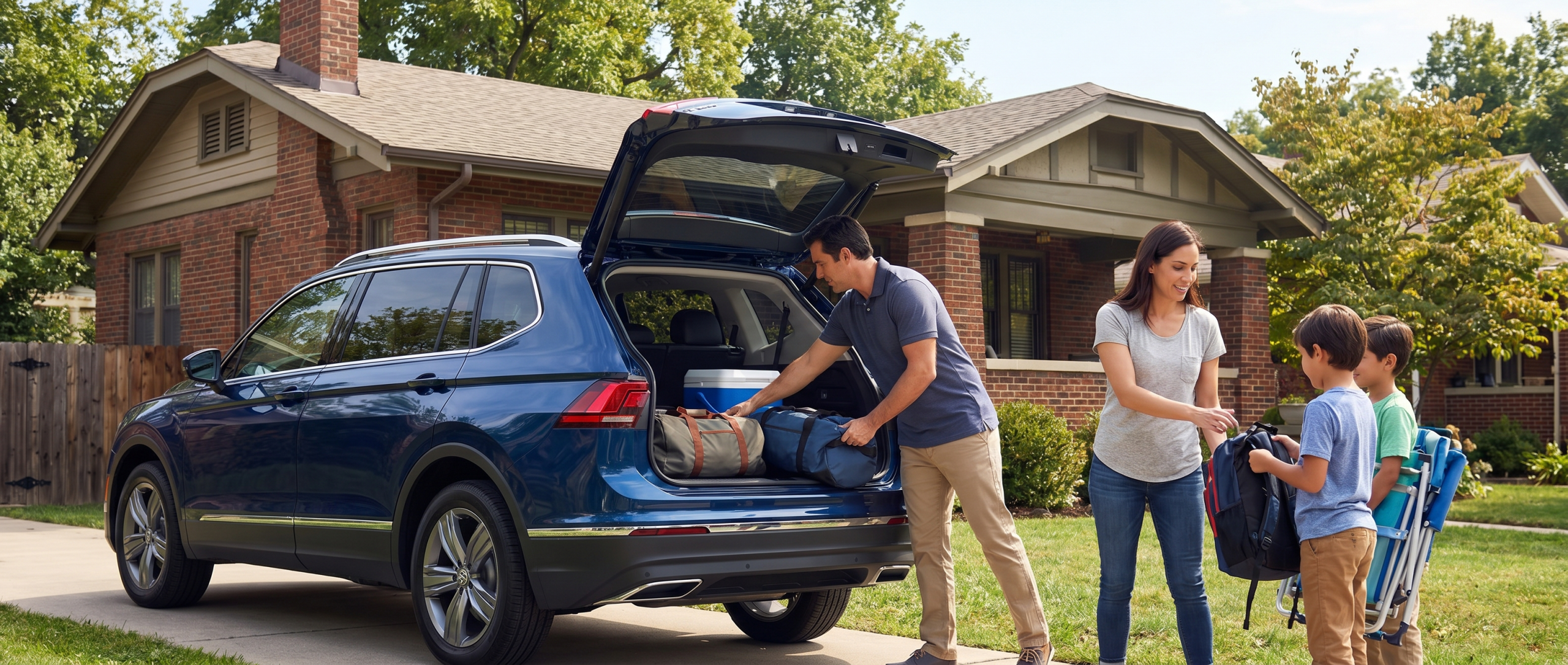
Volkswagen Tiguan cargo space and 4MOTION All-Wheel Drive in Spartanburg.
Volkswagen Tiguan Trade-In Value Spartanburg | Steve White VW

Volkswagen Tiguan Trade-In Value in Spartanburg: A Professional Guide

Finding the exact Volkswagen Tiguan trade-in value in Spartanburg starts with moving past the generic online estimators. If you are currently navigating the Upstate in a vehicle that feels increasingly small or unreliable, the transition to a Tiguan represents more than just a new set of keys.

At Steve White Volkswagen, we understand that Spartanburg drivers are looking to turn their current vehicle equity into a seamless, high-tech upgrade. Whether you are dealing with a cramped sedan or an aging SUV, this guide helps you navigate the appraisal process with total confidence.

The Upstate "Transition Phase" Framework

Most drivers looking for a Tiguan near Greenville, SC, or Anderson fall into one of three specific categories. Identifying where you sit helps simplify your trade-in strategy and ensures you focus on the features that matter most for your specific lifestyle.

  • The Capacity Seeker: You are currently squeezing car seats into a vehicle that wasn't built for a growing family. You need the Tiguan’s available third row to handle the morning drop-off at Spartanburg Day School.
  • The Tech-Deficit Commuter: Your current daily driver lacks modern integration, making your commute on I-85 feel like a chore. You are trading for the refined German engineering and the hushed cabin of a European SUV.
  • The Reliability Strategist: You’ve noticed your current car struggling with South Carolina’s humid summers or sudden afternoon storms. You want a "clean break" before major repairs become necessary.

View New Inventory

Matching Your Current Ride to Tiguan Equity

If You're This BuyerConsider ThisWhy It Fits
Outgrown Sedan OwnerTiguan SE with TechnologyAdds massive cargo volume for grocery hauls from the Beacon area.
High-Mileage CommuterTiguan S with IQ.DRIVEReduces driving fatigue during stop-and-go traffic on Asheville Highway.
All-Weather AdventurerTiguan SEL R-LineProvides 4MOTION® AWD confidence for slick Upstate roads and storms.

When we evaluate trade-ins near Boiling Springs, we consistently see that vehicles with a clear "story" fetch the best value. Bringing your records from our Service Center helps our team validate the care you've put into your car, translating directly into a more transparent offer.

Real-World Performance on Spartanburg Roads

The Tiguan isn't just another SUV; it is a tool designed to solve specific local frustrations. If you have ever felt the "mental claustrophobia" of a car that no longer fits your life, the Tiguan’s modular interior offers an immediate sigh of relief.

Navigating the Reidville Road congestion or the tight parking spots in Downtown Spartanburg requires a vehicle that is nimble yet substantial. The Tiguan handles like a smaller car but offers the safety presence of a larger SUV.

It’s not the flashiest vehicle on the road, but its composure during a heavy South Carolina downpour is where it truly shines. The IQ.DRIVE suite acts as a second set of eyes when traffic on I-26 becomes unpredictable.

Ensuring Long-Term Confidence in Your Trade

A common anxiety for many Upstate drivers is the fear of "leaving money on the table" during a negotiation. We neutralize this risk by providing a straightforward appraisal process that honors the true market value of your vehicle in the Spartanburg region.

In month one of Tiguan ownership, you will likely notice the ease of Apple CarPlay connecting before you even leave your driveway. By year three, you will appreciate the Tiguan’s reputation for holding its value, protecting your investment for the future.

Our goal is to make the Steve White Volkswagen experience the most professional interaction of your journey. We focus on the long-term value of the relationship rather than a single transaction.

Common Questions About Volkswagen Tiguan Trade-In Value in Spartanburg

How do I maximize my Volkswagen Tiguan trade-in value in Spartanburg?

To maximize your trade-in value, provide a full service history and ensure all basic maintenance is up to date. At Steve White Volkswagen, we find that a well-documented vehicle is often worth more than one with a recent cosmetic detail but no service records.

Can I trade in a car that still has a loan for a Tiguan?

Yes, you can trade in a vehicle with an existing loan at our Spartanburg dealership. We will contact your lender to get the payoff amount and apply any positive equity toward your new Volkswagen Tiguan, simplifying the transition for you.

Does the condition of my tires affect my trade-in value?

Yes, the condition of your tires is a factor in the appraisal. Drivers in the Upstate often benefit from having tires with good tread depth to handle our frequent rain, and having a fresh set can improve the immediate resale value of your trade.

Should I fix dents before trading in my car for a Tiguan?

Generally, you do not need to perform major bodywork. Our team in Spartanburg can often handle repairs more cost-effectively than an individual. We recommend focusing on a thorough cleaning and gathering your maintenance records instead.

Trading in your current vehicle should feel like a step toward a better daily experience, not a source of stress. If you are ready to trade a high-stress commute for the refined, tech-forward interior of a Tiguan, the path forward is simple.

By prioritizing transparency and local expertise, we help you turn your current equity into a vehicle that truly fits your life in the Upstate. Visit our Used Inventory or Contact Us today to start your appraisal.
Recommended Posts

Your Volkswagen Commuter Checklist: Woodruff to Spartanburg

Your Volkswagen Commuter Checklist: Woodruff to Spartanburg

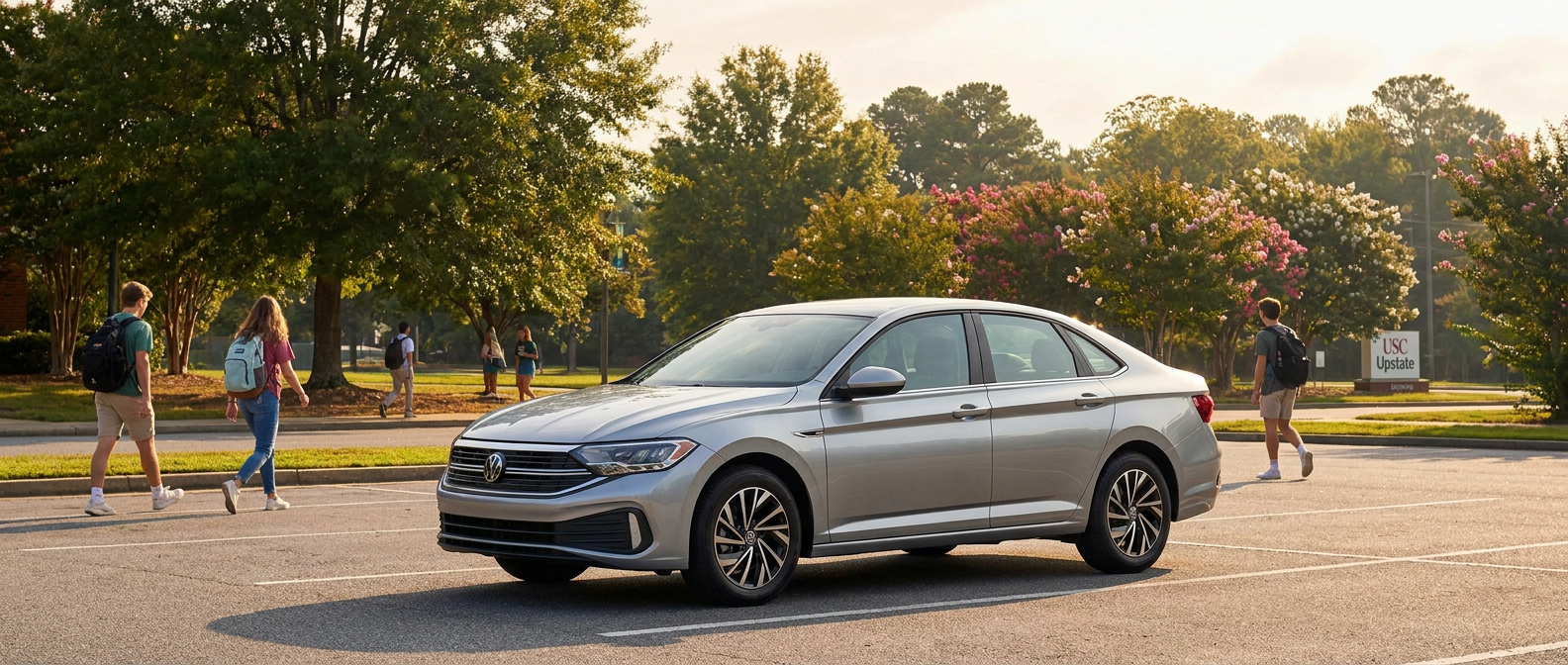
The 22-mile run on I-26 from Woodruff into Spartanburg is genuinely easy driving, but picking the wrong car for it still costs you real money and real frustration over a semester. The 2026 Volkswagen Jetta is probably the most efficient choice in our lineup for a solo student commuter. Need cargo room without giving up much at the pump? That's where the 2026 Volkswagen Taos comes in. And the 2026 Volkswagen Tiguan makes sense if you're hauling more than just a backpack. This checklist helps you figure out which one matches your situation before you walk in, so the conversation on our lot is about specifics instead of basics. What Goes on the Checklist? Work through these eight items in order, and each one narrows the field before you ever set foot on the lot. Daily mileage and fuel cost reality (How many days per week are you driving?) Five round trips from Woodruff to Spartanburg is about 220 miles per week. At the EPA-estimated 34 mpg combined for the 2026 Jetta, that's a little over six gallons per week on regular 87-octane. Know this number before you walk in. Parking situation on campus (USC Upstate is primarily a commuter campus, which means the lots fill up.) A compact sedan fits more easily into the tighter spots on University Way than a full-size SUV does. Sedans and subcompact crossovers park without drama. Bigger vehicles need a plan. How much gear travels with you (A laptop bag fits in any of our models.) A music equipment case, art supplies for studio classes, or two roommates' worth of laundry won't. Know your load before you pick a body style. Who else drives it (A car shared with a parent or a roommate has different needs than one only you touch.) A manual transmission on the Jetta GLI, for instance, needs everyone in the household comfortable driving stick. Road conditions you'll actually face (I-26 between Woodruff and Spartanburg is well-maintained interstate.) You don't need all-wheel drive for this commute in normal conditions. But if you're also driving to family in the upstate foothills in winter, that calculus changes. Budget for ownership, not just purchase (Factor in insurance, younger drivers pay more on sportier models, fuel, and the Volkswagen service intervals.) We can walk you through what first-year ownership realistically looks like. Financing pre-approval status (Get pre-approved before you arrive.) It shortens the process considerably and gives you a real budget ceiling instead of a guess. Trade-in value of your current vehicle (If you're upgrading from a high-school car, get its trade-in value in writing before you shop.) That number directly affects what you can spend. Why Each Checklist Item Actually Matters Fuel costs on I-26 are measurable, and they show up on a student budget fast. The EPA rates the 2026 Jetta S at 29 city and 40 highway mpg on regular fuel. Step over to the 2026 Taos FWD and you're at 28 city and 36 highway. The 2026 Tiguan S FWD runs 26 city and 34 highway. Over a full academic year, those differences compound into a real gap. We've seen students overlook this and focus only on how a car looks (understandable), but a Jetta that saves you fuel over two semesters is money worth keeping. Parking is a hard operational constraint here. Check the campus lots on University Way, because they're busy during peak hours and a sedan or subcompact crossover like the Taos slots into almost any space without overthinking it. The Tiguan isn't large by any standard, but it's a compact SUV whose width matters in a packed row, so plan your parking before you commit to a body style. Cargo volume numbers do the talking. The 2026 Taos offers up to 65.9 cubic feet of maximum cargo volume with the rear seats folded (more than enough for a semester's worth of moves or a significant instrument case). Its bigger sibling, the Tiguan, goes up to 69.8 cubic feet measured from behind the front seats. A Jetta is a sedan, so it's trunk-only at 14.1 cubic feet. A sedan can't carry what a crossover can. If you need flexible interior space, look at the Taos or the Tiguan. Travel light and the Jetta trunk is fine. Sharing a car changes the math. The Jetta GLI is genuinely fun (228 horsepower on a compact sedan platform with great German driving feel), but the six-speed manual transmission is a dealbreaker if a parent also drives the car now and then. The automatic-equipped standard Jetta removes that friction. Know your household before you decide on trim. All-wheel drive on I-26 is rarely necessary but occasionally right. Upstate South Carolina winters are mild compared to the mountains, and the I-26 corridor from Woodruff clears quickly after ice events. For the straight commute, front-wheel drive handles it. If your life also involves driving up into the Blue Ridge foothills on weekends or visiting family in areas that ice over harder, the available 4MOTION all-wheel drive on the Taos SEL or the Tiguan is worth the conversation. Just know the fuel economy tradeoff. The EPA rates the Taos AWD at 28 mpg combined versus 31 combined for the FWD version. Team note: On Reidville Road, a fair question from first-time Volkswagen buyers in smaller Upstate communities is whether a German car demands premium fuel. Every 2026 Jetta, Taos, and Tiguan on our lot runs on regular 87-octane. That one fact tends to recalibrate the conversation. Checklist Item Why It Matters for This Commute Weekly mileage estimate Sets your real fuel cost floor; the Jetta at 34 mpg combined is the most efficient of the three Parking footprint Sedan and subcompact crossover fit standard spots without planning; compact SUV needs awareness Cargo requirement Jetta trunk is 14.1 cu ft; Taos reaches 65.9 cu ft folded; Tiguan reaches 69.8 cu ft from front Household drivers Manual transmission (Jetta GLI) only if everyone is comfortable; automatics simplify shared ownership Winter driving needs I-26 corridor is mild; 4MOTION AWD available on Taos SEL and Tiguan if foothills driving applies Pre-approval in hand Tightens budget before the lot; shortens the visit; removes the guessing Trade-in value confirmed Real number changes what is affordable; get it in writing first Fuel type expectation All three models run regular 87-octane, not premium Get Pre-Approved Before You Visit Your Print-and-Go Recap Before You Come In Run through this before your visit to Steve White Volkswagen Spartanburg, and you'll be ready to make a decision instead of just starting one. Calculate your weekly mileage. Woodruff to Spartanburg is roughly 22 miles each way on I-26. Multiply by your actual driving days per week. Decide on body style (Sedan (Jetta) for efficiency and compact parking; subcompact SUV (Taos) for cargo flexibility; compact SUV (Tiguan) for maximum interior room.) Confirm who drives it and whether a manual transmission works for the household. Check your parking situation (campus lot, apartment, or shared driveway; know the footprint you're working with). Decide whether AWD is actually needed (for the I-26 commute alone, front-wheel drive is the right call for most students; AWD makes sense if foothills or mountain driving is part of the regular routine). Get pre-approved (takes a few minutes and gives you a real number). Value your trade-in (so that figure's already in hand when you arrive). Know your timeline (the fall semester's already underway; if you need the car for commuting now, tell us that upfront and we'll work around your schedule). We're on Reidville Road, which puts us at about the midpoint between Woodruff and USC Upstate if you're coming up I-26. Stop in during the week when it's quieter, tell us your checklist answers, and we'll get you into the right car for the right run. Efficiently. Frequently Asked Questions What is the most fuel-efficient Volkswagen for a Woodruff-to-Spartanburg commute? The 2026 Jetta is the most fuel-efficient option in our lineup for this commute. The EPA rates it at 29 city and 40 highway mpg on regular 87-octane gasoline, with a 12.8-gallon tank that gives a combined range of around 449 miles. For a solo commuter covering roughly 22 miles each way on I-26, the Jetta wins. Do I need all-wheel drive for driving between Woodruff and Spartanburg in winter? For the I-26 corridor between Woodruff and Spartanburg specifically, front-wheel drive handles typical Upstate South Carolina winter conditions well. The corridor clears quickly after ice events. If your routine also includes driving into the Blue Ridge foothills or areas that see more sustained ice, the available 4MOTION all-wheel drive on the Taos SEL or the Tiguan is worth considering. For the daily commute alone, you'll do fine without it. See Current Volkswagen Offers Steve White Volkswagen Spartanburg 2671 Reidville Rd, Spartanburg, SC 29301 (864) 585-2492

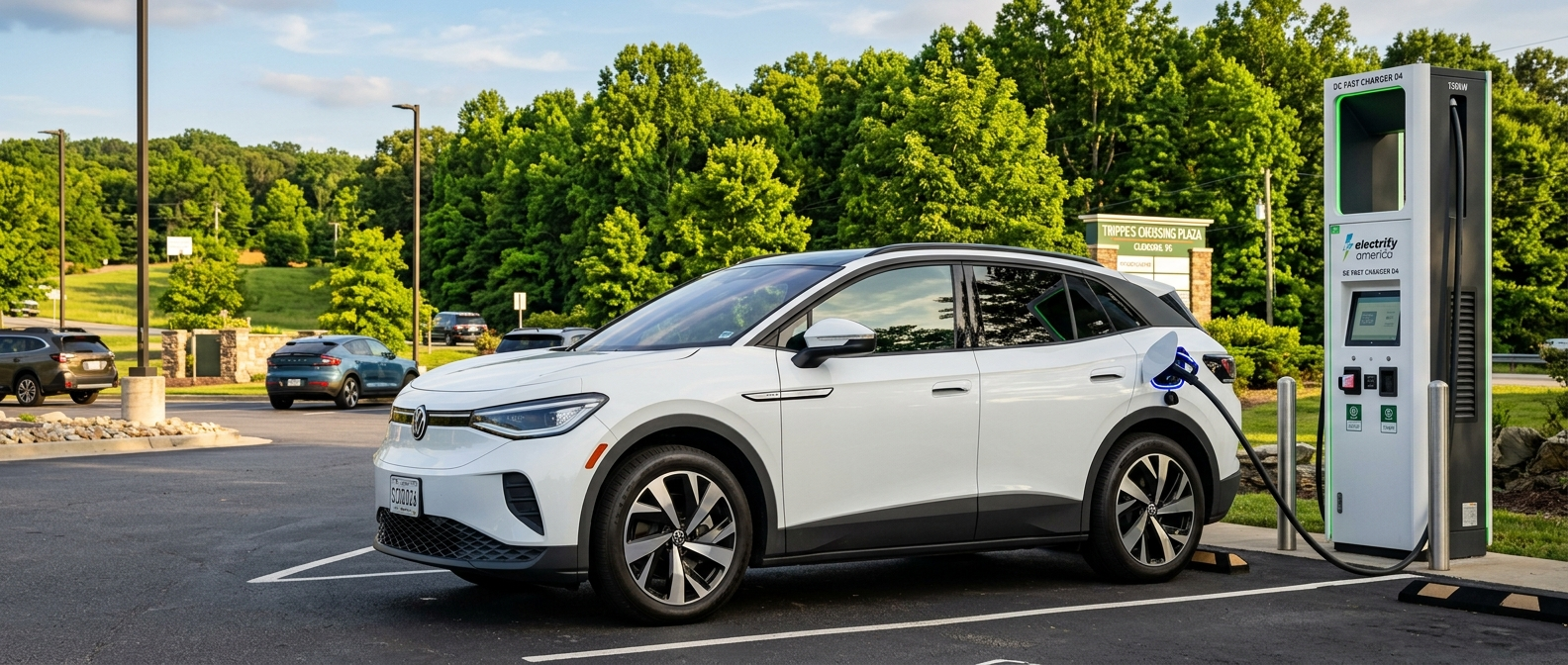
2026 Volkswagen ID.4 charging at a public DC fast charger in Spartanburg, SC

Volkswagen ID.4 Charging Questions Spartanburg Buyers Ask Most

A shopper's first honest question about the ID.4 is usually whether charging will actually fit their life in Upstate SC. That question is fair, and it deserves a straight answer instead of a brochure. The short version is yes, charging works well in Spartanburg and across Upstate SC, though the plan matters. We'll walk you through what you actually need to know about the 2026 Volkswagen ID.4 before you drive off our lot. How far will the 2026 ID.4 really go here in Upstate SC? The EPA rates the rear-wheel-drive 2026 Volkswagen ID.4 Pro at 291 miles on a single charge and the all-wheel-drive version at 263 miles, though in real Upstate SC driving you'll see closer to 240 to 265 miles from the RWD trim off that verified 82-kWh battery pack. Those are real, tested numbers. Check the AC draw before you judge the range. Summer heat in Spartanburg runs 85 to 95 degrees Fahrenheit through July and August, and the ID.4 uses an electric resistance heater for cabin cooling management rather than a heat pump. Running the air conditioning at highway speed on I-85 in August does pull meaningfully from the pack. A 70-mph cruise with the AC at full tilt won't be dramatic, but it nets you something closer to the lower end of that 240-to-265 range, not the EPA ceiling. None of that is a flaw unique to Volkswagen. It's physics. Plan your legs around 230 to 250 miles of real-world range in summer, and you won't get caught short. Volkswagen ID.4 Range and Charging at a Glance (2026 model year, EPA-rated) Configuration EPA Range DC Fast Charge Rate 10% to 80% Time Level 2 Rate Pro RWD (82 kWh) 291 miles 175 kW ~28-30 min 11 kW (~37 mi/hr) AWD Pro (82 kWh) 263 miles 175 kW ~28-30 min 11 kW (~37 mi/hr) AWD Pro S Plus (82 kWh) 255 miles 175 kW ~28-30 min 11 kW (~37 mi/hr) *EPA estimates. Actual range varies with speed, temperature, load, and driving habits.* Browse 2026 ID.4 inventory at Steve White Volkswagen Where do you charge locally in Spartanburg? The public charging picture in Upstate SC is solid and getting better, with two primary fast-charge options inside Spartanburg itself plus the I-85 and I-26 corridors covered for the longer legs, so day-to-day you'll rarely think about it and road trips stay simple. The setup breaks into two buckets. In Spartanburg: Tesla Supercharger, 2100 Winchester Place (off I-26 near Burger King): 8 stalls, up to 250 kW, open 24 hours every day. The 2026 Volkswagen ID.4 connects here natively through its built-in NACS port, no adapter needed. For an I-26 commuter or someone running errands on the west side, this is the handiest fast-charge stop in town. ChargePoint Level 2, Wofford College: slower (Level 2 adds about 37 miles of range per hour through the 11-kW onboard charger of the ID.4), but useful if you're already on campus or nearby for a couple of hours. On the corridors: The I-85 corridor between Spartanburg and Greenville has DC fast chargers at key exits, and I-26 toward Columbia carries reliable fast-charge coverage too. If you're running down to Charleston (around 210 miles by I-26), one 25-to-30-minute stop near the Columbia area handles it cleanly in the RWD trim. The AWD is tighter on that run in summer, so plan for a stop a little earlier. See what 2026 Volkswagen ID.4 trims are in stock now Charging tip for Spartanburg summers: South Carolina heat slows charge acceptance above 80% state of charge noticeably. Plan to charge to 80% at DC fast stops and move on. The final 20% takes about an additional 18 to 22 minutes (a slow crawl next to the 10-to-80% window) and adds far less range per minute than that window does. On a road trip, stop at 15 to 20% and charge to 80%. That rhythm keeps you efficient and protects the battery's long-term health. What the 2026 NACS port means for you The 2026 ID.4 ships with a North American Charging Standard (NACS) port natively built in, which is the same plug standard as Tesla's Supercharger network A CCS combo adapter is included in the box for backward compatibility with older Electrify America and EVgo stations No extra purchase needed to use the Spartanburg Supercharger on Winchester Place The included two-year Electrify America Pass+ membership activates through the Electrify America app and gives Pass+ pricing on the national EA network (roughly 25% below the base guest rate, per Electrify America) Plug&Charge functionality means the car and the Electrify America charger authenticate each other automatically; you plug in and walk away, no app tapping required See Current ID.4 Offers Plan it this way: a Spartanburg driver's charging routine Coming from a gas-powered SUV, the charging routine of the ID.4 tends to feel harder in your head than it plays out in practice, since it's fundamentally a home-charging car that keeps a fast-charge safety net ready for road trips and long weeks. We'll break it down for Spartanburg. At home: Install a 240-volt Level 2 charger (a standard 48-amp EVSE from any certified electrician). The 11-kW onboard charger of the ID.4 tops up from a typical evening's depleted state in five to six hours overnight. You wake up to a full charge every morning without thinking about it again. If a dedicated circuit isn't possible right away, the standard 120-volt Level 1 cable that ships with the 2026 ID.4 adds about 3 to 4 miles of range per hour, which covers a short daily commute but not much more. On I-85 toward Atlanta or Charlotte: Both directions have DC fast-charge stops within comfortable range. Set your cruise around 68 to 70 mph for the best efficiency on the highway, and plan your stop when the battery hits 15 to 20%, not when it's nearly empty. The ID.4 charges fastest from 10% to 60%. Use that window. For SC Highway 11 and the Blue Ridge foothills: Day trips along the Cherokee Foothills National Scenic Highway sit well inside a single charge from Spartanburg. The 100-mile route isn't a range challenge. It's an enjoyment challenge, because the rolling terrain makes regenerative braking genuinely fun to use. You'll come back with more charge than you'd expect on a route with that many elevation changes and speed adjustments. Schedule a Volkswagen EV service or charging consultation Frequently Asked Questions Does the 2026 Volkswagen ID.4 work with Tesla Superchargers in Spartanburg without an adapter? Yes. The 2026 Volkswagen ID.4 ships with a native NACS (North American Charging Standard) port built directly into the car. That port is physically compatible with the Tesla Supercharger network's NACS stalls. The Spartanburg Supercharger on Winchester Place is confirmed as a NACS Partner Site and open to non-Tesla vehicles. You drive in, plug the Supercharger connector in directly, and charge. No aftermarket adapter is required. For older CCS-only stations, a CCS combo adapter comes with the vehicle. Does charging to 100% hurt the 2026 Volkswagen ID.4 battery? Occasional full charges won't cause immediate harm, and Volkswagen does build in a buffer zone so the battery is never truly at zero or truly at maximum. That said, the charge curve of the ID.4 above 80% is noticeably slower, and regular sustained charging to 100% does add cumulative thermal and electrochemical stress to the lithium-ion cells over time. Volkswagen recommends keeping daily charging in the 20-to-80% range and charging to 100% only right before a long trip. In Spartanburg's summer heat, that 80% ceiling also keeps the battery cooler and makes the next DC fast-charge session faster. What does the included Electrify America plan actually cover with a 2026 ID.4? New 2026 Volkswagen ID.4 purchases from an authorized Volkswagen dealer include two years of Electrify America Pass+ membership, which Volkswagen and Electrify America confirm provides Pass+ pricing rates on the Electrify America DC fast-charge network. Pass+ members pay roughly 25% less than standard guest rates at Electrify America stations. The plan also enables Plug&Charge, so your car and the Electrify America charger authenticate each other automatically when you plug in. Activation needs the Electrify America app, an account, and a six-digit enrollment code from your selling dealer. The plan is for original purchasers only and isn't transferable. Explore Financing Options for the ID.4 Steve White Volkswagen Spartanburg 2671 Reidville Rd, Spartanburg, SC 29301 (864) 585-2492

2026 Volkswagen ID.4 charging at a downtown Spartanburg municipal parking garage

Why the Volkswagen ID.4 Works for Daily Driving Near Downtown Spartanburg

In this article How Do D Mode and B Mode Actually Work? Which Mode Do You Actually Need Here? Charging Around Downtown Spartanburg What This Means for Your Next Vehicle Yes, and we'd call it one of the better fits we carry for drivers running downtown-and-back routes across Upstate SC. That answer comes with a nuance a lot of reviews skip. The ID.4 isn't a "set it and forget it" EV. It has two distinct drive modes that behave very differently, and knowing which one to use where turns a competent electric SUV into something genuinely efficient on the specific roads around here. Browse the Volkswagen ID.4 and ID. Buzz lineup at Steve White Volkswagen Spartanburg The D mode of the 2026 Volkswagen ID.4 coasts like a traditional car (best for I-85 corridor speed); its B mode recovers energy through stronger regeneration (best for stop-and-go through downtown Spartanburg). Choosing the right mode for each stretch of your commute is the one skill that separates a good ownership experience from a great one. How Do D Mode and B Mode Actually Work? D mode and B mode split the driving between coasting and stronger regeneration, and the short of it is that the ID.4 skips true one-pedal driving, so lifting off the accelerator in D mode won't drag the car to a stop the way it would in some rival EVs. Instead, the powertrain prioritizes coasting. According to the own engineering documentation of Volkswagen, coasting takes priority in D mode because converting kinetic energy back into electricity always involves losses, and on a sustained highway stretch, letting the vehicle roll freely preserves more range than constant regeneration. Switch the shifter to B mode and the behavior changes. Lifting off the throttle now applies meaningful regenerative resistance, and the motor of Volkswagen recovers energy in most moderate braking situations, transitioning to friction brakes only when harder stops demand it. You'll still touch the brake pedal to reach a full stop. Otherwise, B mode handles the rest. D Mode (Drive) B Mode (Brake) How it works Motor coasts on lift-off; regen activates through the brake pedal Stronger regen on lift-off; friction brakes for final stop only Best for Highway segments (I-85 corridor, sustained speed) Stop-and-go (downtown signals, Reidville Road traffic) Energy behavior Preserves momentum; fewer conversion losses at speed Recaptures more energy in deceleration-heavy driving Driver feel Familiar to gas-car drivers Light "engine braking" pull on lift-off Spartanburg use case The 30-mile I-85 run toward Greenville or Anderson The last mile through downtown to a parking garage The EPA rates the 2026 ID.4 at 113 MPGe combined for the rear-wheel-drive version and 102 MPGe combined for the all-wheel-drive. Those numbers assume a blend of city and highway conditions. In Spartanburg, where a typical commute mixes a corridor sprint on I-85 with slower downtown blocks, you'll want D mode on the highway and B mode once you exit. One trip, both efficiency numbers. Which Mode Do You Actually Need Here? Which mode you actually need comes down to the stretch of road in front of you, so you'll run B mode through town and D mode on the corridor, and Spartanburg's layout makes that split easy to feel on a normal commute. Reidville Road, where our store sits, feeds directly into the downtown grid in under 10 minutes. The last stretch runs signals, turns, and the occasional backup at peak hours, which is B mode territory. Every deceleration into a red light becomes a small deposit back into the battery rather than heat thrown off by friction brakes. See how the Taos and other Volkswagen models compare for Upstate commuting The longer corridor sections are a different story. If your drive involves any sustained I-85 mileage between Spartanburg and Greenville (around 30 miles), you'll want D mode as the default. Aggressive regen on a 70-mph highway stretch costs more energy through conversion than it returns, and coasting between gradual speed changes is the more efficient physics here. One thing we notice at the counter is that drivers coming from gas cars tend to start in D mode and stay there. The habit makes complete sense. D mode mimics what a traditional automatic transmission does, and the 2026 ID.4 in D mode still recovers energy whenever you actually press the brake. Staying in D mode doesn't waste range; it just leaves a little efficiency on the table in dense urban conditions where B mode would net you measurably more energy back. View our current 2026 Volkswagen ID.4 inventory Upstate Charging Terms Worth Knowing Term What it means Level 2 charging 240-volt AC charging; the 2026 ID.4 accepts up to 11 kW, adding roughly 25-30 miles per hour of charge DC fast charging Direct-current charging; the 2026 ID.4 supports up to 175 kW, taking the battery from 10% to 80% in roughly 28 minutes MPGe Miles per gallon equivalent; the EPA's standardized way to compare EV efficiency against gasoline vehicles Eco Assistance The onboard system of the ID.4; it reads navigation data and prompts you to lift off the accelerator ahead of slowdowns to maximize regen Charging Around Downtown Spartanburg Charging around downtown is easier than the range-anxiety headlines suggest, and for a Spartanburg daily driver the concern shrinks fast once you look at the actual numbers, though it does hinge a little on whether you've got a plug at home. Range anxiety is a reasonable starting concern for any EV buyer, so let's put numbers to it. See Current Volkswagen ID.4 Offers The EPA-rated range of the 2026 ID.4 is 291 miles on the rear-wheel-drive version (263 miles on the all-wheel-drive). The average round-trip commute into and out of downtown Spartanburg is a fraction of that. You're not managing range on a daily basis so much as managing a charging routine. The city keeps it simple. The City of Spartanburg operates public electric vehicle charging stations across downtown parking lots and garages. So an ID.4 driver who parks downtown through the workday can top off while the car sits. The 2026 ID.4 handles Level 2 charging at up to 11 kW, which translates to about 25-30 miles of range added per hour at a Level 2 station. That's enough that a full eight-hour workday of parking adds solid margin on top of whatever you've brought from home. For road trips or longer Upstate runs on I-26 toward the coast or I-85 toward Atlanta, Spartanburg has public DC fast charging options accessible off both major corridors. The 2026 ID.4 accepts DC fast charging at up to 175 kW, and the own figures of Volkswagen put a 10-to-80 percent charge at approximately 28 minutes at a compatible high-speed station. That's a coffee stop. The tradeoff worth naming is simple enough. If you don't have a Level 2 charger at home, you're relying on the charging infrastructure for more of your daily top-ups. That works in Spartanburg, but it does ask for a little more planning than plugging in at your own house each evening. It's a fair consideration, not a dealbreaker, and it's worth knowing before you commit. Explore financing options for the Volkswagen ID.4 What This Means for Your Next Vehicle The 2026 Volkswagen ID.4 earns its place as a Spartanburg daily driver through a specific set of advantages, though they won't do the work for you: range that exceeds any realistic round-trip commute in the Upstate, a drive-mode system that rewards learning even slightly, and a local charging network that fills gaps for drivers without home charging. The 30-minute DC fast charge window means the I-85 and I-26 corridors to other Upstate cities stay practical. What it is not is a vehicle that asks nothing of you. Knowing when to use B mode is a small habit with a measurable payoff. Understanding the charging network rather than guessing at it removes the anxiety that comes with a new EV. We'll walk through both of those at delivery, because we think the ownership experience is better when drivers leave the lot with a real handle on the technology instead of just a key fob and a hope. If you're driving a daily route that touches downtown Spartanburg at any point, the architecture of the ID.4 is built for exactly that pattern. Come see what we have on the lot. We'll walk you through both modes on your test drive so you leave with a clear picture of how the car fits your specific route. Frequently Asked Questions Does the 2026 Volkswagen ID.4 have one-pedal driving? Not in the traditional sense. The ID.4 doesn't decelerate to a complete stop on lift-off alone. In B mode, the regenerative braking is strong enough to handle most moderate slowdowns without touching the friction brake pedal, though you'll still apply the brake to reach a full stop. For Spartanburg drivers, B mode in downtown conditions is the closest thing to one-pedal behavior and a useful efficiency tool on stop-and-go streets. How long does it take to charge the 2026 Volkswagen ID.4 from 10% to 80%? At a DC fast charger rated for the maximum 175 kW input of the ID.4, Volkswagen estimates approximately 28 minutes to go from 10% to 80% battery. On a Level 2 home or public charger at 11 kW, you're looking at around eight hours for a complete empty-to-full charge, which fits an overnight home routine or a full workday parked at a public downtown station. Get Pre-Approved for the Volkswagen ID.4 Steve White Volkswagen Spartanburg 2671 Reidville Rd, Spartanburg, SC 29301 (864) 585-2492