

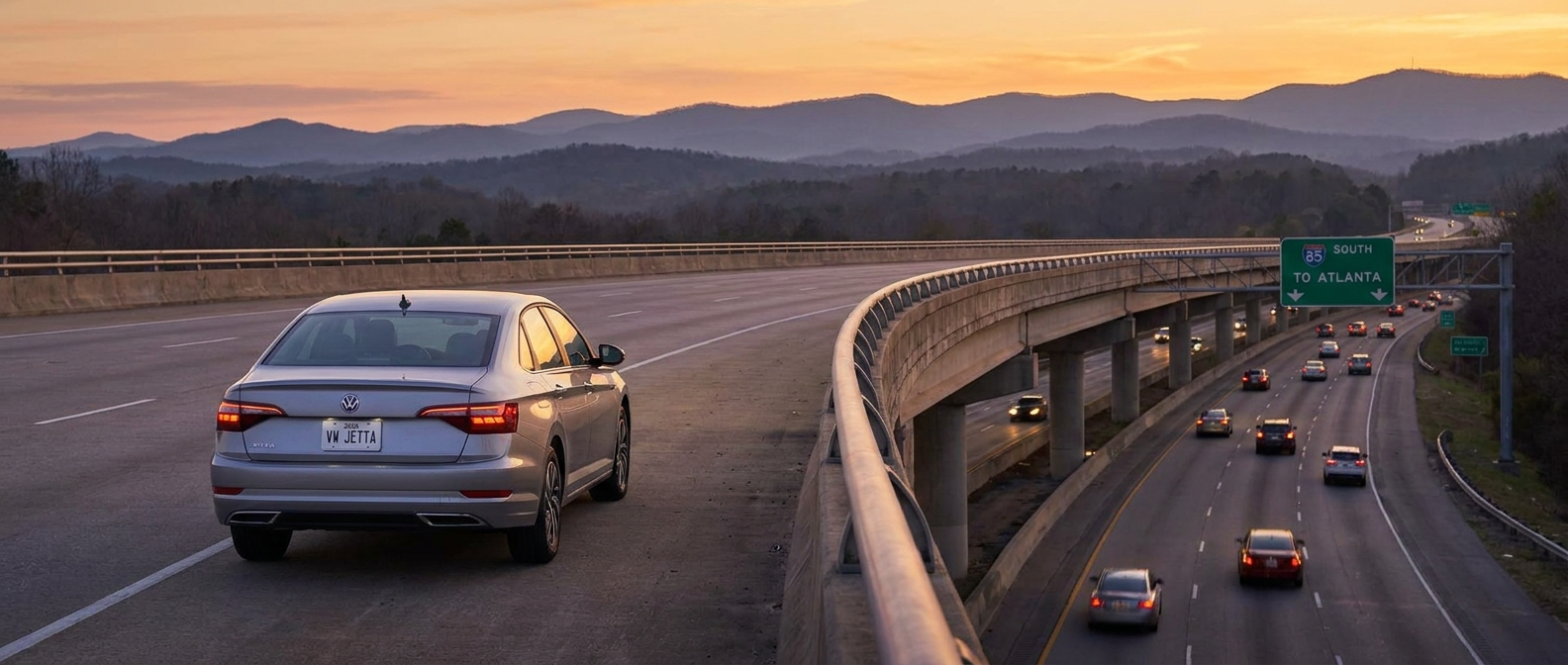
Putting real I-85 miles on a car every week changes the math, and the answer here isn’t the one the spec sheet points to. The 2026 Volkswagen Jetta and the 2026 Hyundai Elantra sit close enough on price and efficiency that most comparison articles call it a draw. We don’t. For the specific demands of Spartanburg’s daily commute, these two sedans pull in noticeably different directions.
- The Jetta carries 184 lb-ft of torque arriving low in the rev range; the Elantra delivers 132 lb-ft but not until 4,500 rpm. That gap is real on I-85 on-ramps.
- The Elantra’s base SE trim posts a slightly higher EPA-estimated 35 mpg combined versus the Jetta’s 33-34 mpg combined. Honest win for Hyundai.
- The Elantra is genuinely roomier inside: 42.3 inches of front legroom versus the Jetta’s 41.1, and 38.0 inches of rear legroom versus 37.4.
- Volkswagen’s IQ.DRIVE suite (adaptive cruise with Travel Assist, Front Assist with auto-braking, blind-spot monitoring) comes standard on every 2026 Jetta trim. On the Elantra, driver-assist content varies by trim level.
- Bottom line: tall drivers and passengers lean Elantra. Drivers who prioritize feel, safety tech, and daily-highway punch lean Jetta.
What’s the Real Difference Between These Two Sedans?
The bigger difference between these two is character, and it shows up in how each car does the daily job rather than on the spec sheet, since both are front-wheel-drive compact sedans with no AWD option and roughly matched fuel economy. Both cover the basics well. Where they split is the feel.
| Spec | 2026 Volkswagen Jetta | 2026 Hyundai Elantra SE |
|---|---|---|
| Engine | 1.5L turbo I-4 | 2.0L naturally aspirated I-4 |
| Horsepower | 158 hp | 147 hp |
| Torque | 184 lb-ft | 132 lb-ft |
| Transmission | 8-speed automatic | CVT |
| EPA City / Hwy / Combined | 29 / 40 / 33-34 mpg | 31 / 40 / 35 mpg |
| Front Legroom | 41.1 in | 42.3 in |
| Rear Legroom | 37.4 in | 38.0 in |
| Cargo Space | ~14.1 cu ft | 14.2 cu ft |
| NHTSA Overall | 5 stars | 4 stars (overall) |
| Standard Driver Assists | Full IQ.DRIVE suite | Varies by trim |
The EPA rates the Jetta at 29 city / 40 highway / 33-34 combined. The EPA rates the Elantra SE at 31 city / 40 highway / 35 combined. Highway numbers match exactly. The Elantra wins city and combined at the base trim. Call that a verified difference, not a rounding artifact.
The torque story runs the other way. Volkswagen’s 1.5-liter turbo delivers 184 lb-ft at low revs. Hyundai’s 2.0-liter naturally aspirated engine produces 132 lb-ft at 4,500 rpm. On the interstate, that gap shows up right where you feel it, at the merge and the pass.
Does the Transmission Actually Matter for Daily Driving?
Yes, it matters more than the raw numbers suggest, because the Elantra runs a continuously variable transmission and the Jetta runs an 8-speed conventional automatic, and those two setups behave differently the moment you ask for hard acceleration even though they feel nearly identical at a steady cruise. The delivery is where you notice it.
CVTs are smooth and efficient, and the Elantra’s does its job well. Under a normal cruise, you won’t notice much difference at all. But ask for hard acceleration from 65 mph on a highway on-ramp, and a CVT tends to hold a flat, buzzy note while the engine builds speed. The Jetta’s 8-speed steps through its gears in a way that feels more deliberate and more predictable.
It’s a subjective thing, we’ll grant. We also hear about it consistently from drivers who commute by highway and ask us about long-term fatigue.
The Jetta GLI goes further with a 6-speed manual or 7-speed DSG option if that’s your preference, though that’s a different budget conversation entirely.
For the standard Jetta, the 8-speed automatic paired with that low-end torque means the car moves off a complete stop with authority. Spartanburg drivers know the Reidville Road lights to the I-85 ramp by heart. That sequence is where torque delivery earns its keep.
See Current Volkswagen Specials
Passenger Room and Practicality
Give Hyundai its due here, because the Elantra is measurably larger inside than the Jetta, not by a huge margin but verifiably, with 42.3 inches of front legroom versus the Jetta’s 41.1 inches and 38.0 inches of rear legroom versus 37.4. The Elantra’s total passenger volume checks in at 99.4 cubic feet. The Jetta measures 94.7 cubic feet without a sunroof.
Browse our pre-owned sedan inventory if you’re flexible on model year and want to compare what’s on the lot.
If you’re six-foot-two or you regularly carry adults in the back seat, the Elantra’s extra room stops being a talking point and becomes the reason to buy it. Cargo space comes out essentially even, 14.2 cubic feet in the Elantra against 14.1 in the Jetta.
The Jetta’s interior doesn’t feel cramped. It feels measured, tight the way a well-engineered German car tends to feel tight. What it lacks in raw cubic footage it makes up for somewhat in dashboard quality and tactility (harder things to put a number on). Sit in both before deciding.
Safety Features: Which One Has Better Standard Coverage?
Both cars are safe and the crash ratings show it, but the more useful split for a commuter is what comes standard on a base trim, because per NHTSA the 2026 Volkswagen Jetta earned a five-star overall safety rating while the NHTSA rates the 2026 Elantra at four stars overall. The rating gap isn’t the most useful distinction here.
What you get on a base trim without optioning up tells you more. Volkswagen’s IQ.DRIVE suite comes standard across the entire 2026 Jetta lineup. That includes Travel Assist, which pairs adaptive cruise with lane-centering, plus Front Assist with automatic emergency braking and pedestrian detection, blind-spot monitoring, rear traffic alert, and Emergency Assist. Per NHTSA, the 2026 Jetta holds that five-star overall result with those features baked in at the S trim.
On the Elantra side, the available driver-assist content changes with each trim level. An Elantra SE can be configured with fewer of these features than a Jetta S. Worth checking trim by trim if safety tech is a deciding factor for you.
For someone who drives I-85 daily, adaptive cruise with lane assist takes real fatigue out of a long commute. Getting it standard, without a trim upgrade, matters.
So Which Sedan Should Spartanburg Commuters Pick?
Neither car is the wrong answer, since both are genuinely good compact sedans in 2026, but the choice splits cleanly by driver profile, so drive one before you commit and let the differences you actually feel settle it. The split is easier to see once you frame it by who’s behind the wheel.
Choose the 2026 Volkswagen Jetta if you prioritize a connected, confident highway driving feel; you want adaptive cruise control and Front Assist standard on every trim without shopping trim levels; you value the 8-speed traditional automatic over a CVT; and you find the interior quality and German-engineering character worth the tradeoff in raw interior volume.
Choose the 2026 Hyundai Elantra if interior space is the primary factor, especially for taller drivers or passengers; you want the best base-trim fuel economy, the EPA’s 35 mpg combined on the SE; or you’re attracted to the Elantra Hybrid’s 51-54 mpg combined figures, which are genuinely in a different efficiency league.
The Elantra’s extra interior room and slightly better base MPG are real advantages, and we won’t pretend they aren’t. What the Jetta gives back is a more driver-connected daily experience, a stronger torque foundation for highway use, and a standard safety-assist suite that doesn’t send you into the trim chart.
Our team at Steve White Volkswagen Spartanburg is happy to walk you through either car. Come drive the Jetta and decide for yourself whether the character lands for you.
Frequently Asked Questions
Does the Volkswagen Jetta get better gas mileage than the Hyundai Elantra?
Not at the base trim. The EPA rates the 2026 Elantra SE at 31 city / 40 highway / 35 mpg combined, while the EPA rates the 2026 Volkswagen Jetta at 29 city / 40 highway / 33-34 mpg combined. Highway efficiency is identical at 40 mpg. The Elantra wins on city and combined at the base level. If fuel economy is the top priority, the Elantra standard or its Hybrid variant (rated up to 54 mpg combined by the EPA) is the stronger choice. The Jetta’s advantage is not in raw efficiency but in its turbo torque delivery, 8-speed automatic transmission, and standard IQ.DRIVE safety suite.
Is the Volkswagen Jetta safer than the Hyundai Elantra?
Per NHTSA crash testing, the 2026 Volkswagen Jetta earned a five-star overall safety rating. The NHTSA rates the 2026 Hyundai Elantra at four stars overall. Beyond the crash ratings, the Jetta’s practical safety advantage for commuters is that Volkswagen’s full IQ.DRIVE suite (Travel Assist with adaptive cruise and lane centering, Front Assist with automatic emergency braking, blind-spot monitoring, and rear traffic alert) comes standard on every 2026 Jetta trim, including the base S model. On the Elantra, driver-assist availability varies by trim. For a driver who wants those features without navigating trim levels, the Jetta’s standard coverage is a meaningful advantage.
Connect with us

