

Blog

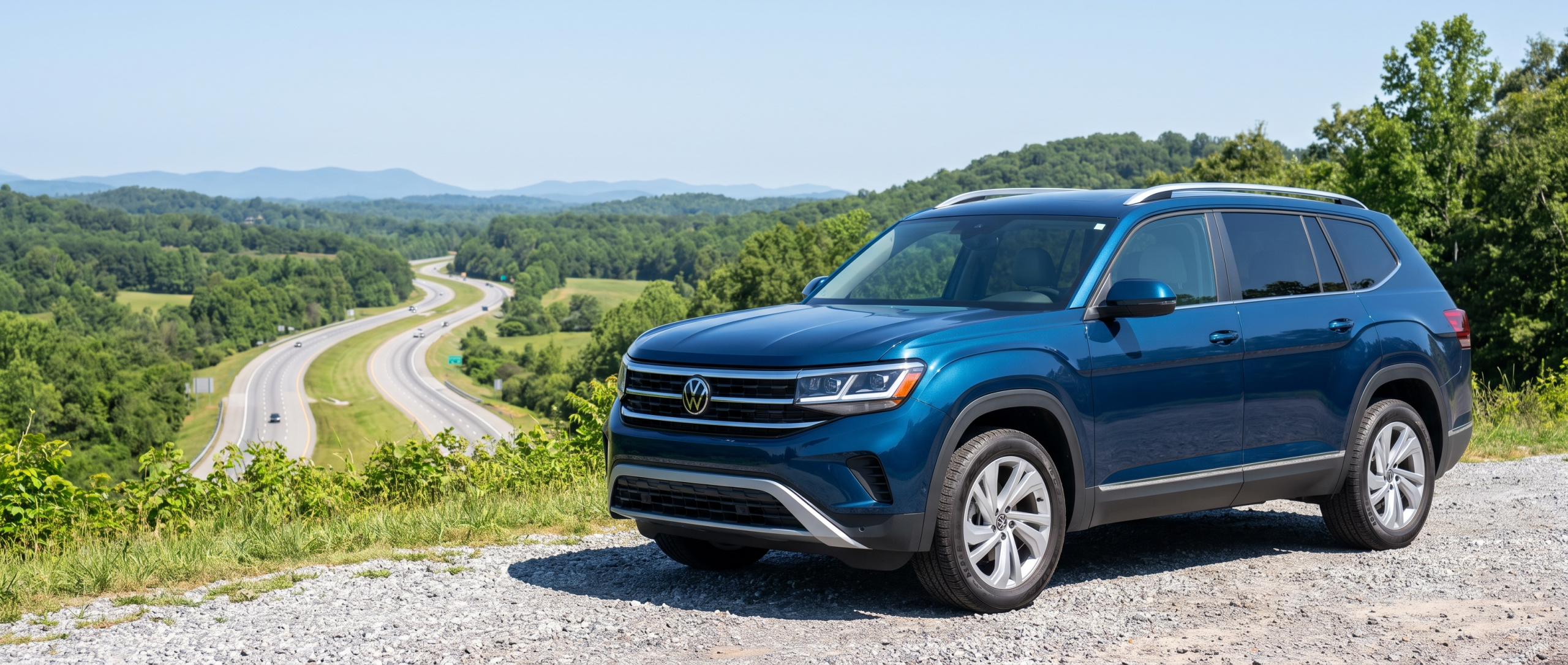
2026 Volkswagen Atlas at a Blue Ridge foothills overlook in Upstate South Carolina, loaded for a summer I-85 road trip

4 Best Volkswagen Models for Summer Vacations Starting on I-85

In this article The 2026 VW Summer Road-Trip Ranking No. 1 -- The Atlas Handles Every Seat and Every Bag No. 2 -- The Tiguan Punches Well Above Its Fuel Bill No. 3 -- The Jetta Goes the Distance Without Stopping Three Things to Know Before You Load Up and Leave No. 4 -- The Taos Makes the Most of a Compact Footprint The I-85 corridor through Upstate South Carolina threads through Spartanburg, Greenville, and Anderson across roughly 106 miles before it fans out toward Atlanta to the south and Charlotte to the north. For most Upstate drivers, that stretch is the starting line for nearly every major summer road trip -- the beach, the mountains, a long weekend in a city. The right VW turns that run into a pleasure; the wrong one turns it into a luggage negotiation. The top pick for most families is the 2026 Volkswagen Atlas -- a 3-row SUV with 96.6 cubic feet of maximum cargo volume and 269 horsepower ready to merge confidently onto I-85. But the best choice depends entirely on who is in the seats and what is in the trunk. Here is a ranked breakdown of the four 2026 VW models best suited to an I-85 summer departure. The 2026 VW Summer Road-Trip Ranking Rank Model Best For Standout Spec 1 Atlas Families of 5-7 with big gear hauls 96.6 cu. ft. max cargo, 269 hp 2 Tiguan Couples and small families EPA-est. 34 mpg hwy (FWD), 69.8 cu. ft. max cargo 3 Jetta Solo drivers and traveling pairs EPA-est. 40 mpg hwy, ~512 mi. highway range 4 Taos First-time SUV buyers, weekend trips EPA-est. 36 mpg hwy (FWD), compact footprint See Current VW Summer Specials No. 1 -- The Atlas Handles Every Seat and Every Bag Seven people, four checked bags, a cooler, and a portable speaker. The 2026 Atlas was engineered for exactly that situation. Volkswagen's 2026 Atlas is rated at 20 city and 27 highway mpg (FWD) by the EPA -- not the most efficient figure in the segment, but paired with an 18.6-gallon tank, that puts 500-plus highway miles of theoretical range on the table. More important to most families is the cargo geometry: 20.6 cubic feet behind the third row expands to 55.5 cubic feet when that row folds, and to a flat 96.6 cubic feet when both rear rows go down. The 2026 Atlas earned a 2026 IIHS TOP SAFETY PICK designation -- meaningful when you are responsible for a full load of passengers through the summer construction zones that tend to cluster around the Spartanburg-Greenville stretch of I-85. Every trim ships with a 12-inch floating touchscreen, roof rails, and Adaptive Front Lighting. Upper trims add Travel Assist, Volkswagen's semi-autonomous adaptive cruise and lane-centering system, which reduces fatigue noticeably on a four-plus-hour interstate run. The second-row bench slides 7.7 inches fore and aft, letting taller adults choose third-row legroom over cargo depth -- a real decision on actual road trips. AWD note for Upstate SC summer trips: The Atlas's 4Motion AWD is standard on upper trims. For a summer I-85 run from Spartanburg to Atlanta or Charlotte, FWD handles the route confidently. The AWD investment makes more sense as the calendar moves toward winter. No. 2 -- The Tiguan Punches Well Above Its Fuel Bill For a couple or a family of three or four who want genuine German-interior quality without needing three rows, the 2026 Volkswagen Tiguan is the road-trip efficiency leader among VW SUVs. The EPA estimates the Tiguan S (FWD) at 26 city and 34 highway mpg -- the strongest highway figure in the 2026 VW SUV lineup. With 69.8 cubic feet of maximum cargo when the rear seats fold flat, it handles a full weekend's luggage for two or a tightly-packed four. A new-for-2026 top trim, the SEL R-Line Turbo, upgrades to a higher-output 2.0L producing 268 horsepower and 258 lb-ft of torque. For drivers who want to leave Spartanburg on Reidville Road, merge onto I-85 south toward Anderson, and feel the car settle confidently into 75-mph interstate cruise, that powertrain removes any hesitation from the equation. All 2026 Tiguan trims ship standard with four USB-C ports rated at 45 watts each -- enough to simultaneously charge two phones and a tablet, which is the practical minimum for any family road trip. The full IQ.DRIVE suite (Travel Assist, Adaptive Cruise Control, Active Blind Spot Monitor, Rear Traffic Alert, Lane Assist) is standard across every trim. No separate safety package required, no shopping for the right trim to get highway assistance. No. 3 -- The Jetta Goes the Distance Without Stopping Solo drivers and traveling pairs face a different optimization: comfort at sustained highway speeds, a trunk that fits real luggage, and a fuel figure that keeps stops rare. The 2026 Volkswagen Jetta delivers all three. The EPA rates the standard Jetta at 29 city and 40 highway mpg with the 1.5L turbocharged four-cylinder and 8-speed automatic -- the highest highway figure in the 2026 Volkswagen gasoline lineup. On the 12.8-gallon tank, that translates to an EPA-estimated highway range of roughly 512 miles before a fill, which covers an Atlanta-to-Charlotte run with fuel to spare. Rear-seat passengers get 37.4 inches of legroom -- generous for a compact sedan -- and the 14.1-cubic-foot trunk handles two standard carry-on suitcases without ceremony. The cabin is oriented deliberately toward the driver: supportive front seats, controls positioned to minimize reach, and an 8-inch display angled inward. For anyone cutting south on I-85 toward Atlanta or north toward Charlotte, the Jetta's highway efficiency is a verifiable advantage over most of the non-hybrid compact segment. The Jetta GLI variant adds 228 horsepower and 258 lb-ft of torque for drivers who consider the drive the point rather than the destination, with a six-speed manual standard and an EPA-estimated 36 highway mpg in that configuration. Three Things to Know Before You Load Up and Leave SC Highway 11 -- the Cherokee Foothills National Scenic Highway -- runs 100 miles along the Blue Ridge as a scenic alternative to I-85. The Tiguan's agile size and the Jetta's efficiency both reward the detour; a fully loaded Atlas is better served staying on the interstate. Travel Assist is standard on every 2026 Tiguan trim via IQ.DRIVE; Atlas drivers should confirm which trim includes it before a long-haul run. I-85 through the Greenville-Spartanburg corridor carries heavy freight traffic on weekday mornings. Departing before 7 a.m. or after 9 a.m. runs noticeably cleaner. No. 4 -- The Taos Makes the Most of a Compact Footprint Not every summer trip requires a three-row hauler or a performance sedan. The 2026 Volkswagen Taos earns its spot on this list for a specific traveler: the first-time VW SUV buyer, the weekend explorer heading for the Blue Ridge foothills, or anyone who prizes a maneuverable footprint in vacation-town parking lots over maximum cargo volume. The EPA estimates the FWD Taos at up to 36 highway mpg, which for an SUV is a genuinely strong number -- it turns the I-85 leg from Spartanburg toward Anderson and beyond into roughly a one-stop trip on a 15-gallon tank. The honest trade-off is cargo volume: the Taos's rear cargo area is sized for weekend duffels rather than hard-sided luggage for four. Two travelers packing smart will find it more than adequate. Four travelers with full suitcases will want the Tiguan. Every Taos ships with IQ.DRIVE safety technology, wireless Apple CarPlay and Android Auto, and a driving position elevated enough above I-85's lane lines to keep the ride relaxed across a full Upstate South Carolina summer afternoon. Get Pre-Approved for Financing Steve White Volkswagen Spartanburg 2671 Reidville Rd, Spartanburg, SC 29301 (864) 585-2492
VW ID.4 vs. Mustang Mach-E: What Spartanburg EV Buyers Actually Need to Know About Range and Charging

Both the 2026 Volkswagen ID.4 and the Ford Mustang Mach-E can handle a Spartanburg commute without drama -- the ID.4 RWD delivers an EPA-rated 291 miles while the Mach-E tops out at 320 miles on its extended-range battery. The more useful question for drivers along the I-85 and I-26 corridors is how each vehicle behaves when the battery gets low, where you actually stop to charge, and which charging network each car can access without an adapter. Those details separate a confident daily driver from one that requires more planning than you bargained for. How Far Will Each EV Really Go in Upstate SC? EPA ratings are a clean-lab benchmark. They assume mild temperatures, moderate speeds, and no accessory load. Spartanburg summers deliver sustained heat, and your climate system runs constantly -- which costs range. Here is the verified picture, EPA-attributed, for the configurations most Upstate SC drivers actually consider. Configuration EPA Range DC Fast Charge Speed 10-80% Time ID.4 RWD Pro (82 kWh) 291 miles Up to 175 kW ~30 min ID.4 AWD Pro (82 kWh) 263 miles Up to 175 kW ~30 min Mach-E Select RWD (std battery) 260 miles Up to 150 kW ~32-38 min Mach-E Premium RWD (ext battery) 320 miles Up to 150 kW ~38-43 min Mach-E Premium AWD (ext battery) 300 miles Up to 150 kW ~38-43 min The EPA rates the 2026 ID.4 RWD at 291 miles and the AWD variant at 263 miles, with both running on the same 82-kWh battery. The ID.4 also accepts up to 175 kW of DC fast power, compared to the Mach-E's ceiling of 150 kW, which means the VW can add range faster at a compatible fast charger. For the Mach-E, the extended-range battery is the one to focus on if highway trips matter to you -- the 320-mile RWD figure accounts for realistic long-haul use on the Atlanta-to-Charlotte run along I-85. One variable that matters more than most comparison articles admit: the ID.4's South Carolina summer heat sensitivity. Volkswagen's US-market ID.4 uses a resistive heater rather than a heat pump, which draws more energy from the battery during cabin conditioning -- a factor that cuts into both summer cooling efficiency and cold-morning range. The 2026 Mach-E, by contrast, ships with a standard heat pump across all trims, which extracts ambient warmth more efficiently and keeps the battery load lower during those occasional Upstate SC January cold snaps. Caution for hot-weather charging: In peak Spartanburg summer heat, an ID.4 that has been sitting in a parking lot will sometimes throttle DC fast-charge speeds until the battery thermal management brings pack temperature down. Plan an extra five to ten minutes into your first summer fast-charge stop, or precondition the battery via the infotainment menu before you arrive at the station. The 2026 ID.4 charges faster at the station (up to 175 kW vs. 150 kW), but the Mach-E's standard heat pump means a more predictable efficiency floor during temperature swings in Upstate SC winters. Where Do You Charge in and Around Spartanburg? The honest answer is that Spartanburg is well-served by the main networks, particularly along the interstate corridors. PlugShare lists more than 118 total charging stations in Spartanburg. The specific stops relevant to each vehicle depend on which connector your car uses. The Tesla Supercharger at Winchester Place (off I-26 west) is open 24 hours and delivers up to 250 kW. The 2026 ID.4 ships with a NACS (North American Charging Standard) port, which means it plugs directly into Tesla's Supercharger network without any adapter. That is a concrete advantage: Spartanburg's Supercharger, with eight stalls, is one of the most reliable and fastest charging sites in the city. The 2026 Mach-E uses a CCS1 port rather than NACS, so it cannot access Tesla Superchargers without an aftermarket adapter. For Mach-E drivers in Spartanburg, the primary fast-charge options are Electrify America (present along the I-26 and I-85 corridors at Walmart and shopping centers) and EVgo stations. Both work well, but the network density and stall availability is currently thinner than Tesla's. Browse VW's current EV inventory at Steve White Volkswagen Spartanburg to confirm which trims are in stock, or talk to our team about pairing the ID.4 with a home Level 2 charger setup. For road trips, the I-85 and I-26 corridors both carry DC fast-charge coverage at key exits. South Carolina is receiving continued private investment in charging infrastructure, with Electrify America sites concentrated at interstate shopping-center exits. An Upstate SC driver heading to Greenville (under 40 miles), Anderson (under 50 miles), Charlotte (roughly 75 miles), or Atlanta (roughly 175 miles) can complete most of those legs easily on either vehicle. See Current VW Specials Picking the Right Configuration for Your Driving Life Most Spartanburg drivers fall into one of two categories: the daily commuter who charges at home every night, and the corridor traveler who regularly makes runs toward Charlotte or Atlanta. Here is how the two vehicles line up against each scenario. Home-charging daily commuter: If your round-trip is under 80 miles and you have a 240-volt outlet in your garage or carport, both vehicles handle this comfortably. The ID.4 charges at up to 11 kW on Level 2, replenishing a depleted 82-kWh pack in roughly 7.5 hours overnight. The Mach-E's extended-range 91-kWh pack takes closer to 10-11 hours on Level 2. Neither requires a DC fast charger for daily use. The I-85 corridor commuter: Spartanburg sits between Atlanta and Charlotte. If you are driving that stretch regularly, fast-charge access matters as much as EPA range. The ID.4's 175-kW DC capability and direct NACS port access give it a meaningful advantage at Spartanburg's Tesla Supercharger. A 30-minute stop on a half-empty battery adds roughly 170-190 miles -- enough to complete a Spartanburg-to-Charlotte leg and return without a second stop. SC Highway 11 weekend drivers: If you use the Cherokee Foothills Scenic Highway along the Blue Ridge front as a weekend destination, elevation gain is a factor. Both EVs experience minor range reduction climbing into the foothills, but the ID.4 RWD's 291-mile buffer gives you comfortable headroom for a day loop from Spartanburg without needing to charge en route. Plan a top-off in Gaffney or at the Greenville stations before a longer Highway 11 run. Explore financing options at Steve White Volkswagen Spartanburg when you are ready to run the numbers on ownership. Schedule EV service to keep your battery and charging hardware in top condition through Spartanburg's seasonal swings. Frequently Asked Questions Does the 2026 VW ID.4 work with Tesla Superchargers in Spartanburg? Yes. The 2026 Volkswagen ID.4 comes with a NACS port from the factory, which allows it to plug directly into Tesla Supercharger stations -- including the 250-kW station on Winchester Place off I-26 in Spartanburg -- without any adapter. This is one of the most significant practical advantages the ID.4 gained for 2026, opening up the most widely available fast-charging network in the area to VW drivers. How much does Upstate SC summer heat actually affect EV range? Heat affects range primarily through air conditioning load and battery thermal management. The EPA estimates test vehicles in controlled conditions; in sustained South Carolina summer heat, real-world range typically runs 10-20 percent below the EPA figure on highway driving. The ID.4's lack of a heat pump means its resistive heater draws more battery power during temperature extremes than the Mach-E's heat pump does. In practice, plan your summer trips using roughly 80 percent of the EPA-rated range as your usable buffer, and use battery preconditioning features before a DC fast-charge stop. Which is better for the daily Spartanburg commute -- the ID.4 or the Mach-E? For most Spartanburg daily drivers, the ID.4 is the simpler choice: a quieter, more comfort-focused cabin, native Supercharger access for top-offs at the I-26 station, and a 291-mile RWD range that clears a week of normal commuting without touching a public charger. The Mach-E is the stronger fit for drivers who prioritize an engaging driving feel and want the extended-range battery's 320-mile buffer for frequent long-haul trips toward Atlanta or Charlotte. Your ideal pick depends less on the EPA number and more on how often you leave Upstate SC. --- Start Your Financing Application Steve White Volkswagen Spartanburg 2671 Reidville Rd, Spartanburg, SC 29301 (864) 585-2492
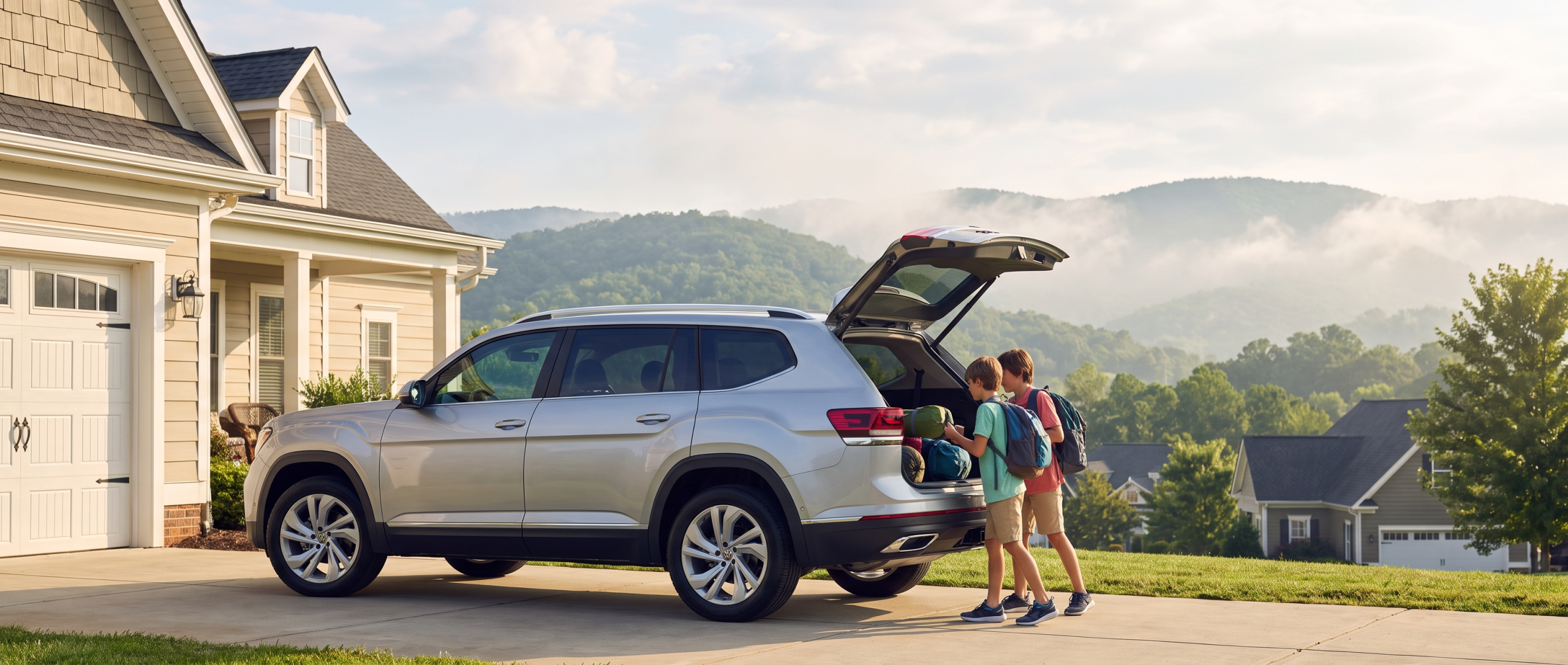
2026 Volkswagen Atlas loaded with family cargo in Upstate South Carolina near Spartanburg

How to Pick the Right Volkswagen for a Busy Family Driving the Inman-Spartanburg Corridor

In this article What Actually Matters When Choosing a Family VW for This Route? Seats and Cargo: Where the Three Models Diverge The Atlas vs. Atlas Cross Sport: What the Numbers Miss Match the VW to How Your Family Actually Drives Your commute on I-26 between Inman and Spartanburg is only about 15 miles. But the gear that travels with a busy family -- car seats, sports bags, a weekend's worth of camping kit for Croft State Park, a middle schooler who insists on bringing everything she owns -- turns that short run into a serious packaging question. Three 2026 Volkswagen SUVs answer it differently. The right one depends on how many seats you need, how much cargo you're moving, and whether the 4Motion AWD system is a weekly necessity or a occasional comfort. The short version Three rows, seven seats: the 2026 Atlas is the pick -- 20.6 cu ft of cargo behind row three, up to 96.6 cu ft with rows two and three folded, towing up to 5,000 lbs when properly equipped. Two rows, maximum cargo per seat: the 2026 Atlas Cross Sport gives you 40.3 cu ft behind the rear seats and 77.6 cu ft fully folded, with adult-grade rear legroom of 40.4 inches. Compact daily driver for a smaller family: the 2026 Tiguan's EPA-estimated 26/34/29 mpg (S FWD) makes it the fuel economy leader of the three, and it fits a family of four without the midsize footprint. AWD on the I-26 corridor: all three offer 4Motion AWD -- it matters most when Upstate SC ice storms roll through in January and February; for dry July commutes it adds peace of mind without a major efficiency penalty. Bottom line: count your heads, count your bags, then match the model -- the spec table below does the math. Browse current VW inventory at Steve White Volkswagen Spartanburg What Actually Matters When Choosing a Family VW for This Route? The Inman-to-Spartanburg drive via I-26 is one of Upstate SC's most well-worn daily corridors -- and it tests a family SUV in both directions. Morning school runs in stop-and-go surface traffic put a premium on fuel economy and cabin calm. Weekend runs toward the Blue Ridge Mountain foothills, or a Saturday at Croft State Park's lakes with kayaks on a roof rack, ask for cargo room and confident highway power. Here are the four variables that actually separate these three VW options for a local family. Model Best For Key Spec Trade-Off 2026 Atlas Families of 5-7; road trips; towing 96.6 cu ft max cargo; 5,000 lb tow; 20/27/23 mpg (FWD, EPA est.) Largest footprint; tighter in parking decks 2026 Atlas Cross Sport Families of 4-5; cargo-over-seats priority 77.6 cu ft max cargo; 40.4 in rear legroom; 20/27/23 mpg (FWD, EPA est.) No third row; five-seat ceiling 2026 Tiguan Smaller families; daily-commute MPG 69.8 cu ft max cargo (seats folded); 26/34/29 mpg (S FWD, EPA est.) 5-seat only; less towing (1,500 lbs FWD) The decision hinges on one question before anything else: does your household ever need a third row of seats? If the answer is sometimes -- grandparents on holidays, a carpool, a sports-team run -- the Atlas resolves it cleanly. If the answer is never, the Cross Sport or Tiguan gives back cargo room and real-world fuel savings on the I-26 commute. Seats and Cargo: Where the Three Models Diverge The single most concrete difference in this lineup is the seating architecture, and it ripples into every other number. 2026 Atlas The 2026 Atlas carries up to seven passengers across three rows. Volkswagen lists third-row legroom at 33.7 inches -- enough for kids, shorter adults, and the occasional teenager who draws the short straw. Behind that third row sits 20.6 cubic feet of cargo space, which accommodates a decent grocery run or a day bag each. Fold both rear rows flat and the EPA-verified maximum reaches 96.6 cubic feet -- the kind of number that handles a Costco run and a soccer gear haul on the same trip. The second row also slides fore and aft 7.7 inches, which makes third-row access easier even with child seats in place. 2026 Atlas Cross Sport The 2026 Atlas Cross Sport drops the third row and reclaims it as cargo volume. Behind the rear seats: 40.3 cubic feet. Fold them: 77.6 cubic feet. That cargo hold is shaped more usefully than the Atlas's, too -- lower liftover and a squarer load floor mean strollers and bikes load without the awkward angle. Rear passengers in the Cross Sport get 40.4 inches of legroom, which is generous for adults on a longer I-26 run toward Greenville. 2026 Tiguan The 2026 Tiguan is the compact of the group. VW lists total cargo volume with seats folded at 69.8 cubic feet, and the two-row interior seats five. It no longer offers a three-row option (that configuration was discontinued after the 2024 model year). For a family of three or four whose cargo needs are moderate -- bags, a stroller, a few grocery totes -- it is a practical, right-sized choice for Reidville Road errands and the Spartanburg school pickup circuit. See the 2026 Atlas at Steve White Volkswagen Spartanburg Explore the 2026 Atlas Cross Sport Cargo tip: Before ruling out the Tiguan as too small, stack your actual weekly cargo in a garage corner. Many Inman families with two kids discover the Tiguan's 69.8 cubic feet handles the everyday load fine -- the Atlas or Cross Sport becomes the right call only when gear escalates to organized sports or camping season. The Atlas vs. Atlas Cross Sport: What the Numbers Miss Both Atlas models share the same turbocharged 2.0-liter engine producing 269 horsepower and 273 lb-ft of torque, paired with an eight-speed automatic. The EPA rates both FWD variants identically at 20 city / 27 highway / 23 combined mpg. The 4Motion AWD variants nudge down slightly -- the EPA puts AWD Atlas and Cross Sport SE models at 20 city / 26 highway / 22 combined. So fuel economy is not the deciding factor between them. The deciding factor is whether you ever fill a third row. Families who have had the grandparents in town for the holidays or who regularly run a five-plus-kid carpool know the moment a seven-seater earns its keep. Families who genuinely run four people and cargo every week will find the Cross Sport's squarer, lower cargo hold more practical than the Atlas's deeper, three-row-behind load floor. The Cross Sport's rear doors are also wider, which makes loading children into rear-facing car seats faster -- a real-world detail that a spec sheet does not capture. Atlas towing: up to 5,000 lbs when properly equipped -- enough for a boat toward Lake Bowen or a camper trailer Cross Sport towing: up to 5,000 lbs when properly equipped -- same capacity in a slightly sleeker package Tiguan towing: 1,500 lbs FWD / 1,800 lbs 4Motion -- a different category suited to light utility trailers only Pros and Cons: 2026 Atlas vs. 2026 Atlas Cross Sport Pros Cons Atlas: third row for 5-7 passengers Atlas: largest exterior footprint of the three Atlas: 96.6 cu ft max cargo volume (EPA-verified) Atlas: slightly lower fuel economy than Tiguan on daily commute Cross Sport: more useful cargo floor shape Cross Sport: five-seat ceiling, no third-row option Cross Sport: 40.4 in rear legroom, adult-friendly Cross Sport: less max cargo than Atlas (77.6 vs 96.6 cu ft) Both: 5,000 lb tow capacity when properly equipped Both: AWD drops combined MPG to 22 (EPA est.) See Current Volkswagen Offers Match the VW to How Your Family Actually Drives The I-26 corridor from Inman to Spartanburg is a short, familiar run -- but the life packed into that drive changes month to month. The three-row family has three kids, a consistent carpool obligation, or routinely travels with extended family across I-85 toward Greenville or Charlotte. The 2026 Atlas is built for your life: the third row is real seating, not a penalty box, with 33.7 inches of legroom for kids. The 4Motion AWD option matters when Upstate SC's Isothermal Belt delivers an ice storm in winter. The active family of four has two kids under 12, a trailer hitch for a small boat or utility trailer, and cargo that swings between soccer season and summer camping. The 2026 Atlas Cross Sport's low liftover, wide rear doors, and 40.3 cubic feet of accessible cargo suit you better than the Atlas's deeper, third-row-behind hold. The sleeker roofline also means a roof rack does not turn the vehicle into a barn door at highway speeds. The compact commuter family has a smaller household with one or two kids, and the I-26 commute is a daily priority. The 2026 Tiguan's EPA-estimated 26 city / 34 highway / 29 combined mpg (S FWD) is meaningfully better than the Atlas siblings on fuel per mile, and the compact footprint navigates tight campus zones around USC Upstate or downtown Spartanburg without the parking-deck anxiety of a midsize SUV. View the 2026 Tiguan at Steve White Volkswagen Spartanburg All three come standard with Volkswagen's IQ.DRIVE suite -- forward collision warning, adaptive cruise control, lane assist, and automatic emergency braking -- so the safety floor is consistent across the lineup regardless of which model you choose. Frequently Asked Questions Does the 2026 Volkswagen Tiguan still come with three rows of seats? No. Volkswagen discontinued the three-row Tiguan configuration after the 2024 model year. The 2026 Tiguan is a five-seat, two-row compact SUV. Families who need a third row within the VW lineup should consider the 2026 Atlas, which seats up to seven passengers across three rows with 33.7 inches of third-row legroom. Is 4Motion AWD worth it for Spartanburg-area driving? For most Upstate SC families commuting between Inman and Spartanburg, FWD handles the majority of dry summer and fall conditions well. The case for 4Motion AWD strengthens in winter: Spartanburg County sits in the Isothermal Belt, a geography where warm air rolling over the Appalachians can create unpredictable temperature swings of 20 degrees or more, bringing unexpected ice on I-26. Volkswagen's 4Motion system uses an electronically controlled multi-plate clutch that operates in FWD during normal conditions and routes torque to the rear wheels only when sensors detect slip -- so it adds confidence without a constant fuel economy penalty. On the 2026 Atlas FWD, the EPA estimates 23 mpg combined; 4Motion SE trims come in at 22 mpg combined -- a modest real-world difference for the added winter traction. Explore Financing Options Steve White Volkswagen Spartanburg 2671 Reidville Rd, Spartanburg, SC 29301 (864) 585-2492
A Summer Day in Upstate SC: 4 Stops, One VW, Zero Dead Batteries

July in Spartanburg is no joke. Average highs sit at 91 degrees F, and under the hood of a parked car, temperatures routinely climb past 140 degrees F -- the threshold where battery electrolyte begins to evaporate, corroding internal lead plates and quietly shaving months off your VW's battery life. AAA reports fielding nearly 2 million battery-related service calls every summer, and the southern United States is the hardest zone: batteries in the South and Southwest average just 2.5 to 3 years, versus 5 years up north. That gap is real, and it is exactly why protecting your Volkswagen Tiguan -- or any VW in your driveway -- takes more than hoping for a cool morning. Here's the plan: a four-stop Spartanburg day that moves you through the practical battery-care steps a VW driver should actually take in July, tied to real places around Upstate SC. Each stop is a checkpoint. Together they add up to a battery that makes it through summer and into the fall commute without drama. What's the Route? Stop When Where What to Do What to Bring 1: The Pre-Drive Check 7:30 AM Your driveway Inspect terminals, confirm battery age Flashlight, clean rag 2: The Shade Park 9:00 AM Croft State Park Morning trail, car in full tree cover Sunscreen, water bottle 3: The Service Stop 11:30 AM Steve White Volkswagen Spartanburg Battery load test, terminal cleaning Your VIN and service history 4: The Cool-Down Loop 3:00 PM I-85 / I-26 corridor 25-plus minute highway run to recharge Nothing extra -- just drive The Four Stops in Detail Stop 1 -- The Pre-Drive Check (7:30 AM, Your Driveway) Most VW battery failures in summer show warning signs before they strand you. The trick is catching them before the first hot errand of the day. Pop the hood while the air is still cool -- Spartanburg's July mornings hover around 70 degrees F, which gives you a window before under-hood temps build. Look for two things. First, check for white or blue-green buildup around the battery terminals. Heat accelerates corrosion, and corroded terminals restrict the electrical current your VW's battery management system depends on to charge correctly. Heavy buildup means a service visit is overdue. Second, note the battery's age. Battery specialists consistently recommend a professional load test after the second year; a battery past three years in a hot-climate market like Spartanburg is living on borrowed time. One VW-specific detail most generic guides miss: Volkswagen models -- including the Atlas, Jetta, and Tiguan -- use either AGM (Absorbent Glass Mat) or EFB (Enhanced Flooded Battery) technology rather than a conventional lead-acid unit. AGM batteries power VW's start-stop system and handle the repeated charge and discharge cycles that stop-and-go driving creates. If yours ever needs replacement, the new battery must be registered to the car's battery management module by a technician with VW-compatible diagnostic equipment. Installing a standard lead-acid battery in an AGM-spec car causes the smart alternator to charge at the wrong rate, and the replacement fails early. This is a dealer-level step, not a parking-lot swap. Stop 2 -- The Shade Park (9:00 AM, Croft State Park) Jetta drivers, Tiguan owners, and anyone else in the VW family will appreciate this one: parking in genuine tree canopy shade can lower under-hood temperatures by more than 20 degrees F compared to an asphalt lot in full sun. That is not a small margin when 140 degrees F is the electrolyte evaporation threshold. Croft State Park, just south of downtown Spartanburg at 450 Croft State Park Road, covers more than 7,000 acres of wooded piedmont terrain -- a former WWII Army training site that now offers over 17 miles of hiking and biking trails, fishing and boating on 165-acre Lake Craig, and dense tree canopy that qualifies as genuine shade. The park is open daily during Daylight Savings Time until 9 PM, so a 9 AM arrival gives you the coolest trail conditions and the best shaded parking spots before the midday crowd. While you walk the Palmetto Trail passage along Fairforest Creek, your VW sits under tree cover rather than in a reflective parking deck. That two-hour window at lower temperature measurably reduces the chemical stress on the battery. If you have been running the AC hard on the drive in, give the car a brief cool-down at idle before shutting off -- it lets the alternator partially recover charge before the battery sits unattended. Summer Timing Note. Croft's trail humidity climbs fast after 10 AM -- start walking by 9 AM to catch the shadiest, coolest window. The Fairforest Creek crossing on the Palmetto Trail stays noticeably cooler than the open-sun sections. A small day-use fee applies at the park entrance; no reservation is needed for day use. Stop 3 -- The Service Stop (11:30 AM, Steve White Volkswagen Spartanburg) Heat damage is cumulative and invisible until it is not. A battery that started summer at 85 percent capacity and has cycled through six weeks of 90-plus-degree days may now sit at 60 percent -- enough to start the car fine, but not enough to recover from a long AC-on idle in a hot parking lot. A professional load test measures the battery's actual state of health under real amperage demand, which is fundamentally different from the voltage reading your dashboard shows. At Steve White Volkswagen on Reidville Road, the service team uses VW-compatible diagnostic tools -- the same systems required to register a new battery to the car's management module if replacement is needed. That coding step matters specifically for VW drivers because the smart alternator adjusts its output based on the battery type registered in the system. Aftermarket shops without VW scan-tool access frequently skip this step, which is why some owners report a brand-new battery failing within months of an outside-shop swap. Signs your battery may not survive the summer: the engine cranks slower than usual in the morning, the start-stop system stops engaging on its own, a battery or electrical warning light flickers, or interior lights dim briefly when the AC compressor kicks on. Any one of those is worth a load test before a hot afternoon strands you. Schedule a Battery Inspection Stop 4 -- The Cool-Down Loop (3:00 PM, I-85 / I-26 Corridor) The afternoon stop is the one most drivers skip -- and it is the one that actually recharges the battery after a stop-and-go morning. Short trips under 20 minutes at low speeds use more charge than the alternator can replenish, especially with the AC running at maximum. The fix is deliberate and simple: take a 25-to-30-minute highway run before parking for the rest of the day. The I-85 / I-26 interchange corridor south of Spartanburg is a practical loop for exactly this purpose -- consistent highway speeds, minimal traffic lights, enough miles to let the alternator fully cycle the battery back toward capacity. VW's battery management system is most efficient at sustained highway speeds above 50 mph, so the interstate is the right venue for a recharge run. Think of it as planned maintenance, not wasted miles. If you have been sitting at Croft State Park or the dealership for two or more hours with the engine off and the cabin hot, the first stretch should be at highway speed with the AC running -- the alternator handles both the cooling load and the battery recovery simultaneously. Drivers who take only short in-town runs -- the school pickup, the Reidville Road grocery stop, the downtown Spartanburg coffee run -- are the ones who face a dead battery on a humid August morning that otherwise looked perfectly ordinary. A weekly loop like this one is maintenance. Tweak It to Your Crew The four-stop framework adapts to any VW driver and any summer schedule. Atlas Cross Sport owners carrying a full family load (rear AC zone, rear entertainment screens, multiple USB devices) have a meaningfully higher electrical draw and may benefit from stretching Stop 4 to 35 or 40 minutes on the highway. The principle scales with accessories: more load running, longer recharge time needed. Golf GTI and Jetta GLI drivers who lean on sport mode and a loud audio system are in the same boat. If you are regularly running high accessory loads on short in-town hops, the weekly highway loop is non-negotiable. ID. Buzz and other VW EV drivers shift the battery-protection logic slightly: avoid leaving the high-voltage pack at 100 percent charge in a hot parking lot, and limit fast-charging sessions during peak summer heat, as rapid charge cycles in high ambient temperatures accelerate high-voltage battery degradation faster than heat alone. For any VW with start-stop technology -- Tiguan, Atlas, Taos, Jetta GLI -- the AGM battery is the single most heat-sensitive component in the car, and Spartanburg's July is its annual stress test. The morning check, the shaded park stop, the professional load test, and the recharge loop cost you nothing more than a deliberate Saturday. What they buy is a battery that carries you cleanly through summer and into October without a surprise click. By the Steve White Volkswagen Team | July 2026 See Current VW Specials Steve White Volkswagen Spartanburg 2671 Reidville Rd, Spartanburg, SC 29301 (864) 585-2492
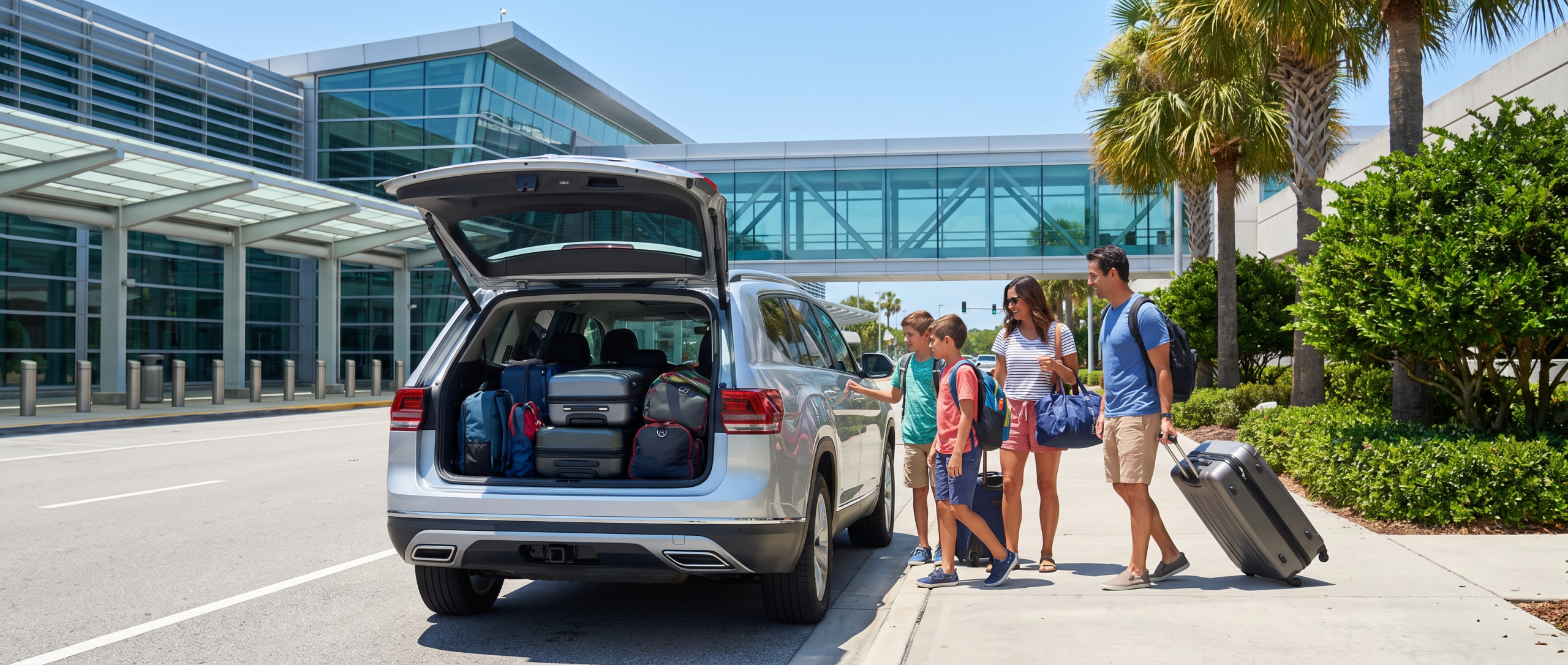
Table Rock State Park Is an Hour from Spartanburg -- Your VW SUV Makes the Drive Half the Trip

In this article What's the Plan at a Glance? Table Rock Offers More Trail Options Than Most Drivers Realize The Cherokee Foothills Scenic Highway Is the Other Half of the Trip Choosing the Right VW SUV for How You Actually Pack Take I-26 West to Exit 5, point the nose onto SC Highway 11, and you arrive at one of South Carolina's most dramatic state parks in roughly an hour -- but the right VW SUV turns the Cherokee Foothills Scenic Highway into a reason to leave early. Whether you are loading hiking poles for the summit or a picnic blanket for Pinnacle Lake, the 2026 Volkswagen Tiguan and 2026 Volkswagen Atlas each earn their place on this route for genuinely different reasons. What's the Plan at a Glance? Stop What to Do Best Time Parking Notes SC-11 / Cherokee Foothills Scenic Hwy Scenic drive through Blue Ridge foothills; roadside farm stands Morning departure Roadside pulloffs available Grant Meadow Overlook (4750 SC-11, Pickens) Photograph Table Rock Mountain from the highway, no park fee 8-10 a.m. before haze Small roadside lot Table Rock State Park (158 E. Ellison Lane, Pickens) Hike Carrick Creek Loop or the summit; swim Pinnacle Lake; picnic Arrive by 9 a.m. summer weekends Main lot off E. Ellison Lane; fills fast on peak days Aunt Sue's Country Corner (107 Country Creek Dr., Pickens) Homestyle lunch or ice cream, two miles east of the park on SC-11 11 a.m. to 2 p.m. Ample parking Table Rock Offers More Trail Options Than Most Drivers Realize The trailhead kiosk at Table Rock's Nature Center is worth a stop before you choose your route, because the park packs four very different experiences into its 3,083 acres at the edge of the Blue Ridge Mountains. The Carrick Creek Nature Trail covers a 1.9-mile loop past Carrick Creek Falls, a 15-foot cascade that drops into a natural swimming hole -- ideal for families with younger kids or anyone who wants a scenic hour without heavy climbing. The Table Rock Summit Trail climbs 2,000 feet over roughly 3.5 miles one-way to a 3,124-foot granite dome; on a clear July morning the view stretches south to the Greenville skyline and northwest to the peaks of the Great Smoky Mountains. SC State Parks requires a hiking registration card at the trailhead kiosk before ascending either summit route -- a genuine safety measure that takes about two minutes. The park's main gate opens at 8 a.m. during summer. From Spartanburg, the official South Carolina State Parks driving directions are direct: I-26 West to Exit 5, then SC-11 approximately 45 miles to the park entrance on E. Ellison Lane. Local note: The Grant Meadow Overlook at milepost 4750 on SC-11 gives you a clean, no-fee view of Table Rock Mountain before you even pull into the park -- a natural first stop and a good photo frame for the day. The Cherokee Foothills Scenic Highway Is the Other Half of the Trip SC Highway 11 -- a 119-mile National Scenic Highway featured in National Geographic and Southern Living -- runs through peach orchards, past views of the Blue Ridge foothills, and alongside Lake Keowee before reaching the park entrance. From the I-26 interchange near Campobello it transitions quickly from Piedmont to mountain foothills, and the long stretches without traffic signals make it feel more like a weekend road trip than a navigation step. This is the stretch where the Tiguan's tuned suspension and precise steering feel purposeful. The 2026 Tiguan S posts EPA-estimated fuel economy of 26 city / 34 highway mpg on regular unleaded, so the roughly 90-mile round trip from Spartanburg barely registers on the gauge. Drivers who want available 4MOTION AWD for the tighter foothills curves still see an EPA-estimated 22 city / 30 highway mpg from Volkswagen. A few things worth knowing before you leave Reidville Road: SC-11 passes roadside farm stands selling Upstate SC peaches through July -- a brief stop worth building in Lake Keowee comes into view through the tree line in the northern Pickens County section Cell signal weakens near the park; download offline maps before you leave Spartanburg The park gate closes at 6 p.m. in summer, so an 8 a.m. departure from Spartanburg gives you a full day The Atlas Cross Sport sits on the same engine as the Atlas and handles this route with the same composure Choosing the Right VW SUV for How You Actually Pack The 2026 VW lineup at Steve White Volkswagen Spartanburg offers two clear answers for this trip, and the right one depends on group size and gear volume. The 2026 Tiguan carries up to 69.8 cubic feet of cargo with rear seats folded, and its standard 2.0-liter TSI engine produces 201 horsepower with 221 lb-ft of torque. For a couple or a small group carrying day packs, trekking poles, and a cooler, that is a comfortable fit. The optional 4MOTION AWD is available on the first three trims -- a practical addition for any driver who uses SC-11 year-round, not just for summer day trips. The 2026 Atlas is the answer when you have five to seven passengers and everything that comes with them. Volkswagen lists the Atlas at up to 96.6 cubic feet of cargo with all rows folded, and it seats seven in its standard three-row layout. The Atlas earned a 2026 IIHS TOP SAFETY PICK designation -- a meaningful credential for families loading kids into a vehicle headed toward mountain roads. Under the hood, the 2.0-liter TSI produces 269 horsepower and 273 lb-ft of torque, and properly equipped trims offer up to 5,000 pounds of towing capacity when a kayak trailer comes along. Both models carry Volkswagen's IQ.DRIVE driver-assistance suite as standard equipment, which earns its keep on a winding two-lane highway where the mountain scenery competes for your attention. See Current VW Offers Table Rock State Park rewards drivers who leave early and stay curious about the road getting there. The Cherokee Foothills Scenic Highway is not a detour from the destination -- it is part of it. Value Your Current Vehicle Steve White Volkswagen Spartanburg 2671 Reidville Rd, Spartanburg, SC 29301 (864) 585-2492
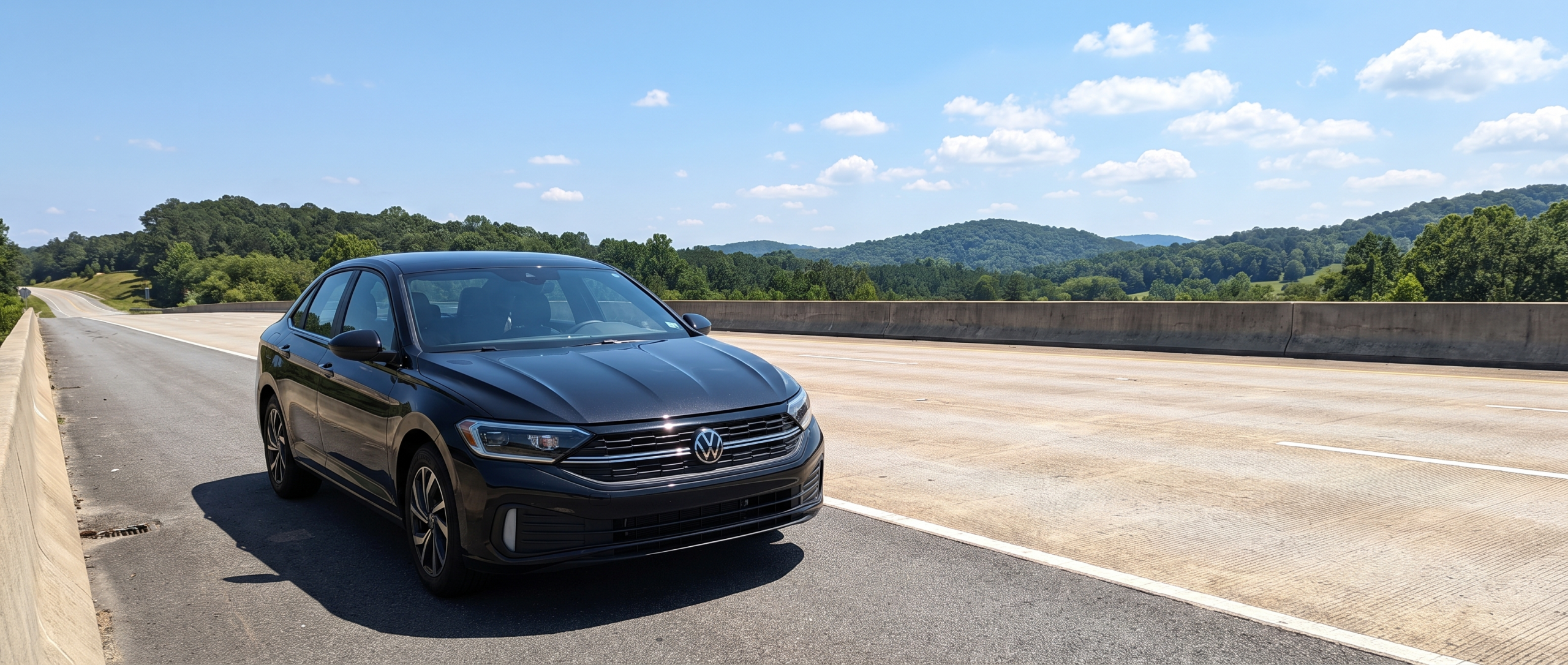
2026 Volkswagen Jetta on a sunny South Carolina highway overpass during summer

3 Ways to Drive the Jetta Through a Spartanburg Summer (S, SE, or GLI?)

Spartanburg's July average high sits at 91.4 degrees Fahrenheit -- and the heat index pushes the "feels like" reading to 109.4 degrees. That changes the conversation about which commuter car to drive. The 2026 Volkswagen Jetta handles this kind of heat better than most people expect, but the right trim depends entirely on what your I-85 commute actually asks of you. Here is how the three most distinct configurations stack up. The short version The Jetta S gives I-85 drivers the EPA's 40 mpg highway rating and standard dual-zone climate control for the leanest possible commute. The Jetta SE adds remote start, a panoramic moonroof, and wireless phone charging -- features that matter most when the car has been sitting in a Spartanburg parking lot all afternoon. The Jetta GLI delivers 228 horsepower, a choice of six-speed manual or seven-speed DSG, and sport-tuned handling for the driver who wants more from the daily run. All three come standard with VW's IQ.DRIVE suite, including adaptive cruise control with stop-and-go and automatic emergency braking. All three earned a 5-star overall safety rating from NHTSA. Explore the 2026 Jetta lineup at Steve White Volkswagen Spartanburg and see which trim is available today. How Do the Three Trims Compare on the Specs That Count? For a Spartanburg driver, the decision hinges on three things: how efficiently the car runs the I-85 corridor, how fast it recovers from sitting in summer heat, and how much driver engagement you want along the way. The table below maps each trim to the verified specs behind those questions. Feature Jetta S Jetta SE Jetta GLI Engine 1.5L turbo, 158 hp 1.5L turbo, 158 hp 2.0L turbo, 228 hp Torque 184 lb-ft 184 lb-ft 258 lb-ft EPA Highway MPG 40 mpg 40 mpg 36 mpg (manual) / 35 mpg (DSG) Climate Control Dual-zone Climatronic (standard) Dual-zone Climatronic (standard) Dual-zone Climatronic (standard) Remote Start Not included Standard Standard Sunroof Not included Panoramic moonroof (standard) Standard Wireless Phone Charging Not included 15-watt (standard) Standard Seating Surfaces Cloth CloudTex leatherette Sport cloth Transmission 8-speed automatic 8-speed automatic 6-speed manual or 7-speed DSG IQ.DRIVE Safety Suite Standard Standard Standard NHTSA Overall Rating 5 stars 5 stars 5 stars Best For Budget-conscious highway commuter Daily comfort in heat Enthusiast with a long commute The EPA rates the Jetta S at 29 city / 40 highway mpg and the SE at 29 city / 40 highway (33 combined), while the GLI with the DSG runs 26 city / 35 highway mpg. Which Comfort Features Actually Matter When It Is 109 Degrees Outside? The heat index number -- 109.4 degrees "feels like" in Spartanburg's July -- is where the SE's feature set starts to earn its place. The single most practical upgrade the SE offers is remote start: a driver can cool the cabin to a usable temperature before getting in, rather than fighting soaked-seat heat for the first five minutes of a commute. That sounds like a small thing until the alternative is leather-surface syndrome in a blacked-out parking lot off Reidville Road. The Jetta GLI approaches heat differently. Its cabin stays the same size (37.4 inches of rear legroom, 14.1 cubic feet of trunk space), but the 2.0-liter turbocharged engine produces noticeably stronger pull from a standing start -- 258 lb-ft of torque versus 184 lb-ft in the standard Jetta. On the onramps where I-85 funnels onto the Charlotte corridor, that difference shows up in how confidently the car merges. What all three trims share is Climatronic Touch dual-zone automatic climate control as standard equipment -- not a feature reserved for upper trims. Volkswagen lists this as standard across the entire 2026 Jetta line, meaning the driver and passenger can each set an independent temperature without the air quality degrading into a compromise between the two. The IQ.DRIVE suite, included on every 2026 Jetta regardless of trim, covers adaptive cruise control with stop-and-go, automatic emergency braking with pedestrian detection, blind-spot monitors, lane-keeping assist, and Emergency Assist -- a system that can slow and stop the car if it detects a medical event at the wheel. See Current Jetta Offers Parking-lot pre-cool tip: The SE's remote start activates the Climatronic system before you approach the car. In a Spartanburg July, setting the temperature the night before and triggering remote start from the building exit buys roughly five minutes of cooling time -- enough to clear a genuinely uncomfortable cabin before the seat belt goes on. Search available Jetta inventory to find current trims on the lot. Matching the Right Trim to Your Drive Each trim solves a real problem for a specific Spartanburg driver. Here is the cleaner version of that decision: Choose the Jetta S if: Your commute is primarily highway miles on I-85 between Spartanburg and Greenville and fuel efficiency is the dominant factor. The EPA's 40 mpg highway rating is the number you care about most. Climatronic dual-zone climate control covers your comfort requirement and remote start is not a priority. Choose the Jetta SE if: Your car sits in a surface lot during the day and you want to walk out to a pre-cooled cabin. The panoramic moonroof and CloudTex seating surfaces represent genuine daily quality-of-life gains for you. Wireless phone charging and a power-adjustable driver's seat matter for a long commute. Choose the Jetta GLI if: You want a compact sedan that feels engaged on the road, not just efficient. The 228-horsepower 2.0-liter turbo and choice between a manual gearbox or the seven-speed DSG matters to you specifically. You are the kind of driver who prefers a car that rewards attention rather than simply absorbing miles. All three deliver the same rear passenger room (37.4 inches of legroom, confirmed in VW's published dimensions), the same 14.1 cubic feet of trunk space, and the same NHTSA 5-star overall crash rating. The differences are about what the car adds to the experience on top of that common floor. Explore financing options with the team at Steve White Volkswagen Spartanburg before you visit. Frequently Asked Questions Does the 2026 Volkswagen Jetta have automatic climate control as standard equipment? Yes. Volkswagen lists Climatronic Touch dual-zone automatic climate control as standard equipment on every 2026 Jetta trim, including the base S. Each zone can be set independently, and the system adjusts airflow automatically to maintain the selected temperature. This is not an upgrade or package item -- it is included on every car in the lineup. Is the Jetta fuel-efficient enough for a daily highway commute from Spartanburg to Greenville? The EPA rates the 2026 Jetta S and SE at 40 mpg on the highway, which puts it among the more efficient non-hybrid compact sedans available today. The turbocharged 1.5-liter engine runs on regular 87-octane fuel, so that efficiency does not come with a premium-fuel cost attached. For a driver covering the roughly 30-mile stretch of I-85 between Spartanburg and Greenville each day, the Jetta's highway rating translates into real-world refueling intervals that most commuters will notice. Start Your Financing Application Steve White Volkswagen Spartanburg 2671 Reidville Rd, Spartanburg, SC 29301 (864) 585-2492

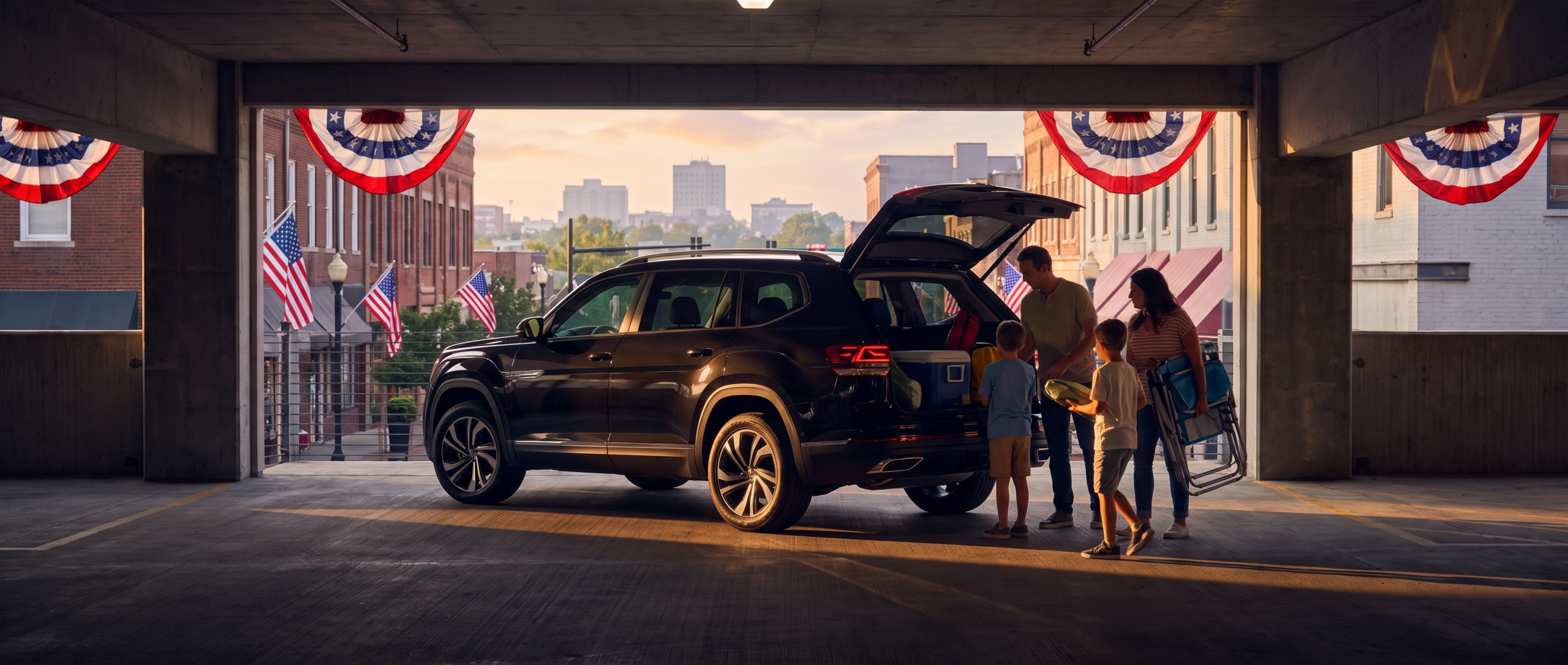
2026 Volkswagen Atlas parked in a downtown Spartanburg parking garage on the Fourth of July

Your Parking Playbook for Spartanburg's Red, White & Boom

Downtown Spartanburg fills fast on the Fourth of July. The City's Red, White & Boom celebration draws a crowd to two locations -- Morgan Square for the afternoon and Fifth Third Park for the fireworks at 9:30 PM -- and every driver who waits until dusk to think about parking ends up making three loops and missing the opening shell. Here is the play: know your lot before you leave Reidville Road, match your VW's footprint to the right zone, and you will be watching fireworks instead of brake lights. The 2026 VW Jetta is the easiest vehicle to park anywhere downtown on a busy evening -- more on why its 186.5-inch length and 35.8-foot turning circle matter when the garages start filling up. Where Should You Park, and When? The event runs in two phases. Morgan Square hosts live music from 2:00 PM to 5:00 PM, followed by a public parade to Fifth Third Park, where festivities continue at 5:00 PM ahead of the 9:30 PM fireworks. That two-phase structure means parking pressure peaks twice: once around 2:00 PM downtown and again around 5:00 PM near the ballpark. Arrive by 6:30 PM at the latest for a stress-free spot near Fifth Third Park. Arrive by Where to park Best fit (VW) Key tip 2:00 PM Dunbar Street Garage (Morgan Square area) Jetta, Taos, Tiguan, Atlas Free, first-come; fills for the afternoon set 5:00 PM Stadium Garage, 158 Pollard St -- enter from S. Daniel Morgan Ave Jetta, Taos, Tiguan 600+ spaces; City-controlled; approach from north on Morgan Ave 6:30 PM Street parking within walking distance of Fifth Third Park Jetta, Taos Street parking is free after 5:00 PM; tightest spots After 7:00 PM Municipal lots scattered along Daniel Morgan Ave Jetta Most garages at capacity; nimble footprint wins The City of Spartanburg operates five downtown parking garages with more than 3,300 total spaces. On a normal night that is plenty. On July 4 with America's 250th anniversary on the schedule, it is not. The Dunbar Street Garage sits within a block of Morgan Square and is the natural anchor for the afternoon portion; the Stadium Garage at 158 Pollard Street is the primary structure for the ballpark. Parking at the Stadium Garage is subject to a fee set by the City of Spartanburg -- plan accordingly. See Current VW Offers The Maneuvering Play: Which VW Fits Which Zone Compact downtown streets and multi-level garages do not treat all vehicles equally. The width between a parked Jetta and a parked Atlas is nearly a foot of body metal, and that gap shows up in tight ramp turns and narrow street spaces. The 2026 Volkswagen Taos measures 175.9 inches long and 72.5 inches wide -- genuinely compact, with a 35-foot turning circle that makes it the easiest SUV to slot into the street spots along Daniel Morgan Avenue when they open after 5:00 PM. Browse the Taos if a small footprint matters for your downtown routine beyond July 4. The 2026 Volkswagen Tiguan steps up to 184.4 inches long and 73 inches wide, still well within the compact SUV category. It handles multi-level garage ramps without drama and carries up to 69.8 cubic feet of cargo flat-folded -- enough for chairs, a blanket, and everything the family wants to bring. See the Tiguan lineup for a closer look at how it packages the family without the full-size footprint. The 2026 Volkswagen Atlas at 200.7 inches long and 78.3 inches wide is the widest driver in the VW stable. That body width works beautifully on the I-85 commute home from the Upstate, but it earns its keep in the Stadium Garage rather than on a street spot at 9:00 PM. Head straight for the garage from S. Daniel Morgan Avenue, arrive before 6:30 PM, and the Atlas settles in without issue. Tip -- Insider Parking: The cleanest approach to Fifth Third Park from any direction is from the north side of Morgan Avenue. Streets near the stadium close as the evening builds, and southbound approaches cross train tracks -- the north approach keeps you out of that shuffle. Pull in on Pollard Street for the Stadium Garage. Tip -- Event Etiquette: Outside food and beverages are not permitted inside Fifth Third Park. Load the cooler for the tailgate before the gates, not after. The venue is also fully cashless, so leave the cash in the glovebox and keep your card handy at the concession stands. Next step: Before July 4, confirm the City of Spartanburg's parking page for any event-day closures or lane changes along Daniel Morgan Avenue -- the city posts live updates when construction projects affect the downtown footprint. Your Pre-Show Checklist A clean night at Red, White & Boom comes down to ten minutes of preparation before you leave the driveway. Run through this before you back out: Arrive target: Leave no later than 6:00 PM if attending Fifth Third Park for the fireworks. 6:30 PM is the last comfortable window for the Stadium Garage. Navigation set: Plug in 158 Pollard Street, Spartanburg SC 29306 for the Stadium Garage; confirm entry from S. Daniel Morgan Avenue. North approach: Come from the north side of Morgan Avenue to avoid street closures near the stadium and the train tracks to the south and west. Chairs and blanket loaded: The field at Fifth Third Park is open seating; no rentals on site. Payment card ready: The venue is cashless. Garages use automated kiosks accepting debit and credit cards. Bag check: Bags must be soft-sided and no larger than 16 x 16 x 8 inches to enter the ballpark. Phone charged: You will want it for navigation out of downtown after the fireworks -- everyone leaves at once. Plan the exit: After the 9:30 PM fireworks, the entire crowd heads to the garages simultaneously. Stay in your seat an extra 10 minutes; the lot clears faster than the ramps. Browse the full Steve White Volkswagen lineup to see which model makes your next Upstate outing -- the Fourth or otherwise -- a smoother drive. Value Your Trade-In Steve White Volkswagen Spartanburg 2671 Reidville Rd, Spartanburg, SC 29301 (864) 585-2492

The Family Gear Checklist Every Atlas Driver Needs Before a SC Summer Outing

The moment before you load the Atlas is the moment that decides everything. Pack in the wrong order and a soft-sided cooler gets pinned behind a camp chair, the kids' bag ends up unreachable on the highway, and someone is rearranging gear in a Croft State Park parking lot in July heat. Pack with the right configuration in mind first and the 2026 Volkswagen Atlas handles the whole family's summer load -- cooler, chairs, towels, dry bags, and all -- with room to close the liftgate cleanly. Below is a configuration-first, print-and-go checklist built specifically for the Atlas's three cargo modes. Choose your mode based on how many people are riding, then load in the sequence listed. The gear fits. The cooler stays put. What Goes on the Checklist? Start by choosing your Atlas cargo mode. That decision drives every other packing choice. Step 1 -- Choose your configuration 7-passenger mode (all rows up): 20.6 cu ft behind the third row. Enough for a soft-sided cooler, a compact bag per person, and a roll of towels. Folding chairs go in a carry bag stood vertically behind the third-row headrests or strapped to the roof rack. 5-passenger mode (third row folded, second row up): Volkswagen lists 55.5 cu ft behind the second row. This is the sweet spot for a full family outing. A large hard-sided cooler, four camp chairs, two duffel bags, and a gear tote all load cleanly with space above for a collapsible wagon or beach umbrella. 2-passenger mode (both rows folded flat): 96.6 cu ft behind the front seats. Reserved for the serious haul -- think an organized camping run with sleeping gear, a wheeled cooler, an air mattress, and a portable stove. The load floor lies nearly flat front-to-back for easy sliding. Step 2 -- Load in this order (all modes) Heaviest items first, centered low. The cooler goes in first, positioned on the centerline of the cargo floor. A shifting cooler during a hard stop on I-85 is a hazard; centered and low, it stays put. Chairs and poles alongside the cooler. Folded camp chairs or umbrella poles slide beside the cooler, parallel to the vehicle's long axis. They act as a natural wall to keep softer items from toppling. Duffel bags and dry bags next. Soft bags conform to whatever shape is left. Pack them with the handles facing out so you can pull them without unpacking everything above them. Towels, blankets, and kids' bags on top. These are the items you need first when you arrive. Stack them last so they come out first. Snacks, sunscreen, and devices in the second-row door pockets and center console. The Atlas carries multiple USB-C charging ports across all three rows so devices charge on the drive, not at camp. Roof rack overflow check. Standard roof rails on all Atlas trims accept an add-on cargo box or crossbars (sold separately, installed by the dealer). If you use one, pack it with lighter items -- sleeping bags, foam pads, life jackets -- and secure the load per the owner's manual before leaving Reidville Road. Step 3 -- Confirm before you close Cooler lid fully closed and latched No loose items above the load floor line (anything above the second-row headrests blocks rear sightlines) Third-row headrests removed or folded down when that row is empty (improves rearward visibility on SC Highway 11) Hands free? Swipe your foot under the rear bumper to trigger the available hands-free liftgate on SE Technology and higher trims, then confirm it fully seals Devices plugged into USB-C ports before departure -- 15-watt wireless charging pad also available on the center console for front-row passengers Why the Atlas Configuration Matters More Than Raw Cubic Feet A number on a spec sheet does not tell you that a hard-sided cooler is roughly 1.5 to 2.5 cubic feet -- or that a set of four camp chairs in carry bags takes about three to four cubic feet. Knowing the Atlas's three configurations and what each one realistically holds lets you make the packing decision at home, not at the liftgate. The Atlas Cross Sport is worth knowing about if your crew runs five or fewer -- it offers a sportier two-row profile and still handles a full day's worth of gear -- but when you are consistently moving six or seven people, the full three-row Atlas lineup is where the configuration flexibility pays off most. The second-row slide is the feature most drivers overlook. Volkswagen engineers the Atlas's second-row bench to slide 7.7 inches fore and aft. Slide it toward the third row and third-row passengers in the back seat gain meaningful legroom -- useful for teenagers on an hour-long drive toward the Blue Ridge foothills. Slide it toward the second-row passengers and the cargo bay behind row two deepens accordingly. This slide-to-configure logic means the 55.5 cubic feet listed in 5-passenger mode is a floor, not a fixed ceiling, depending on how you position that bench. The squared-off cargo floor shape matters as much as the volume. Unlike crossovers with sharply sloped rear windows that cut into usable vertical space, the Atlas's more upright roofline preserves that vertical dimension behind the second row. That is where a wheeled cooler or a stacked set of chairs can stand rather than lean, making unpacking at the park significantly cleaner. Safety travels with the gear. The IIHS awarded the 2026 Atlas its TOP SAFETY PICK+ designation, the institute's highest honor, and NHTSA issued a five-star overall safety rating. The standard IQ.DRIVE suite -- adaptive cruise control, lane assist, front assist, and Travel Assist semi-automated highway assistance -- is on every 2026 trim. When the cargo bay is full and the whole family is aboard, knowing the driver-assistance layer is working on a long SC summer run matters. Trip tip: Pack a small mesh bag clipped to the driver's seat-back hook and fill it with toll coins, a park pass, and a small first-aid kit. Croft State Park's day-use area is accessed directly off US-176 south of Spartanburg. Having the pass out before you turn into the entrance keeps the line moving. Item / Why It Matters Item Why It Matters for the Atlas Hard-sided cooler (centered low) Prevents sliding on highway curves; stays accessible via liftgate Camp chairs in carry bag (upright alongside cooler) Locks soft bags in place; easy to grab first at the park Soft duffel bags (handles facing out) Conforms to remaining space; pull-accessible without unpacking Towels and blankets (top layer) First out at the destination; keeps the cooler sealed below USB-C cables and phone mounts Atlas provides charging ports in all three rows; no dead devices on arrival Roof-rack cargo box (lightweight overflow) Standard rail accepts aftermarket crossbars; best for bulky lightweight items Cargo net or strap (over cooler) Secures the load; unrestrained items in SUVs are a safety concern per NHTSA guidelines Print-and-Go: Your Atlas Summer Outing Recap This is the one-page version. Screenshot it, print it, or leave it open on the passenger seat. Before you pack: Decide configuration: 7-passenger (20.6 cu ft), 5-passenger (55.5 cu ft), or 2-passenger (96.6 cu ft) Confirm roof rack crossbars are locked if using a cargo box Load sequence: Cooler -- centered, low, latched Chairs and poles -- alongside the cooler Duffels -- handles facing rear Towels, blankets, kids' bags -- top layer Snacks and devices -- door pockets, console, USB-C ports live Before you close: No items above the second-row headrest line Third-row headrests folded (if row is empty) Liftgate fully sealed (use hands-free swipe if available on your trim) Atlas's 4MOTION AWD selected if weather on SC Highway 11 has turned -- available across the full lineup, including financing options to fit any trim decision Ready to see how the Atlas fits your family's gear in person? The Steve White Volkswagen team on Reidville Road can walk you through the full lineup and open the cargo bay with your real gear in mind. View Current Atlas Offers Frequently Asked Questions Will a full-size hard-sided cooler fit in the Atlas with all seats up? Yes, but placement matters. With all three rows occupied, Volkswagen lists 20.6 cubic feet of cargo space behind the third row. A standard 48- to 62-quart hard-sided cooler fits in that bay -- centered low and pushed fully forward -- but you will have limited room for additional tall items alongside it. The practical move for a full seven-passenger crew is a soft-sided cooler in the rear, with hard-sided coolers reserved for the 5-passenger configuration when 55.5 cubic feet opens behind the second row. Do the Atlas's standard roof rails support a cargo box for extra gear? Roof rails are standard on all 2026 Atlas trims. They accept aftermarket crossbar systems, which in turn support most major cargo box brands. Volkswagen sells add-on accessories separately, and the dealer team can advise on load ratings per your trim. Pack lighter, bulkier items -- life jackets, foam sleeping pads, camp chairs -- in the roof box and keep heavy items (coolers, food) on the cargo floor where the vehicle's center of gravity benefits most from the low placement. Value Your Trade-In Steve White Volkswagen Spartanburg 2671 Reidville Rd, Spartanburg, SC 29301 (864) 585-2492

Picking the Wrong VW for a July 4th Weekend Trip Is an Easy Mistake. Here Is How to Avoid It.

In this article What Is Actually Going on With the VW-to-Trip Mismatch? How the Jetta's Highway Number Changes Your Planning Matching Your VW to the SC Highway 11 Drive DIY Checks vs. What to Leave to the Service Team *By the Steve White Volkswagen Spartanburg Team | July 2026* A Fourth of July weekend puts a specific set of demands on a vehicle: summer heat with a full cabin, luggage packed to the headliner, a stretch of interstate, and -- if you know what you are doing -- a winding two-lane road through the Blue Ridge foothills. Most drivers grab whatever is in the driveway without thinking twice. If you are choosing between models or have a purchase decision sitting in front of you, though, the match matters. Each Volkswagen in the lineup handles a different version of this trip well, and loading the wrong one for your itinerary costs you efficiency, comfort, or simply the pleasure of the drive. The short answer: for a solo driver or a couple chasing highway miles, the Jetta is the efficiency pick. For a small family with weekend gear, the Tiguan fits the scenario. For a full-crew run with three rows of passengers, the Atlas is the straightforward call. And for the driver who wants the road itself to be the destination, the Golf GTI earns a specific conversation. What Is Actually Going on With the VW-to-Trip Mismatch? Choosing a road trip vehicle by feel rather than by scenario is how you end up with a compact sedan packed like a circus act, or a three-row SUV burning more fuel than necessary for two people and a weekend bag. The table below maps four common Spartanburg-departure profiles to the VW that actually fits each one, anchored in verified specs. Trip Profile Best VW Match Deciding Spec Where It Shows Up 1-2 passengers, light bags, max highway range Jetta EPA 40 mpg highway (1.5L turbo, 8-speed auto) Fewest fuel stops; I-26 to Charleston on a single tank Small family, 4-5 passengers, weekend gear Tiguan EPA 34 mpg highway (FWD S trim); 69.8 cu ft cargo seats-down Compact footprint on winding Hwy 11; room for gear Three rows, 6-7 passengers, full luggage Atlas 96.6 cu ft cargo all seats-down; 18.6-gal tank; seats 7 I-85/I-26 legs; all passengers comfortable plus gear Two adults; the drive is the destination Golf GTI 241 hp; 273 lb-ft torque; standard limited-slip differential Every corner on SC Highway 11 from Campobello toward Gaffney The diagnosis is simple: your trip profile is the deciding variable. Knowing that up front eliminates second-guessing at 70 mph. How the Jetta's Highway Number Changes Your Planning For a driver leaving Spartanburg on I-26 toward the coast or on I-85 toward the mountains, the 2026 Jetta's EPA highway rating of 40 mpg reshapes the whole trip math. The EPA rates the 2026 Jetta S at 29 city / 40 highway / 34 combined -- with the 1.5-liter turbocharged four-cylinder and eight-speed automatic, on regular 87-octane fuel. The 12.8-gallon tank gives this car an EPA-estimated total range of 449 miles in S trim. For context: the Spartanburg-to-Charleston run on I-26 covers roughly 230 miles each way. A Jetta S handles that round trip on a single fill without sweating. The Jetta GLI trades a portion of that highway efficiency -- the EPA rates it at 26 city / 36 highway / 29 combined with the six-speed manual -- for 228 horsepower and 258 pound-feet of torque from its 2.0-liter turbo. If the itinerary includes any spirited driving, the GLI is worth the discussion. Both models take regular gasoline, a practical detail on smaller rural roads where premium pumps are not guaranteed. A note before any holiday trip: Upstate South Carolina July temperatures routinely reach the low 90s. A full cabin with luggage adds real thermal load to your cooling system. A quick service visit before the long weekend is the kind of insurance most drivers skip and then wish they had not. The 2026 Volkswagen Jetta S is EPA-rated at 40 mpg highway -- a figure normally associated with hybrid powertrains, achieved here without one. Schedule a Pre-Trip Service Inspection Matching Your VW to the SC Highway 11 Drive SC Highway 11 -- the Cherokee Foothills National Scenic Highway -- runs nearly 120 miles through five Upstate counties, entering northern Spartanburg County near I-26 at Campobello and winding through the Blue Ridge foothills toward Gaffney. It is a road that rewards a well-sorted vehicle and mildly punishes one that is not calibrated for its pace. The National Scenic Byway Foundation describes it as providing access to more than 120 waterfalls and 150,000 acres of public lands; the drive itself, winding along the southernmost peaks of the Blue Ridge, is the attraction. For family road trippers, the Tiguan is the right fit for this route. The 2026 Tiguan S FWD is EPA-rated at 26 city / 34 highway / 29 combined, and it carries up to 69.8 cubic feet of cargo with the rear seat folded. Its sport-tuned suspension keeps body motions controlled through directional changes, which Hwy 11 delivers frequently through the Greenville and Pickens County sections. For the driver who wants the road to be the reason for the trip, the Golf GTI earns its own paragraph. Volkswagen's 2026 GTI carries a 241-horsepower 2.0-liter turbocharged engine paired to a seven-speed dual-clutch automatic and -- critically for an elevation-varied, curve-heavy road -- a standard limited-slip differential that keeps the front end planted through corner exits. The 2026 GTI marks the model's 50th global anniversary; SC Highway 11 is precisely the kind of road the GTI was built to enjoy. For the full-family deployment -- grandparents, parents, kids, coolers, and fireworks blankets -- the Atlas handles it cleanly. The EPA rates the 2026 Atlas FWD at 20 city / 27 highway / 23 combined. Paired with its 18.6-gallon tank, that puts highway range at roughly 425 miles on a full load. Cargo volume with all rear seats folded reaches 96.6 cubic feet. Every passenger gets a real seat, and the luggage is not a puzzle. DIY Checks vs. What to Leave to the Service Team A holiday weekend is not when you want to discover a tire at the wear-indicator limit or an air conditioning compressor working harder than it should. Here is how to divide pre-trip prep between what you can do in the driveway and what is worth a service visit. Handle yourself the evening before: Check tire pressure cold, before the car moves. The correct PSI for your specific VW is on the sticker inside the driver's door jamb -- not on the tire sidewall, which shows the maximum. Confirm coolant, washer fluid, and oil levels are within range through the reservoir caps. Make sure your VW's service interval display is not within a few hundred miles of its next scheduled trigger point. A warning light on I-85 at mile marker 80 is not the July 4th experience anyone is after. Worth a technician's eyes before the trip: A/C performance under load. Running maximum cooling with a full cabin and luggage on a 90-degree Upstate SC afternoon is measurably harder on the compressor than a daily solo commute. A technician can verify refrigerant charge and compressor function quickly. Belts and hoses (60,000-mile threshold). Heat accelerates deterioration in rubber components. If your VW is approaching or past this mark, a visual inspection takes minutes and catches the ones to watch. Stored fault codes. A diagnostic scan will surface anything your vehicle has logged that has not yet triggered a dashboard light. Better to know now than on a mountain road. Schedule a service appointment at Steve White Volkswagen Spartanburg before the pre-holiday window fills. The service team on Reidville Road books quickly in the days before a long weekend -- getting in now means you leave Friday with confidence. View Current VW Specials Steve White Volkswagen Spartanburg 2671 Reidville Rd, Spartanburg, SC 29301 (864) 585-2492

How to Set Up Your Volkswagen for a Summer Road Trip from Spartanburg

In this article What You Need Before You Start Setting Up Your VW Cargo Zone in Five Steps Your Road-Trip Checklist Before Pulling Out of the Driveway A Quick Recap Before You Head Out SC Highway 11 -- the Cherokee Foothills National Scenic Byway -- runs 120 miles through Upstate South Carolina from the Georgia line near Lake Hartwell all the way to Gaffney, passing peach orchards, state parks, and views of the Blue Ridge foothills that most I-85 drivers never see. It is one of the most naturally rich drives in the Southeast, and it starts practically in your backyard. The setup that determines how well the trip goes, though, happens before you back out of the driveway. Volkswagen's current lineup -- from the three-row Atlas to the redesigned Tiguan to the electric ID. Buzz -- gives Upstate drivers real cargo flexibility, a capable climate system, and standard driver assistance features that make a summer day trip feel genuinely effortless. This guide walks you through the full pre-trip setup, so the first thing you encounter on SC 11 is a mountain view, not a scramble for sunscreen at the bottom of the luggage pile. The single most important thing you can do before a summer VW road trip is configure the cargo zone first, then pack around it -- not the other way around. Get the seats into their final position before a single bag goes in the vehicle. What You Need Before You Start A successful setup is mostly a planning task, not a gear-acquisition task. Before you touch the liftgate, have these items confirmed or in hand. Item Why It Matters for a Spartanburg Summer Trip Final headcount and seat configuration Determines whether row 2 or row 3 folds; sets the cargo floor height on the Atlas Full tank of fuel Atlas FWD EPA-estimated 27 mpg highway means roughly 500 miles on a full tank; SC 11 is 120 miles with limited gas options mid-route Cabin air filter status Upstate SC summer pollen and humidity load the filter quickly; a clogged filter strains the Climatronic system Tire pressure (cold) Summer heat increases tire pressure roughly 1 psi per 10 degrees F; check cold before loading Travel Assist on or confirmed Atlas and Tiguan standard IQ.DRIVE suite includes Travel Assist for highway segments; confirm it is enabled in the driver profile Cargo anchors and tie-down loops located Atlas cargo floor has integrated tie-down hooks; know where they are before loading heavy items Phone mount or dashboard navigation ready SC 11 has limited cell coverage in stretches; download the offline map before departure Setting Up Your VW Cargo Zone in Five Steps This is the step that most drivers skip until they are already in the parking lot at the trailhead, surrounded by bags that will not close. Do this at home, on a flat surface, before the cooler goes in. Step 1: Decide your configuration and lock in the seats. The number of passengers traveling determines everything that follows. In the Atlas, leaving the third row up gives you substantial cargo space -- enough for a soft cooler, two medium duffels, and a day-pack. Fold the third row flat and that expands significantly, the practical sweet spot for a family of four with full luggage. If you are traveling as a couple or hauling gear for a multi-day trip, folding both rear rows opens extensive load floor space. The Atlas third row uses a 50/50 split fold, so you can keep one rear seat up for a passenger or a dog while the other half stays flat. Make this call first and do not change it mid-pack. In the 2025 Tiguan, the two-row layout is already decided for you: substantial space behind the rear seats for a weekend trip with all five seats occupied, or expandable space with the 60/40-split rear row folded. The Tiguan's cargo floor sits notably flat when the rear seats fold, which matters when sliding in a hard-shell luggage case or a long bike bag. Step 2: Place the heaviest items at the floor, forward of the axle line. Coolers, tool kits, and full water jugs go in first, centered low, and pushed as far forward in the cargo zone as the configuration allows. This keeps the vehicle's handling balance stable on SC 11's curves and prevents the cargo from shifting forward under hard braking -- an issue that becomes uncomfortable at highway speeds on the I-85 approach to the byway. The step most drivers get wrong: Loading the cooler last, on top of everything else. It is the heaviest, most shift-prone item in the load. It goes in first, flush against the rear seatback or cargo barrier, with two tie-down straps run through the Atlas's integrated floor hooks. An unsecured cooler will slide forward in a hard stop. Step 3: Build vertically in the soft-goods zone. Once the heavy anchor items are down, stack soft bags and pillows vertically against the cargo side walls. Packing cubes or compression bags compress clothing efficiently and let you stack without losing stability. Leave the center lane clear from liftgate to seatback so rear visibility stays unobstructed and so any item grabbed on the road is accessible without a full unpack. Step 4: Set the Climatronic climate system for summer conditions. In Upstate SC in late June, interior cabin temperature after parking in direct sun can spike well above 110 degrees F within minutes. Before departure -- or immediately on startup -- set the three-zone Climatronic (Atlas) or the dual-zone climate system (Tiguan) to max cooling for the first five minutes, then dial back to a sustainable setting once the cabin reaches a comfortable temperature. Crucially, set rear zone controls separately for any passengers in row 2 or row 3; the Atlas Climatronic three-zone system lets each zone run independently so the driver is not overcooling to compensate for a warm back seat. For ID. Buzz drivers: the cabin pre-conditioning feature allows you to cool the vehicle from a companion app while still plugged in, preserving range before you even start the drive. Step 5: Run through the IQ.DRIVE settings in the vehicle menu. The Atlas, Tiguan, and ID. Buzz all carry Volkswagen's IQ.DRIVE suite as standard equipment. Before leaving, confirm Travel Assist is active (it combines adaptive cruise control with lane-keeping assist for highway segments), check that Front Assist collision warning sensitivity is set to your preference, and verify the Emergency Assist feature is enabled. On the SC 11 corridor itself, the byway has significant stretches of two-lane road with limited visibility on curves -- you will be in a primarily driver-engaged mode, not highway assist mode -- but the I-85 segments connecting Spartanburg to the byway are exactly the scenario Travel Assist is designed for. See Current VW Offers Your Road-Trip Checklist Before Pulling Out of the Driveway Print this or save it to your phone. Run through it the evening before, not morning-of. Seat configuration locked in (third row up, half-fold, or fully flat) Heaviest items loaded first, tied down with cargo anchors Soft goods packed vertically, center lane clear to liftgate Climatronic rear zones set independently; or ID. Buzz pre-conditioned via app Full fuel tank confirmed Tire pressure checked cold before loading IQ.DRIVE Travel Assist confirmed active in driver profile Offline map of SC Highway 11 downloaded (cell coverage is patchy mid-route) Cabin air filter checked -- summer pollen in Upstate SC clogs filters fast Emergency roadside kit accessible (not buried under the cooler) Sunscreen and water in the front cabin, not the cargo zone Tie-down hooks used for any heavy item in the load Book a pre-trip service check at Steve White VW A Quick Recap Before You Head Out The setup process above takes about 20 minutes the first time and closer to five on return trips once it becomes habit. The core sequence is always the same: configuration before packing, heavy items anchored first, climate set proactively, and IQ.DRIVE confirmed. That sequence applies whether you are loading the Atlas for a full family run down SC 11 toward Table Rock or fitting the Tiguan for a solo overnight. The Cherokee Foothills Scenic Byway is a genuinely distinctive drive -- it has been featured in publications including National Geographic and Southern Living -- and the vehicles in the VW lineup are well-suited to the way Spartanburg and Upstate SC drivers actually use them: real cargo room, capable standard tech, and a European road manner that holds together on a two-lane with elevation changes. All that said, none of it matters if the cooler is blocking the rearview mirror on exit from Reidville Road. Value Your Trade at Steve White VW Steve White Volkswagen Spartanburg 2671 Reidville Rd, Spartanburg, SC 29301 (864) 585-2492

Volkswagen Atlas loaded with luggage at GSP airport curbside drop-off in summer

4 Volkswagen Models Worth Taking to GSP Airport This Summer

In this article How These Four VW Models Compare for the GSP Run The Atlas: Three Rows and a Cargo Floor That Loads Fast The Tiguan: The Compact Choice With Surprising Cargo The Taos: When You're Traveling Light and Watching Fuel The Jetta: The Efficient Two-Hour Cruiser for Light Packers The Atlas earns the top spot for Spartanburg families heading to Greenville-Spartanburg International Airport this summer -- and the reason is specific. GSP's curbside operates as an active-loading-and-unloading zone only, which means fast, efficient bag transfer matters more than you might expect. The Atlas delivers 20.6 cubic feet of accessible cargo room behind its third row and a low, square load floor that lets you pull suitcases without climbing in. Pair that with the 26-mile I-85 corridor drive from Reidville Road and the Upstate SC summer heat, and you have a real use case, not a generic ranking. Every pick below is evaluated against the same four airport-run criteria: cargo access, passenger space, I-85 highway efficiency, and summer cabin comfort for the whole family. See Current VW Summer Offers How These Four VW Models Compare for the GSP Run Rank Model Best For Cargo (seats up) Combined MPG (EPA est.) 1 Atlas Big families, 7 seats 20.6 cu ft 23 mpg (FWD) 2 Tiguan Couples, small families 26.5 cu ft 29 mpg (FWD S) 3 Taos Solo or duo with carry-ons 27.9 cu ft 31 mpg (FWD) 4 Jetta Light packers, 2-hour I-85 cruisers n/a (sedan) ~35 mpg (hwy est.) Airport curbside note: GSP's curbside is active-loading-and-unloading only, and Garage A and B charge by the hour once you pass the free 15-minute window. A vehicle with quick rear-hatch access and a wide cargo opening earns its place on a summer trip. The Atlas: Three Rows and a Cargo Floor That Loads Fast When the whole family travels -- grandparents, car seats, checked bags, and a stroller -- the Atlas is the one VW that handles all of it without compromising anyone's legroom. Volkswagen built the 2026 Atlas with 20.6 cubic feet of cargo space behind the third row and up to 96.6 cubic feet when both rear rows are folded. The third row's 50/50 split and the second row's 60/40 design mean you can carry five adults and still load two rolling suitcases behind the third row without the gate-check shuffle. The EPA rates the 2026 Atlas FWD at 20 city / 27 highway / 23 combined. Over the 26-mile I-85 run from Spartanburg, the 18.6-gallon tank barely registers the trip. Standard Climatronic three-zone automatic climate control is a genuine asset in an Upstate SC July -- the driver can hold 68 degrees up front while rear-seat passengers hold their own zone, so nobody is fighting the vents on the way home from a 6 a.m. international connection. The Atlas's low, square cargo opening and standard roof rails are load-bearing advantages at curbside. You are not hoisting bags over a high lip or sliding them through a narrow aperture. The Tiguan and Taos make sense for smaller parties -- see their sections below. The Tiguan: The Compact Choice With Surprising Cargo Two adults and a summer's worth of carry-on luggage fill the Tiguan's cabin without reaching its limits. The 2026 Tiguan redesign (third generation, launched for 2025) dropped the old optional third row and redirected that space into a deeper, more usable two-row layout -- the result is 26.5 cubic feet behind the rear seats, more loadable volume than the Atlas despite being a full class smaller. Wide-opening rear doors and 60/40-split folding rear seats add to the practical picture. The EPA rates the 2026 Tiguan S FWD at 26 city / 34 highway / 29 combined -- the best combined efficiency of any two-row VW SUV in the current lineup. That 34-highway figure runs smoothly on I-85 between Spartanburg and the airport. Heated front seats and available panoramic sunroof round out the summer-travel comfort story. For a couple or a family of three checking one bag each, the Tiguan covers the trip without the bulk of a full three-row hauler. The Taos: When You're Traveling Light and Watching Fuel A weekend trip for two, a couple of carry-on rollers, and 26 miles of Interstate -- that is the Taos scenario. The 2026 Volkswagen Taos earns an EPA-estimated 28 city / 36 highway / 31 combined with FWD, the highest combined figure of any gas-powered SUV in the VW lineup. It runs on regular 87-octane fuel, which matters at the pump when summer gas prices climb. The 13.2-gallon tank and 36-mpg highway rating give you an estimated 475-mile highway range without a stop. Cargo behind the rear seats measures 27.9 cubic feet in FWD models -- deceptively large for a subcompact SUV and enough room for two checked-bag-sized rollers. Rear legroom measures 37.9 inches, so a taller teenager in the back seat does not spend the I-85 run knees-to-chin. The one honest limitation: the Taos carries five and handles luggage for five only when you fold the rear seat flat. For a family of five with bags, the Atlas is the more honest choice. Buying caution: Airport run frequency matters for trim selection. If you are doing the GSP run with a full family several times per summer, the Atlas's Climatronic three-zone system and hands-free power liftgate (available on upper trims) reduce the physical effort per trip noticeably. Choosing the base trim of a larger vehicle often makes more sense than the top trim of a smaller one when the use case calls for it regularly. The Atlas three-zone climate system holds separate temperatures for front and rear passengers The Tiguan's wide rear doors help with child seat installation and removal in tight airport lanes The Taos FWD holds an estimated 475-mile highway range on a single tank of regular fuel The Jetta's sedan trunk keeps bags secure in covered storage -- useful in GSP's surface lots The Jetta: The Efficient Two-Hour Cruiser for Light Packers Not every GSP trip requires an SUV. A couple flying carry-on only, a solo driver dropping off a family member, or a professional traveler with one rolling bag -- those are Jetta scenarios. The 2026 Volkswagen Jetta is a German-tuned compact sedan with a trunk that keeps luggage out of sight in economy and valet parking, a composed highway ride on I-85, and fuel efficiency that makes the round trip cost very little at the pump. The Jetta's 1.5-liter turbocharged engine sends power through an 8-speed automatic and delivers strong highway cruising range. Its highway fuel economy figure exceeds most compact sedans in the class -- making the Spartanburg-to-GSP-and-back run genuinely inexpensive on gas. Adaptive cruise control comes standard on upper trims, which makes the 26-mile highway leg feel relaxed in summer traffic. The Jetta fits the driver who values the German refinement of a sedan and simply does not need three rows of seats for a two-person summer trip. Value Your Current Vehicle Before You Upgrade Steve White Volkswagen Spartanburg 2671 Reidville Rd, Spartanburg, SC 29301 (864) 585-2492

Volkswagen Taos compact SUV ideal for first-time buyers in Spartanburg, SC

Why the Volkswagen Taos Is Ideal for First-Time SUV Buyers in Spartanburg County, SC

Buying your first SUV is one of those decisions that feels bigger than it probably is - but that doesn't mean it's simple. The Volkswagen® Taos has become one of the more quietly compelling options for first-time SUV buyers in Spartanburg, SC, and there are real, practical reasons why. This guide breaks down exactly what makes the Taos a smart starting point, from its manageable size and fuel economy to the features that actually matter for everyday life in Spartanburg County. The Taos Hits a Size That First-Time SUV Buyers Actually Want Most people stepping up from a sedan or hatchback don't want to immediately wrestle with a full-size SUV. The Taos occupies a compact footprint that feels approachable from day one - short enough to fit comfortably in most parking garages and tight city spots, but tall enough to give you the elevated seating position that draws people to SUVs in the first place. For anyone navigating downtown Spartanburg, the Westgate Mall area, or the parking situations near Wofford College on a regular basis, that balance matters more than most people expect. A 178-inch overall length keeps the Taos nimble without feeling cramped inside. Did you know? The Volkswagen Taos was designed specifically for the North American market and made its debut in 2022, built to match the practical needs of U.S. drivers rather than being adapted from a foreign-market vehicle. Interior space tells a different story than the exterior dimensions suggest. Rear passengers get genuine legroom, and the cargo area behind the second row offers enough space for grocery runs, gym bags, and weekend trip luggage without requiring creative packing strategies. Fuel Economy That Makes Sense for Spartanburg County Commutes Spartanburg County stretches across a wide area, and whether you're commuting along I-85 toward Greenville or heading up Highway 176 toward Inman or Landrum, you're covering real miles every week. Fuel costs matter. The Taos™ delivers EPA-estimated fuel economy of up to 28 mpg in the city and 36 mpg on the highway with the front-wheel-drive configuration - numbers that hold up well against most compact SUV competitors. For a first-time SUV buyer who might have driven a smaller sedan before, the Taos keeps the efficiency close to what they're used to. Here's what that looks like in practical terms for Spartanburg County drivers: Daily commuting on I-85 or I-26: The highway rating means longer stretches between fill-ups Errand driving around Spartanburg: City efficiency doesn't fall off a cliff the way it does in larger SUVs Weekend drives to Croft State Park or the Upstate trails: Combined efficiency stays strong on mixed-road trips Occasional longer hauls to Charlotte or Columbia: Highway capability carries you comfortably If fuel economy is near the top of your priority list - and for a first-time buyer, it often is - the Taos makes a strong case without having to work hard at it. Safety Ratings That Give First-Time Buyers Real Confidence One of the biggest anxieties around buying a first SUV is safety. The Taos addresses this with a solid set of standard driver assistance features that come on every trim, not just the upper levels. Standard safety features across Taos trims include: Forward collision warning with automatic emergency braking Blind spot monitoring Rear traffic alert Lane keeping assist Adaptive cruise control For someone who hasn't driven an SUV before, these systems work as a confidence layer. Blind spot monitoring is especially useful during the early adjustment period when the slightly wider body of an SUV feels unfamiliar in highway lane changes. Pro tip: Take time during your first few weeks with the Taos to learn how each driver assistance feature responds in your specific driving environment. These systems are calibrated to alert you early, and understanding the feedback helps you trust them rather than find them distracting. The Taos also earned a Top Safety Pick designation from the IIHS, which carries real weight when you're making a first major vehicle purchase and want the reassurance of an independent rating. How the Taos Compares to Other VW Options for New SUV Buyers Volkswagen's lineup gives buyers real choices, and it's worth understanding where the Taos sits before committing. The table below maps out how the Taos compares to its siblings for a first-time SUV buyer's priorities. Model Best For Seating Starting Footprint Key Advantage for New Buyers Taos First-time SUV buyer, solo or couple 5 Compact Easy to drive, strong efficiency, lower entry point Tiguan Growing families, more cargo need 5-7 Midsize Third-row option, more interior space Atlas Cross Sport Buyers wanting a larger two-row SUV 5 Full-size Bold presence, more power options Atlas Large families, max passenger and cargo 7-8 Full-size Maximum space and versatility For most people buying their first SUV in Spartanburg County, the Tiguan™ is the next step up if they want more room and plan to expand a family soon. But if you're starting out and want a vehicle that's genuinely easy to own and operate without feeling like you're managing something oversized, the Taos is the right fit. What Spartanburg County Roads and Weather Ask of a Compact SUV South Carolina's Upstate region has its own set of driving demands that are worth factoring into any SUV purchase. Spartanburg County sees mild winters compared to more northern states, but the area does experience ice events and the occasional winter storm that catches drivers off guard. The Taos is available with 4MOTION® all-wheel drive, which gives Spartanburg County buyers a practical option for those winter mornings on roads like Highway 221 or the back routes near Cowpens that can ice over quickly. It's not a heavy off-road vehicle - and it was never meant to be - but AWD capability covers the conditions that Upstate South Carolina actually throws at drivers. Summer heat and humidity are the bigger seasonal factor here. Spartanburg summers are long and warm, and the Taos manages cabin cooling well with a well-designed climate system that handles South Carolina heat without struggling. For families spending time at Lake Bowen or making the trip toward Glendale Shoals Memorial Park on summer weekends, that comfort holds up across longer drives. Trim Levels: Finding the Right Taos Without Overcomplicating It One of the quiet advantages of the Taos for first-time buyers is that its trim structure doesn't require an advanced degree to figure out. There are three main trims, and each one builds logically on the last. Taos S - The base trim that already includes: 8-inch touchscreen with wireless Apple CarPlay and Android Auto Forward collision warning with automatic emergency braking Blind spot monitoring Adaptive cruise control 17-inch wheels Taos SE - Adds meaningful comfort and tech upgrades: 10-inch touchscreen Heated front seats Keyless entry with push-button start 18-inch wheels Taos SEL - The fully loaded experience: Navigation Panoramic sunroof Leather-wrapped seating surfaces Upgraded driver assistance features For a first-time buyer, the S trim is genuinely complete - it isn't a stripped-down entry point that leaves you wanting more. Browse our new inventory to see current Taos availability across all three trims and find which configuration matches your priorities. Common Questions About the Volkswagen Taos for First-Time Buyers in Spartanburg, SC Is the Volkswagen Taos a good first SUV for someone in Spartanburg, SC? The Volkswagen Taos is a strong choice for first-time SUV buyers in Spartanburg, SC because it offers a manageable size, strong fuel economy, and a full suite of standard safety features without the overwhelming scale of a midsize or full-size SUV. Its compact footprint handles Spartanburg County roads, parking situations, and daily commutes comfortably. How does the Taos handle South Carolina winters and ice? The Taos is available with 4MOTION all-wheel drive, which is well-suited to the occasional winter ice events and mixed-condition roads that Spartanburg County experiences. For a region that rarely sees heavy snow but does deal with ice on back roads and bridges, AWD provides the traction confidence most Upstate SC drivers need. How fuel-efficient is the Volkswagen Taos for Spartanburg County commuters? The front-wheel-drive Taos earns EPA-estimated ratings of up to 28 mpg city and 36 mpg highway, making it one of the more efficient compact SUV options for drivers commuting on I-85, I-26, or Highway 176 in the Spartanburg area. These numbers hold up well for both in-town errands and longer drives toward Greenville or Cherokee County. How does the VW Taos compare to the Tiguan for a first-time SUV buyer? The Taos is smaller and more efficient, making it easier to manage for someone new to SUV ownership. The Tiguan offers more interior space and an optional third row, which becomes more important for growing families. If you're buying solo or as a couple without immediate family expansion plans, the Taos is typically the better fit. If you need room to grow, the Tiguan is worth a close look. Does the base Taos S trim include good standard technology? Yes - the Taos S comes standard with an 8-inch touchscreen, wireless Apple CarPlay and Android Auto, adaptive cruise control, blind spot monitoring, and automatic emergency braking. For a base trim, the feature list is genuinely useful rather than just checking a box, which matters for first-time buyers who don't want to stretch to upper trims for basic functionality. Where can I test drive the Volkswagen Taos near Spartanburg, SC? The Taos is available for test drives at Steve White Volkswagen, serving buyers throughout Spartanburg County including residents coming from Boiling Springs, Duncan, and the Cherokee County area. A test drive is the clearest way to confirm whether the Taos size, visibility, and driving feel match what you're looking for as a first-time SUV buyer. The Taos Makes Your First SUV Decision a Straightforward One For first-time SUV buyers in Spartanburg County, the Volkswagen Taos delivers something that's genuinely hard to find: a vehicle that doesn't require you to compromise much of anything. You get efficient fuel economy, solid safety ratings, a manageable size, and enough cabin comfort to make every drive - whether it's a weekday commute or a Saturday trip to Croft State Park - feel worthwhile. The team at Steve White Volkswagen knows Spartanburg County roads and can help you find the Taos configuration that fits your life from day one. View New Inventory Schedule a Service Steve White Volkswagen Spartanburg 2671 Reidville Rd, Spartanburg, SC 29301 (864) 585-2492

Contact Us

Fill out this form below and we'll contact you shortly
*Required Fields